
Margo’s Got Money Troubles, by Rufi Thorpe****

Margo’s Got Money Troubles, by Rufi Thorpe, is a bold, inventive, and very funny novel about a young woman cut adrift in a difficult, expensive world. My thanks go to NetGalley and William Morrow for the invitation to read and review. This book is for sale now.

Margo is the daughter of a Hooters waitress and a former pro wrestler, an absentee father with a family of his own; her mother had been his woman on the side. Consequently, Margo has always understood that she would have to hit the ground running when she grew up, and so she’s enrolled in a junior college. When the brief affair with her English professor leaves her pregnant, she has nobody reliable to advise her. The women she confides in urge her to terminate the pregnancy, and of course, the professor does, too; yet Margo likes the idea of becoming a mother, and it’s her fetus. Nobody can make her do anything. She decides to keep it.

Her mother is about to marry a man with money and conservative values, and she sees Margo as a loose cannon that just might upset the whole ship, so she tells her to terminate or be cut off.

Wow, Mom. Really?

Margo’s roommates hadn’t agreed to share an apartment with a baby. They need to sleep! They have to get up early!

Early on, I’m rolling my eyes. Part of me is thinking that Margo is about as dumb as they come; part of me is wondering why no author in this entire world is writing—or, more likely, why no major publishing house is publishing—novels in which a young woman chooses to have an abortion and take back her body and her life. But I’m overthinking, because soon, Margo—who after all, is just young, naïve, and rudderless—admits her error. She loves her little boy, but she had no idea he would be so expensive, or that motherhood would be so difficult. She tells her father, who re-enters her life as her mother steps away,

 “’I shouldn’t have had him,’ as though some rip cord had been pulled inside her. ‘I know that, okay? Everyone told me it would ruin my life and it did. They were right, and I was stupid, and I didn’t get it. Okay? But now I’m here.’ And her father, who strangely enough becomes the most reliable adult in her life, says, ‘Yes. Now we’re here.’”

Later, Margo will comment that nothing can make a person pro-choice like having a baby.

Margo has been waiting tables, but she can’t find child care, and when she brings the baby to work, she’s fired. And the truth is, she doesn’t like leaving her baby. Then one day, while looking at her naked self in a full length mirror, she observes that she has huge boobs for the first time in her life. Men would pay to see this. She opens an account on OnlyFans.

And so this controversial choice becomes the crux of the story. Some friends reject her, and her mother has really had it with her now. But there are a lot of meaty conversations that are thought provoking, and so, even though this old lady schoolteacher reviewer is mighty uncomfortable reading about an online sex worker’s film process, there are related questions that cannot be ignored. For example, Jinx—her father—advises her against it, saying that she shouldn’t get mixed up with these kinds of girls, and she asks him, “What are ‘those kinds of girls’?” And it’s true. A man can send his dick pix out into the world any number of times and places, and whereas many will consider these gross, or obscene, which they are, how many people will condemn the guy’s entire character, his moral fiber, for having done it? So the double standard is screaming to be recognized.

Margo goes through a lot of grief, defending custody of her son when the skeevy professor resurfaces, as well as having to deal with housing crises and other problems. But the central issue lurking in the shadows is that of a young mother choosing sex work as a career.

I have to tell you quite frankly that I was way out of my comfort zone through much of this book. I am probably not part of its target audience, despite the fact that I was approached to cover it. Partway in, I considered not finishing it, but the quality of the writing is so strong that I kept going, and I’m glad I did.

The story is told from a third person omnipotent perspective, but it shifts in a surprising and funny way, and that’s all I will say about that, lest I ruin it. I wonder from time to time if we have an unreliable narrator, but this is more than that. This unusual point of view a brave choice, and I think she carries it off well.

There are a lot of worthwhile discussions that can spring from this novel; it’s fertile territory, if you’ll pardon the expression, for book clubs. It’s also being adapted for Apple TV. I recommend this book for any feminist that likes to laugh, and isn’t afraid to think outside the box.
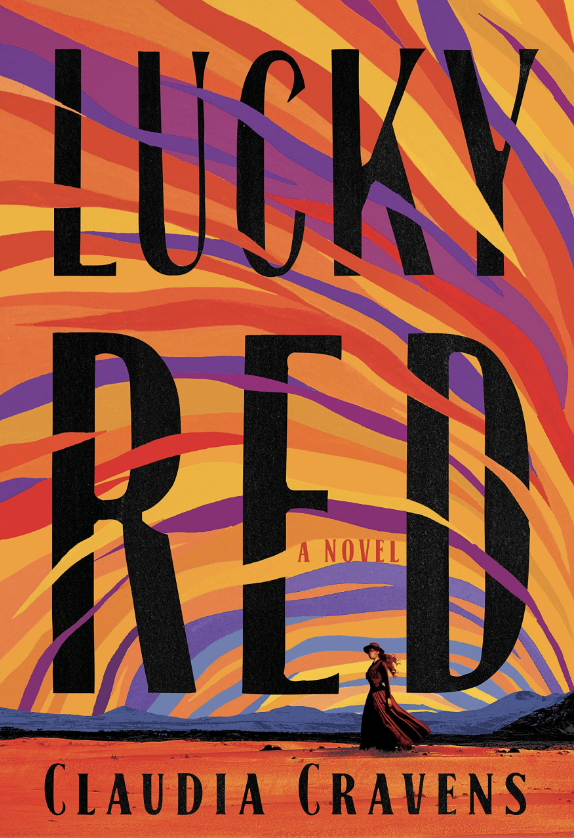
Lucky Red, by Claudia Cravens*****

Larry McMurtry, eat your heart out. There’s a fine new word-slinger come to town, and her name is Claudia Cravens.

My thanks go to Random House and Net Galley for the invitation to read and review Lucky Red. This book is for sale now, and you should get it and read it.

Bridget lives a life of hardscrabble deprivation; her mother died in childbirth, and all she has is her pa. He loves her, but he’s worthless; when he finally gets a bit of money, he invariably drinks and gambles till it’s nearly gone. During one such episode, he gambles away their little house, and then buys a homestead, sight unseen and many miles away. What they find instead is a tar paper shack; there are no crops or tilled acreage, no tools or even a decent place to live. They crawl into the miserable hovel to get out of the elements, at least, and get some sleep; a rattler has the same notion, but when pa thrashes in his sleep, the rattler bites him in the neck, and then there is only teenage Bridget.

Bridget makes her way to Dodge City, and in no time, she is stone cold broke. She’s recruited to work in a brothel, the only one in town owned and run by women. She doesn’t mind the work and makes friends among the other “sporting women,” and is curiously removed from the process for which she is paid; slide prong A into slot V; moan a little, gush, and collect your pay. But later, she finds herself obsessed with a new sex worker; a lovely blonde woman named Sallie. Everyone around her understands the significance of this fascination, but Bridget herself doesn’t get it. She’s young, and she’s naïve. But when Spartan Lee, a female bounty hunter, comes to town and asks to hire Bridget, the sun shines and the angels sing.

This story is epic, and in many ways reminds me of Little Big Man, but with a female protagonist. And in many ways, what makes it so successful is its restraint. At the book’s outset, there’s a slimy man that wants to buy Bridget’s hand in marriage, which would give her father a nice chunk of change, but she hates the man, and her father doesn’t push it. A less capable writer would have done it the other way, but here, and in every instance where I predict what will happen because it’s so obvious, Cravens does something else. And the lesbian sex is brief and almost free of physical details—a sad thing for anyone looking for soft porn, but it serves to keep the story moving forward—with the emotion behind it carrying the internal narrative.

Although Bridget has no complaint about the work she does, and the management is more benign than in houses owned and run by men, Cravens keeps it real. One night, Sallie is attacked by a client, and Bridget bursts in to rescue her. It doesn’t go well. Sallie berates her for her naivete:

“You don’t see the first thing about this, though, do you. They all have a knife, Bridget. They all have a gun, and they were all born with two fists on the ends of their arms. You think you’ve got this all figured out, but any single one of ‘em could take a swipe at you some night and you’d be dead before you hit the ground.”

To tell you more would be to spoil it for you, so I’ll leave you with this: Lucky Red is the best debut novel of 2023, and one of the best books I’ve seen this year, period. Don’t miss it.

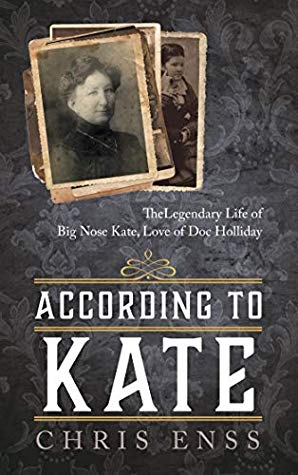
According to Kate, by Chris Enss***

Kate Elder, better known as Big Nose Kate, was a colorful character in the mercurial Wild West. Together with her paramour—possibly her husband—Doc Holliday, she shot, swindled and burned her way through Kansas, New Mexico, Texas and other parts of the American Southwest. My thanks go to Net Galley and Two Dot Publishing for the review copy. This book is for sale now.

Enss is a capable writer, and I enjoy seeing women about whom little has been written brought to the foreground. Enss amassed a fair amount of material on her subject, but some of it was contradictory, and the greatest contradictor of all was Kate herself, who decided to tell her own life story when she was too old to recall everything properly. Enss tells the reader in the title and introduction that she is telling Kate’s story from the subject’s point of view, and she adds numerous footnotes explaining  conflicting information throughout the narrative.

I read things I had never known before about this time and place, and general historical knowledge is where Enss shines best. For example, a ‘soiled dove’ was allowed to own real estate, whereas married women of the time were not. There were a number of financial advantages to owning a house of ill repute. Kate grew up in a middle class household and was not without choices, but she didn’t care to be married off in the way her family had proposed. In the end she was both a shrewd businesswoman and an adrenaline junkie, one that made a point of having at least one loaded gun handy when a situation called for it. I enjoyed reading about it.

Unfortunately there is a lot of conflicting information and the gaps in the story are numerous. Anytime I start seeing the words “might,” “must have, “ “likely” and so forth, I pull back from the narrative. I can’t get lost in a story when I have to mentally filter the things that are known to have happened from the things nobody knows for sure.  I think Enss has done as good a job as could be done with the documentation available, but Kate is a hard nut to crack.

What I would love to see is historical fiction written with Kate as the protagonist, viewed through the eyes of a feminist writer such as Enss. With historical fiction one can freely fill in the gaps, provide dialogue, and make notes at the end of the story letting the reader know what she has invented or changed.

Those with a special interest may want to read this biography, but I see it largely as a niche read.