
Lexington, by Kim Wickens****

Kim Wickens’s book Lexington tells the story, not only of one immensely famous, popular race horse, but of horse racing in general during a bygone era in the U.S. My thanks go to Net Galley and Random House Ballantine for the review copy. This book is for sale now.
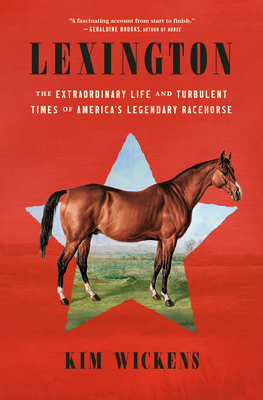
From 1780 to 1860, horse racing was the most popular spectator sport in the United States, and almost a religion in the South. Great fortunes rose and fell with the purchase, training, performing, and procreating of prize horses, and Lexington was the greatest of them all. Kim Wickens has done an astounding amount of research. This is probably the best documented work on equestrian history on the market today. If you love horses, and especially if you love horse racing, then this book is for you.

This reviewer knows little about either subject; I read it because it was different from most history books I’ve seen. My particular interest is the American Civil War; the synopsis mentioned General Grant and Abraham Lincoln, and I was all in. One of Lexington’s progenies was gifted to Grant by a supporter during the war, and he prized it greatly. The horse, Cincinnati, carried its new owner into at least three major battles. Grant allowed no one else to ride it, except, on a single occasion, President Abraham Lincoln.

Sadly for me, that’s about all we see of Lincoln, Grant, or the Union Army. It’s done in about four pages, which left me with 412 other pages. There are additional aspects here that are of interest to me, in particular the role of Lexington and his descendants in the crime spree by a bushwhacker named Sue Mundy, a name the man took on in order to throw lawmen off his trail. In fact, I found the second half of this meaty story to be much more interesting than the first half. Of course, although I like horses well enough from a distance, I have never been a rider or had any active interest in them. I am a city dweller, urban to my bones. For horse lovers, perhaps the first half will be as interesting or even more so.

One thing that I must mention has to do with the difficult material. This is nonfiction, and sometimes Lexington and other horses were mistreated by those responsible for their care. Whereas some race horse owners genuinely loved their steeds, ultimately they were investments. What to do with a horse, whether to race it or rest it, keep it or sell it, was governed mostly by the bottom line. Doubtless they would be appalled, were they alive today, to see the vast amount of coddling and spoiling we in the twenty-first century devote to our various fur babies. If you were to make a Venn diagram between us, about the only item that would occupy the shared bubble in the middle would be that we all own animals. That’s it. Whereas there is never any gratuitous description of the violence and other cruelties visited on the horses Wickens discusses, it’s in there, and if you can’t stand it, don’t read it.

I have rated Lexington four stars for a general readership, but for those with a strong, particular interest in horses, racing, and the history of both, this is most likely a five star read. Wickens is off and running!

Best Historical Fiction of 2019: Finding Dorothy, by Elizabeth Letts

Honorable Mentions:

The Liar’s Child, by Carla Buckley*****

Buckley is a force to be reckoned with,  an established writer, but she is new to me; I wasn’t done with this grab-you-by-the-hair thriller when I lurched over to my desktop to order two more of her novels from Seattle Bibliocommons, a thing I rarely do. Big thanks go to Net Galley and Random House Ballantine for the review copy. You can get this book March 12, 2019, and you should.

Sara Lennox is starting life new under the witness protection program. She has a new name and a dull new life, working as a cleaner—seriously, her a house cleaner?—and living in a damp, dull one-bedroom at the Paradise Apartments on North Carolina’s outer banks. It’s sweltering here. She asked to be placed on the Pacific Ocean, but no, she’s stuck here. Welcome to Paradise!

To top it all off, her handlers tell her not to go anywhere for a while; don’t take risks. It’s like telling a fish not to swim for a few months.

Meanwhile, the family next door is in crisis, but then for them, that’s not new. Whit and Diane Nelson have a stormy relationship; they know how to yank each other’s chains, and they do it constantly. Diane is gorgeous, a stunning woman that’s accustomed to owning every room she enters. She’s also completely irresponsible, devoid of even the most basic maternal instincts, and this came to a head when she snapped their little boy into his car seat, then went to work without dropping him off first. She forgot he was there, okay?

But it’s not okay. In the end, little Boon did come out of that coma—but psychologically he’s a mess, and once he is home, Diane is no better a mother than she was before. Add to this the ensuing visits from Robin the social worker and the intrusion of the state into their lives.

Why can’t that woman just mind her own business?

Whit loves his kids and knows he should leave Diane, but he can’t. They are the codependents from hell. So as twelve-year-old Cassie develops, she is burdened with many of the tasks that Diane ought to be doing; she’s the one Boon comes to when their parents’ raging battles scare him. Cassie has a right to be a preteen, but she can’t have a normal adolescence because Diane is doing that despite her age. It isn’t fair. What’s more? It’s making this girl mean.

Sara meets Cassie when Cassie breaks into her apartment. It sat empty for a long time, and Cassie had become accustomed to thinking of it as her own space. Leap across the balcony railing onto the one adjoining, and there you are. Cassie is a ball of rage, furious at her mother’s abdication and her father’s inability to set boundaries. Angry kids get into trouble. Lots of it.

And then Diane disappears. She’s done that before, taken off in a huff with no warning, abandoning her children and then reappearing after days, a weekend, a week or more. But this time is different. Her car and her purse are still here, for instance. And as the story climbs toward its crescendo, we get the sense that something sinister has occurred. Oh, Whit. What did you do?

Despite her disinclination to be involved with this family, Sara is pulled into the lives of the children. When a record-setting storm hurls its fury down upon the Outer Banks and the Paradise Apartments and evacuation is the order of the day, Sara sees Boon, then Cassie as she leaps into her car to peel out of there. His father’s car is gone. Though it’s the last thing she wants to do, Sara gets back out and lets Cassie and Boon scramble into her car. They’re off, and nobody knows who these children left with.

Buckley is absolutely unerring in her development of Sara and all of the members of the Nelson family. When an inconsistency appears, later in the story we see why the author put it there in order to move the story forward. Psychological fiction can be written without deeply layered characters, but it’s a lot better with characters like these, so achingly real.

So in the end, which character is the liar’s child? Every single one of them.

Those that love a true thriller, one that makes your pulse race and your breath stop from time to time should buy this book and read it. Buckley is a master storyteller of the first order, and you won’t want to miss it.