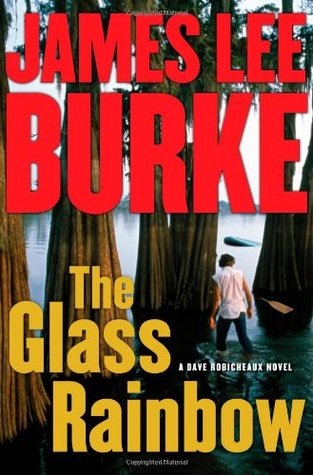
The Glass Rainbow, by James Lee Burke *****

theglassrainbowIf you are new to the series, do yourself a favor and go all the way back. This book is #18 of 20. Start with The Neon Rain and work your way forward. You won’t be one bit sorry.

For those who wonder whether this remarkable author whose work began in the 1960’s still has the stuff it takes to write Edgar and Pulitzer-nominee worthy material, the fact is that if anything, he’s even better. He is one of a very small number of mystery and crime thriller authors that can juggle the bad guys and storyline that is related to the crime under investigation and weave them inextricably and seamlessly with the continuing story of friendship, of familial devotion, and of personal ethics. Besides Sue Grafton, I have never seen a mystery writer develop character more fully or completely without missing a beat, and do it in an ongoing manner over decades without any consistency popping up to remind us that time has passed and the author’s memory is imperfect. Either Burke has an amazing memory or an amazing editor; one way or the other, he is an unmatchable writer.

The Glass Rainbow finds Dave still living in his home in New Iberia with Molly, Snuggs, and that almost supernaturally long-lived raccoon, Tripod. Alafair is home from Reed College, and she is dating a very bad man. Kermit Abelard, the man Alafair has fallen for, has contacts in the literary world that Alafair has been told will help launch her career; but people like Robert Weingart and Layton Blanchet are not in the world to be guardian angels to the young, the naïve, or the vulnerable. In fact, the opposite is true:

“ Sex was not a primary issue in their lives. Money was. When it comes to money, power and sex are secondary issues. Money buys both of them, always.”

This gibes with what I also believe is true of the vast majority of very wealthy people, and that is one of the reasons Burke’s work resounds in such a personally satisfying way for me. But it’s really more than a philosophical affinity; it is also unmistakably about character development.

In many novels, whether they are mystery, historical fiction, or general literature, there are plot devices that pop up over and over and over again. A threat against the protagonist’s family member is as old as the mountains, and as tired as a traveling salesman who’s been on his feet for three weeks straight. In other words, I see it coming and I groan. Once in awhile, if the novel was already not going well, I abandon the book then and there.

Another is alcoholism. A lot of writers know that there are a tremendous number of recovering alcoholics, not to mention people who love them, among their readership. I can relate to it. There are so many drunks and former drunks in my family that I won’t even have hooch in my house. I am a single-household Carrie Nation. Get it out of here! But hell if I want to read about it. I am already sick of alcoholism, and I do not need it in my fiction. Do. Not.

Cancer is another one. I won’t rant. You get the idea.

But because Burke’s writing is so deeply personal, he can (and does) use all of those above devices at one point or another and sometimes I don’t even notice that I am accepting his premise until halfway into the book. During the first three books of his series, which he has said in interviews were a trilogy in which Robicheaux sorts out his alcoholism before he is good for much else, I got tired of it but I kept on turning the pages.
The magic that makes his writing so exceptional is that he draws the reader in deeply enough to persuade us, at least for portions of the time that we are reading his novel, that we are part of his family. Alafair is not just his daughter. She is part of our family. We have to watch out for her. The boomer generation reads this stuff, and a lot of us have raised teens and young adults who have made some mis-steps that either were dangerous or appeared to be, and we spent our fair share of sleepless nights, so when Dave rolls out of bed after failing to sleep and goes to sit in the kitchen until his newly-adult daughter shows up to home, we put on our bathrobes and trudge into the kitchen with him. We blink drowsily and pull up a chair. Or we follow him on out to the porch.

And we don’t like these people Alafair is hanging out with. When we get older, we become adept, often through cruel experience, at spotting the phony altruism that these people slide over their personas like cheap sparkling hubcaps with metallic spinners on an old jalopy. When Layton dies, Burke reflects to Clete:

“I think Layton was too greedy to kill himself. He was the kind of guy who clings to the silverware when the mortician drags him out of his home.”

Later, when trying to get a handle on Abelard and his involvement in a case to which Robicheaux has been assigned, he and Clete attend a charity gala:

“ The guests at the banquet and fundraiser were an extraordinary group. Batistianos from Miami were there, as well as friends of Anastasio Somoza. The locals, if they could be called that, were a breed unto themselves. They were porcine and sleek and combed and brushed, and they jingled when they walked.”

Later in the story one of them speaks down to Robicheaux, telling him that his working class roots are repugnant:

“You may have gone to college, Mr. Robicheaux, but you wear your lack of breeding like a rented suit.”

Hey. That’s not a rented suit. It’s his own damn suit, and he should wear it proudly.

And thus I find myself defending him as I might a brother, a cousin, an uncle. He’s not just one of the good guys; he’s one of my good guys.

Some reviewers say that Burke has a particular kind of book he writes that becomes redundant over time. I disagree. His Robicheaux series no more becomes redundant than a human life does. Is my sister’s personality, my cousin’s, my son’s and my daughter’s, consistent over time for the most part, though of course we all grow and evolve in certain ways? Oh yes yes yes. And am I tired of them? Do I feel as if I would prefer to move on to others who may be more full of surprises? Not in the least.

Just as we make new friends, I love reading new novelists, whether they are merely new to me, or just breaking into the field.

But there is nothing quite like an old friend or a beloved aunt; nobody and nothing can replace these.

And thus it is with the novels written by James Lee Burke.
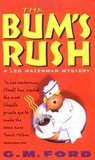
The Bum’s Rush, by GM Ford *****

thebumsrushI have read every speck of fiction written by the man who calls himself GM Ford. Part of it is that he sets a good deal of his work in Seattle, and I was stunned to find him (in one or another of the Leo Waterman books) chasing a villain into my neighborhood, down my street, and when he turned and I read the description of the house in which the body was found, I thought…MY STARS! I KNOW WHICH HOUSE HE MEANS!

Okay. That won’t happen for most of you. But if you can track down the old Leo Waterman books (Ford’s earliest series), they are both riveting in their own right, and absolutely hysterical in places. I have always liked books that feature working class heroes. Some of Waterman’s friends are homeless men, and when he gets money, he takes them things. It’s sort of sweet, at the same time that the mystery is compelling, at the same time that it is, in a wry, clever way, very VERY funny!

I was heartbroken when he ended this series, and overjoyed to see him come back with Chump Change, his most recent release (see review). Consider this a generic endorsement of all of the Waterman books. His other series, with Frank Corso as protagonist, is well written, but not meant to be funny. It was good too, but ultimately, my heart belongs to Leo.

Droll, witty, and brilliantly written. If you can, get them all and read them in order!

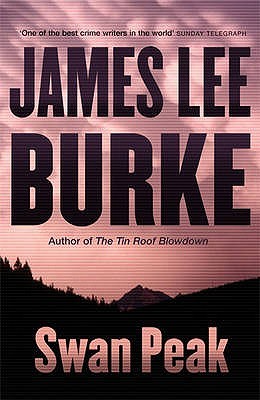
Swan Peak, by James Lee Burke *****

Swan PeakThis series began decades ago, when Dave Robicheaux and his best friend and cop partner, Cletus Purcel, were in their prime. Now they are much older, aging along with their creator, the legendary James Lee Burke. Robicheaux is happily married to Molly, a strong, loving woman who can deal with the harsh twists and turns that Dave’s life metes out. Clete continues to be drawn toward women with “disaster, stay away” stamped on their foreheads. It’s nice to know there are some things the reader can depend upon.
Just as the author divides his time between Montana and New Iberia, Louisiana, so does Dave, and this installation is set in Montana. Dave, Molly and Clete are on vacation, staying with friends, but Clete drives headlong into trouble, for once not of his own making, almost immediately. The local cops aren’t entirely sympathetic, nor are the Feds, all of whom know that he has a suspicious history in the area; he may be connected to a flaming plane that took down a nasty mobster and some of his entourage, a crash that may not have been accidental. Nobody has ever proven anything, but the presumption of innocence doesn’t apply to the attitudes that people take. It’s unfortunate, since Clete will need all the help he can get in this one:

 
Clete Purcel had given up on sleep, at least since he had been sapped with a blackjack,
wrist-cuffed to the base of a pine tree, and forced to hear a machine dig his grave out
of a hillside. He kept his nightlight on and his piece under his pillow and slept in fitful
increments. The trick was not to set the bar too high. If you thought of sleep in terms
of minutes rather than hours, you could always keep ahead of the game.

 
Yes, friends, there is trouble to spare on this vacation-from-hell, the bevy of frustrated wanna-be artists, corrupt wealthy baddies, and women with miserable pasts and questionable futures to whom Cletus is invariably drawn, moth to candle flame, that we have come to expect from a colorful, adrenaline packed story like the ones Burke spins when he writes this series.
But not all is rotten and wrong. Dave and Molly are fonder and more loving than ever as they grow older together. The protagonist explains that

 
There are occasions in this world when you’re allowed to step inside a sonnet,
when clocks stop, and you don’t worry about time’s winged chariot and hands
that beckon to you from the shadows.

 
Is the man with the half-melted face someone associated with Sally Dio? Is he Dio himself? Or is he merely a disabled man with a deeply flawed character?
Who killed those teenagers?
To find out, you need to get a copy of this wonderful book, but if you haven’t read the rest of the series, I recommend reading them in sequence. Because nobody writes better than Burke.

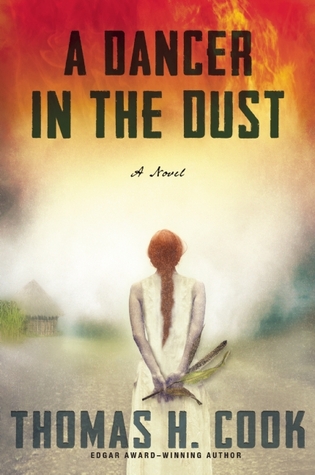
A Dancer in the Dust: A Novel, by Thomas H. Cook *****

a dancer in the dustA Dancer in the Dust is a multifaceted novel. It is a love story, the doomed love of Ray Campbell, a risk assessor from the United States for Martine Aubert, an African woman of Belgian descent. Martine lives in, and loves, the country of her birth, a fictitiously independent nation called Lubanda. And it is a story of paternalism, and of how much easier it is to place someone else in a risky position rather than oneself. It is also a story that raises thought-provoking social issues.
My thanks go to the publisher and the first reads program for the chance to read this free. It is beautifully written, but it is also one that starts with a man grieving, and by chance it arrived in the mail when I was grieving a younger family member who died very unexpectedly. Every time I picked the book up, the clouds formed, and so I took what I would generally consider to be an unconscionably long time reading it. For awhile, the words just couldn’t sink in.
When I got my wits about me, it occurred to me that I ought to find out whether Lubanda was a real place or not, lest I make an ass of myself while reviewing it. Sure enough, Lubanda, though not really an independent nation, exists in east-central Africa as a subsection of Tanzania. Cook makes it larger and more populous than it is in real life for the purpose of his fictional vehicle. And when you are as painterly and skillful with words as Cook is, you can pretty much do what you need to in order to tell your story.
So we rejoin Campbell as he sets out on his return trip to Lubanda. He left there after Martine was killed, returned to New York City, but the death of a man known to both Ray and Martine sets his wheels back in motion. Seso, whom Campbell considered a friend, has turned up dead, murdered, in New York City. Campbell has weighed risks and taken the safer course all of his life, and in turn, he has been left with nothing and no one. He is finally ready to toss all of his chips on the table in hopes of at least winning redemption, and so he sets out in search of Seso’s killer.
“Actually, we have plenty of opportunities to do the right thing…It’s taking back the wrong thing we can’t do.”
Martine had died because she would not do what the Western aid providers think she should do, a program the government bought into lock, stock and barrel. She had tried to explain in logical terms why their plan for her country was wrong, but no one was listening. Nation after nation had become a “funhouse mirror into hell” because of Western policies: Uganda, Kenya, Congo, and the list continues. Patrice Lumumba embraced modern ideas and methods, but ultimately died when he defied his keepers.
In setting out to find out what happened to Seso and why, Campbell is looking to trace back the thread. Cook’s account is brutal and searing, but it is too well told, too compelling, and raises too many thorny social issues that bear examining to be set aside. Read it for Africa; read it for the mystery it unravels; or read it for social justice. But get the book, and read it now!

Somebody Owes Me Money! by Donald Westlake *****

 somebodyowesme Imagine that you are a working class guy, okay, not always technically LEGAL work, and you place a small bet on a fairly frequent basis with a friend who is also a bookie. And week after week, just as with lottery tickets, it is money down the drain.

Then suddenly, the angels sing: Hallelujah! Your horse just won on some VERY long odds! You trot joyfully up the stairs to your bookie’s flat…and he’s there. Dead. On the floor. It looks like a professional hit.

So…what would you do?

If it was me, I know what I’d do! I’d run like hell! NEVER MET the guy. But not our protagonist. (And this is all right there at the start, mind; I haven’t spoiled a thing beyond the very beginning of the book). OUR protagonist is thinking of just one thing: he has FINALLY won a bet, and he is GOING to collect! So, whoever took this guy out must be the one who owes him money now, RIGHT? Well, where is he?

Westlake has made me laugh many, many times. I will miss him terribly, and am glad he wrote so much. I felt at least one of his novels should be on this list.

The Yankee Club, by Michael Murphy ****

theyankeeclubMichael Murphy has created an entertaining read that may keep you up past your bedtime as the end approaches. I was fortunate enough to get a chance to read it early via his publishers and Net Galley.

The premise is that Jake, a former PI turned mystery writer, has been living in Florida, having fled there heartbroken after his romance with the lovely Laura ended. Now he is back in New York. Laura is a famous actress, engaged to a very wealthy man, but Jake has not come back for her; he has returned because his former partner, Mickey, has been murdered.

During the first 25% of this novel, my attention wandered. This is unusual for me, and of course not a good sign. I went back over the writing to try to diagnose why this happened, since there was no obvious problem in his plotting, setting, or character development. Finally I decided that the pace was a little slow because so much attention had been given to scene setting and the introduction of peripheral characters (who would later be very important). My advice to any reader who enjoys detective fiction is to hang in there, if you find this happening to you, because it does pick up and becomes much more engaging once the story begins to roll forward.

There is a plethora of bad guys, surprises and betrayals at every turn. Jake proves to be as tough as Sam Spade, and he is ready to give his all to protect the woman he loves, though as it turns out, she is hardly a damsel in distress; I won’t say more lest I ruin it for the reader.

If I had one piece of advice to offer this writer, it would be to use a little more subtlety. Don’t tell us how your character feels, and in particular, don’t do so repeatedly. Show us in action and dialogue. If these things are handled effectively enough, it won’t be necessary to tell us who feels what and why.

Small details I particularly enjoyed: the florist’s truck, and toward the end, the bicycle.

One thing I didn’t enjoy and didn’t need, though hardly the writer’s fault: a message repeatedly popping up on my kindle telling me that I had something on my tablet that had not been purchased at amazon, and if they were in error and it had been something of theirs, I should restart my kindle and pull it out of the archives. I blew past this message 3 times; once they totally removed my view of the text and put the home page back up. Did I mention that this was irritating, especially since Net Galley does offer the option of sending the galley straight to kindle, which is how mine got there?

Thanks for permitting this rant to interrupt my review. All told, this is a really fun story once the scene has been set and action is underway. You won’t be disappointed.

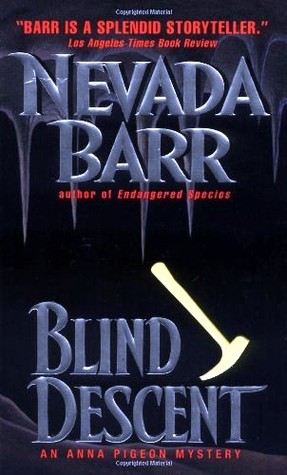
Blind Descent, by Nevada Barr*****

blinddescentOf all of the riveting tales Barr has spun around her park ranger protagonist, Anna Pigeon, this is, I think, the most compelling (and I have read them all)! For those that want to know, it’s the sixth in a long series, each of which is set in a national park.

Have any issues with claustrophobia? If yours is intense, you may need to give this one a miss. It involves caving and spelunking, including oh my stars crawling in a tiny horizontal tunnel where five extra pounds put on over a last-minute cheesecake just could mean the end of you. Once you’ve gone miles and you can’t go forward, and your light is out…what are you supposed to do, go backwards? It’s not like it’s all one tunnel. There are places you can fall, wrong turns you can take. After all, it was not made to be entertainment, it’s a seriously bad-ass part of Mother Nature that I don’t care to think about too hard.

Now, imagine that you are on such an intense journey, and that you are Anna Pigeon (whose only really detrimental characteristic is a stereotypical view of large people…you know, lazy, poor character, untrustworthy…I said something on Barr’s website once and she responded that this is her character’s perspective, so if you are sensitive about snarky remarks regarding people who have any extra meat on their bones, beware the whole series). Okay, now with that digression aside, imagine you are Anna Pigeon, and because you are a buff, toned ranger with a good reason to do so, you have headed into one of these caving expeditions; you’re in a tight spot; and it is only there that you realize that someone on the expedition would prefer you not make it out again.

Barr’s bias against sizable people aside, her writing is otherwise so impeccably skillful that I have no choice but to give her all 5 stars. Don’t read it right before you go to sleep, unless you are COMPLETELY untroubled by things that go bump in the night!

The Yiddish Policeman’s Union, by Michael Chabon *****

They say all stories have been told in one way or another, but to reduce Chabon’s The Yiddish Policemen’s Union to a “whodunit” is a travesty.

When I saw that a fellow reviewer had laughed at the notion of Chabon smiling and patting himself on the back as he wrote, I thought she was being ungracious. This was until after I had completed the book, which another reviewer accurately described as “hyper literate”. Now I can see him doing just that.

Oh yes, this is good writing at its finest, with a plot that pulls together with breathtaking attention to detail (LOTS of detail), incredibly lush descriptions, and droll humor, all of which no doubt account for the myriad honors and awards heaped upon the writer. He earned them all, but in reading, one feels the envy that a wallflower feels in the presence of the homecoming queen, or the 98 pound weakling feels when a muscular Adonis struts his stuff at the beach.

If you want a nutshell version of a review, it’s “Who killed the Yid?” But if you want a nutshell of anything, this book will be too much for you. It is not a tome to be skimmed or looked over while you hold a conversation or watch television. It demands full and complete attention. At first, I didn’t understand this, and had to restart twice when I took the book into my hands right before falling asleep and didn’t remember any of what I had read the next morning. It is better to begin it with full, wide awake attention!

Others have done a fine job of covering the setting, both place and time. There are a lot of characters to shuffle; Chabon does so deftly, but it is the job of the reader to keep up with him. Landsman is the detective and protagonist, but there are so many more, and some people are not what they seem to be. The story is rife with surprises, and I won’t spoil it for you by giving them away.

One thing worth noting as you go into it, especially if, like me, you are reading on an e-reader: the end, though this is not a short book, may feel abrupt because there is a glossary of Yiddish terms at the end, along with a teaser for the next book. Therefore, although all signs pointed to the story’s being nearly wrapped up, I thought Chabon was about to toss one more spanner into the works to fill up about 75 more e-pages. I was startled when the book ended , saying, “Wait. That’s it?” This is unlikely to be a problem if you have the physical book in hand, though.

Over and over again I found myself highlighting passages that were, I thought, the most magnificent figurative language I had ever seen. Eventually I was foolishly highlighting whole pages, and you don’t want them all here. Just know that Chabon has created a strange and miraculous world that features an underworld rebbe (rabbi) and a host of goons as the obstacle, but ultimately the Moriarty to the Yiddish Holmes is a surprise, to say the least.

I conclude with just one bit of philosophical musing dropped in toward the end, which I find irresistible. It does not provide a spoiler, though, because the answer to the puzzle is not revealed here. It’s just a little sample of the marvelous word-smithery wrought by our champion of writers, as Landsman reflects that in the future, “any kind of wonder seems likely. That the Jews will pick up and set sail for the promised land to feast on giant grapes and toss their beards in the desert wind. That the Temple will be rebuilt, speedily and in our day, War will cease, ease and plenty and righteousness will be universal…and every suit will come with two pair of pants.”