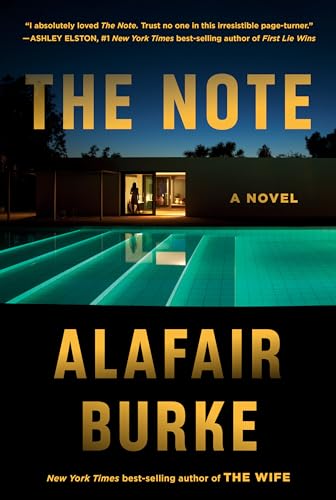
The Note, by Alafair Burke**

The Note by Alafair Burke is a thriller that sends three lifelong female friends on a gal pal vacation together; they have skeletons in their closets, scandals from their pasts, and that’s part of the bond. But try though I might, I couldn’t bond with any of them or care about their dilemmas.

My thanks go to NetGalley and Knopf Publishers for the review copy. This book is available now.

The internal narrative was so flaccid that I kept having to go back to reread parts of it, because I realized that I’d zoned out while reading and had no idea what had just happened. Once I had the plot straight, I struggled to recall the names of all three women. (Kelsey, May, and…?)  These characters struck me, when they struck me at all, as vapid and self-absorbed. The dialogue seemed banal.

When I saw in the promotional blurb that these three women would be vacationing together in The Hamptons, it gave me pause. I don’t like reading about rich people, and with a rare exception now and then, I don’t like rich people, period. But there have been a number of times that a terrific novelist has made me forget all about my no-no list, so I crossed my fingers. I’d read one other of Burke’s novels and it was pretty good, so I thought I’d give this one a go; it was a mistake.

I’m trying to think of a saving grace, some positive aspect that I can insert here in order to keep this review from being brutal, but honesty, I come up dry. I cannot recommend this book to you.  

The Best Mystery Stories of the Year 2025, by John Grisham and Otto Penzler*****

John Grisham and Otto Penzler have teamed up and compiled a delightful, high-quality collection of short mystery stories to entertain you. My thanks go to NetGalley, High Bridge Audio, and Penzler Publishers for the review copies. You can buy this book now.

All told, there are 20 stories that made the cut, plus a “bonus” story at the end. This mystifies me; why not just say there are 21 stories? Maybe there’s a tradition of only selecting 20. At any rate, I liked all of them except one, which I’ll explain in a moment. They are all well written, and they encompass a wide variety of subgenres. My favorites are “Home Game,” by Craig Faustus Buck; “Only a Story,” by Kai Lovelace; and “Effie’s Oasis,” by Casey Stegman. I had never even heard of any of these writers, so now I have three new authors to watch for. I was not as fond of “Dream Stuff,” by Lou Manfredo, but that’s because I dislike noir mysteries for the way that women are disrespected. Here’s an example: “Mary Lou, my previously noted overpaid secretary, poked her cute little head into my office…” and it goes on in that vein. I haven’t deducted anything from my rating, because I know that the aspects that I find problematic are part and parcel of noir mysteries, and so I can’t see penalizing this one author in the collection, or Grisham and Penzler, when I know that there are a considerable number of readers that love these stories, and not all of them are men.

One other minor irritation is that I was provided with both the digital and audio versions of the galley, but the stories aren’t in the same order in both books, which led to a fair amount of panicked flipping around my digital copy to try to match up with the story being read. If they’re going to edit the order in one format, I’d appreciate it if they would do it in both so that they match; hopefully this is straightened out in the finished copies.

 But while I’m talking about the audio version, I should also mention that the readers, Marnye Young and Jamie Renell, are top notch. There’s a great deal of dialogue in most of these stories, and they are both pitch perfect in reading the characters’ voices.

Whether you prefer a print or digital copy to read with your eyes, or an audio book that can follow you around while you do other things, you can’t go wrong with this collection. Highly recommended to all that enjoy the genre, and perfect for Halloween.

In the Time of Five Pumpkins, by Alexander McCall Smith*****

In the Time of Five Pumpkins is the 26th installment of the #1 Ladies’ Detective Agency mysteries by Alexander McCall Smith. This is hands down my favorite cozy series, and it may very well be my favorite series, period. Precious Ramotswe is our chief protagonist and owner of the business, and her easy-going manner with others and her capacity to smooth over a difficult situation are a breath of fresh air. Of course, Precious is fictional, but she feels real to me. I feel as if I have known her for decades, which in the literary sense, I have. My thanks go to NetGalley and Random House for the invitation to read and review. This book is for sale now.

As with all of my best loved, long-running mystery series, the joy of reading is only partly to do with the mystery. In fact, I almost think Smith could forget to include a mystery and I might take a good long while to notice; I enjoy greeting the continuing characters that I haven’t seen in some time. Mr. J.L.B. Matekoni, who is married to Precious and runs a garage in the same building where Precious has her office; Mma Potokwane, Precious’s “traditionally built” best friend, who runs an orphanage and always has fruitcake ready when Precious visits; Charlie, the formerly bumbling mechanic who is shaping up nicely as a part time detective trainee; and of course, Mma Makutsi:

Employees who leave it to their employers to promote them may have a long time to wait, but this was not the fate of Mma Makutsi. She had somehow managed to promote herself, first to the role of senior secretary, then without discussing the matter with Mma Ramotswe, to assistant detective, associate detective, associate director, co-director and so on, to the position she had most recently chosen for herself—executive president for development. This was a novel description and had rather puzzled Mma Ramotswe.

Passages such as this one leave me gasping! How many of us, in a similar situation, would allow someone that we had hired to give herself such exalted titles? It’s both bizarre and preposterous. But there’s never a question of salary; no matter what she calls herself, Mma Makutsi makes the same money as before, and no one here is making very much.

The stories usually have more than one thread, and so it is with this one. A woman arrives from the States to meet someone that turned up in her ancestry search, and the agency is hired to help her find them. At the same time, another case involving marital problems, though not the usual sort, is presented. And a third thread has to do with a shady character that has befriended Mr. J.L.B. Matekoni. Before all is said and done, Charlie has a “Clovis Anderson moment,” which has been a long time coming, and J.L.B. Matekoni saves his creepy new friend from a “government crocodile.”

This is a series that never gets old, and perhaps because the excitement is ramped up just a tick in this one—not too much, we do want to keep it cozy, after all—it may be my favorite so far. Highly recommended to all that love the genre.

Sharp Force, by Patricia Cornwell****-*****

4.5 stars, rounded upwards.

Sharp Force is the 29th mystery in the Kay Scarpetta series, and it’s a humdinger. My thanks go to NetGalley, Grand Central Publishing, and Highbridge Audio for the invitation to read and review; this book will be available to the public October 7, 2025.

In writing this wildly successful series, author Patricia Cornwell goes deep into character, which is the best way to write a long running series. There are, after all, only so many ways to kill someone, and only so many reasons for doing so. One can add strange variations that raise questions, and indeed, Cornwell does, but the thing that keeps me on the edge of my seat is not only identifying and stopping the killer in question, but also making sure that Kay and her family are also safe. I’ve been following these folks for the whole series, and knowing that Benton, Marino, Lucy, and even Dorothy, Kay’s obnoxious sister who’s married to Marino are safe. I even worry about the cat, and this time around, we have reason to do so. (For those with triggers: no animal cruelty is involved in this book.) Conversely, there are also long running nemeses such as Dana Diletti, the journalist that will ruin the progress of an investigation in order to gain a scoop, and Maggie, the obnoxious secretary whom Kay fired for cause, but who is still working in an adjacent position, spying for friends in high places. Round all of these off with the disturbing, fascinating Janet, an AI entity developed by Kay’s badass niece, Lucy, a tech genius whose late lover, Janet, is the model for the AI. Janet—the artificial one, since the flesh and blood one was killed several books back—knows too much, and though she is helpful at times, she also has a tendency to stir up trouble within the family.

When all of these characters are stirred into Cornwell’s cauldron, the trite, often obnoxious tropes one runs into aren’t needed or used here, a welcome relief. Kay isn’t going to be knocked over the head and kidnapped; she doesn’t have an alcohol problem and the constant itch that goes with it; she hasn’t been framed and called upon to exonerate herself. (Some of these appeared early in the series, but have been blessedly absent for a good long while.)

There are a couple of recurring features that I would like to see the author avoid. These appear at the very beginning, so the reader has a long time to get over them: for example, why does there always have to be a big storm on the way just as the book opens? And when the narrative commences with Kay and Benton packing to spend Christmas in London on vacation, I roll my eyes and say, “No, we already know something will prevent this trip from taking place. Unpack your suitcases, kiddies, you never get to go anywhere.”  And once again, the murder victim is someone Kay knows. These are small issues and rendered smaller by their appearance early, so I can quickly recover from my annoyance, but honestly, Cornwell has enough skill to dodge these next time, and she should.

I was fortunate enough to have both the digital and audio versions of this novel. Reader January LaVoy, one of my favorites, does a fine job.

The high rating I give this story, despite the opening irritants, is based on how I feel as I’m reading. I read anywhere from six to ten books at a time, located in various forms and on various devices, and while I am reading this one, I don’t have much interest in the others, although some of them are quite good. I cannot deny a strong rating to a book when I itch to return to it, as I surely do; then too, the ending is always important in a novel, and all the more so in a mystery, and this ending is terrific!

One side note: the Scarpetta books form the basis for a new series coming out soon, starring Nicole Kidman—a personal favorite—in the title role. I’m on pins and needles waiting for it!

Highly recommended to those that love the genre.

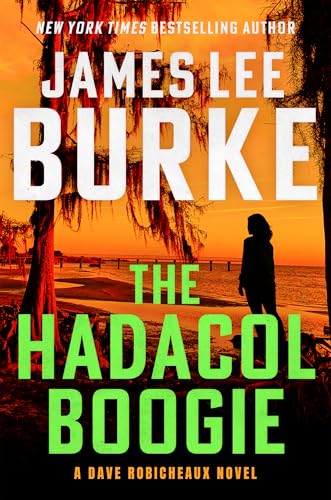
Clete, by James Lee Burke*****

Mortality is mortality. It comes to you when it’s ready. We don’t set the clock.

The Dave Robicheaux series by James Lee Burke is one of the finest ever written. As the faithful know, Clete Purcel is Dave’s partner in whatever he does. Once they were cops that called themselves “The Bobbsey Twins from Homicide.” (You probably need to be a boomer to get the reference.) Now they are on their own, but they are still like family to one another. This is the 24th in the series, and it’s the first to be told from Clete’s point of view. It’s a brilliant idea for two reasons: first, because Clete is a well written and wildly popular character, and also because it gives us a chance to see Dave through someone else’s eyes, someone that loves him, but isn’t him.

My thanks go to NetGalley and Grove Atlantic for the invitation to read and review, along with my profound apology for being so very late. This book is for sale now.

In this installment, a new drug ring has come to Louisiana, and it’s creating still more violence, more death, and more crime in general. Clete, who is now a private detective, is hired by a woman named Clara Bow. (If the name rings bells, it’s because the real Clara Bow was a famous movie star from the silent film era.) The Clara that hires Clete wants him to look into the activities of her skeevy ex-husband. Once he begins, we hardly have enough time to breathe. Clete hits the ground running, and there are no slow passages till the book concludes.

My favorite passages are the ones in which a woman named Chen, whom Clete rescues, then falls for, tells him how he appears to her. Here’s one: “You always gentleman, Mr. Clete. Your cats sleep on your face and you no mind. The world kill men like you because you brave and you kind.”

Later, Chen promises him that she won’t go back to taking drugs. “That because I go to a meeting every day with the Work the Steps or Die Motherfucker group. The Motherfuckers are very nice.” He advises her not to use that term in public. Don’t you love it?

Like every book in the series, this one moves seamlessly from scenes with quirky characters and dark humor, to glorious literary passages that I have to read more than once just to admire the writing, to passages that are gritty and violent and occasionally terrifying. Let me put it this way: you will never be bored.

Can you dive in mid-series? I did; then I became so enamored that I went back and read all the rest of them.

Highly recommended.

The Autumn Springs Retirement Home Massacre, by Philip Fracassi*****

It’s not just every day that I run across a five-star slasher novel, but author Philip Fracassi hasn’t written just any slasher novel, either. The Autumn Springs Retirement Home Massacre is one of this autumn’s most agreeable surprises. My thanks go to NetGalley, Macmillan Audio, and Tor for the review copies; this book will be available to the public September 30, 2025.

When a friend recommended it, she said it was funny and also different from her expectations. I agree on both counts. I was anticipating a book with plenty of old-folks barbs, sort of like the satirical carol, “Grandma Got Run Over by a Reindeer.” I considered whether I was up for it, given that I am a grandma myself, and decided my sense of humor hadn’t aged out. Sure, let’s give it a go.

Instead, though the book is indeed darkly funny in places, it also has aspects I didn’t anticipate. How many humorous slasher stories have character development, for instance? How many have genuinely poignant moments? And finally, on a more traditional yardstick, I find myself completely surprised by the solution.

Our protagonist is Rose Dubois, a 70-year-old retired school teacher. She buys a unit in the retirement community, not because she’s too decrepit to remember her medications or because she needs constant monitoring, but because she is ready to live in a smaller home near other people her own age. Her daughter has been urging her to come live with her instead, but Rose has friends here. She likes her little place, and she values her independence. She doesn’t want to go anywhere else.

Then her pals begin dying. The first is her bestie, and it stings, but also raises questions. The death—without giving anything away—seems out of character. But surprises happen, and they’re not all nice ones, so she and Angela’s other friends grumble, but move on.

But as the title suggests, there’s another. And another. Where will it stop? Rose and her remaining friends vow to stop it themselves, since the local cops and the home’s administrators don’t seem terribly concerned.

The story also raises the issue, a very real one, of the public’s lack of concern for the elderly. Hey, old people die. That’s what we do! And moreover, before we go, older folks become nearly invisible. The author’s moving note in the afterword explains why he took the approach he did.

Not long after I began reading, I was given access to the audio version, narrated by one of my favorites, January LaVoy. Although the print version is delightful, I give a slight edge to the audio because its format, which is mostly linear, lends itself well to this medium, and also because LaVoy always brings something extra to her narration.

Highly recommended to all that enjoy mysteries and a little gallows humor.

Apostle’s Cove, by William Kent Krueger****-*****

Apostle’s Cove is the 20th novel in the Cork O’Connor mystery series by William Kent Krueger. The series takes place in a fictional town of Aurora, Minnesota near an Indian Reservation. Most of the characters are all or partly Ojibwe (also known as Chippewa, or Shinnob). Apostle’s Cove is an area with spectacular views, and it is home to the malign widow of an enormously wealthy man, who built a mansion there.

My thanks go to NetGalley and Atria Books for the review copy. This book is available to the public now.

This story commences with Cork receiving a call from his son, Stephen, who’s working with The Great North Innocence Project, an organization that helps people that have been wrongly convicted. Cork is a restauranteur and private detective now, but Stephen tells him that during his time as sheriff, Cork sent an innocent man to prison. For 25 years, Axel Boshey has been serving out a lifetime term for a murder he didn’t commit. He confessed to it in order to shield the person he thought to be the actual killer. Now Stephen wants Cork to go back, untangle the mess, and get Axel out of lockup.

The story—and the series—is helped considerably by its appealing recurring characters. The two most compelling ones are the very oldest—Henry Meloux, an ancient wise man that lives in the forest and counsels those that seek his help—and the very youngest, the seven-year-old grandson affectionately known as Waaboo, a child with supernatural powers to whom the spirits speak.

Halloween is fast approaching, and there is great excitement as the small community prepares for it. Waaboo is excited, yet also troubled. The Windigo, a cannibalistic spirit, is nearby, and it’s hungry. It isn’t here for Waaboo, but nevertheless, he is disturbed by it.

The story is complex and, in most regards, believable. I read multiple books at a time, but while I read this one, the others became sidelined much of the time. This series is reliably well written and entertaining, and so it is with Apostle’s Cove.

Can you jump in mid-series? I did. I began reading it with the 18th in the series. Whereas it’s more fun once you recognize the characters, there’s nothing that will confuse a new reader.

Highly recommended to those that enjoy the genre.

Fever Beach, by Carl Hiaasen**-***

What happened? I used to absolutely love novels by Carl Hiaasen. In his most recent release, Fever Beach, we see a conflict between good—in the person of our main character, Viva Morales—and evil, played by a variety of Proud Boys wannabees and other undesirables. The good person is always good; the bad guys have no redeeming qualities. Only Viva’s ex-husband is a dynamic character.

Still, my thanks go to Doubleday and NetGalley for the review copy. This book is for sale now.
As I read, I keep reminding myself that this is not a book I’m supposed to take too seriously, to lighten up and just roll with it. I certainly used to do so when reading Hiaasen’s work. But perhaps because of the stereotyping and complete lack of nuance, what might otherwise have seemed droll and satirical, instead comes across like a whole lot of cheap shots fired off the bow.

Mind you, I am certainly not a fan of ultraright organizations, and the rising tide of bigotry, fascist ideology and anti-Semitism concerns me greatly. But in an already highly polarized nation and world, all I can think as I read is that this story isn’t helping. It is the snobbery and elitism of the highly educated that has driven a large number of folks into the arms of extreme right; some intelligently reject the elitism and cancel culture consciously, but they aren’t in this book. In real life, those that are poorly educated and/or intellectually handicapped, as the bad guys in this book are, would in most cases give their right arms to wake up “clever” like Viva.  It strikes me as counterproductive to write a book that makes fun of right-wing intolerance, while practicing intolerance from a different angle.

Back in the day, before anyone judged anyone else by the color of their hat, I used to roar with laughter at this author’s work. Did it change, or did I? I would like to think it is the former.

I rated this book 2.5 stars and have rounded it upward, more from a fondness of his early novels than anything else. I do recall reading another of his more recent books—not for review, but just because I felt like it—and saw some of the same problems, so I will tell you that this book will probably work for you if you enjoyed his last one. Apart from that, I cannot recommend it.

Overkill, by J.A. Jance*****

Overkill is the 18th book in the Ali Reynolds series. Ali and her husband, B. Simpson, run a cybersecurity firm. This mystery features two parallel problems. The first is when B’s first wife, Clarice, is accused of a murder that she didn’t commit. B. wants nothing to do with the problem—or Clarice—but Ali is convinced that she should look into it. The second problem is that Cami, the young woman that works for Ali and B., is being stalked while on a business trip. Both problems create a tremendous amount of suspense for the reader, and Jance is an expert at juggling many threads and details without dropping anything, while making the story clear enough that the reader can keep track. I enjoyed this book a great deal, and it’s for sale now.

My thanks go to NetGalley and Gallery Books for the review copy.

One of the things I love most about reading a J.A. Jance mystery is the feminist mojo she brings to every book. It’s subtle and built into the plot, rather than reading like a manifesto, but her sympathies toward working women, both professionals like Ali, and humble housekeepers such as the woman accused here, is manifest. It’s not an unusual mindset to encounter in a novel these days, but Jance has been doing it since long before it was common. In addition, her pacing never flags, and I don’t get confused by her plot lines, even when there are a good number of characters to track.

This is the first time I’ve used an audio version to read any of Jance’s books; I had fallen behind a bit, so I checked out the audio to keep me company on a road trip. Karen Ziemba does a fine job with the narration. I highly recommend this book to those that love the genre; you can read it as a stand alone if desired.

What Kind of Paradise, by Janelle Brown*****

What if the Unabomber had had a daughter? Thriller writer Janelle Brown spins a fascinating, credible, and memorable story based on this idea. My thanks go to NetGalley and Random House for the invitation to read and review. This book is for sale now.

Jane Williams grows up in a remote mountain cabin with her father; her mother died many years ago, so it is just the two of them. Once in a rare while she is allowed to accompany him into town to visit the bookstore, maybe even get an ice cream cone, but otherwise, she is cut off from society. She has no friends, apart from a casual friendship with the bookstore owner’s daughter; she has no play dates, no television, no computer. She is homeschooled. 

But every now and then, her father will wake her from a sound sleep in the middle of the night. They have to go! She grabs her bugout bag and goes through their established routine, escaping via the tunnels he has built beneath their cabin. Her heart pounds, her chest heaves…but hey, it turns out to be only a drill, after all.

Her father is a writer, composing political tracts that he sells in small, independent bookstores that carry zines. And so, for most of each day, he writes, she reads, and when the weather permits, she watches ants build hills, picks wildflowers, and leads the sort of bucolic life he has planned for her. But then, things change.

The story is told from Jane’s point of view; when Jane longs for even a photograph of her dead mother, anything at all to tell her about the other half of her beginnings, I feel it viscerally. Poor kid. But things are not necessarily as they appear, and as she grows to adulthood, Jane finds clues, small tidbits she’s not meant to find, and each morsel leaves her ravenous for more.

The story unfolds in the 1990s with occasional flashes of Jane’s childhood the decade before, so while it’s not historical fiction, it does have a retro vibe, one that Brown provides with absolute accuracy. We see small snatches of the events that took place in the U.S. during that time, but Brown is too good to rely on pop culture, so these are meted out sparingly, only when needed, never as a crutch.

This is a fun read, and it’s unlike anything I have seen written recently. I highly recommend it to fans of the genre.