
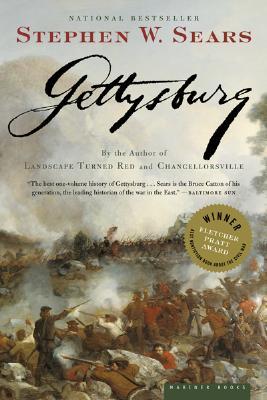
 This is the most thorough and brilliant account of the Battle of Gettysburg (all three days, plus the approach and the departure) I have ever read. This is the most thorough and brilliant account of the Battle of Gettysburg (all three days, plus the approach and the departure) I have ever read.
I have to laugh at the reviews that claim there is too much detail here. Hey, folks, look at the title, and look at the number of pages. If you aren’t ready to have the complete, detailed account, you should know before you buy it or check it out from your library that this isn’t for you. I used to teach about the American Civil War, and it continues to be a strong area of interest for me. I wouldn’t have wanted this to be my first, second, or third book about this war; actually, for the serious reader who is just getting started, McPherson’s Battle Cry of Freedom (which won the Pulitzer) is the best starting point. For those not interested in as thorough an account, it may be easier to start with historical fiction, and then move to nonfictional accounts of the war to help you straighten out the facts from the frills. For me though, I was ready to get down and resolve some conflicting ideas I had read. Some who specialize in the Confederate angle blame JEB Stuart for not coming in when Lee expected him with the intelligence that was needed. Some blame Longstreet for not enthusiastically embracing and supporting Lee’s plan of attack. And still others say the buck stopped with Lee, who after all was in charge and made the call. Sears says this was overall (from the Confederate side) a case of great overconfidence. Earlier in the war,Stuart had ridden all the way around Union commander McClellan’s forces twice to upset him and cut off his communications. This was intended to be trip #3, and it was expected to net similar results, apart from the foraging. The rebels were looking forward to gaining food and other supplies from the well-fed Pennsylvanians. Indeed, when Stuart did finally return–too late to do any real good regarding Gettysburg–he had an enormous trainload of wagons filled with the things Lee had sent him to get. But the Union’s forces had cut Stuart off, had come between him and Lee, and he and his cavalry had the very devil of a time safely making their way around the Union and back to Lee. Overconfidence; Sears makes a convincing case. Another blunder attributable to overconfidence was in waiting an extra day to attack, if they were going to attack without further intelligence from Stuart. Sears makes an excellent case that if they were going to attack Union forces, it should have been later (once Stuart was there to fill them in) or right away, because there were a lot of Union forces making their way toward Gettysburg (and the Confederates knew this much) that would be there the following day–when the battle actually began–who were not yet there. And Ewell, in general a strong commander, makes a terrible, terrible blunder in telling Lee that the Yankees who occupy Cemetery Ridge will be rendered harmless because Jubal Early is occupying the hill that is east of them, and higher. He reasoned that if the rebels had Seminary Ridge to the west and Culp’s Hill, the Union would be wedged in between opposing forces and rendered harmless. But the critical mistake is in giving Jubal Early “discretionary” orders to occupy this hill, and not telling Lee this. Early waits, deciding to send another force under him, headed by Johnson, to occupy Culp’s Hill, and in the time wasted, the Union takes the ground, changing things dramatically. Shifting to the Union perspective, we see that the forces are led overall by Meade, who has led the Army of the Potomac for exactly four days. Through intrigue among the generals below him, Hooker, a good general whose rank and file loved him but whose immediate inferiors found abrasive, was robbed of the glory of taking the field after he had made the plans and set them in motion. On the second day of battle, Sickles, a political general (meaning that he was given command because of his high governmental office, rather than military leadership or experience) refused Meade’s orders repeatedly. And this is one thing I greatly appreciate about Sears: some writers will tread softly when criticizing a commander who later becomes a casualty, as though printing word of the officer’s stubbornness or stupidity and its consequences for the men beneath him might be a breach of etiquette. But the fact is, a lot of men there got dead because of the stupidity or wrong-headedness of those who exercised authority over them, and in the case of this battle, both sides have let their own men know that flight or failure to fight will result in their summary shooting, so it isn’t as though a man could just duck behind a log and wander away from battle, as happened in some other really poorly conceived fights. The truth should be told exactly as it occurred, and in a thorough, well-documented, linear way, Sears lays the story, the exact truth unvarnished, before us. As things unfold, the carnage for which this three day battle is known takes many of the bravest and best down right away. John Reynolds, one of Meade’s ablest generals who was offered overall command and refused it,was shot through the throat and died within the first hour of battle. John Bell Hood was injured and incapacitated, but recovered to fight again, but not at Gettysburg. The most notable action on the second day is the Union’s Chamberlain’s decision not to retreat or surrender when faced with the fact that they are surrounded and completely out of ammunition. Looking down at the desperate rebs trying to climb that hill, he shouts, “Fix bayonets!” and with this, the rebels surrender. A heroic moment! On the second day, Union efforts are hampered by the “continued obtuseness of Slocum” and Sickles’ failure to occupy the ground assigned. By the time Meade gets to Sickles in person after Sickles has refused orders sent to him multiple times, it is too late for Sickles to move, and the damage is done. When Sickles loses his leg,an officer in the Second Corps remarks, “The loss of his leg is a great gain to us, whatever it may be to him.” Hancock, a far more capable commander, is placed in command, and he does the job right. The statistics, both regarding loss of able leaders on both sides as well as the rank and file, particularly for the rebels on the third and most gruesome day, are appalling. Many times Sears refers to this as “Fredericksburg in reverse”, and indeed, Union soldiers can be heard crying out, “Fredericksburg!” The aftermath is controversial. Initially, Lincoln was gravely disappointed to hear that Meade had let Lee and the rebels that still lived “escape”. Yet I cannot help but wonder, if he had stood in the pouring rain that came down on a sea of bodies, one acre of which was completely covered with corpses, some three days dead, and more than one body thick in places; if he had seen that there were only four of the original ten commanders still alive and fit to serve; if he had watched the 17-mile long hospital train of wounded Confederates that groaned away toward the Mason-Dixon line; if in viewing all of this, Lincoln himself would not have said, “Enough. Enough for now. Let’s bury our dead and treat our wounded, and get in out of the rain.” I hope I have conveyed the level of detail you can expect from this tome. If my review is a mite lengthy, you may not want to read five hundred pages plus notes on the topic. Sears writes better than I do, of course, but this is a study only for those who can already tell Sickles, Slocum, Sykes and Sedgwick apart. If you are still getting to know the players, this ballgame may be too long for you. But it is the ultimate detailed account for those who know some, but don’t feel they know enough. I often am forced to give books away because of the finite amount of space in the home library my family has collected, but this particular volume will retain a place of pride as long as I am here. |
Tag Archives: military history
Memoirs of General William T. Sherman, by William T. Sherman *****
 It’s important to admit bias up front, and I will tell you that I went into this with a strong sense of near-adulation. Sherman has long been my greatest hero among American generals (and it’s a short list). I have no use for Civil War literature that waxes nostalgic for the “lost cause” of wealthy Southern Caucasians, nor can I stomach the revisionist notion that the war was really just a sad, sad misunderstanding that might have been averted with a little more discussion. I don’t see it that way. I see it as an historic necessity with material roots. Marxist historian George Novak wrote that the opportunity to avoid war and let the Industrial Revolution march forward unfettered by slavery was lost when the slave owners firmly declined all offers to compensate them for “their” slaves and let them go free, so that progress and humanity might take a great leap forward. And so I am a great fan of Sherman’s. His march through Georgia was correct and righteous, and the anger his soldiers unleashed upon the state that began the whole process in a premeditated and aggressive manner, South Carolina, was well placed.
Now that all of that has been dealt with, I can talk about his written record.
Sherman’s memoir is remarkable. He was one of those rare beings, both a soldier and an incredible scholar (in the mold of Lewis and Clark, perhaps). He headed a military academy in Louisiana when the South seceded, and after giving a moving farewell speech to his students–the man gives a sense of being capable of really creating personal bonds, while at the same time knowing that if he has to say goodbye forever, he’ll do it–and went to Washington to seek orders.
Sherman is an outstanding writer, and his voice comes through loud and clear. I confess my affection for him is marred slightly by his horrific perspective (probably not unusual, but this guy never did anything halfway) toward the American Indian. I decided enough was enough, and skipped forward to the Civil War. My husband, whom I will call Mr. Computer, was also reading it, as we had accidentally procured two copies, and he did the same.
The opening years of the war are incredibly frustrating to study. McClellan had been a big-deal general during the war against Mexico, and he was initially placed in charge, while Grant and Sherman lingered in the background out west, each having left the military under a cloud, Grant for his drinking during the Mexican war, and Sherman as having been perceived as crazy. (Today I think a nice bottle of Xanax or Valium would’ve done wonders for the man in peace time years, but I believe he merely suffered from anxiety, and there’s a lot of that out there)!
By reading Sherman, one does not get an account of the whole Civil War; he can’t rightfully provide such a thing, because this is a memoir, so he writes about the places he went and the battles in which he took part. He is lavish in his praise of competent or even excellent officers, and takes pains to mention as many as possible by name, sending them down in history as heroes alongside himself.
His most famous contribution, the 3-campaigns-in-one march of some 425 miles, from the siege of Atlanta, to its invasion, and his willingness to tell the truth and avoid the senseless pussyfooting of his predecessors, who had stupidly believed that by firing over the heads of the Confederates, they could scare them into submission, is an inspiration. He understood that in order to win a war and have it be over, the gloves must come off, and ugly things had to be done. He limited his attacks to Confederate soldiers until the local population began to sabotage his efforts, at which point, without hesitation, he burnt local homes, measure for measure. Inside the city, he endeavored to destroy any and all infrastructure that would aid the enemy, since Confederate weapons, clothing, and food were nearly all warehoused in this city. He personally supervised the destruction of the railroads that would otherwise keep supplies moving between Atlanta and the field, and cut his own supply line, a gutsy move unheard of previously. He soon learned not to trust Cavalry to destroy the railroads, because they’d just tear the tracks off, and someone else would put them back on. Sherman supervised the heating of the rails till they were white-hot and pliable, and created a tool for bending them around the trunks of trees, or into knots when no trees were nearby, so that no one would ever use them again.
Sherman has an unfairly tainted reputation regarding the Black people of the South, perhaps because he discouraged newly-freed families from following his train. The issue was a logistical one; he had enough food for his soldiers, thanks to their resourcefulness in foraging, and he welcomed single Black men to assist in noncombatant ways in order to free up his soldiers. (He was not willing to arm his Black enlistees, and was pleasantly surprised when he found others had successfully done so later). But when someone from Washington came down and privately interviewed former slaves to see who they trusted and who they didn’t, they gave their unilateral trust to Sherman. This is the proof for me, that although he was later unsure they were ready for the ballot before they became literate (with which I disagreed), he treated them with kindness and they revered him, viewing him alongside President Lincoln, as their liberator.
Grant was so eager to have Sherman back to help him fight Lee across the Potomac that he nearly boarded him and all his men onto ships once he reached the sea. Sherman talked him out of it, saying that he must go THROUGH the Carolinas in order for those insulated in die-hard South Carolina to see the might of the American army, and understand that resistance truly was futile. The newspapers (and Sherman’s feelings toward the press were as plain as everything else; on the one hand, I do love a free press, but they were publishing his battle plans, which were supposed to be secret, and so I can understand his hostility toward them!) of the South printed lies, saying that the South was winning its quest for separation, and Sherman felt that personal experience was the only thing that would really convince those who had first seceded, who had fired on Fort Sumter, and perhaps since they started all this, it was appropriate that they not be spared the privations that the people of Georgia, who were much less enthusiastic toward the Confederacy, had experienced.
Grant was smart enough to listen to him, and let him follow what he considered the best course of action. Lincoln was a true friend and leader who knew when to stop delegating. Again and again, lies came to him about Grant, that he was drinking again, etc. and should be removed, and Lincoln, who was well and truly done with the likes of McClellan, Pope, and Burnside, said, “I can’t spare this man. He fights”. I mention this, not as a digression but because Grant and Sherman were hand in glove. This partnership, this blending of mind and purpose, is part of what made victory possible.
Sherman and his men fought their way through woods, swamps, over quicksand, through areas previously considered impenetrable, and unlike many high-ranking officers, he gave himself no perks that he did not share with his men (apart from the rare invitation to dinner with a Union family). At the very end of his memoir, he devotes perhaps 20 or 30 pages to what constitutes effective leadership, and one thing I was struck by is that he believes a commanding officer should ride up front, because the men leading it have pride in the fact that they are leading, and that disorder and bad behaviors are limited to the rear. In short, he is safer with the men in front, and he has to see what is ahead to draw the correct conclusions about what should be done next. He sleeps on the ground, just like his men. At one moving point, he and his men sought refuge from a storm by sleeping in a church, and some of the soldiers found carpets and made him a little bed up by the altar. Sherman told them to give that bed to their division leader, because he was used to sleeping hard. “Then I fell down on a pew and was instantly asleep”.
After Lincoln’s assassination by a Confederate sympathizer, and attempts upon the lives of Seward, Secretary of War, and others, newly-minted President Johnson suddenly knocked Sherman’s legs from beneath him. Without a hint or clue as to why, Sherman was suddenly vilified, and the orders to his subordinates NOT TO OBEY HIM were released to the press. Such lack of appreciation for a man who gave his all to the Union took my breath away. Apparently Secretary of War Stanton, who replaced Steward once he was injured, was filled with paranoia and behaved both irrationally and unfairly. This was primarily his doing, and Sherman knew it. He reported to Grant, and ONLY to Grant.
Upon reaching Washington DC, each leading general paraded with his army before a massive crowd, and Sherman had his rightful place on the review stand once he reached it. He passed down the line, shaking hands along the line of others who’d been seated there…until he reached Secretary Stanton. At this point, he states that he publicly brushed past the outstretched hand offered him, thus returning the public insult that had been dealt him in the press. He snubbed the guy in as public a manner as possible, and I once again wanted to cheer. Well done.
“War is war, and not popularity seeking”, he responded to someone who questioned his destruction of Georgia, and the sieges that left rebel cities on the brink of starvation. And he was right. It can’t be over until someone has the courage to wage real war. His frankness and his affection for his troops, even though he knew some of them would fall, or maybe even more so because of it, was deeply moving, and I came away feeling that I had read one of the best memoirs ever.
One more thing I’d add, for those who get the edition that I read: if you flip to the last page, it says 490. Hmmmm. The book appears to be longer, but then, there’s a lot of small print, where he documents everything meticulously, using primarily the telegrams and letters from himself to his superiors and vice-versa.
But there’s something more. This was originally a two volume set. It’s less expensive to buy just one book, but it remains two volumes under one cover. Once you reach the FIRST page 409, There is a page that says VOLUME II and then you start on page 1 again, so that you are actually reading over 800 pages.
Put together with Southern historian Shelby Foote’s less-apt and rabidly pro-Confederate trilogy, this was a meal, yet I don’t regret reading them together, since it provided two perspectives (and I am finishing Burke Davis’s book on Sherman’s march to the sea, a smaller volume with a third perspective that is closer to Sherman’s own).
But if you ask me who I believe when facts collide: I believe Sherman.
Post script: Shelby Foote’s Civil War trilogy is not reviewed on this blog, because I only give space to work I respect and have rated at four or five stars on a one-through-five star scale.

