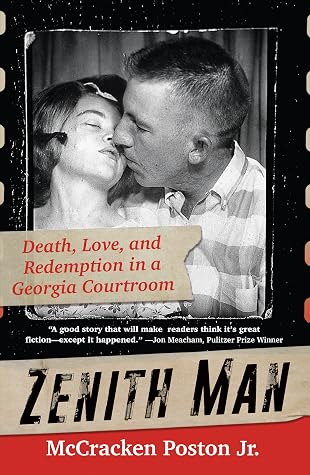
Zenith Man, by McCracken Poston, Jr. *****

Zenith Man is a memoir written by attorney McCracken Poston, Jr. about his most interesting case. Alvin Ridley, his neighbor, had been accused of imprisoning, then murdering his wife. Poston was sure that Ridley had done no such thing, but the tiny Georgia town of Ringgold was swift to rush to judgment, and it took him nearly every minute of every day for nearly a year to research, then try his case.

My thanks go to NetGalley and Kensington Publishing for the review copy. This book was originally published in 2024, but this new version with an updated epilogue is available to the public now.

Ridley made his living as a television sales and repair man during the late 1900s, thus the title. His wife, Virginia, died, and his flat affect when he called the hospital to tell them as much set off all sorts of alarms, aided by Virginia’s sister, who had never cared for Ridley. When it came down to it, Ridley just wasn’t cut out the way that others in Ringgold were, and that made him difficult to defend. Poston comments, “I had put my all into helping the weirdest man in town.”

For starters, the man smelled dreadful; he hadn’t bathed or washed his clothes in at least a year. The judge had to have the courtroom fumigated after just a couple of days of the trial. (The case was then moved to a larger courtroom, one with windows!) He didn’t answer questions the way that others would. It took a solid week for just to get him to let Poston in the house so that he could see where Virginia had died; but once he did, he was even surer that Ridley was an innocent man.

(The promotional blurb from this book claims that this story resembles a nonfiction version of a John Grisham novel; it also claims to hold elements of “Rain Man” and Just Mercy. Overblown claims like these are a pet peeve of mine, and yet ultimately, I found myself occasionally wanting to call the defendant Alvin Radley, and I realized that this is because Ridley did, in fact, slightly remind me of Boo Radley in To Kill a Mockingbird.)

I won’t go into further detail about the case itself, as Poston has already done a fine job of that, but I will say that this memoir reads a lot like narrative nonfiction. I was deeply absorbed, and I found myself putting books by favorite authors aside until I could finish this one.

Highly recommended!

Earl, Honey, by D.S. Getson*****

“Ever since Pa hit him in the head with the two-by-four, Earl had lived with blinders.”

If you can read that opening line and not be curious about what comes after it, check your pulse, because there’s a good chance you are already dead. As for me, I was drawn to it immediately, and I thank Net Galley and Matador Publishing for the review copy. This book is for sale now.

When we meet Earl, the year is 1921 (although occasionally, we skip forward to 1970.) Earl is in the courthouse watching his father’s trial:

‘I di’nt fornicate with no donkey. Es ist eine dirty lie!’ From the back of the darkly paneled room, he feels his pa’s rage like a ground tremor rippling its way through the crowd the crowd to the spot where he sits, surrounded by family. Well, except for Rose. She’s up front in a special seat…

‘And what about the other charge, Mr. Hahn? Is it true your daughter, Rose, is carrying your child?’

Boom. So right in the first chapter, you can plainly see that if you are someone that needs to know about triggers before reading a novel, this may not be your book. And that’s a shame, because the quality of the writing is phenomenal, from the riveting opening line, all the way to the last.

Earl’s pa does, in fact, go to jail; even if he wasn’t guilty as sin (and of it,) which he clearly is, everyone in town hates him with an abiding passion, most of all his wife and ten children.

“There wasn’t a man within a hundred miles of Sampson County who would stand up for Reinhardt Hahn.”

It is unusual for me to include so many quotes in a review, but as you can see, the writing is so clear, strong, and resonant that I cannot do it justice any other way.

As the title and first line suggest, the story is Earl’s, and we follow him through the remainder of his childhood and adolescence. At its end, I am thunderstruck when I read the author’s note explaining that the whole story is based on the truth. Earl was her grandmother’s brother; Reinhardt Hahn, or “Pa,” was her great-grandfather.

Friends, this is easily one of the best novels to come out of 2022, and I am convinced that the only reason it isn’t parked on the New York Times bestseller list is because it was self-published, and therefore it didn’t receive the kind of publicity that a major publisher could have provided.

I won’t say more; to do that, I’d have to fish out some more quotes, and they are even better when read in context. Highly recommended; D.S. Getson is an author to watch.