Zero Days, by Ruth Ware****-*****

What would spring be like without another Ruth Ware mystery?  I hope never to find out. My thanks go to Net Galley and Gallery Books for the review copy.  This book goes up for sale Tuesday, June 20, and those that love a fast-paced, high octane read should order a copy.

One of the finest things about Zero Days is the premise. Our protagonist is Jacintha “Jack” Cross, and she and her husband, Gabe, run a pen testing business. I had never heard of pen testers before; these are people that are hired by corporations to hack into their systems and then report their areas of vulnerability so that they can be corrected before unfriendly hackers find them. Jack is the physical penetrator, and so while Gabe is home worming his way into the client’s network, Jack is on site, physically breaking into the business’s building.

This reviewer has two immediate family members that are fairly high on the IT food chain, so I asked both of them whether this is a real thing; they assured me that it is, although they had never heard the abbreviation. Most penetration testers don’t physically breach the physical building; usually it’s a tech breach only.

On this occasion, Jack meets up with a security guard that doesn’t believe she’s there legitimately, and by the time she straightens things out and gets home, her husband is dead.

When I read my notes, I can find plenty to criticize. At the outset, as Jack is breaking into the site, she has her earbuds in and Gabe is talking to her, and there is some conversation about the sex they’re looking forward to after the job that I find jarring and out of place. Yes, the purpose is to let the reader know that their marriage is strong, but I would have preferred greater subtlety. Then the cops decide Jack is their number one suspect, and when I see that Jack is going to investigate in order to clear her own name and find Gabe’s killer, I actually groan, because this is such a tired, overused trope. And the vast majority of this novel is Jack being chased, Jack running, Jack hiding, Jack running some more.

However, when it’s time to read–and I have several books going at a time, some galleys, some not–I find myself reaching for this one every time. Ware’s pacing never flags, and there’s creativity in the choices Jack makes that are reminiscent of Thomas Perry’s legendary Jane Whitefield series, but with technology added. I love that it’s the woman in this pen business doing all of the physical work, and Jack is a genuine badass, which makes my feminist heart beat harder. She is injured badly in one escape, and I fret over her and even wonder how she’s carrying it off, given the severity, but Ware convinces me that Jack is propelled by adrenaline and a complete indifference to her own safety and health, now that Gabe is gone. There is a small twist thrown in at the end that I find annoyingly predictable, but it’s almost an afterthought, and so it doesn’t impact the main body of the story. And there are occasional brilliant, original bits of figurative language that I love.

In point of fact, I wouldn’t mind seeing Jack Cross again.

For those that love an adrenaline rush, this book is recommended.

The Spies of Shilling Lane, by Jennifer Ryan****

Sometimes what I really need is a feel-good story. Had I ascertained that this was that sort of book, I would have had it read by the publication date. I read the beginning twice, decided it was going to fall into the grim duty category since I had accepted a review copy, and I set it aside. My apologies go to Net Galley, Crown Books, and the author for my lateness; my heartfelt thanks go to Jayne Entwistle, the reader for the audio version of this lovely tale, for rekindling my interest. I procured the audio version from Seattle Bibliocommons and listened to it while I rode my stationary bike and prepared dinner in the evenings. I began listening to it because I owed a review, but soon I found that I preferred this novel to the other good book I had been listening to just for pleasure.

Our story begins with Mrs. Braithwaite feeling injured and put upon. Her husband is divorcing her, and the women in the local charity club have banded together and ousted her from her treasured position of leadership. She is miserable. Betty, her only child, has run off to London, intent upon aiding her country now that the second World War is upon them, and she isn’t answering her calls. Mrs. Braithwaite decides to visit her, but upon arrival, she discovers that Betty is missing. The story flows from her effort to find her daughter and also herself.

Those seeking an espionage thriller won’t find it here; the story is character based, and in this Ryan succeeds richly. Mrs. Braithwaite enlists the reluctant assistance of Mr. Norris, Betty’s milquetoast landlord, and it is these two characters that are wonderfully developed. None of this would have been achieved without the spot-on cultural insights regarding the World War II generation. The shallower pop-cultural references to music are well and good, but Ryan goes deeper. The fact that the character is known only by her formal title, with the salutary “Mrs.” in place of a first name, speaks not only to the protagonist’s dignified, somewhat cold façade, but also to the practices of the time. Use of first names was considered an intimacy among the elders of this time period; women addressed their peers by it unless they were close friends or family members. Even the way that the plot develops is reminiscent of the fiction and movies of that generation. As in most good historical fiction, the setting mingles with the characters to move the plot forward.

I am not much of a cozy mystery fan, but I think this story would please cozy readers. At the same time, I appreciate the careful balance the author uses; the touching moments are deftly handled, never becoming cloying or maudlin. At other times there’s a playful, spoofing quality to it, as Mrs. Braithwaite and Betty search for each other, each fearing the other is in danger and thus placing herself in it.

I recommend this book to cozy readers, fans of historical fiction, and anyone in need of a boost in morale. It’s for sale now.

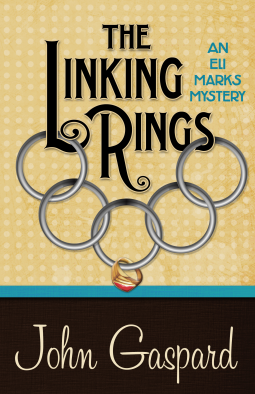
The Linking Rings, by John Gaspard****

TheLinkingRingsThis title is the fourth in the Eli Marks series; I read the one before it and loved it, but you will be fine if you’re jumping in uninitiated. Thanks go to Net Galley and Henery Press for the review copy, which I received free and early in exchange for this honest review. The book is now for sale.

Eli and his girlfriend, Megan, head to London, where he and his Uncle Harry are attending a sort of reunion with a group of magicians. When one of them is murdered, Harry is arrested and so Eli investigates in order to clear his uncle. Along the way more magicians are killed, and Eli discovers that another magician, a TV magician that holds little respect from his peers, has stolen Eli’s signature act.

Gaspard writes a solid mystery, with a manageable number of characters with a complex but blessedly linear plot. His sense of humor slays me. That said, I blanched a few times at the gender stereotypes, which aren’t entirely redeemed by the brief discussion about sexism in the industry. However, the last fifteen percent of the story is so brilliantly crafted—and so hilarious—that I could only bow in awe when it was over.

Recommended to those that enjoy a cozy mystery.

The Quantum Spy, by David Ignatius*****

“America is a country where race matters. The more people say they are, what, color-blind, the more it is a lie.”

thequantumspyDavid Ignatius writes gripping spy fiction, and this is his best work.  The basis of this one is the longstanding intelligence war between the CIA and its Chinese counterpart; the story is fictional, but his careful research ensures that this could have happened.  Lucky me, I read it free thanks to Edelweiss and W.W. Norton and Company Publishers. This book will be available to the public tomorrow, November 7, 2017.

Harris Chang is Chinese-American, raised to respect the red, white and blue.  He works for the CIA, and has been sent to investigate a leak in a quantum research lab. As the USA and China struggle to achieve technological dominance, tensions rise. Chang wonders if he has been chosen to investigate based on his ethnicity, since he knows very little about China or even his own family tree; why yes he has. The Chinese expect to be able to turn him because of it, and over the course of time, his bosses begin to suspect that it’s happened.  Harris is loyal, and he chafes at the unfairness of his treatment, but is determined to succeed. After all, what could prove his loyalty more clearly than to perform above the standard to which most of the Agency’s employees are held?

The setting changes constantly as spies chase other spies all over the world, but the story takes place primarily in Arlington, Virginia and in Singapore. There are also some especially tense, intriguing scenes set in Mexico, and I love the side details about Trotsky’s house, which is now a museum.

Ignatius dumbs down nothing for anyone, and so the reader should have literacy skills that are sharp and ready. Don’t read this one after you take your sleeping pill. Trust me.

The story can be read—and mostly will be, I think—as an enjoyable bit of escapism. With current events so intense, we all need some of that, and it’s what I expected when I requested the DRC. But I find it much more rewarding because of the racial subtext. It’s an area that’s important to me, and at first my back was up when I saw hints of it without knowing what the writer’s intentions were. So many are astonishingly clueless, or worse, when it comes to this aspect of fiction. But as I saw where he was taking it, I had to completely reevaluate my opinion. I would love to be surprised in exactly this way more frequently.

The ending made me want to stand up and cheer.

Highly recommended to those that love strong thrillers, and even more so for those that also cherish civil rights in the USA.