Funny Farm, by Laurie Zaleski*****

“You never know what you are capable of until the day comes wen you have to go places you hadn’t planned on going.”
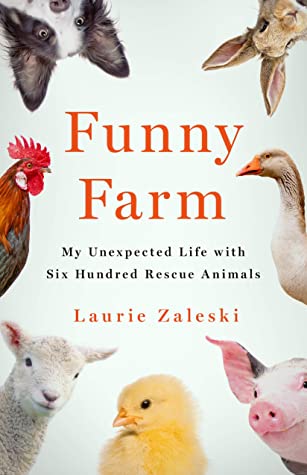
Laurie Zaleski knows how to make a debut. Funny Farm: My Unexpected Life With 600 Rescue Animals has created a tremendous buzz, and all of it is deserved. My thanks go to Net Galley and St. Martin’s Press for the review copy. This book will be available to the public Tuesday, February 22, 2022.

Laurie’s early childhood was in many ways an enviable one; her mother stayed home to raise Laurie, her brother, and her sister, and her father made enough money to hire household help and buy a couple of vacation homes, too. There was nothing they lacked for, other than physical safety. Because while her father could be warm, and loving, and generous, and funny, he could also be a monster. His reign of terror was worsened by alcohol consumption. As the beatings became uglier and more frequent, Annie, their mother, chose poverty for the children and herself over the constant terror and danger of living with their dad.

“’I almost became a nun,’ Mom would joke years later. ‘Then I met the devil…’ Annie McNulty and Richard Zaleski fell in love like tripping into an open manhole: one wrong move followed by a long dark plunge.”

There’s one searing episode Zaleski recounts, toward the end of their life with Dad, in which they are all hidden in a bedroom with the door blocked shut, and their father is sneaking up on them, commando crawling up the hallway toward them so they won’t see his shadow approaching, and he has a large knife between his teeth. It sounds like something from a Stephen King novel, doesn’t it?

And so, when Annie’s efforts to build a modest nest egg to finance their flight is uncovered, she has no other option but to leave without the money. She finds a dumpy cabin in the woods, half fallen down and in no way legally rentable, and strikes a bargain with the owner. To say that their standard of living decreases is the understatement of the year, but they make it work.

Once she has made her escape, apart from the creepy forays from an unseen enemy that occur from time to time, Annie can’t turn away anyone else, human or otherwise, that is in a dark and vulnerable place. The woods surrounding their little shack begin sprouting makeshift outbuildings; there’s a little lean-to here, and a sort-of paddock there. And it keeps growing.

Zaleski is a gifted storyteller, and she alternates her narrative from the present to the past, breaking up the nightmarish episodes of her childhood with hilarious stories, most of which are about the critters. Her writing is so nimble that I find myself repeatedly checking to see what else she’s published, because there’s just no way this can be her debut. But then, that’s what they said about Harper Lee, right?

Perhaps the most glorious aspect of this book is seeing how Annie McNulty’s can-do attitude, sterling work ethic, and positivity transformed her life and lit a path for her children. She provided them with an outstanding role model, and in return, they did everything possible for her when cancer forced her to slow down.

This book will inevitably be compared to Educated and The Glass Castle because it is a memoir of someone that has overcome horrifying challenges in childhood and emerged triumphant. But make no mistake, Zaleski’s story is in no way derivative, and likely will be held up as an example for future writers. It makes my feminist heart sing!

Highly recommended.

City of the Dead, by Jonathan Kellerman*****

The Alex Delaware series began in 1985 with the publication of When the Bough Breaks, and it’s been going strong ever since. City of the Dead is number 37, and in many ways, its style is closer to the original than more recent editions, and I consider this a good thing. My thanks go to Net Galley and Random House Ballantine for the review copy. This book is available for purchase today.

The story begins with a moving van, and two drivers looking to beat that nasty Los Angeles traffic by starting early. They’re making their way through an upscale residential neighborhood when something hurtles toward them in the dark, and the van makes a sickening crunch as it rolls over it. It’s a man, clad in his birthday suit alone; nobody can see the face anymore, because that’s where the wheels went. Once it becomes clear that the man was already dead when he was tossed into the street, Detective Lieutenant Milo Sturgis is called in. Milo is a homicide cop; Alex Delaware, our protagonist, is a child psychologist as well as Milo’s best friend. Milo often consults with Alex—sometimes officially, sometimes not—when a case has tricky psychological contours.

There are two threads to our plot. The first is the aforementioned corpse under the van; a small trail of blood leads the police to the house from which it came, where they find another body, that of the woman that lived there. There are all sorts of twists and turns; the woman turns out to be someone Alex knows slightly from a case in which he testified, but the man proves much harder to identify.  The second thread is more straightforward, a custody case he’s been asked to evaluate for the court. Ultimately, there is some overlap between the two threads, and this is not something I can recall seeing in other books in the series. It’s very well done.

One thing I often forget between Delaware novels is how funny Kellerman can be. In this case, the story unfolds fast, and it isn’t until about the 70 percent mark that the humor is interjected. Delaware and Sturgis are interviewing a couple of enormous bodyguards, and the scene makes me snicker out loud. The pacing never flags, and there is a lot of dialogue that crackles and makes the pages turn

There are two elements I’ve complained about in recent Delaware novels. The first is the sordid stuff; kinky sex that comes off as a bit seedy and leaves me with a sour gut. None of that this time! I’m so pleased. The second is the unrealistic elements in which Alex does way too much cop stuff for a civilian. There have been times, in other books, where Alex tackles bad guys, or is given a Kevlar vest, and when that happens, the magic is compromised. It makes me think about the author, because I’ve stopped believing 100 percent in the characters. Again, that is scaled way back here. In fact, there’s one instance where Alex suggests that he be the one to entice a suspect into giving up a coffee cup or something else containing DNA, and Milo shuts that down. It’s not necessary, and they’re not doing that.

The last several Delaware novels have been four stars from me, because although I did enjoy them, the elements that I just mentioned kept me from going all in. This time I feel everything was exactly right. You can jump in if you’re new to the series, but once you do, you’ll want to go back for the others. Highly recommended.

Psycho by the Sea, by Lynne Truss*****

Lynne Truss is hilarious, but with this fourth installment of the Constable Twitten series, she has outdone herself. My thanks go to Net Galley and Bloomsbury for the review copy. This book is riotously funny, and it’s for sale now.

Truss first came on my radar with her monstrously successful nonfiction grammar primer, Eats, Shoots & Leaves: The Zero Tolerance Approach to Punctuation. A decade later I began reviewing, and one of my first reviews was for Cat Out of Hell, and later, the first in the Constable Twitten series, A Shot in the Dark, followed by the second, The Man That Got Away. I somehow missed the review copy for the third, Murder by Milk Bottle, which I discovered when I received the review copy for this fourth in the series; after sulking for a bit, I took myself to Seattle Bibliocommons and checked it out so that I’d be up to date when I began reading this one. It proved to be a good idea.

I tell you all this so you’ll see why I thought I had this author figured out. She had proven to have a distinctive, rather odd fiction writing style, which began in a sort of corny, groaning, oh-my-God-is-this-the-best-you-can-do style, but then sneakily grew better and funnier until by the second half, I’d be laughing my butt off. So as I open Psycho by the Sea, I have fortified myself to give Truss a minute or two to warm up. It will be funny, I am sure, but probably not just yet.

Surprise! This time, Truss had me laughing right out of the gate.

For the uninitiated, this satirical series is set in Brighton, a coastal resort town in England, in the 1950s. Our protagonist, Constable Twitten, is brilliant but irritating. He joins a small force that consists of Chief Inspector Steine, who has, until recently, been more interested in boosting tourism by pretending that Brighton has no crime, than in breaking up the formidable organized crime gang that runs amok, than in solving any of the crimes that have been committed. That was true until the last installment, when he inadvertently covered himself in glory and is now basking in the limelight, some of it literal as he is invited to speak on television or receive yet another award for his cleverness and courage. We also have Sergeant Brunswick, who would solve crimes gladly if he weren’t so everlastingly stupid; instead, he yearns to go undercover, even when there is no earthly purpose in it; when he does, he always manages to be shot in the leg at least once.

By now the readers know that the cleaning lady in charge of the station is a criminal mastermind. Mrs. Groynes is part cleaner, part den mother, and part overlord, and she makes herself loved and indispensable by showing up with cake, providing constant cups of tea, and listening to the cops to make sure that her operation is nowhere close to being discovered. In the first of the series, Twitten discovers what Groynes has been up to, but not a single, solitary cop or civilian will believe him. He’s new, after all, and they’ve known Palmyra Groynes forever. Mrs. Groynes, a crime lord? Don’t be ridiculous!

Now it seems that Palmyra has a competitor, someone that wants her turf and is willing to mow down her operatives in order to take it. I never would have seen this coming, and it’s an ingenious development. Old characters come back, and a new one, a formidable secretary sent down from London, turns the cop shop into a much more legitimate enterprise, and also sends Groynes packing. Even Twitten wants her back.

My favorite moment is when Twitten is being held at gunpoint, and he is so pedantic and obnoxious that he bores his assailant out of shooting him.

Not only does this book hit my funny bone right away, it also features a more complex, well balanced plot, and more character development. Until now, I had assumed no real character development was being attempted, because it’s satire, satire, satire, but now, it appears one can do both, and Truss does both bally splendidly.

“Flipping hedgehogs!” You have to get this book, but it will be more enjoyable if you read the other three first. Highly recommended.

The Eternal Audience of One, by Remy Ngamije*****

“Life is not hard in Windhoek, but it is not easy, either. The poor are either falling behind or falling pregnant. The rich refuse to send the elevator back down when they reach the top. And since cities require a sturdy foundation of tolerated inequalities, Windhoek is like many other big places in the world. It is a haven for more, but a place of less. If you are not politically connected or from old white money, then the best thing to be is a tourist. The city and the country fawn over tourists. The country’s economy does, too. That is when it is not digging itself poor.

That is Windhoek. The best thing to do in the city is arrive and leave.”

And now, raise your hand if you find yourself wondering where Windhoek is. Don’t be shy. You’ll have plenty of company…ah. Yes. I applaud your bravery, being the first. And you, and you…and you in the back. Anyone else? That’s what I thought. Look around. Almost all of you. So now, I’ll relieve your discomfort and tell you, it’s in Namibia. Our protagonist, Seraphim, and his family must relocate there during the upheaval in their native Rwanda. This is his story, told in the first person.

My thanks go to Net Galley and Gallery Books for the review copy. This book is available to the public now.

Seraphim’s parents are strivers, working industriously to ensure that he and his siblings will have excellent educations and better lives. As a young man, he works hard and is fiercely competitive in school, but once he is at university in Cape Town, he becomes a party animal, using Cliffs Notes to dodge the assigned reading and embarking on booze fueled, all night romps. Ultimately, this is a coming of age story in a different time and place than that which most Western readers are accustomed to. And oh, my friend, if you are going to spread your wings and stretch your global literacy just a teensy bit, then this is one painless way to do it.

Once he’s inside South Africa, Sera deals with Apartheid, and during the course of his education, is advised by a wise friend, who tells him that if you want decent notes, you must befriend BWGs. These are Benevolent White Girls, and they seem to know some sort of educational code that young Black men have somehow been shut out of. There’s a funny passage about how to tell if a Caucasian is the sort one can hang out with, and to explain the difference in his own social class growing up, in contrast to others in his social group, he describes a problem with desks. There are fifty children in the class, he says, and not everyone can have a desk. Little Sera gets busy, and eventually is able to rise from chair number 50, to chair number three. Then, after a struggle with Gina and Hasham, the first and second place students, he rises to the first chair, first desk. When a friend asks what became of Gina and Hasham, Sera shrugs with his characteristic cocky arrogance, and he tells him, “I like to think they married and had second and third place children.”

Part of what I love is the way the voice here sounds like young men in their late teens and early twenties, here, there, or probably just about anywhere. In my experience, his demographic is the most hilarious of any in real life, and it comes shining through here, full of irreverent wit.

The narrative isn’t linear, and there’s some creative jumping around that, when combined with the internal discussions the narrator calls “The Council of the Seraphims,” can be difficult to keep up with. Don’t try to read the second half of this novel after you’ve taken your sleeping pill.

All told, this is a brainy, hilarious work, which is perhaps why Ngamije is being compared to Chabon and Zadie Smith.  He resembles neither, apart from being very literate and extremely funny. In fact, this book is worth reading just for the snarky texts sent by Sera and his friends; their handles crack me up even before I see what they have to say. Highly recommended, even at full price.

Breath Better Spent, by DaMaris B. Hill*****

At the start of this, her second published poetry collection, Hill mentions the lessons we have learned from Audre Lord and others. I like Lord’s poetry, too, but it’s time for Lord to move over and make some space. Hill is a powerhouse. Her recent collection about imprisoned women, A Bound Woman is a Dangerous Thing, is phenomenal, and it’s won her awards and many accolades, but this new book, an ode to Black girlhood, is better still. Her perception, intimacy, vulnerability and fearlessness all come through in what is most likely the best poetry collection we’ll see in 2022. My thanks go to Net Galley and Bloomsbury for the invitation to read and review; it becomes available to the public January 25, 2022.

In the preface, Dr. Hill discusses her influences, as well as the way she has divided this collection into sections. She starts by discussing the murder of Breonna Taylor, right there in her home state of Kentucky, and she goes on to point to the increasing incidents of disciplinary measures against Black girls in school, along with a disturbing rise in their incarcerations. Society is failing Black girls, and we need to do better.

In reading this collection, I find I process the poems best if I only read one or two each night. As I go, I highlight the titles of my favorites. There’s not a bad one in the bunch, but I am most taken with the first, “Jarena Lee: A Platypus in A Petticoat;” “How the Tongue Holds,” which is completely horrifying, and and so well done; “What You Talking ‘Bout;” “Hotter Than July;” and one dedicated to a family member that served in the military, “Those Sunless Summer Mornings.” At the end is a series themed around missing Black girls, here and in Africa. Again, I am drawn to a segment dedicated “to my niece and her bullies.” And breaking up the intensity are occasional moments of surprising humor that make me laugh out loud.

The thing that comes through, strong and long, is Hill’s affinity for, and understanding of Black girls. I have written scathing reviews several times, one quite recently, when authors include children prominently in their books without having taken the time to learn the developmental stages of their characters. Here, it’s the opposite. Hill knows girls, and she knows them well and deeply. She mentions that some parts of this collection are “semi-autobiographical,” but her knowledge runs much, much deeper than one gets simply by having been a girl. And so, though this collection will be useful to those teaching or studying courses in Black Studies, Women’s Studies, and of course, poetry, the people that absolutely need to read this collection are teachers in training. This should be mandatory reading for anyone planning to go into education. For that matter, it would also be excellent material for teacher in-services.

Several of Hill’s poems are contextual, dealing with the current political climate, and it’s now, with voting rights in question, cop violence rampant, and racism becoming increasingly overt, that we need books like this to counter the reactionary elements. It’s brave and powerful writing, and if you don’t order a copy, you risk missing out. Highly recommended.

Hypnosis is for Hacks, by Tamara Berry****

Eleanor Wilde is a sham medium, a fraud who’s used her dramatic talents and the trust of her clients to bilk them. But lately things have changed; she has received intelligence from the great beyond, specifically from her deceased sister. As a businesswoman that now resides in a small town in the UK and doesn’t want her neighbors to hate her, she’s shifted most of her business to herbal cures and such. As it happens, this doesn’t keep all hell from busting loose.

My thanks go to Kensington Books and Net Galley for the review copy. This book is for sale now.

Eleanor–you may call her Ellie—is the protagonist in a satirical cozy mystery series, and this is the fourth. I read and reviewed the first two, but somehow missed out on the third. The first two took place in a tiny village where the ruling family lives in an honest-to-goodness castle. She went there, in the first in the series, to conduct a bogus séance, but instead fell in love with Nicholas, heir to the estate. Now the castle is in need of serious repairs. It’s summer, and the castle is hot enough to be uninhabitable, and so Ellie accompanies the elderly Vivian, matriarch of the castle, to the seaside. Her brother Liam, who is visiting, joins them. And once there, all sorts of things go wrong. We have a menacing, possessed doll that reappears in or near Ellie’s room, no matter what she does to destroy it, and a sinister figure from Ellie’s checkered past shows up as well. And of course, of course, of course, Ellie witnesses a murder shortly after arriving, but nobody will believe her.

I came away of two minds about this particular installment. The thing I’ve appreciated most about this series is that Berry’s writing is hilarious, and whenever an obvious plot device is utilized, it’s done in such an over-the-top manner that we can imagine the author winking and guffawing. Nothing here is to be taken seriously. In the past there’s been very little character development, and I was okay with that, because I wasn’t looking for great literature; I was looking for a laugh.

Here I find some changes. There’s less humor, although two particular bits, one involving lobsters and another involving, per the title, hypnosis, made me snicker. But I also find more character development. Realistically speaking, a series can’t last long if there’s no character development, and so I’m pleased to see Berry adding a bit of depth, but at the same time, what I really want is to laugh out loud. We live in tense times, and there’s a growing body of evidence that we live longer if we laugh. A silly, escapist novel that lets us forget current events entirely for a brief while, forget our own troubles, whatever they may be, and sit back and howl at what our clever author has cooked up, is worth more than many can imagine.

Nonetheless, this story is better by far than most of what’s out there within the humor genre, and I recommend it to you. Now…where’s that cat?

The Liar’s Dictionary, by Eley Williams***

The Liar’s Dictionary sounded like a fun read, and my thanks go to Net Galley and Doubleday for the review copy. In the end, though there are some lovely moments, the execution doesn’t live up to its promise.

This book has been in my collection of review copies for a year now, and every now and then, I’ve told myself to get with it, set aside other galleys and take care of this one. But so help me, the beginning is dry and interminable, and I found that rather than read this novel, I’d rather not read at all. Finally, I ferreted out a copy of the audio book, and when I was able to do other things with my hands, I was able to get through it, although there were still a couple of times that my mind wandered, and I had to either run it back, or dive back into the digital review copy in order to acclimate myself.

The story alternates between two protagonists in two different settings, one the present, the other the past. In Victorian London, Peter Winceworth, an alienated, abused employee, deliberately invents words to add to the dictionary to which he has been assigned. He has no personal life to speak of, and although he manufactured a lisp purely for his own amusement, his boss is so nasty to him that he can’t shake the lisp in his presence. He falls for the boss’s fiancée, but it doesn’t go well, and hence he must wreck revenge.

In the present time, Mallory is tasked with finding and eliminating the invented words. Mallory is an easier character to bond with, but neither Mallory or Peter sees a great deal of development. There are a handful of very funny moments in the mid-section of the novel, and there’s one brilliant death match between Winceworth and a homicidal pelican. Beyond that, I didn’t find much joy.

This book is for sale now if you want it, but my advice is to get it free or cheap unless your pockets are deep and you’ve got no other way to empty them.

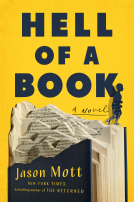
Hell of a Book, by Jason Mott*****

It really is.

This book is a standout in more ways than one. First the obvious: look at that cover! Then again, how many novels have a nameless protagonist all the way through the book? Get into it deeper, and the distinctions become more complex. The buzz around it is wholly justified. My thanks go to Net Galley and Random House for the review copy. This book is for sale now.

Our author is on an odyssey that takes the form of a book tour, and it lands him, in the end, back where he grew up. He doesn’t tour alone; apart from the various organizers he meets in various locations, he is accompanied by a small Black child he refers to as “The Kid.” Alternately, we also see the story of a young Black boy, a very Black boy, nicknamed “Soot,” who grows up in the American South.

As I read, I am always on the back foot, understanding most of what it being said, yet developing questions as I go. Our author says (often) that he has a condition, and that this is probably why he can see The Kid when others cannot. My notes ask whether his condition is dissociative, and is The Kid just part of himself? Or is The Kid Soot? Are Soot and The Kid both part of the author? Every time I come up with a plausible theory, something else happens to undercut it. Yet one other thing becomes clearer all the way through: to be born an African-American boy in the United States is to be perpetually on the back foot; perpetually having to guess how best to proceed; to perpetually guess at one’s welcome or lack of same, at the quality of one’s relationships with Caucasians, to perpetually guard one’s own safety. And to be very Black—“Nigga, I bet when you get out of the car your daddy’s oil light come on”—is to invite not only the suspicion and hostility of Caucasians, but to draw the enmity of lighter Black people, too.

The synopsis of this story that initially drew me billed it as humor, and in places, it is not only funny, but laugh-out-loud funny. But the further we get in, the darker it becomes.

There are a number of sardonic references to the publishing world; editors, agents, and other promoters have told the author that while it’s fine to write about Black characters, He must not write about being Black:

“The last thing people really want to hear about is being Black. Being Black’s a curse—no offense—and nobody wants to feel cursed when they read something they just finished paying $24.95 for…The future of this country is all about patriotic, unity-inducing language. Post-Racial. Trans-Jim Crow. Epi-Traumatic. Alt-Reparational. Omni-Restitutional. Jingoistic Body-Positive. Sociocultural-Transcendental. Indigenous-Ripostic. Treat of Fort Laramie-Perpendicular. Meta-Exculpatory. Pan-Political. Uber-Intermutual. MOK-Adjacent. Demi-Arcadian Bucolic. Write about love. Love and Disney endings…”

Later, an interviewer asks if the past doesn’t still matter, and the author says, “It does. Not just three-fifths of it, but all of it.”

So, my friend, you can see why this book should be called a love story. Race? Oh, no no no. Fear? Injustice? Police brutality? Of course not. After all, this is a hell of a book!

Highly recommended; one of the year’s finest.

Game On! by Janet Evanovich****-*****

Stephanie Plum has been my constant companion for decades, but she never seems to get any older. We should all be so lucky!

My thanks go to Net Galley and Atria Books for the invitation to read and review. This book is for sale now.

Stephanie is a bounty hunter, working for her cousin Vinnie’s bail bond service. She tracks down no-shows, takes them to have their hearings rescheduled, and collects a commission. Her mother wishes fervently that she would get a normal job such as a bank teller, or just go ahead and marry long-time boyfriend Officer Joe Morelli, and keep house and raise kiddies. But Stephanie is long on independence, and she’s short on marketable skills, and so this is what she does. And we readers are well aware that she wouldn’t be half this hilarious as a housewife, so we cheer her on.

In an interview, author Evanovich said she had lit on the idea of a bounty hunter protagonist because the writer doesn’t need a background in legal matters the way that she would if she used a cop, detective, or lawyer. The primary skill required of a bail bonds enforcer is lying, and she felt she had a good grasp of that one.

You gotta love it.

There have been a few wobbles in the series, and a moment (long ago) when I thought perhaps it was played out. But like her intrepid protagonist, the author rallied and came back stronger than ever.

Can you read this book if you haven’t read any of the others in the series? Yes. Yes, you surely can; but you are most likely going to want to go back for the rest once you do so.

There are a few things that strike me as I read this one. I suddenly find myself wondering why Stephanie doesn’t seem to have women friends. She’s lived in Trenton—in the Burg—her entire life, so shouldn’t she have a few lifelong pals? But by the end of the story, I realized that her work buds are her go-to girls. Lula gets into a scrape and leaves what little she has to Stephanie (but of course, Lula pulls through. I don’t feel like this is a spoiler; since when would a riotously funny writer like Evanovich off a main character?) Connie is a distant relative, but she’s also a friend.

I also find myself, like other reviewers, wondering about the sanitized language and decreasing vocabulary levels. We’ve been drifting in this direction for awhile. At the start of the series, profanity was used by the people and in the situations where you’d expect to find it. The overall language level was accessible to anybody that finished eighth grade. Over the last several episodes, however, it’s been drifting downward. Now, apart from one “damn”, I found nothing, although the euphemisms are stellar (“What the fork,” “What the Hellman’s Mayonnaise,” “Son of a bagel.”)  And the overall vocabulary level is now down to about fifth grade. If it goes any lower (see the author’s other series,) I may not be interested anymore, but as it stands, it’s fast, it’s snappy, and I’m in.

The usual elements—escorting Grandma Mazur to viewings at the mortuary; exploding cars; men surprising Stephanie when they let themselves into her locked apartment; dinner with Stephanie’s parents; a geeky witness, or victim, or possibly even an offender, that Stephanie takes under her wing; and the red-hot Joe Morelli are all present and accounted for. Stephanie’s mother has been drinking heavily every time Stephanie gets into a dangerous scrape, and Evanovich has been toying with some character development in her direction. I hope she follows through.

The tension of Stephanie trying to decide between Morelli and the mysterious Ranger is over, for now, at least, and it was getting old, so I applaud this development. She knows that Ranger will never marry her, and there’s a lot he’ll never tell her. She knows Morelli. They grew up together, and they understand one another. Marriage, maybe not yet; but Joe is the one. She’s tempted by others in this installment, but for once, she behaves herself. Good.

Whereas this series isn’t the magnificent literary accomplishment attained by some mystery Grand Masters, and it doesn’t try to be, I rate it as five stars in the humor genre. It made me laugh out loud on page two, and though I read quite a lot of books each year, those that have made me howl this year can be counted on one hand. It’s a more valuable characteristic than some might guess, especially during these tense times.

Highly recommended to those that need a good laugh.

The Joy and Light Bus Company, by Alexander McCall Smith*****

“Connections with others were what made life bearable…We all need reassurance, she thought. We all need people to tell us that everything is going to be all right, even when it is not, and that we should not worry, even when we clearly need to be concerned about something. We are only human, after all, and that is why reassurance is so important to us. That is undoubtedly well known.”

I am not generally fond of cozy mysteries, yet I love this series hard. I told a friend—who works as a therapist—that the #1 Ladies Detective books are the cheapest therapy on the planet, and she agreed.

My great thanks go to Edelweiss and Penguin Random House for the review copy. This charming tale will be for sale November 16, 2021.

As is usual, we have two equally important story lines woven into a single narrative. The detective story has to do with a client—a most unpleasant fellow, but a client, nonetheless—that has come to the agency looking for help with his father’s will. His father is still alive, but not entirely himself anymore, and is planning to leave his valuable home to his nurse. Mma Ramotswe and Mma Makutsi are enlisted to dig up information about this woman, and to see if anything can be done to reverse his father’s decision. The second storyline concerns Mma Ramotswe’s husband, Mr. J.L.B. Matekoni, who has decided to invest in a dubious-sounding scheme to turn secondhand buses into a bus service. Mma Ramotswe is horrified, because in order to invest the necessary sum, it will be necessary to take out a bank loan, using the building that houses the businesses—Matekoni’s auto repair, and Ramotswe’s detective agency—as collateral. There’s also a smaller thread involving human trafficking of small children locally, and as usual, it is dealt with tidily and in a most entertaining fashion.

The book begins with Mma Ramotswe wondering what makes men happy. This is a tricky way to start a book, given the current social climate especially. Many readers, women in particular, are sensitive to having a male author write about a female character’s fervent longing to make her husband happy. The internal monologue could use some tightening up here, and that’s unusual for this writer. However, this passage is near the beginning, and once it’s done, the rest of the book more than makes up for it.

What is the alchemy that makes this series so successful? Certainly at the start, there was the novelty. It’s unusual for an English-language series to be set in Botswana, or at least, it was when this one began. But it takes a lot more than that to sustain a series over so many years.

For me, the gentle humor goes a long way. I also appreciate the depth of respect for working people that shines out of every book in this series. Mma Potokwane, who runs the orphan farm and is Mma Ramotswe’s closest friend, reflects on the squabble over the old man’s will. “Rich people are always forgetting that they are only rich because of the work of others. They do not dig their money out of the ground, you know, Mma.”

Also? There are a lot of us out here that are also “traditionally sized,” and we love seeing lovable, successful characters that look, to some extent, like ourselves.

There’s the notion that people are inherently good—try finding that in your average noir detective story—and also, the idea that ordinary people can and should intervene to the best of their ability when they see wrongdoing. “Sometimes those people simply did not see what others could see; sometimes their hands were tied; sometimes they felt threatened. And all of that meant that there were times when it was left to people like them, a private detective and the matron of an orphan farm, to do what had to be done.”

This story, however, is singular in that both Mma Ramotswe and Mma Makutsi manage their husbands through deception. Grace Makutsi reveals that she gets her husband, Phuti, to take his vitamins by stirring them into his breakfast tea without telling him. Precious Ramotswe, when unable to persuade Matekoni not to apply for the bank loan, sneaks around behind his back, looking for a way to kill the deal without his knowing it. Neither of these things leads to marital disaster, yet I find myself wondering whether these things may come back on them in a future installment.

The fact that I find myself feeling concerned about the marriages of two women that are fictional, fictional, fictional says a great deal about Smith’s capacity to develop characters with depth and breadth.

I can talk about this series, and these characters, and this book all day. I’ve already come close to it. But the best way for you to appreciate it is to get this book. It comes out in a week, so I suggest you order a copy now. Highly recommended.