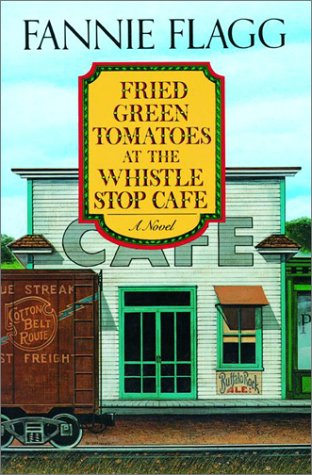
Fried Green Tomatoes at the Whistle Stop Cafe, by Fannie Flagg *****

friedgreentomatoesIf I had to whittle several decades of reading down to thirty favorite books, this one would make the cut. It is wonderful on so many levels. Flagg has published a number of glorious, whimsical yet not shallow novels, always set in the deep South. This one is the jewel in her literary crown.

Have you seen the movie? If you have, this book may be easier for you to read. I read it, and absolutely (as you can see) loved it. The issue for other readers I’ve talked to is that the book hops back and forth in terms of setting, including time period, and it doesn’t provide an obvious heads-up that this is what is happening.

There are two stories being told, one that of a contemporary woman who is unhappy with her life, menopausal and fearful that she is losing her husband’s attention, bored and feeling worthless. She is spending part of her weekend at a nursing home where her husband’s wife resides, but the woman hates her and won’t let her in the room. It is in the lobby where she is faithfully stationed, downing the candy stash from her purse for comfort, that she meets one of the home’s residents, who tells her pieces of her life story, a little more each visit. But in the book, we are taken back in time in other ways. Suddenly we are reading a small town newspaper, and if you are a person who skips chapter headings, you’re likely to find yourself entirely confused.

I won’t give away more of the plot, but for the time in which it was written, this novel bravely took up one progressive (IMHO) cause about which not much was being written. It’s very subtle. Other parts of the story will leave you laughing so hard that you either can’t catch your breath, or if you are old enough, you may not hang onto…something else.

Highly recommended.

A Small Place, by Jamaica Kinkaid *****

Before I retired, I tried to take one nice vacation each year, and I often structured these around two things: my kids and their needs, and the fact that I was vacationing in the summer (teacher) and HATE hot, humid climates. I also really didn’t want to go to a place where the poor rely on tourist dollars to eat dinner. In short, I didn’t want to become the Ugly American Tourist.

I shared this information with a colleague who is African-American, and we were talking tourist meccas where the locals are mostly dark, the visitors mostly pale. He let out a roar of laughter and said, “Have I got a book for you.” He referred me to this slender volume. In it, Kincaid unleashes a scathing attack upon the well-fed, entitled-feeling tourist and gives the reader a glimpse of just how the residents feel about those who stream through, self-obsessed and often immensely insensitive.

I was glad my spouse and I had decided to take the children to Yellowstone.

Kincaid is one fine writer, and her vitriol is well placed. If you are not familiar with Antigua and the surrounding area, and if your feelings are not too easily hurt, give it a shot. It’s a real eye opener!

The Yiddish Policeman’s Union, by Michael Chabon *****

They say all stories have been told in one way or another, but to reduce Chabon’s The Yiddish Policemen’s Union to a “whodunit” is a travesty.

When I saw that a fellow reviewer had laughed at the notion of Chabon smiling and patting himself on the back as he wrote, I thought she was being ungracious. This was until after I had completed the book, which another reviewer accurately described as “hyper literate”. Now I can see him doing just that.

Oh yes, this is good writing at its finest, with a plot that pulls together with breathtaking attention to detail (LOTS of detail), incredibly lush descriptions, and droll humor, all of which no doubt account for the myriad honors and awards heaped upon the writer. He earned them all, but in reading, one feels the envy that a wallflower feels in the presence of the homecoming queen, or the 98 pound weakling feels when a muscular Adonis struts his stuff at the beach.

If you want a nutshell version of a review, it’s “Who killed the Yid?” But if you want a nutshell of anything, this book will be too much for you. It is not a tome to be skimmed or looked over while you hold a conversation or watch television. It demands full and complete attention. At first, I didn’t understand this, and had to restart twice when I took the book into my hands right before falling asleep and didn’t remember any of what I had read the next morning. It is better to begin it with full, wide awake attention!

Others have done a fine job of covering the setting, both place and time. There are a lot of characters to shuffle; Chabon does so deftly, but it is the job of the reader to keep up with him. Landsman is the detective and protagonist, but there are so many more, and some people are not what they seem to be. The story is rife with surprises, and I won’t spoil it for you by giving them away.

One thing worth noting as you go into it, especially if, like me, you are reading on an e-reader: the end, though this is not a short book, may feel abrupt because there is a glossary of Yiddish terms at the end, along with a teaser for the next book. Therefore, although all signs pointed to the story’s being nearly wrapped up, I thought Chabon was about to toss one more spanner into the works to fill up about 75 more e-pages. I was startled when the book ended , saying, “Wait. That’s it?” This is unlikely to be a problem if you have the physical book in hand, though.

Over and over again I found myself highlighting passages that were, I thought, the most magnificent figurative language I had ever seen. Eventually I was foolishly highlighting whole pages, and you don’t want them all here. Just know that Chabon has created a strange and miraculous world that features an underworld rebbe (rabbi) and a host of goons as the obstacle, but ultimately the Moriarty to the Yiddish Holmes is a surprise, to say the least.

I conclude with just one bit of philosophical musing dropped in toward the end, which I find irresistible. It does not provide a spoiler, though, because the answer to the puzzle is not revealed here. It’s just a little sample of the marvelous word-smithery wrought by our champion of writers, as Landsman reflects that in the future, “any kind of wonder seems likely. That the Jews will pick up and set sail for the promised land to feast on giant grapes and toss their beards in the desert wind. That the Temple will be rebuilt, speedily and in our day, War will cease, ease and plenty and righteousness will be universal…and every suit will come with two pair of pants.”

Between, Georgia by Joshilyn Jackson *****

Jackson’s folksy, humorous love story is more complex than it appears at first glimpse; its entertainment value is instantly obvious. She has taken the town of Between, Georgia, which exists midway twixt Athens and Atlanta, and used it to create a fictional haven for a plethora of characters drawn so deftly that they all but materialize in front of the reader.

Nonny, our protagonist, is between many things. In fact, the deeper one looks at this supposedly light romance, the more “betweens” there are in the story, in setting, in plot, and above all, in character. The teacher in me wants to assign an essay question about it. You are excused from the essay, but you ought to read the book, even if, like me, you generally pass on romances. And for goodness sake, pay attention!

In some ways, this is a story that could have been set in just about any Between in just about any English-speaking setting as long as it was in a small town (and anyone who sniffs at the story as failing to accurately represent Georgia and Georgians completely misses the fact that this is not really a story about Georgia at all). How many of us have dealt with the question of nature versus nurture? How many of us have alcoholics, anxious individuals who are prone to harming themselves, yet keeping “four baby steps” out of the psych ward, neat freaks, slobs, and feuding relatives in our lives? Are you nodding yet? And how many of us have a small person in the family we suspect is being raised by the wrong relative? Then there are those of us who are between relationships, and the world that exists between the hearing and the deaf, the blind and those whose visual acuity is dandy. I am only scratching the surface here. There is so much of life jammed into this one work of fiction that it leaves me breathless.

It is the commonness and humanity in this tale that ultimately makes it so empathetic and readable, but the writing is brilliant. The prose are so fresh and original that they make me question several of the five star ratings I have given to other writers.

Jackson has written a real gem. Sometimes I conclude my reviews by saying that a book is worth reading if you can get it free or cheap. Not this story, not this time. Open a window and order it, or get in the car and go get it. You have to read this book. Whether for depth of literary analysis or pure fuzzy joy, you’ll be richer for doing so!

The All-Girl Filling Station’s Last Reunion, by Fannie Flagg *****

Big, big fun! I recently read this wonderful new work by the famous and always hilarious Fannie Flagg. One of Flagg’s hallmarks is that she spins over-the-top characters so real you can almost see them, but then she sneaks in subtle metaphors and other devices so clever that for me, it takes awhile to sink in.

As she did in Fried Green Tomatoes (a personal favorite), she morphs back and forth between the present and the bygone era of World War II, homing in on the WASPs–women who served as pilots for the armed services, ferrying planes from one part of the country to another so that all military male pilots could do other things.

The story starts in the present with the key protagonist, Sookie, who is informed one day by mail that she is adopted. Given that she is already having a few anxiety issues, this is the last thing she needs. As women go, she feels like a failure; she is a little finch, and does not stand a chance of fulfilling the thunderous expectations of her adoptive mother, who was a Blue Jay from the get-go. When the bomb drops on Sookie, she realizes that she has been reading the wrong horoscope all this time! Her mother has made such a fuss about family bloodlines and heredity, and it turns out that her long-gone ancestors are “total strangers”! She is about ready to come unstuck.

I won’t spoil the rest of it for you. In a completely entertaining manner, Flagg drives home the inequity dealt women pilots during this time period, who received no veteran status, medical benefits, or pension for their service to the country. The 39 who died on the job had no death benefits, either. I salute Flagg (oh, sorry, bad pun!) for putting her literary muscle behind a feminist cause at a time when many sneer at feminism as a thing of the past.

One minor detail that I mention for those who are Japanese-American, Japanese, or close to someone who is: because Pearl Harbor is mentioned here, vintage (but nevertheless painful) use of the “J” slur is used here. It is contextual, and it passes by quickly, but just as many folks blanch at reading Twain’s fiction for the “n” word, so do those who are stung by the “J” word (myself among them) need to know it’s coming. It just helps to be prepared. It isn’t done in a mean-spirited way, and I am glad I read it. But sometimes it helps if you can brace yourself.

The plot is well-paced and is less complex than Fried Green Tomatoes, which hosted a variety of settings that required the reader to carefully scan the heading on the first page of a given chapter in order to be properly oriented. This is more of a quick back-and-forth. It was my fun, light reading at bed time. My only real regret is that it’s over.

Get a copy right away if you love Fannie Flagg as I do!

Life Among the Lutherans, by Garrison Keillor, Holly Harden (ed.) *****

Garrison Keillor is one of the funniest men alive. Most people who follow his work do so from his Prairie Home Companion, a show carried on NPR and at least for a time, also on the Disney cable channel in the USA.

But obviously, he writes, and he does it a lot; there is quite a bit of overlap between his radio bits and what he publishes. Usually his best work doesn’t stray too far from that track.

This little gem is a case in point. Each little chapter (3-5 pp. each generally) is almost certainly one of his monologues, and they are worth purchasing. Some of us are better at appreciating his work in print, anyway. This compact volume moves, as is typical of the writer, between gut-splittingly funny, to wry, to poignant. He is able to blend these in a bittersweet way nobody else I can think of does.

The first three selections are among the most hysterical. A convention of Lutheran ministers comes to Lake Wobegon; I won’t give you more than that, it would ruin it. I love his Norwegian bachelors, the herdsmen, and at one point, I looked at my husband, who is a Japanese citizen, and realized that in his reticence and solitude, he just could be a closet Norwegian, and maybe also a closet Lutheran. After all, as Keillor points out, a lot of Lutherans don’t really believe in a god, but it’s awkward to come out and admit it.

If you are a very serious-minded Lutheran, this book may offend you. If you are completely new to Keillor, just be aware that he isn’t truly reverent about very much.

But for his fans, and of course I am one, that’s where his genius lies.

Will Not Attend: Lively Stories of Detachment and Isolation, by Adam Resnick *****

Humor is a risky genre. A romance or historical fiction can be a little dull, wander a bit, and perhaps get away with it, but when something isn’t funny, it really just isn’t. Happily, that is not a problem for Mr. Resnick, who has been writing humor for others, including David Letterman, for a good long while, but not as much as himself. Here he is. Thanks for the free book, Blue Rider Press, but thanks even more to Adam Resnick, because there is seldom anything any of us need more than a good laugh.

Despite the title, Resnick’s dark humor does not wander so far down the path of alienation as to lead to misogyny. If you have ever desperately wanted not to attend a party, speak to a neighbor, or pretend to be in a good mood when you really aren’t, this is your book.

Favorite chapters were “An Easter Story”, “Booker’s a Nice Guy”, “Scientology Down Under”, and “The Strand Bag”. However, nothing here strikes me as filler; the quality of the writing is consistent throughout.

For every teacher’s inservice I endured in which all of us were solemnly reminded that sarcasm is never appropriate when speaking to students (yeah, right), this book serves as vindication.

In fact…at the end of the school year, it is a cherished tradition to gift one’s teacher. If you have a child or grandchild between grades kindergarten and high school graduation, you’ll need a copy of this book for the last day of school. Give the hard cover edition to show you have class, and that you respect education. If your child inscribes it, the teacher may remember him or her up the road apiece. Just a consideration.

Do it now.

Liberty, by Garrison Keillor *****

LibertyKeillor is best known for his radio show, A Prairie Home Companion, on NPR. I have read many reviewers (not from the mainstream media, but amateurs like me, who review on amazon and goodreads) who insist that Keillor is only funny when he delivers the lines himself, and that once you put his work in print, the humor is lost.

Nonsense!

I like reading Keillor’s novels, though the collections of quirky philosophy and bits of his radio work set in print are worth a gander as well. This one is set in the home town he has made known to many of us. (If you haven’t read or heard anything by Keillor, you may still enjoy it, but I recommend reading his classic material first. Lake Wobegon Days is a nice launch-point). In some places it is dry and droll; at other times, I found myself doubled over and gasping for breath. And to be frank, I am not that easily amused.

In fact, I laughed out loud on the first page. People often say, and tritely so, “I couldn’t put it down”, and what they mean sometimes is that they read it often until it was done, and they really enjoyed it. But I genuinely never put this book down unless it was strictly necessary. It was an awesome weekend. I was recovering from surgery and had to be sedentary, and this cheered me up considerably. It is not poignant in the way the L.W.D. is; this is just plain FUNNY. It hit my funny bone from a sort of blind spot and then kept rolling.

Life is serious business, and most of us just don’t laugh often enough. Studies show that laughter actually helps us live longer. But if you get this book and laugh your way to a massive MI, and the last thing you remember is something this hilarious, I still say it’s the best way to go out.

Get the book right away; the Fourth is just around the corner!

How Not to Calm a Child on a Plane, and Other Lessons in Parenting from a Highly Questionable Source, by Johanna Stein ****

This is the most hilarious thing I have read in a long time! If you are a parent (really, of any vintage), and especially if you are a mother, you can’t really miss here. Favorite passages brought back oh, so many memories. The childbirth segments brought back exactly four memories, and the Pitocin drip made me wince with what the trendy folk are calling “muscle memory”. And thank you to Net Galley for the free read!

Who in the world, besides this woman, would think to save her placenta to use in a practical joke?

Other great favorites had to do with the Binky Fairy and of course, of course the airline puppet.

The only thing that kept this from earning my fifth star–which indicates, as far as I am concerned, that it is among the best of its genre–were the footnotes. On an e-reader, footnotes pop up in the middle of the text or wherever, and slightly lighter colored print didn’t work for me. It’s jarring. Use the best material in those footnotes in the text, and just cut the rest of them. The book can stand on its own without them.

For the reader, my advice is to get this one on actual paper. It will be funnier if you don’t have to decode it. And there is no doubt whatsoever: Stein is searingly funny!