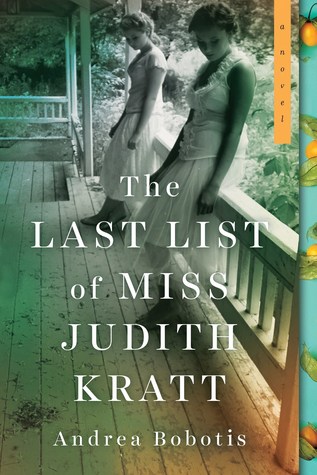
The Last List of Miss Judith Kratt, by Andrea Bobotis*****

“We will choose what we take with us.”

This thunderous debut by Andrea Bobotis bears a small resemblance to the work of Elizabeth Strout and the late Harper Lee. Issues of race and menacing family secrets simmer beneath the surface of this narrative like some otherworldly being biding its time in the swamp, till at last it rises and we must look at it.

As the story commences, Judith, who is quite elderly, is ready to take inventory. Her family home, all six thousand square feet of it, is jammed full of heirlooms, and each is fraught with history. The year is 1989, but as Judith examines one heirloom and then another, she takes us back to the period just before the stock market crashes, back when she was young and her parents and brother were still alive.

I have to confess that the first time I picked up this story—free to me, thanks to Net Galley and Sourcebooks Landmark—I thought, Huh. A boring old lady and her stuff. Pub date’s a ways off, so let’s put this one on the bottom of the pile. Of course, I picked it up again later. I read a bit farther this time and found I was acutely uncomfortable; I told myself I had to read it because I had requested the galley, but then I didn’t for awhile.

But like Judith, I pride myself on being reliable, so toward the end of June I squared my shoulders and opened the book. An hour later my jaw was on the floor and my husband was avoiding me, because he knew if he got too close I would start reading out loud. If you were to show up right now I’d do the same to you. I genuinely believe this novel and the characters and social issues they’re steeped in is one for our time.

Judith is the eldest of the Kratt children; her companion, Olva, lives with her, but her status is undetermined and remains that way far into the book. Part of the time she appears to be a live-in servant, hopping up whenever Judith wants a cup of tea or a blanket; at other times the two of them sit on the porch together and watch the world go by as if they were sisters or good friends. We know that they grew up together and share a history as well as the trauma of growing up with the vicious, unpredictable Daddy Kratt, the wealthiest man in Bound at the time.

As layer after layer is peeled back, using the household treasures that are inventoried as a framework of sorts, we see the gratuitous cruelty that was part of both women’s daily existence as children. Kratt can be generous at times, and yet at others—with increasing frequency—he is vicious and sadistic. We see the responses his unpredictable fury brings out of Judith as a child, her younger brother Quincy, who’s a chip off the old block, and their younger sister, Rosemarie. Kratt can ruin someone’s entire life purely on whim and never feel the slightest regret. He likes to watch. The entire town fears him.

Now he’s gone, and here we are. Judith acknowledges that her social skills are stunted, and she never knows what to say or do to smooth a difficult situation. She was never a pretty girl, and she has never married.  We can also see that she is solipsistic, insensitive to the feelings of others, and at times just straight-up mean, but she doesn’t see herself that way, because she measures herself against her late parents.  Judith is nowhere near as nasty as her daddy was; she has never permitted herself to be broken by him, as her mother was.  So Judith tends to let herself off the hook lightly. As she remembers back over the years the cataclysmic events that have taken place around her—or in some cases, because of her—her overall tone is self-congratulatory.

But her little sister, who is also an old lady now, returns to the family manse, and that overturns the apple cart in a big way.  How dare Rosemarie run out and leave Judith to contend with that awful man but now come back to claim her birthright?  Isn’t that right, Olva?

Olva just smiles.

In fact, this story is every bit as much about Olva as it is about Judith. . Every single one of these women is sitting on secrets; every one of them has a different story to tell. Every new revelation brings additional questions to mind, so that although this is not a mystery or a thriller, I cannot stand to put it down. I generally like to flop on my bed at night and read before I go to sleep, but I can’t do that with this book. I’d climb under the covers; open the book; read a little ways and then sit bolt upright. Eventually I realized that this cannot be the bedtime story. (It occurs to me just now that retelling one or another portion of this story in the voice of one of the characters not heard from would make a great creative writing assignment related to point of view.)

What Bobotis has done here is masterful. She begins with an old, wealthy white woman and yet develops her, and I cannot think of even a dozen books where that has been accomplished in a believable way in literature; once we get old, that’s pretty much who we are going to be. But the elderly Judith at the story’s end is a better person than the elderly Judith at the outset. And as if that weren’t enough, she also develops Olva, the dark-skinned elderly companion that seems to us, at the beginning, to be a live-in servant or nurse of some sort. But however circumspect Olva has been—a prerequisite for an African-American that wants to stay alive in the American South in the past and at times, maybe the present—Olva does in fact have some things to say. It is Rosemarie’s return that makes this possible.

This isn’t necessarily a fun novel to read, and yet the skill with which it is rendered is a beautiful thing in and of itself. I believed every one of these characters, those within this pathologically corrupt family and those around it. I suspect that the formidably talented Bobotis could pluck any one of these characters and create a sequel just as remarkable. This writer is going to be around for a long, long time, and as for me? I’m ready to read whatever she comes up with next.

Highly recommended.

Alpha and Omega, by Harry Turtledove****

I greatly enjoyed We Install and Other Stories when it came out a few years ago, and so when Turtledove’s name came up again, I pounced on the chance to read and review Alpha and Omega. Thanks go to Net Galley and Random House Ballantine. This book will be available to the public Tuesday, July 2, 2019.

The Dome of the Rock, an ancient Islamic shrine, is about to be relocated so that the Jewish Third Temple may rise in its place. As the story commences, a rare, completely red heifer has been identified and will be used as a sacrifice for the occasion. Chaim, a youngster who has raised Rosie and regards her as a pet, is not entirely on board, but he is just one kid, and he has no authority at all.

Until he does.

Turtledove is a master writer of alternative history, which I confess isn’t my usual wheelhouse, but I do love me some old school science fiction now and then, and this book is that, too. A three-way conflict develops between the Orthodox Jews of Israel; the Muslim Grand Mufti—and the Islamic nations with which he is aligned—and the evangelical Christians of the American South, led by the Reverend Stark. Archaeologist Eric Katz, a secular Jew with no religious axe to grind, provides the reader with an objective, every-man perspective, accompanied by his girlfriend, Orly.

If I could change one thing about this story, I’d like to see a female character developed well outside of the traditional pigeonholes; journalist Gabriella almost gets there but doesn’t. However, this is an issue that’s endemic to the genre.

All told, the miracles that unfold within this witty tale are delightfully provocative; this is a story that will rocket to the top of the banned book list, and you’ll want to know why. I recommend it to fans of the genre.

Make Me a City, by Jonathan Carr***

I am always on the lookout for something different, and so I leapt at the chance to read this publication free and early. Thanks go to Net Galley and Henry Holt. It’s for sale now.

The story is set in and around Chicago, back when the city was first born. It tells a tale of shifting alliances and double crosses; yet in other ways it is an old story, one in which a Caucasian interloper cannot bear to see a Black man rise to a position of wealth and influence. It’s not an easy read.

Conceptually the story is strong, but the author tries to do too much at once. Shifting points of view; development of disparate characters; and an old time dialect that is challenging all by itself serve to render the story muddy and confusing. Too much is lost, and at the halfway point, I gave it up and commenced skimming.

Despite this, I believe Carr is a talented writer and I like his ideas. I would read his work again.

Never Have I Ever, by Joshilyn Jackson*****

Amy Whey has everything she has ever wanted: a successful marriage, a lovely home in Florida, an adorable baby and a stepdaughter she genuinely loves. Her roots in the neighborhood are deep and secure, and her dearest friend is right there as well. Then all of it—every last bit—is threatened by a newcomer with an agenda all her own.

Jackson has had a string of bestselling novels, most notably Gods in Alabama and Between, Georgia.  She is among my favorite writers, and this is her best book to date. My thanks go to Edelweiss and William Morrow for the review copy; however, this is one novel I would have paid full jacket price for if it had come down to it. This is the finest mystery you’ll see in 2019, and it will be available to the public July 30, 2019.

It’s time for the monthly book club to meet, and although Char is the host, the group has temporarily relocated to Amy’s for logistical reasons. The members have gathered, but then there’s a rap on the door. Who in the world…?  It’s the newcomer, a renter that has taken residence in “the Sprite house,” named for its unfortunate paint color. She hasn’t been invited, but she’s come, just the same:

She was the pretty that’s on television: symmetrical features, matte skin, and the kind of long, slim, yoga body that still made me feel self-conscious about my own. I hadn’t been seriously overweight since I was a teenager, but looking at her I was instantly aware of the little roll of baby weight still clinging to my middle…She didn’t look like my own destruction to me. She looked…the world was ‘cool.’…An odd thing to think. I was forty-two years old…I looked at the loaded gun on my doorstep, and, stupid me, I hoped she had the right house.”

This new neighbor is Roux, and she is a darker, more adult version of The Cat in the Hat. Instantly divisions are sowed, and old established friendships are tested as she manipulates these women into competing for her approval.  She’s done her homework, and she knows everyone’s darkest secrets, especially Amy’s. But Roux hasn’t bargained for the kind of adversary she has chosen. Amy proves to be a bad enemy.

This is a compelling thriller, the sort that takes over my life until it’s done. I finished reading it months ago and have read dozens of other books since, but something in me still stirs when I glimpse the book’s cover. In fact, I wasn’t able to write this review until I had allowed myself to read it a second time.

Part of Jackson’s magic is in addressing real parts of women’s lives that seldom make it into our literature. It is gratifying to see her address emotional overeating as a component of Amy’s story; yet I would love to see her write another novel in which the protagonist is a good person with heart and dignity, and yet is still obese (rather than formerly.) If anyone can do that well, it’s this author.

Run along now; you’ve got a book to order. If you’re stone cold broke, get on the library’s waiting list. Nothing else can take the place of this story.

Honestly, We Meant Well, by Grant Ginder****

“All art is appropriation.”

Sue Ellen Wright is a professor of Greek classics; she’s headed for Greece to deliver lectures and reminisce about the experiences of her youth. At the last minute, her philandering husband Dean and the couple’s lovesick son Will decide to tag along. Grant Ginder has made a career of writing hilarious prose about disastrous families, and Honestly, We Meant Well made me laugh out loud more than once.  Thanks go to Net Galley and Flatiron Books for the review copy. This book is for sale now.

The book opens as Sue Ellen is conferring with a freshman who’s come to her office to challenge his midterm exam score:

“’I’m pretty sure I got this one right.’

“Connor points to a picture on his midterm…it’s an artifact that he was meant to identify.

“’That’s not a bong, Connor. That’s a Corinthian urn from the fifth century B.C.E…’

“But can’t you see how it could have been a bong?’

“’No,’ Sue Ellen says, ‘Actually, I can’t.’”

Teachers, are you experiencing flashbacks here? And those of you that aren’t teachers can appreciate that Sue Ellen needs a break, one that takes her as far away as possible. Her bags are packed.

Dean is a professor as well, and he’s a celebrated one. As the writer of a bestselling novel, The Light of Our Shadows, he is permitted to cherry-pick which students may enroll in his seminars. He knows he ought not to have sex with any of them, but they’re so insistent; and why shouldn’t they be? He’s a genius. At the moment, though, he’s a genius with writer’s block, and he thinks a Grecian holiday might just be what he needs; it will strengthen his marriage and get his creative juices flowing as well.

Will is a student, but who can chart a course, academic or otherwise, when his heart has been shattered? His boyfriend broke up with him and has instantly turned up on Instagram with kissy-face photos of himself with his new squeeze. It’s humiliating. It’s horrifying. Worse: everyone is liking those photos. Meanwhile, he has committed an unforgivable academic sin, one he’s desperate to keep his parents from learning.

Ginny Polonsky works at the university, and she knows where the bodies are buried. Readers know what Ginny knows—well, most of it anyway—and as the family unknits itself and copes with one unforeseen event after another, we are waiting for Ginny’s other shoe to drop on them. It’s immensely satisfying when it does.

There’s not a lot of character development here, but not much is needed. I believe each of these characters, which are written with admirable consistency. The prose is tight and the resolution surprises me. I would read this author again in a heartbeat.

The Wrights are Caucasian and middle class, and this is the demographic most likely to enjoy this book. It’s just the thing to toss into your suitcase or carry on when you’re headed on a trip of your own.

Call Your Daughter Home, by Deb Spera*****

Deb Spera is a force; small wonder that Call Your Daughter Home is the book that bloggers have been talking about. This barn burner of a debut goes on sale today.  My thanks go to Net Galley and Harlequin for the review copy.  It curled its fingers around me on page one, and by page ten I knew it wouldn’t let me go till it was done with me. It ended as powerfully as it began.

The year is 1924. Gertrude Pardee lives with her four little girls in a shack in the swamp in Third World conditions; they are nearly feral. A storm is coming, but Gert has a job to do. Her brutal ass hat of a husband lies dead in the swamp, dispatched by the bullet she blasted into his brainpan. As the storm bears down, she peels off her only dress and strides naked into the muck to deal with his corpse:

“Alligators feed once a week, and sometimes, if the prey is big enough, they don’t need to eat for almost a year. But I don’t know how long it takes a gator to eat big prey. Daddy never said nothing ‘bout that and I never asked.”

Our other two main characters are Retta, the first free woman in her family, and Annie, Retta’s employer. Retta cares for Mary, Gert’s youngest, when Gert is too sick and injured from the broken face she sustained the last time Alvin beat her; Retta’s husband Odell and her neighbors all tell her that it’s trouble to bring a white child into Shake Rag. “Don’t get messed up with that white family. No good can come of it,” and she knows it’s true. What if the girl dies? But Gert coaxed her into it, telling her it would be the Christian thing to do, and Retta is moved by this sick, helpless five year old. She assures everyone it’s just for three days.

Miss Annie is a Caucasian small businesswoman and wife of a farmer, yet she has trouble of her own; there’s some dark family baggage she’s been avoiding for a good, long while. As the storm bears down, evidence comes to light and she is forced to see it. Not one of us would want to be Miss Annie; believe it.

Spera weaves a captivating tale, and we see the world from the disparate points of view of all three women, each of them told alternately in a first person narrative, and we’re also told how they see each other. The setting is dead accurate, brooding and thick with dread, and it scaffolds the development of each character more capably than anything I have read recently.

It is Retta that tells us that as we give birth, we must call out to our child so that “whichever soul is at the gate will come through.” She called out to her girl as she birthed her, but now she is gone. In fact, each of these three women has lost a daughter, and this provides the central theme of the story.

Feminists and those that love Southern fiction have to get this book and read it. There’s nothing like it. Do it.

The Thing in the Stone and Other Stories, by Clifford D. Simak***-****

Clifford D. Simak was given the third Grand Master Award by the Science Fiction and Fantasy Writers of America; he wrote short stories proliferately for several decades in the last century.  His work was generally published in magazines, but with the digital age comes the release of his collected work in twelve volumes.  My thanks go to Net Galley and Open Road, from whom I received a review copy…two years ago. Ouch. As you might expect, this title is for sale now.

Here’s the thing about this collection as a whole: not all of it is science fiction. Simak wrote a lot during the 1940s and 1950s, and back then it was Western stories that sold big. For fans of science fiction, then, these stories are definitely a mixed blessing. The Thing in the Stone and Other Stories is the twelfth and final collection in the series.

The tltle story is excellent, and it shows why the editor has not chosen to separate Simak’s sci fi and Western stories into separate volumes: some of his stories—some of his best ones in fact—blend the two genres. In this one, Daniels sits on his farmhouse porch and chats with the sheriff; there are concerns about chicken thieves in the area. But even at the outset, small references here and there tell us that this is no ordinary Western story. For one thing, up North is an area casually referred to as “the Canadian Shield.” And as the sheriff departs and the rest of the story unfolds, Daniel learns that he is not alone, and his visitor is an unusual one indeed. This story contains a beautifully written inner monologue, and I find myself rereading passages out of admiration for the word smithery involved.

The next two stories are fun ones. “The World of the Red Sun” is suspenseful, and “Skirmish”, which is a man-versus-machine tale with a degree of prescience is laugh-out-loud funny in places. These stories, alas, are followed by an interminable Western—not blended, just cowboys and more cowboys—that I finally gave myself permission to skip. The rest of the stories offered after it are good, but the first three are the ones I like best.

Should you buy this collection? I suggest that if you are new to Simak’s writing, you purchase the first collection in the set, I Am Crying All Inside and Other Stories. It doesn’t matter whether you read the collections sequentially, but this is a solid short story collection and his best selling one also. I have read and reviewed eight of the twelve volumes in the set, and although The Thing in the Stone and Other Stories is well written and entertaining, there are five volumes, all reviewed here, that I rate as five stars. Of course if you have the opportunity to buy the entire set and have a serious love of old school sci fi, you won’t be disappointed.

Waisted, by Randy Susan Meyers*****

Randy Susan Meyers wrote The Murderer’s Daughters and The Widow of Wall Street. Her new novel, Waisted is a fiercely feminist story that skewers the weight loss industry and a society that “treats fat people like out-of-control horrors” and the war against women with its “intersectionality of misogyny, fat shaming, [and] faux health concerns.”  Thanks go to Atria and Net Galley for the review copy. You should read this book.

Alice married Clancy when she was “break-up skinny,” not knowing that he isn’t attracted to any woman that isn’t thin. Daphne is tormented by her 108 pound mother, whose toxic monitoring and obsession with Daphne’s eating have nearly driven her daughter over the edge.  Alice and Daphne meet at Privation,  a live-in weight loss program in rural Vermont. They and five other women sign on because they are promised rapid weight loss free of charge, with the caveat that they must agree to be filmed 24 hours a day for a documentary. The program is not only extreme; it is cruel and dangerous.

“Welcome to hell, ladies, where we recognize that life is unfair, and you pay the price for every action you take…You’ve eaten your way through pain, through loss, through happiness, and just for the plain pleasure of crunching calories between your teeth. Not one of you knows how to live with privation. So you landed here. The last stop.”

The women don’t know that there are no doctors here, or that they are part of a nasty experiment to see what women will tolerate in order to become thinner, even when it is obvious that such a program cannot be sustained. Each time one or another of them considers decamping, there’s a weigh-in that shows them to be even lighter than they were earlier in the week, and with dreams of a new, sleek, lovable body ever nearer realization, they persevere.

The readers that will relate to this story best are also the ones that will have a hard time getting through the first half of it. Meyers drives home so many uncomfortable truths that overweight women like me have trained ourselves not to think about most of the time because they are painful. Do it anyway. It’s high time someone wrote this book.

Apart from its very real underpinnings, the story is far-fetched and features an unlikely outcome, but that doesn’t matter. A more nuanced or realistic version would fail to deliver the message in as brilliant a fashion.

This is urgent, angry, and at times darkly funny prose. It will be available Tuesday, May 21, 2019. Highly recommended.

Clover Blue, by Eldonna Edwards*****

Edwards is the author of This I Know, and here, once again, she creates a powerful story based on a youthful yearning for identity. My thanks go to the author and her publicist for the printed galley, and to Kensington and Net Galley for the digital copy.  It will be available May 28, 2019.

Our setting is a small commune in California in the early 1970s. Our protagonist, Clover Blue, sleeps in a tree house with some of the other commune members. There’s no running water or electricity, but we don’t miss what we don’t have, and California has a mild climate. Though decisions are made collectively, with younger and older residents each having a vote, Goji is the spiritual leader of the group. In place of formal education, young commune members study with him. Blue can read as well as other children his age, and he knows more about nature than most would because it’s part of his everyday experience. He doesn’t remember living anywhere else; his life is happy, and his bonds with his communal family are strong ones.

But everyone wants to know their origins, and Blue is no different. As puberty approaches, he begins to ask questions. He gains the sense that older members know things they won’t tell him, and it heightens his desire to find out. Goji promises him that he will be told when he turns twelve, but his twelfth birthday comes and goes, and still Goji evades his queries.

And so the story darkens just a bit as Blue undertakes research on his own. He has a hunch as to who his biological parents might be, and despite the communal culture that regards every older person as the mother or father of every younger person, he wants the particulars and is determined to get them. The things he learns are unsettling and produce further questions.

A large part of the problem the communal elders face is that the State of California does not recognize the commune, and the living conditions and educational process used there are not legally viable. Because of these things, Goji discourages interaction with the outside world, and sometimes essential services—such as medical care—are given short shrift because of the risks they pose. Instead, naturopathic remedies are used, often to good result.

Edwards builds resonant characters, and I believe Blue, the sometimes-mysterious Goji, and Harmony, the member of the commune that is closest to Blue. There is enough ambiguity within each of them to prevent them from becoming caricatures; everyone holds various qualities within them, none being wholly benign or malevolent. The way that we judge these characters isn’t built upon their ability to do everything well, but in how they deal with their mistakes when they make them. In addition, some writers of historical fiction—which technically this isn’t, but it has that vibe—fall into the trap of establishing time and place through the cheap shortcut of pop cultural references and well known historical events. Edwards doesn’t do that, but she does use the speech of the time period so effectively that at times, I feel transported back to my own adolescence. There are aspects of the period I’d forgotten entirely that surprise and delight me; if there are errors, I don’t see them.

Ultimately, the story takes a turn that harks back (somewhat) to George Orwell’s classic, Animal Farm, in that while everyone at the commune is said to be equal, some are “more equal than others.” Cracks in the foundation of their once-idyllic lives form, and we see who has strength of character, and who is lacking.

If I could change anything, I would make the ending less rushed, and I’d also urge the author to be less afraid of letting the ugly parts play themselves out as they most likely would in real life. In this novel and her last, it seems like the tragic aspects that occur near or at the climax are a hot stove, and we have to move away from them quickly. I’d like to see Edwards let the stove burn a little more.

 I do recommend this book to you. In fact, it may be a five star read, but it’s almost impossible to evaluate it without comparing it to what the author wrote earlier, and this made the five star standard difficult to achieve here. Those that love historical fiction should get it and read it.

The Paris Diversion, by Chris Pavone*****

Chris Pavone is the real deal. The Paris Diversion sees the return of CIA employee Kate Moore, the protagonist from his first novel, The Expats. This taut, intense thriller is his best to date, and that’s saying a good deal. Lucky me, I read it free thanks to Net Galley and Crown, but you can get it tomorrow, May 7, 2019.

Kate wears many hats, moving deftly from professional spy to primary caretaker of two children, one of whom is medically fragile. Her husband Dexter calls himself an investor, but he’s basically just a weasel. His weak character comes into play in a big way in this story as he is tied to a shady financial deal that in turn is tied–though he doesn’t know it– to a terrifying terrorist event that takes place in the heart of France:

“She gasps. She is surprised at her reaction, like an amateur. She has never before seen anything like this. No one here has. What she sees:  a man is standing all alone in the middle of the vast open space, looking tiny. He’s wearing a bulky vest, and a briefcase sits at his feet, the sort of luggage that in action-adventure films follows around the president of the United States, a shiny case lugged around by a tall square-jawed man wearing a military uniform, a handsome extra with no speaking lines. The nuclear codes…Yes, Dexter was right: that’s a suitcase bomb.”

Events unfold seen from the viewpoints of several different characters. In addition to Kate, we have the bomb-wearer; his American driver; the sniper assigned to take the bomb-wearer out; billionaire Hunter Do-You-Know-Who-I-Am Forsyth; and a mysterious woman using the name Susanna. Points of view change frequently, and the brief chapters become even briefer as the story unfolds, creating even more suspense. Pavone (that’s three syllables—Puh-vo-KNEE) has keen insight into the lies weak people tell themselves to justify their poor choices, and at times he is wickedly funny. Favorites here are the internal monologue of our ass hat billionaire; the moment Kate takes down the security guard; and the exchange between Kate and Hunter’s assistant, Schuyler.

Because I spend several hours of every day reading, I can almost always put a book down, even an excellent one. For the best books, I reserve good-sized blocks of time when I won’t be interrupted, and these are the ones I read with joy, rather than out of duty to the publisher. But it’s been awhile since I stayed up late because I had to know how a book ended. The prose here is so tightly woven that every word is important; in most books of the genre, there’s a winding down period at the end of the book after the climax has been reached and the problem resolved. In contrast, Pavone moves at warp speed until almost the last word of the last chapter.

I have rarely seen a male writer that can craft a believable female character, and Pavone does that. I appreciate his respect for women. In addition, it appears that Kate may have met her own Moriarti, and so I suspect both she and her nemesis will be back. I hope so.

To say more is to waste words, an unfair tribute to a bad ass writer who wastes none. Get this book and read it. You won’t be sorry.