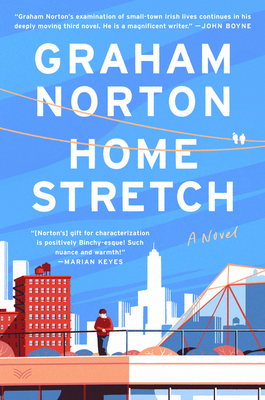
Home Stretch, by Graham Norton***-****

3.5 stars, rounded down.

Home Stretch is Graham Norton’s third novel, and because I absolutely loved his first, Holding, and his second, A Keeper, I expected great things from this one. It’s not a bad book, but it didn’t delight me the way the first two did.

My thanks go to Net Galley and HarperVia for the review copy. This book is for sale now.

We start with a tragic accident, and our protagonist, Connor, is unhurt, but three of his friends are killed, and Connor is blamed by everyone, including his family. It’s a small town, so trying to keep his head up and avoid people that dislike him is impossible.

His family feels the same, and so he is abruptly packed off to Liverpool, and from there to bigger and in many ways, better places. And in many ways this is a favorable development, as he is no longer forced to hide his sexuality; and yet, it’s a tough thing to live a life that’s separate from your family, one that you know would horrify them.

The story is set in the 1980s, the era of the AIDS epidemic. This reviewer lost friends to it during that time; a lot of people did. Norton does a serviceable job with setting, and with character too; and yet, this book lacks the spark of his earlier two novels. The pacing is not as brisk, and the surprising bursts of humor that made me laugh out loud never materialized here. At times it felt like work to read it, and I wonder if he found as much joy in writing it.

I still believe in Norton as a novelist; everybody has a “meh” moment now and then. I look forward to seeing what he writes next.

Unfinished Business, by J.A. Jance*****

Judith Jance has done it again. Unfinished Business is the sixteenth in the Ali Reynolds series; not only does she weave a compelling, tightly plotted tale, but she may have broken new ground with the role technology plays in solving crimes within the storyline. Add a sprinkling of social justice issues, and what emerges is an unmissable novel. My thanks go to Net Galley and Gallery Books for the review copy. This book is for sale now.

Ali is a former journalist, but now she and her husband, B. Simpson, own and run a cyber security firm called High Noon. B. is a nice enough fellow, but we see very little of him. Most of the time he is away on business, leaving Ali to flex her badass crime solving muscles, and providing her with a healthy chunk of disposable income that makes it easier. Other continuing characters are Cammie and Stuart; Frigg, the AI entity operating out of High Noon; and Bob and Edie Larson, Ali’s parents. Our two new characters are Harvey “Broomy” McCluskey, who is a serial murderer, and Mateo Vega, a second-chancer newly out of prison and in High Noon’s employ.

The best long-running mystery series are ones that go deep into the character of the chief protagonist and sometimes others, as well. When you think about it, there are only so many interesting crimes; only so many credible motives; and only so many believable plots an author can spin that involve only the mystery at hand. What makes the most successful ones stand out is the investment the reader has in the character and her life. Jance works her characters like a champ. Within this one, we have multiple interesting side threads. Ali’s parents are aging, and although she is more than willing to support them and advocate for them, they don’t tell her everything. They are independent and intelligent. They treasure their dignity, and their privacy. Sometimes this combination spells trouble, and so it is here. We see Ali trying to juggle the ever-changing aspects of the business while B is out of town, along with health issues facing her father, who won’t talk about them; one of her children gives birth; and then there are issues with her employees.

Point of view shifts between chapters, and so we first meet Harvey, who is a resentful, entitled jerk who has murdered his mother and gotten away with it. Unfortunately, Harvey is also a tenant of High Noon’s, and he’s in arrears on his office rent. No one at High Noon knows that he is dangerous; they figure he’s a deadbeat, and he has to go. Ohhh, honey, look out!

We also meet Mateo. Mateo has spent 16 years in prison for a murder he didn’t commit. His public defender told him the plea deal was the safe bet, and so he took it. He could have been released early if he’d expressed remorse, but nobody and nothing could make him say he did it when he didn’t, so he rotted there for his entire youth. But while inside, he continued to study technology, and earned an online degree. Now he’s released, comes out with skills, and is hired by High Noon.

I love the way Jance uses all of these characters, and the thread involving Cami is particularly interesting.

I read and reviewed most of the recent books in this series, and in number 13, I called this author out for making all of the bad guys in the story Latina or Latino, and all the good guys Caucasian, except for Cami, who is Asian. It’s great to see how she’s turned it around. The social messages here—the broken prison system; issues with keeping the aged safe; the difficulty former prisoners face in starting a new life; and of course, violence against women—are all progressive ones, and none of them hijacks the plot or slows it in any way. In fact, this novel is among Jance’s best, and that’s a high bar to meet.

Highly recommended.

The Nameless Ones, by John Connolly*****

Connolly has written the creepiest, spookiest, best written novel you will see this October. The Nameless Ones is #19 in the Charlie Parker series; my thanks go to Atria Books and Net Galley for the review copy. This book goes up for sale October 26, 2021.

The series continues a conflict that began earlier in the series; that said, you can jump in here anyway. However, once you read this one, you’ll want to go back and pick up the others, or at least, say, the last five or six leading up to it. That’s all to the good, since Connolly can’t write as fast as you can read. Perhaps if you collect them you will be entertained until his next one comes out.

Unlike any of his other Charlie Parker stories, Parker plays a relatively peripheral role, with his two massively popular assistants, Angel and Louis, up front, with Louis having the lion’s share of the action. These two, who have served as Parker’s investigators and at times, as his body guards, are interesting characters. They do not love the law, but they do love each other. Angel is recovering from cancer treatment and Louis is in search of vengeance. Someone they had hired as a liaison in Serbia has been murdered, and the man’s last act, when he saw the walls closing in, was to wire a substantial sum into Louis’s account. Louis, in turn, intends to use that money to terminate the men that terminated his colleague. Stranger still, he is supported—in a massively unofficial manner—by the FBI. He doesn’t like it much, but there they are.

There’s a new character named Zorya, who is dead, but hasn’t crossed over. “She was a creature of the cold and dark. Zorya had winter blood.” She is physically small, and in a hoodie she is generally accepted by bystanders as an adolescent. She has attached herself to one of the men Louis is hunting, and has clairvoyant gifts. But what’s particularly interesting is her relationship to Jennifer Parker, the murdered seven-year-old daughter of Charlie. Jennifer has appeared to her father on a number of occasions, sometimes providing him with critical information. Now Connolly has decided to develop Jennifer, who has obtained a fair amount of power and authority on the other side of the veil. When Zorya targets Charlie, Jennifer targets Zorya. This is one of the coolest gambits I have seen in years, and I can’t wait to see what happens in the next book. But let’s get back to this one, since that’s what I’m supposed to be doing here.

New readers should prepare for a good deal of violence, and the most graphic and horrific shows up right at the beginning, so if you read it and aren’t sure you can stay the course through the end of the book, take heart. Lots more people are going to drop dead, but the most nightmarish details are up front. Nevertheless, it’s not something I read directly before sleeping.

The intensity and horror are nicely broken up with humor; the dialogue featuring Louis, Angel, or both positively crackles. I laughed out loud more than once. A pair of secondary bodyguards, the Fulci Brothers, whom Angel and Louis have deputized to watch out for Charlie at one point, are also welcome additions, and in no way resemble the pair that hired them. Sure enough, they save Parker’s butt. When the police arrive and Parker tells them only the bare minimum, the detective in charge reminds him that his would-be assassins may try again. “The Fulcis won’t always be ready to come to the rescue with a tire iron and a bear head.” (!!!)

As always, Connolly deftly employs a huge number of characters, and yet I am able to keep all of them straight. He keeps the time sequence linear, and this helps the story flow and keeps the players and events from becoming entangled.

If you’ve followed this review to this point, you have all the stamina you need to enjoy this exceptional novel. True, the book is longer than my review, but Connolly writes a lot better, too.

Highly recommended!

God Spare the Girls, by Kelsey McKinney*****

Journalist Kelsey McKinney makes her debut as a novelist with God Save the Girls, and I have a hunch we’ll be seeing a lot more of her work. Lucky me, I read it free and early; thanks go to Net Galley and William Morrow for the review copy. This book is for sale now.

Caroline and Abigail are the daughters of the charismatic head pastor at a megachurch in Hope, Texas. This opening paragraph had me at hello:

“For that whole brutal year, Caroline Nolan had begged God to make her life interesting. He sent a plague instead: grasshoppers emerged from the earth in late June, crawling across the dry grass, multiplying too quickly, staying long past their welcome. Now they carpeted the land she’d inherited with her sister, vibrated in the sun like a mirage. As Caroline drove the ranch’s half-mile driveway, she rolled over hundreds of them. She threw the car in park, stepped out into the yellowed grass beside the gravel drive, and crushed their leggy, squirming bodies beneath her sensible heels.”

Teenagers are people that are exploring their own identities, and there’s often some rebellion mixed into those years, but for Caroline and Abigail, there’s not a speck of wiggle room. They are constantly reminded that everything they do reflects upon their father. Forget profanity, street drugs, shoplifting, booze. These girls have even the most minute aspect of their appearances proscribed. Is that V-neck deep enough to show even a smidge of cleavage? Cover it up, or go change. How much leg? Why aren’t you wearing makeup? Not just your smile, but what kind of smile? How you sit. How you stand. And if these confines were not enough to drive any teen bonkers, they live in a fishbowl that every adult seems to own a key to. People come in and out of the family home all day and all evening, so showing up to watch television in your robe and fuzzy slippers in the family room is a risky prospect, too.

I’ll tell you right now, I couldn’t have. I really couldn’t.

But these are girls raised to believe that the Almighty is always watching, and always knows your heart, and so they do their best to shed petty resentments, whereas others must be buried deep. Buried, that is, until a shocking revelation is made about their father’s extracurricular activities.

The story is primarily told through Caroline’s point of view; Abby is the most important secondary character, and she’s interesting, but we see her through Caroline’s lens. I admire the way that McKinney develops both of them, but more than anything, I admire her restraint. In recent years, fundamentalist and evangelical Christian preachers have gone from being rather shocking, daring novelists’ subjects to low-hanging fruit. As I read, I waited for the rest of it. Which girl was Daddy molesting? What else has he done? Has he embezzled? Does he have a male lover on the side somewhere–or Lordy, a boy? But McKinney doesn’t go to any of those places. She keeps the story streamlined, and in doing so not only stands out from the crowd, but is able to go deeper into Caroline’s character.

At the end, when Abigail prepares to marry the dull, dependable boy her parents like, the scene is downright menacing; their mother, Ruthie, is helping her into her dress, and she “wielded a hook like a sword,” and as everyone takes their positions, the walkie-talkies “hiss.”

There’s a good deal more I could tell you, but none of it would be as satisfying for you as reading this book yourself. Your decision boils down to text versus audio, and I advocate for the audio, because Catherine Taber is a badass reader, lending a certain breathless quality to key parts of the narrative. But if you’re visually oriented, you can’t go wrong with the printed word here, either.

Highly recommended.

Pianos and Flowers, by Alexander McCall Smith**

Well, heck. I have so loved this author’s most famous #1 Ladies Detective series, and more recently have loved his new, satirical series starring Mr. Varg. When I saw this stand-alone collection of short stories—a genre I enjoy—I leapt at the chance to read and review it. My thanks go to Net Galley and Doubleday, but this one fell flat for me.

The collection is scaffolded by vintage photographs from The Sunday Times. Smith provides one of these photos at the start of every story, and then writes something (fictional) about the people and events displayed. I am initially deflated by these, thinking it might be a good fit for some readers, but for me more of a cure for insomnia, because Zzzzzz, when I find the italicized portion, which is intended to be a you-are-there insert. Why, why, why does every Caucasian reader under the sun think that the best way to add some World War II spice to a story, is to interject some of the racist slurs used widely at that time against Japanese people? True, it was a much more mainstream practice back then for white people to use nasty, racist terms to describe anybody and everybody that wasn’t Caucasian; you weren’t entirely safe if you were from Eastern or Southern Europe, so predominant was this tendency. Yet every author understands that if your book is to see wide circulation, you’d better not go tossing anti-Black references in as casual conversational terms. But ah—the Japanese! Now, that’s different. The Japanese don’t fight back all that much, so probably it means they don’t care. (Pause while I retch for a moment or two.)

This cheap-and-easy bit of vile, racist pop culture took this collection down from three stars to two. However, I can assure the reader that had it initially been a four or five star read, it would nevertheless have dropped to an unfriendly rating when I ran across such ugly language.

I am so done with that.

This thing is for sale if you really want it.

The Guncle, by Steven Rowley*****

How do you spell instant parenthood? It’s the last thing GUP—the appellation bestowed on Gay Uncle Patrick—expected, and the transition is hilariously rocky. My thanks go to Net Galley and Putnam Penguin for the review copy; this book is for sale now.

Patrick’s whole life appears to be on hold. He was on television for a good long while, and so both fame and fortune are his. He doesn’t actually have to do anything, and since the demise of his beloved partner, he hasn’t wanted to. Then one of his closest friends, Sarah, who had been his college roommate, dies, and everything changes.

Grant and Maisie, Sarah’s children, are six and nine years old respectively. When the memorial service concludes, Patrick is blindsided by Joe, Sarah’s husband. While she was on her deathbed, she made Joe promise that when she was gone, he’d go into rehab—but of course, someone has to take the children. Joe wants that someone to be Patrick.

The humor is ribald at times, but never over-the-top. Patrick knows nothing about children. Nothing! In a daze, he returns home with his charges in tow, and he has to learn on the job. Maisie is at a somewhat bossy age and is only too happy to tell him what to do and how to do it, and oh is it fun to watch. As the fog lifts, Patrick begins making small changes to create a more child-friendly space, but mostly, he embraces his unconventional situation. There’s a Christmas celebration in the middle of summer; there’s a party. And as he steps up to his new role, he realizes that he should return to work; he has heirs now, after all.

Aunt Clara arrives, and she demands the children return with her. She knows how to do this. She frowns on nearly every aspect of Patrick’s life. But Patrick is amazed to realize he is willing to fight to hang onto them.

Some may be surprised to find a book like this earning a five star rating; it’s not serious literature. It’s fun; it’s fluffy. But this reviewer rates each book on its excellence compared to others of its genre. As a humorous novel, it shines. As a feel-good book, it’s terrific. As beach reads go, what can be better?

Perhaps it’s indicative of Rowley’s skill that I have found myself writing review notes in his voice. This doesn’t happen often. But as for you? You should get this book and read it, because all of us need a mood elevator, and in that respect, it’s a bargain. Highly recommended!

The Santa Suit, by Mary Kay Andrews***-****

3.75 rounded up.

I love a good Christmas story, but so many of them are cloying or insipid. A friend recommended this one to me, and she wasn’t wrong. My thanks go to Net Galley and St. Martin’s Press for the review copy.

Ivy is newly divorced, and she comes away from it with bruised feelings, but also money. Since she works from home, she has the choice to go anywhere, so she buys a farmhouse in a tiny town in North Carolina. She pays for it without ever seeing it in person, and it comes “as is.” At this point, I say, Welp, you’re in for it now, hon. And she is, sort of.

The realtor, Ezra, known locally as “The House Hunk,” has taken a shine to Ivy. He helps her with the heat; when she discovers that the old furniture is still there in the house, he and a friend cart it off for her, and when there’s a problem with her own furniture, he helps bring it all back in. And initially, she regards his attention as a nuisance, maybe even a stalker; but between the fine reputation he enjoys locally, and the number of times he helps her out of difficult situations, she gradually warms to him.

Ivy is a likable protagonist. She’s self-sufficient, but she isn’t cold. She sets about making friends right away. Her new bud, Phoebe, is in a state because she’s fallen in love with someone she met online, and has used a picture of someone else. Now the man Is coming to see her, and she’s panic-stricken. Other new friends include a local business person for whom she does some free, and very good, advertising, and a 96 year old man. Her dog, Punkin, goes everywhere with her, and she talks to him all the time, the way that some of us also do. When she needs assistance it’s because she doesn’t know the area, or because a job requires an extra set of hands, not because she is some helpless airhead. An engaging character indeed.

My rating reflects a couple of sloppy bits that the author and editor should have caught and dealt with immediately. They’re small, but they interrupt the magic, because they cause me to think about the two slackers rather than the story and characters. The first is when she offers Ezra coffee, but warns him that all she has is instant. Two paragraphs later, she is brewing the coffee. Oh, come on! Clean it up. A bit later, after Ezra and a friend have schlepped furniture in from the truck, he asks if she’s been out to play in the snow, and she tells him she doesn’t want to spoil its beauty. “It’s so beautiful, all that clean, untouched white.” And so I wonder: did they teleport the furniture indoors? Because otherwise, surely that snow would have been touched in a whole lot of places.

There are a couple of other inconsistencies, albeit smaller ones, and I am using a fair amount of ink to discuss problems that may seem trivial, but this is no debut author, this is a successful writer with a host of books in her repertoire, and she should know better.

The plot, on the other hand, is excellent. There was one development that I thought was obvious, but when I finished my eyeroll, I was surprised to see that she didn’t take it where I expected, and instead did something much better. I particularly like the way the romance unfolds, and the way that Ivy helps Phoebe out of her dilemma. There are other threads—involving a Santa suit, of course—that are equally delightful.

So, in spite of my complaints, I do recommend this charming, fluffy tale to you. It’s a mood elevator, and we can all use some of that. It’s for sale now.

The Ride of Her Life, by Elizabeth Letts*****

Elizabeth Letts has become one of my drop-everything authors. Instead of writing about the same historical figures that everybody else writes about, she finds noteworthy women that have fallen through the cracks of history. The Ride of Her Life chronicles the latter years of Annie Wilkins, a senior citizen that given not long to live, and not much to lose, decides to embark on a cross-country journey on horseback so that she can see the Pacific Ocean before she dies. I was invited to read and review this remarkable novel by Net Galley and Random House Ballantine. It’s for sale now.

Annie Wilkins lives in rural Maine, and is endeavoring to continue to run the family farm. It hasn’t gone well. Between a series of events beyond her control and an aging body, she falls behind, and then more so, until the bank gives notice of foreclosure. At the same time her lungs aren’t doing well; the doctor gives her two or three years to live, but only if she does so restfully. She is offered a place at the county home, which is essentially a charity lodging for the indigent.

Under similar circumstances and with no family to fall back on, most of us would have sold the farm and gone to rest in the county poorhouse, but Annie is not like most people. She sells up, and she plans her next move carefully. She packs up the things she and her dog will need for their trip, and since the purchase and maintenance of a car are beyond her means, she buys a good horse. That’s it. She packs up her maps and gets on the horse. (The dog alternates between walking and riding.)

Part of the joy in reading of her adventures is the window it provides into the United States in 1954, before most of us were born. For those outside of cities, horseback travel is still not unusual; Annie’s greatest challenge, of course, is her lack of awareness about highway safety. Her initial plan is to ride alongside the road when possible, and on the shoulder when it isn’t, but there are a host of dangers out there, and almost everything that can happen to her, does. But people are essentially goodhearted, and in every instance, someone kind and decent comes along and does right by her and her critters.

In the polarized time in which we live, this is exactly the story we need. I suspect that if Annie were to do the same thing today, there would still be people that would come along, and without inquiring who she voted for in the most recent election or whether she has received a vaccine, would feed her, or offer up their guest room for a night or two, or would drive her to the hospital. Those people were there then; their descendants are here still. We have not changed all that much.

Letts has told an engaging story, but part of my mad respect for her has to do with her attention to detail. The very best historical fiction is essentially true, with dialogue added for interest, and Letts writes the best, no doubt about it. Her endnotes are impressive, and she tells us that she drove more than 10,000 miles while researching her book.

Because I had fallen behind with my reviews, I checked out the audio version from Seattle Bibliocommons and alternated it with my digital galley. Both are outstanding; you can’t go wrong either way. Highly recommended!

Harlem Shuffle, by Colson Whitehead*****

Ray Carney has a foot in both worlds, and he isn’t given to thinking too deeply about that. As the son of a badass criminal, he considers that he has turned out quite respectably; yet, when Cousin Freddie occasionally brings a consignment piece of jewelry to his store, he doesn’t ask many questions about its history. Thus begins a slow, steady slide, from being a mostly-straight retailer, to a mostly-crooked fence. But oh, what a glorious story it makes!

My thanks go to Doubleday and Net Galley for the invitation to read and review. You can buy this book now.

The first time I read Colson Whitehead was when The Underground Railroad was published five years ago. It was unquestionably a work of genius, but it was also a fair amount of work to read. Then The Nickel Boys came out, and when I finally found a copy, it was well written yet so harsh, and at a difficult time for me personally, that I thanked my lucky stars that it wasn’t a review copy, and I gave myself permission to abandon it. So thus far, my admiration for this author has been tempered by the awareness that I would need to roll up my sleeves, or to brace myself, or both.

Harlem Shuffle contains none of that. It’s told in linear fashion, beginning in the late 1950s and ending in the late 1960s. The writing is first rate, as one might anticipate, but it’s also an unmitigated pleasure to read.

Our protagonist, Carney, has married up. His beautiful wife Elizabeth comes from a family with lighter skin, higher social position, and a good deal more money. Elizabeth loves him, but she has expectations. As his young family grows to include a son and daughter, the pressure increases. But let’s not kid ourselves; this isn’t just about Carney supporting his family:

“If he got a thrill out of transforming these ill-gotten goods into legit merchandise, a zap-charge in his blood like he’d plugged into a socket, he was in control of it and not the other way around. Dizzying and powerful as it was. Everyone had secret corners and alleys that no one else saw…The thing inside him that gave a yell or tug or shout now and again was not the same thing his father had. The sickness drawing every moment into its service…Carney had a bent to his personality, how could he not, growing up with a father like that. You had to know your limits as a man and master them…His intent was bent but he was mostly straight, deep down.”

Freddie comes to Carney with a plan: he and his confederates intend to rob the Hotel Theresa, which is the pride of Harlem, the place to stay for Negro patrons of breeding and taste. It was almost sacrilege; and yet, it would also be a fantastic take. Would Ray Carney put out some feelers to find out who could move the sorts of valuable baubles that might be found in the hotel safe? Ray tells him of course not. No no no no no. A thousand times no! And then, he commences doing exactly that.

There are several aspects of this tale that make it exceptional. Whitehead resists the amateurish urge to fall back on pop culture of the period, instead imparting the culture and the pressures of the time more subtly. Racism against Negroes (the acceptable term of the time) by Caucasians; racism by light-skinned Negroes against darker ones, such as Carney; cop violence against all of them; the difficulty faced by Harlem merchants that want to carry first-class products but must first persuade snooty Caucasian company representatives; protection rackets endemic to Harlem, run by Negro criminals as well as cops, so that envelopes had to be passed to multiple representatives every month; and a plethora of other obstacles, stewed into the plot seamlessly, never resembling a manifesto. There’s Whitehead’s matchless ability to craft his characters, introducing each with a sketch so resonant that I had to reread them before moving on; highlight them; then go back and read them a third time after I’d finished the book. My favorite secondary character is Pepper, an older thug so terrifying that even the cops wince when they’re near him. And then there are brief shifts in point of view, and again, my favorite of these is Pepper’s.

Carney isn’t a brilliant decision maker, but he is an underdog, and he’s a survivor as well, and both of these things make me cheer him on. I haven’t had so much fun in a long damn time. When events escalate, Carney finds himself rolling a corpse into a fine carpet, and I can only hope that he chose a relatively cheap rug, because otherwise, what a waste! Those that love the genre mustn’t miss this book, filled with everything anyone could ever want in a noir-style crime novel. Do it, do it, do it!

Another Kind of Eden, by James Lee Burke****

James Lee Burke is a living legend, a novelist who’s won just about every prize there is, and whose published work has spanned more than fifty years.  My thanks go to Net Galley and Simon and Schuster for the invitation to read and review. This book is for sale now.

Another Kind of Eden is a prequel to Burke’s Holland family trilogy. The time is the 1960s, and protagonist Aaron Holland Broussard is in Colorado working a summer job. He falls in love with a waitress named JoAnne, but there are obstacles to their happiness everywhere he looks. There’s a charismatic professor that won’t leave her alone, a bus full of drugged-out young people that have fallen under his influence, and of course, there’s corruption among the local wealthy residents, which is a signature feature in Burke’s work. Aaron is a Vietnam veteran, and he has residual guilt and grief that get in his way as well. He’s got some sort of an associative disorder, though I am not sure that’s the term used; at any rate, he blacks out parts of his life and cannot remember them. He also has anger issues, and he melts down from time to time; there’s an incident involving a gun that he forces a man to point at him that I will never get entirely out of my head, and kind of wish I hadn’t read.

I had a hard time rating this novel. If I stack it up against the author’s other titles, it is a disappointment; a lot of the plot elements and other devices feel recycled from his other work, dressed up a bit differently. But if I pretend that this is written by some unknown author, then I have to admit it’s not badly written at all. By the standards of Burke’s other work, it’s a three star book; compared to most other writers, it’s somewhere on the continuum between four and five. Since I have to come up with something, I decided to call it four stars.

All that being said, if you have never read anything by this luminary, I advise you to start with one of his earlier books–almost any of them, actually.