
The Demon of Unrest, by Erik Larson*****

When it comes to history, it’s hard to conjure a more capable author than Erik Larson. I’ve thought this for some time, but his Churchill biography, The Splendid and the Vile (2020) cemented this impression.  I am therefore gushingly grateful to NetGalley and Crown Books for the review copy. I would have paid full cover price for this book if that was the only way that I could get it—or the only way that I could get it soon.
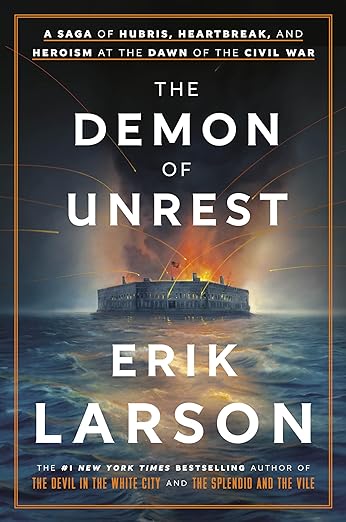
This book focuses on Fort Sumter, the Federal fort off the coast of South Carolina that became the catalyst for the opening guns of the American Civil War. The Southern states that seceded from the US, or that attempted to do so, believed themselves entitled to seize the forts, munitions, and indeed, every single ounce of American property located within the borders of their states—and although Fort Sumter and the lesser, partially constructed forts around it were on islands rather than inside the state’s boundaries, they expected to annex those, too.

Meanwhile, as most know, Major Robert Anderson was the fort’s commander, and he desperately wanted orders from Washington. The period following Lincoln’s election, up until he actually took office, was a critical one, but President Buchanan was determined to postpone any official acts until he could hand the responsibility to someone else. He didn’t want his legacy marred by the beginning of a civil war, or indeed, by any sort of noteworthy strife whatsoever, and so he mostly just hid from everyone. Representatives from South Carolina—would-be ambassadors that came to conduct international business—were turned away without official recognition, and that’s about the only worthwhile thing the guy did. And during this fraught period, Anderson and those he commanded waited tensely to learn whether they would be ordered to evacuate, or to defend the fort.

They waited a long damn time; too long.

This is a complex story and an interesting one, and so there are many historical characters discussed, but the primary three that take center stage are Major Anderson; Edmund Ruffin, a South Carolinian firebreather, stoking the fires of secession; and Mary Chesnut, the highly literate wife of a member of the ruling elite. Others of importance are, of course, President Lincoln; Allan Pinkerton, the head of the notorious Pinkerton Agency, which is tasked with keeping Lincoln alive; and a Southern power broker named Hammond, with whom the story begins.

In starting the narrative by discussing Hammond, Ruffin, and Chesnut, Larson gives us a fascinating window into the minds of the South Carolinian ruling elite, known among themselves as “the chivalry.” They style themselves as if they were characters from out of Arthurian legends, placing their own somewhat bizarre code of honor above every other possible principle, and beyond matters of simple practicality. I’ve always been fascinated by the way that leaders of morally bankrupt causes arrange their thoughts and rationales so that they can look at themselves in the mirror every morning and like what they see, and nobody can explain it quite the way Larson can. Everything is crystal clear and meticulously documented. I’m a stickler for documentation, and so although I feel a little silly doing so for someone of his stature, I pull two of his sources, Battle Cry of Freedom, by James McPherson, and Mary Chesnut’s Civil War, which is the diary she wrote leading up to and during the war, from my own shelves, and turn to the pages indicated in a couple of the notes. There they are, just where Larson said they’d be! This may not impress you, but it makes me ridiculously happy.

The story commences with Hammond, a wealthy planter with a highly elastic moral code. There’s a fair amount of trigger worthy material here—though the term had not been coined yet, he was a sexual predator of the highest order, and delighted in writing about the things he did to his nieces. Although this information, drawn from primary sources, does its job by letting us know exactly what kind of person helped shape the rebellion, it’s hard to stomach, and I advise readers that can’t stand it to either skim or skip these passages, because one can easily understand the majority of the text without them.

Once upon a time, this reviewer taught about the American Civil War to teens, and yet I learn a hefty amount of new information. In particular, I find the depiction of Anderson illuminating. I have never seen such a well rendered portrait of him before.

I could discuss this book all day, and very nearly have done so, but the reader will do far better to get the book itself. Highly recommended, this may well be the best nonfiction book of 2024.

Deliver Me from Nowhere, by Warren Zanes*****

I’m a diehard Springsteen fan and also loved Zanes’s biography of Tom Petty, and so when I saw this book, I was all in. My thanks go to Net Galley and Crown Books for the review copy; this book is for sale now.

Springsteen, yes; but why Nebraska, of all albums? Nebraska just may be the one song that leaves me cold. In the early portion of this story, I wasn’t as enthused as I expected to be, but as the narrative moved forward, I totally got it. Nebraska was written and performed during a crisis period in Bruce’s life. He had grown up in horrible, grinding poverty, and now suddenly he had all this fame and money. On the outside, his life was looking mighty good, but inside, the walls were crumbling. He was clinically depressed, sometimes suicidal, having never dealt with the traumas of his formative years. He rented himself a farmhouse and went there by himself to write songs and tape some demos. He took no friends or family, nor his band; he took one guy along to see to his creature comforts, and that guy’s second job was to be invisible. For most of the book I was convinced that the farmhouse was in Nebraska; nope. New Jersey. And it seems that my lack of enthusiasm for this music was not atypical:

“Nebraska was going to ask a lot of the listeners. If they loved Springsteen for the sliver of hope and possibility of redemption his songs offered, they were out of luck with Nebraska. If they loved the sound of the E Street Band and the way Springsteen led the group, that, too, was gone. If they loved the way he produced and arranged the songs into recordings rich in dynamics, nope, it wasn’t there in the same way…This was the sound of a man forcing out songs while held under water, a rough hand on his neck.”  

The album’s structured to tell the story of murderer Charles Starkweather and his accomplice, Caril Fulgate. He tells the story without judgment, and considers the characters to be a pivotal part of his work.

Here’s the fun part. As Springsteen wrote and recorded the songs, one after another, right there in the master bedroom of the house he was renting, he didn’t worry about any of the finer points of recording, because these were essentially supposed to be demos. For musicians that don’t read or write music in the formal manner, the demos are critical. How will you remember the song you came up with when it’s time to put the album together? You need a recording. So there was Bruce, perched on the end of the bed, with the water damaged Panasonic boom box nearby. He pops in a cassette and commences recording. He writes prolifically, practically vomiting up song, after song, after song. Sometimes you can’t feel better until you get it all out of your system, right?  

But later on, when it’s time to do the mixing and whatever technical processes usually go into a professional recording—which Zanes describes in an easy to follow manner—nothing works. After trying every imaginable method, they end up publishing the music on the cassette, exactly as he recorded it.

Those that want the full story of Springsteen’s life should read his autobiography, Born to Run, which is excellent. But there’s a lot to recommend this smaller little slice of the least known part of this rock and roll icon’s life. For those that love Springsteen’s music, and for those interested in rock music in general, or the technical side of recording, this book is highly recommended.

The Splendid and the Vile, by Erik Larson*****

If some of what follows challenges what you have come to believe about Churchill and this era, may I just say that history is a lively abode, full of surprises.”

Erik Larson wrote The Devil in the White City, and so when I saw that he had written a biography of Churchill, I leapt at the chance to read it. Thanks go to Net Galley and Crown Publishing for the review copy. This book is for sale today.

I have spent most of my life dodging stories of the second world war, largely because I had grown bored, as a young woman, hearing my father’s ramblings with friends. No young person wants to hear their parent’s stories unless they involve great fame or heroism, and perhaps not always, even then. And so, when someone older than myself would speak of “the war,” my ears closed at once. Footage of Churchill’s iconic speeches sometimes popped up on the television, but all I heard was “blah blah blah,” and I would either change the channel or leave the room. And so, it is only now—after a career of teaching American history and government to teenagers—that I find myself curious about Churchill.

The book begins when King George asks Prime Minister Neville Chamberlain—who, along with his staff, had been carrying on with ordinary length work days despite the crisis at hand, and who had been contemplating a surrender to Germany—to step down, and then invites Churchill to take his place. Churchill has no intention of surrendering a single centimeter of British soil to Hitler, and soon everyone knows this. The book ends when the United States formally enters the war. By focusing on this brief period, Larson is able to include detail, the meaty anecdotes and quotes that a full length biography would limit. That said, the hard cover version of this book is still over 600 pages in length, if one includes the thorough and excellent endnotes, and if you haven’t the stamina for other books of this length, you probably won’t have the stamina for this one, either.

Since my childhood impression of Churchill was that he was dull and stodgy, I was fascinated to learn how truly unconventional he had been. He often worked 16 hour days and expected his staff to do the same, but he did so on his own terms, breaking for two baths daily (but dictating from the tub to a male secretary that sat tub side, tablet and pencil in hand), and likewise doing business from his bed, not merely over the phone, but with documents, a typist, an immense thermador to hold his two foot long cigars, and his cat, whom he called “darling.” He might be clad in a silk floral dressing gown (in America, this would be a fancy robe) and pom-pom slippers, or he might be buck naked. Today we would refer to the working baths and feet up in bed as a sort of self-care; the fact that he was able to carry it off during much more conventionally straightened times amazes me. He kept a machine gun in the trunk of his car, and he armed his family members, including the women. Invasion was a real possibility, and if it occurred, he and his family would be primary targets. He told them that if they were to be taken, possibly killed, the least they could do would be to take at least one Nazi down with them. And like so many fathers, he climbed onto the roof during Nazi bombing raids to see the action despite the risk, but made his daughter stay far away from London in the countryside lest she find herself in harm’s way.

Larson incorporates a variety of sources, but the two most frequently quoted are from Colville, who was one of his private secretaries, and Mary Churchill, his teenager. I question the amount of ink young Mary receives initially, but at the end, when I see where life took her, my objections fade. Also included are the views of top Nazi officials, primarily Joseph Goebbels, whose diary shows his dissatisfaction with Roosevelt, whose fireside chats inveighed against Fascism and in favor of the British cousins. Goebbels wishes that Hitler would take a hard line against the Americans, reflecting without an ounce of irony that “One must defend oneself sometime, after all.”

Larson’s congenial narrative draws me in almost like narrative nonfiction. Despite the death, the destruction, and the horror, it is—for me, at least—a curiously soothing read in all but one or two of the harshest spots. Perhaps it is because it was long ago and far away, and I know that—this time, at least—the Fascists will lose.

There is only one photograph in my digital review copy, and a note of a map that will be included in the finished version; I wish there were more. I came to my desktop to see images of the infamous Lord Beaverbrook, the Prof, and Pug Ismay, all of whom were Churchill’s key advisers, and I went to YouTube to listen to the Dunkirk speech and others that were so captivating and celebrated. Now that I grasped the context in which they were given, I can understand why they had an electrifying effect upon the British public and won the favor of other English-speaking nations, my own among them.

Is this the best Churchill biography? For those that want all the nitty gritty, there are many others, and Larson refers to them in his introduction, including one that is eight volumes long. For me, though, this is enough. Those that want an approachable yet professional introduction to this subject could do a lot worse; I recommend you get it and read it, and then you can decide if you want to pursue the subject further.

Highly recommended.

The Spies of Shilling Lane, by Jennifer Ryan****

Sometimes what I really need is a feel-good story. Had I ascertained that this was that sort of book, I would have had it read by the publication date. I read the beginning twice, decided it was going to fall into the grim duty category since I had accepted a review copy, and I set it aside. My apologies go to Net Galley, Crown Books, and the author for my lateness; my heartfelt thanks go to Jayne Entwistle, the reader for the audio version of this lovely tale, for rekindling my interest. I procured the audio version from Seattle Bibliocommons and listened to it while I rode my stationary bike and prepared dinner in the evenings. I began listening to it because I owed a review, but soon I found that I preferred this novel to the other good book I had been listening to just for pleasure.

Our story begins with Mrs. Braithwaite feeling injured and put upon. Her husband is divorcing her, and the women in the local charity club have banded together and ousted her from her treasured position of leadership. She is miserable. Betty, her only child, has run off to London, intent upon aiding her country now that the second World War is upon them, and she isn’t answering her calls. Mrs. Braithwaite decides to visit her, but upon arrival, she discovers that Betty is missing. The story flows from her effort to find her daughter and also herself.

Those seeking an espionage thriller won’t find it here; the story is character based, and in this Ryan succeeds richly. Mrs. Braithwaite enlists the reluctant assistance of Mr. Norris, Betty’s milquetoast landlord, and it is these two characters that are wonderfully developed. None of this would have been achieved without the spot-on cultural insights regarding the World War II generation. The shallower pop-cultural references to music are well and good, but Ryan goes deeper. The fact that the character is known only by her formal title, with the salutary “Mrs.” in place of a first name, speaks not only to the protagonist’s dignified, somewhat cold façade, but also to the practices of the time. Use of first names was considered an intimacy among the elders of this time period; women addressed their peers by it unless they were close friends or family members. Even the way that the plot develops is reminiscent of the fiction and movies of that generation. As in most good historical fiction, the setting mingles with the characters to move the plot forward.

I am not much of a cozy mystery fan, but I think this story would please cozy readers. At the same time, I appreciate the careful balance the author uses; the touching moments are deftly handled, never becoming cloying or maudlin. At other times there’s a playful, spoofing quality to it, as Mrs. Braithwaite and Betty search for each other, each fearing the other is in danger and thus placing herself in it.

I recommend this book to cozy readers, fans of historical fiction, and anyone in need of a boost in morale. It’s for sale now.

The Chalk Man, by C.J. Tudor**

It’s a rare book that I find abrasive right out of the gate, especially since there are no controversial social messages here, just a mystery that I didn’t like and didn’t finish. Thanks go to Crown Publishing and Net Galley for the review copy, which I received free and early in 2017. I should have written a review long ago, of course, but I found it hard to reconcile my antipathy for this story—a debut, no less—with the nearly unanimous adulation expressed by other reviewers. I am still a bit bewildered, but there it is.

This is a book that tries too hard. There are too many cutesy nicknames, and the structure of the plot feels gimmicky and formulaic, as well as mighty unlikely. Of course, most mysteries have aspects that are unlikely because most real-life murders and other mysterious doings have logical, obvious, dull explanations. We agree to pretend the murder mystery is plausible in exchange for being entertained. The problem is that I wasn’t, and so I couldn’t.

Two other factors that contributed to my grumpiness were the overwhelmingly male list of characters, and the cultural collision between British fiction and my brain. I’ve read and enjoyed some British fiction; if not, I wouldn’t have requested this galley. But here the culture and jargon are thick on the ground, and the inner narrative feels endless.

I no longer have to be concerned that I will crush this author’s hopes and dreams; Tudor’s debut is a huge success both in terms of sales and the corresponding enthusiasm of its readership. This author has gone on to publish more books, and I have had the good sense not to request those this time. Ultimately this came down to taste more than anything else, but I have to call ‘em as I see them, and I found nothing to love, apart from a compelling jacket and an attention-getting title.