The Bum’s Rush, by GM Ford *****

thebumsrushI have read every speck of fiction written by the man who calls himself GM Ford. Part of it is that he sets a good deal of his work in Seattle, and I was stunned to find him (in one or another of the Leo Waterman books) chasing a villain into my neighborhood, down my street, and when he turned and I read the description of the house in which the body was found, I thought…MY STARS! I KNOW WHICH HOUSE HE MEANS!
Okay. That won’t happen for most of you. But if you can track down the old Leo Waterman books (Ford’s earliest series), they are both riveting in their own right, and absolutely hysterical in places. I have always liked books that feature working class heroes. Some of Waterman’s friends are homeless men, and when he gets money, he takes them things. It’s sort of sweet, at the same time that the mystery is compelling, at the same time that it is, in a wry, clever way, very VERY funny!

I was heartbroken when he ended this series, and overjoyed to see him come back with Chump Change, his most recent release (see review). Consider this a generic endorsement of all of the Waterman books. His other series, with Frank Corso as protagonist, is well written, but not meant to be funny. It was good too, but ultimately, my heart belongs to Leo.

Droll, witty, and brilliantly written. If you can, get them all and read them in order!

Serpents Rising, by David A. Poulsen ****

serpents risingWhat fun to get in on the first mystery novel of a planned series! Poulsen is an experienced writer, and he knows how to set the hook to reel readers in. I was immediately engaged as I read the initial chapters.

Thank you, Net Galley and Dundurn Press, for the advance peek!

I’d classify this as a cozy mystery, and it’s the first such book I’ve read that was written by a man. I enjoy a limited number of this sub-genre. I dislike seeing everyday people (housewives, caterers, hoteliers) “outsmart” the professionals, and I avoid like the plague any cozy mystery with (*shudder!*) recipes! For those, I use a cookbook. And Poulsen doesn’t do either of those annoying things listed above; so far so good.

His reason for wanting to get to the bottom of his wife’s death by arson is a strong one, not all that new, (the cops suspected him for a long time, and he misses his wife), but old devices like these can still work if the writer is skillful enough to make them seem new. In the beginning, it worked for me.

Equally if not even more engaging is the help he provides his friend Cobb, a private detective being paid to search for a missing teenager with a history of drug abuse. The characters of Jay and Zoe were almost tangible. I used to teach kids of this age, and Poulsen made them so believable that I felt as if I knew them.

That said, the first half of the book is better than the second half. Some of the details in the resolution strained credibility, and the second half also saw a couple of seen-it-many-times plot devices that didn’t look new; they made me groan and mutter, “Oh come on, not that again!”

But you’ll note there are four stars there. It’s a good book, despite the occasional momentary mutter on my part. When the second Cullen and Cobb mystery comes out, it will be on my to-read list.

I was pleased that the author did not add a sickening amount of gore, or add elements that would leave me with a leaden gut for the next two days. Some authors feel that in order to gain the attention of an increasingly easily distracted audience, they have to dig up every horrible possibility and traumatize us. Not so here (or in anything I would label “cozy”). If your “ick” factor keeps you away from Stephen King, you can read this one.

For a fun, relatively quick read to curl up with over the weekend or take to the beach, get a copy of this book. If you are a mystery fan, I think you’ll like it!

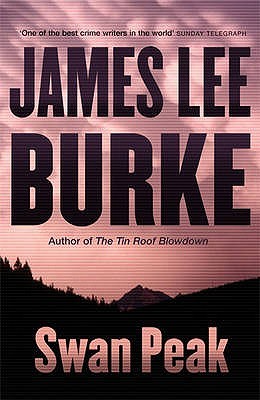
Swan Peak, by James Lee Burke *****

Swan PeakThis series began decades ago, when Dave Robicheaux and his best friend and cop partner, Cletus Purcel, were in their prime. Now they are much older, aging along with their creator, the legendary James Lee Burke. Robicheaux is happily married to Molly, a strong, loving woman who can deal with the harsh twists and turns that Dave’s life metes out. Clete continues to be drawn toward women with “disaster, stay away” stamped on their foreheads. It’s nice to know there are some things the reader can depend upon.
Just as the author divides his time between Montana and New Iberia, Louisiana, so does Dave, and this installation is set in Montana. Dave, Molly and Clete are on vacation, staying with friends, but Clete drives headlong into trouble, for once not of his own making, almost immediately. The local cops aren’t entirely sympathetic, nor are the Feds, all of whom know that he has a suspicious history in the area; he may be connected to a flaming plane that took down a nasty mobster and some of his entourage, a crash that may not have been accidental. Nobody has ever proven anything, but the presumption of innocence doesn’t apply to the attitudes that people take. It’s unfortunate, since Clete will need all the help he can get in this one:

 
Clete Purcel had given up on sleep, at least since he had been sapped with a blackjack,
wrist-cuffed to the base of a pine tree, and forced to hear a machine dig his grave out
of a hillside. He kept his nightlight on and his piece under his pillow and slept in fitful
increments. The trick was not to set the bar too high. If you thought of sleep in terms
of minutes rather than hours, you could always keep ahead of the game.

 
Yes, friends, there is trouble to spare on this vacation-from-hell, the bevy of frustrated wanna-be artists, corrupt wealthy baddies, and women with miserable pasts and questionable futures to whom Cletus is invariably drawn, moth to candle flame, that we have come to expect from a colorful, adrenaline packed story like the ones Burke spins when he writes this series.
But not all is rotten and wrong. Dave and Molly are fonder and more loving than ever as they grow older together. The protagonist explains that

 
There are occasions in this world when you’re allowed to step inside a sonnet,
when clocks stop, and you don’t worry about time’s winged chariot and hands
that beckon to you from the shadows.

 
Is the man with the half-melted face someone associated with Sally Dio? Is he Dio himself? Or is he merely a disabled man with a deeply flawed character?
Who killed those teenagers?
To find out, you need to get a copy of this wonderful book, but if you haven’t read the rest of the series, I recommend reading them in sequence. Because nobody writes better than Burke.

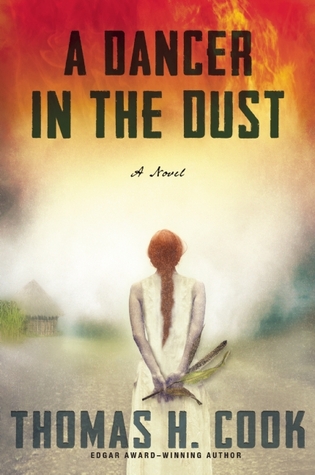
A Dancer in the Dust: A Novel, by Thomas H. Cook *****

a dancer in the dustA Dancer in the Dust is a multifaceted novel. It is a love story, the doomed love of Ray Campbell, a risk assessor from the United States for Martine Aubert, an African woman of Belgian descent. Martine lives in, and loves, the country of her birth, a fictitiously independent nation called Lubanda. And it is a story of paternalism, and of how much easier it is to place someone else in a risky position rather than oneself. It is also a story that raises thought-provoking social issues.
My thanks go to the publisher and the first reads program for the chance to read this free. It is beautifully written, but it is also one that starts with a man grieving, and by chance it arrived in the mail when I was grieving a younger family member who died very unexpectedly. Every time I picked the book up, the clouds formed, and so I took what I would generally consider to be an unconscionably long time reading it. For awhile, the words just couldn’t sink in.
When I got my wits about me, it occurred to me that I ought to find out whether Lubanda was a real place or not, lest I make an ass of myself while reviewing it. Sure enough, Lubanda, though not really an independent nation, exists in east-central Africa as a subsection of Tanzania. Cook makes it larger and more populous than it is in real life for the purpose of his fictional vehicle. And when you are as painterly and skillful with words as Cook is, you can pretty much do what you need to in order to tell your story.
So we rejoin Campbell as he sets out on his return trip to Lubanda. He left there after Martine was killed, returned to New York City, but the death of a man known to both Ray and Martine sets his wheels back in motion. Seso, whom Campbell considered a friend, has turned up dead, murdered, in New York City. Campbell has weighed risks and taken the safer course all of his life, and in turn, he has been left with nothing and no one. He is finally ready to toss all of his chips on the table in hopes of at least winning redemption, and so he sets out in search of Seso’s killer.
“Actually, we have plenty of opportunities to do the right thing…It’s taking back the wrong thing we can’t do.”
Martine had died because she would not do what the Western aid providers think she should do, a program the government bought into lock, stock and barrel. She had tried to explain in logical terms why their plan for her country was wrong, but no one was listening. Nation after nation had become a “funhouse mirror into hell” because of Western policies: Uganda, Kenya, Congo, and the list continues. Patrice Lumumba embraced modern ideas and methods, but ultimately died when he defied his keepers.
In setting out to find out what happened to Seso and why, Campbell is looking to trace back the thread. Cook’s account is brutal and searing, but it is too well told, too compelling, and raises too many thorny social issues that bear examining to be set aside. Read it for Africa; read it for the mystery it unravels; or read it for social justice. But get the book, and read it now!

Half of Paradise, by James Lee Burke ****

halfofparadiseJames Lee Burke has been writing for roughly fifty years now, and this was an early effort, published in 1965; I think it was his first, in fact. It starts out appearing to be short stories, but the narratives involving three individuals eventually make one crushing point about the dismal, cynical failure of the US criminal justice system, which rains down its uneven blows hardest upon the poorest sectors of the population. He never actually says it. He goes one better, by demonstrating it through his fiction.

Those who have read his Edgar winners (Neon Rain and Black Cherry Blues) have come to expect brilliant rendering of setting and complex, absolutely believable character development.

As for me, if Half of Paradise, not an award-winning story but strong nevertheless, a stark, brutal, depressing book reminiscent of some of Russell Banks’s work (but with a Southern exposure) were as good as Burke were ever going to become, I would still choose to read his work over that of most other writers. And because it is indeed grim–and anything with this subject matter ought to be–I always have another book going, too. Actually, I usually have four to six books that I read in rotation. By not making more than one or two of them morbid, I keep myself from plunging to the depths one otherwise might while reading it.

A worthy early effort, still worth reading today if you can stand the sting of the “n” word.

The Yankee Club, by Michael Murphy ****

theyankeeclubMichael Murphy has created an entertaining read that may keep you up past your bedtime as the end approaches. I was fortunate enough to get a chance to read it early via his publishers and Net Galley.

The premise is that Jake, a former PI turned mystery writer, has been living in Florida, having fled there heartbroken after his romance with the lovely Laura ended. Now he is back in New York. Laura is a famous actress, engaged to a very wealthy man, but Jake has not come back for her; he has returned because his former partner, Mickey, has been murdered.

During the first 25% of this novel, my attention wandered. This is unusual for me, and of course not a good sign. I went back over the writing to try to diagnose why this happened, since there was no obvious problem in his plotting, setting, or character development. Finally I decided that the pace was a little slow because so much attention had been given to scene setting and the introduction of peripheral characters (who would later be very important). My advice to any reader who enjoys detective fiction is to hang in there, if you find this happening to you, because it does pick up and becomes much more engaging once the story begins to roll forward.

There is a plethora of bad guys, surprises and betrayals at every turn. Jake proves to be as tough as Sam Spade, and he is ready to give his all to protect the woman he loves, though as it turns out, she is hardly a damsel in distress; I won’t say more lest I ruin it for the reader.

If I had one piece of advice to offer this writer, it would be to use a little more subtlety. Don’t tell us how your character feels, and in particular, don’t do so repeatedly. Show us in action and dialogue. If these things are handled effectively enough, it won’t be necessary to tell us who feels what and why.

Small details I particularly enjoyed: the florist’s truck, and toward the end, the bicycle.

One thing I didn’t enjoy and didn’t need, though hardly the writer’s fault: a message repeatedly popping up on my kindle telling me that I had something on my tablet that had not been purchased at amazon, and if they were in error and it had been something of theirs, I should restart my kindle and pull it out of the archives. I blew past this message 3 times; once they totally removed my view of the text and put the home page back up. Did I mention that this was irritating, especially since Net Galley does offer the option of sending the galley straight to kindle, which is how mine got there?

Thanks for permitting this rant to interrupt my review. All told, this is a really fun story once the scene has been set and action is underway. You won’t be disappointed.

Blind Descent, by Nevada Barr*****

blinddescentOf all of the riveting tales Barr has spun around her park ranger protagonist, Anna Pigeon, this is, I think, the most compelling (and I have read them all)! For those that want to know, it’s the sixth in a long series, each of which is set in a national park.

Have any issues with claustrophobia? If yours is intense, you may need to give this one a miss. It involves caving and spelunking, including oh my stars crawling in a tiny horizontal tunnel where five extra pounds put on over a last-minute cheesecake just could mean the end of you. Once you’ve gone miles and you can’t go forward, and your light is out…what are you supposed to do, go backwards? It’s not like it’s all one tunnel. There are places you can fall, wrong turns you can take. After all, it was not made to be entertainment, it’s a seriously bad-ass part of Mother Nature that I don’t care to think about too hard.

Now, imagine that you are on such an intense journey, and that you are Anna Pigeon (whose only really detrimental characteristic is a stereotypical view of large people…you know, lazy, poor character, untrustworthy…I said something on Barr’s website once and she responded that this is her character’s perspective, so if you are sensitive about snarky remarks regarding people who have any extra meat on their bones, beware the whole series). Okay, now with that digression aside, imagine you are Anna Pigeon, and because you are a buff, toned ranger with a good reason to do so, you have headed into one of these caving expeditions; you’re in a tight spot; and it is only there that you realize that someone on the expedition would prefer you not make it out again.

Barr’s bias against sizable people aside, her writing is otherwise so impeccably skillful that I have no choice but to give her all 5 stars. Don’t read it right before you go to sleep, unless you are COMPLETELY untroubled by things that go bump in the night!

Drowned Hopes, by Donald Westlake *****

drownedhopesA guy gets out of prison, and he goes to get the loot where he buried it. Unfortunately, he’s been gone quite awhile. A dam has been built and the water for a whole town is on top of it now. In order to get to it, he just may have to drown the whole town.

The protagonist is the guy he goes to see about it. Our protagonist, of course, is not a big-time hoodlum with a heart of flint. Westlake doesn’t write that way. No, our guy is callous, certainly; selfish, no doubt. But he does not have anywhere CLOSE to the hard-heartedness required to drown a whole town. And so it devolves upon him to find a way to get the loot, but not kill the town.

Good luck with that.

Funny as hell, but of course, in a slightly dark way, like all of Westlake’s comic capers.

I confess that when a really amazing writer dies, I feel the impulse to review their work to reduce the possibility that it will fade into obscurity. I discovered Westlake’s work about a year after he died. He wrote for fifty years; his Dortmunder series, of which this novel is the seventh, is where most of his funniest stories are found. This title is my favorite among them…and yes. I hunted down every one of them, and when I could not buy them second hand, I asked for them as Christmas and birthday gifts until I had sucked the entire series dry.

I hope you’ll enjoy them as much as I have.

Dead Little Dolly, by Elizabeth Kane Buzelli ****

  This is the first title I’ve read of this engaging cozy mystery series created around Dolly, the local sheriff of a tiny mid-western town. The setting, located in Northwestern Michigan, is original and well conceived; the pacing and transitions are deft and clearly the work of an experienced writer. Best of all are the characterizations, which are colorful and distinctive without being so wildly eccentric as to become caricatures or stereotypes.

I will admit that when it comes to cozy mysteries, I am a hard sell. I want working class protagonists, first off; no wealthy people on cruises or in drawing rooms for me (Dame Agatha Christie as the legendary, sole exception to my rule). I don’t like to see improbable individuals solving crimes that go right over the heads of the police, and I will not read a cozy mystery I even suspect may contain a recipe somewhere. If a novel needs recipes to sell, it’s not much of a novel.

Dead Little Dolly meets all of my snooty criteria. The title character, Dolly, is the sheriff of her tiny town, and has all sorts of family baggage that comes into play. Her mother abandoned her as an infant to join some religious cult in France, and now that she is a single mother, she sternly rejects her grandmother’s wish to contact said long-gone mother. I loved what Dolly had to say about her mother’s lack of responsibility and what might have happened because of it: “How’d she know I’d turn out so good?” This really cracked me up.

There are a couple of somewhat weak spots: the notion that Emily, the journalist, must keep news of our crime prominent in the local press “to keep the pressure on” is nonsense. When this is done, on whom is the pressure supposed to be placed? On THE POLICE. In this case, the police–a force of one–is the victim, and already highly motivated to solve the crime. Are we seeking the assistance of the FBI? No. There is no basis for it, and it is not mentioned. So this particular chunk of motivation is weak.

However, the story is so riveting and such great fun that I was ready to overlook that bit, and indeed kept reading well past my bedtime.

A particularly delicious secondary plot was the coming nuptials of an 80-year-old bride. Her mother had been against the match, and they had waited till her death to wed. The old bird lived to be 101 years old, and now a certain amount of haste was required to give the newlyweds a maximum period of wedded bliss. (I confess this made me think a bit of my favorite aunt, who was widowed at 30 and remarried at 70.)

Dead Little Dolly is a good fun romp, exactly what the doctor ordered when you need a beach read or a little something to take your mind off of your own worries. If you enjoy a good cozy mystery, this one is highly recommended.

A Swollen Red Sun, by Matthew McBride *****

A shudder went through me as I pressed the five star rating, but it’s true: this is among the very best of its genre. Think of Deliverance; think of The Shawshank Redemption on steroids. No…picture it on crank.

A Swollen Red Sun is set in the middle of the hills and “hollers” in Missouri, a long, long way from a real city, a miserable, impoverished place where some folks’ goal is just to find a nice, normal person to smoke crank with instead of all these crazies. (I am avoiding the direct quotation because I read a galley and the rules don’t allow me to use them, but the figurative language and many other well-turned passages here make it really really tempting.) All told, this horrific account of a small community that has rotted from the inside out will make you think long and hard about whether growing up out in a rural area will somehow keep your kids isolated and protected from all the drugs, crime, and gangs that you know big cities hold.

At least in those cities, there are wholesome choices to be made as well, such as museums, theaters, and video arcades. And at least in those cities, there will be someone to hear you scream.

In my own digital shelves, I labeled this grim but brilliant work as “crime fiction”, but that doesn’t really cut it (oh, if you’ll excuse the expression). It’s more like a horror story minus the supernatural elements. McBride stirs up plenty of horror without needing to summon spirits from the great beyond. His are right here on earth, and they do a fine job of giving the reader a case of the heebie-jeebies all by themselves.

Yet, curiously, this novel has just enough moments of relief, however momentary, to keep it from crossing my “ick” threshold. You know what I mean, right? Once in awhile I start reading a book that is so unrelentingly horrifying, contains deeds so nightmarish that I think, “I don’t want to spend my time with something like this,” and then walk around with a sour stomach for a week over what I have already read. I thought this one might go there, but it didn’t.

I have a friend who likes Patricia Cornwell just fine, but there are certain other writers that she’s told me she’ll take a pass on. When I finish a book by Stephen King, I don’t send it her way, and likewise, both Jan Burke and the non-Sherlock thrillers by Laurie B. King caused her to say, “It’s too much.” And for my friend, this story would also, I guarantee, be too much. Let that be your litmus test.

So my advice for you is this. If you like a fast-moving, original, complex thriller with plenty of skeletons in plenty of closets metaphorically, I promise this hardscrabble tale will hold your attention to the very end. If your nerve-endings are too tender for horror tales, or if you have recently had someone close to you die and you aren’t really over it, you may want to set this title aside, at least for now.

I would be amazed if there are no awards headed this author’s direction. It’s a powerhouse of a story, and there’s really nothing else like it.