
Sharks In the Time of Saviors, by Kawai Strong Washburn*****

A story like this one only comes along once in a rare while, luminous, intimate, and deeply affecting. My great thanks go to NetGalley and also Farrar, Strauss and Giroux for the review copy. This book is available to the public, and you should get it and read it.
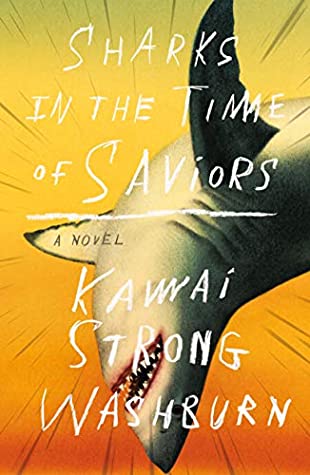
Initially I was drawn to this book for several fairly superficial reasons. The cover is certainly arresting; the title is perplexing. But the biggest draw for me was that it was set in Hawaii, and all of the characters are native Hawaiians. In my corner of the world, the Pacific Northwest, there are a lot of Pacific Islanders. Why anyone would leave such an idyllic climate for the dark, soggy winters we see here used to be a mystery to me, but ultimately, people follow the jobs, and so many Seattle residents come from there.

As a history teacher, I’ve always felt that my students deserve to be included in the curriculum, and so in addition to teaching about Caucasians during whatever time period we’re examining, I work in African-Americans, Latinx, Native peoples, and a variety of Asian ethnicities, but time and again I hit a wall when I tried to find something for my Islander students. And when I’ve taught literature, it’s been the same struggle. Islander kids get shut out every time.  And so now I am retired, and here’s my appeal to other educators out there. Put this book in your classroom.

For the rest of you: apologies. Let’s get on with it.

As we open, the setting is Hawaii in 1995, and the protagonists are two parents and three children, all members of the Flores family. They’re on vacation when seven year old Noa falls into the ocean where sharks are circulating. But instead of devouring the boy, one of the sharks delivers him back to his family, carrying him gently in its jaws, “Like you were made of glass, like you were its child.” The first chapter is told in the second person, with Malia, the mother, recalling the event, speaking to Noa. She tells him, “The gods were hungry for change, and you were that change.” It’s obviously a miracle, and others see it happen also. Their lives will never be the same.

As the story continues, we hear from all of the family members. At first, Noa appears to be gifted with a magical healing ability, but he is still a child, and the demands on him are grueling, exhausting. But this is not the only change his magical abilities produce. Noa is the youngest child in the family, but now the siblings’ hierarchy is completely flipped, and the resentment felt by his brother and sister is dreadful. At one point Kaui, who is academically talented, fumes that she is “just his shadow, shaped like a sister.”  And his brother Dean, who is an athlete, explains:

You’re out at breakfast without him, eating cereal and joking with Mom and Dad, Kaui coming in, and you get them all laughing and smiling, just because of you. But then Noa shows up right, and suddenly it’s all questions about what’s happening with his day and did he sleep okay and here’s some thoughts about which extracurricular program he should enroll in…Hard not for get angry at that. I felt it like a fist flexing inside my own chest.

To make matters even more fraught, there’s an economic downturn that makes it impossible for the parents to support the family. They begin charging people that come to be healed by Noa, and so the youngest child is not only the golden favorite because of his miraculous ability; he’s also the family breadwinner. And again: it’s an awful lot to put on the shoulders of one small child.

The dialect combines with the authorial voice to create characters that I swear I would know if I ran into them, and in many ways, they remind me of the adolescents that I taught. Because I was so unconscionably late here, I checked out the audio version at Seattle Bibliocommons, and I have never heard an audiobook I loved more. The voice actors are so convincing that I can hear them now, more than a month and several other audiobooks, after I finished it.

For me, that would be enough. Create visceral enough characters and I don’t even care much about the plot. But the plot is also gobsmackingly brilliant! I believed I could track where it was headed up until perhaps the 60% mark, and then there’s one surprise turn, and another, and another, till at the end I was simply sitting with my mouth open and my eyes on the text as the audio gave way to the afterword and credits. I had to remind myself to breathe.

This is one of those rare galleys that I could see reading again just for the love of it. This review is my 923rd for NetGalley, and I have chosen to reread fewer than 10 of them, so let that indicate the measure of esteem in which I hold this novel.
The Last List of Miss Judith Kratt, by Andrea Bobotis*****

“We will choose what we take with us.”

This thunderous debut by Andrea Bobotis bears a small resemblance to the work of Elizabeth Strout and the late Harper Lee. Issues of race and menacing family secrets simmer beneath the surface of this narrative like some otherworldly being biding its time in the swamp, till at last it rises and we must look at it.

As the story commences, Judith, who is quite elderly, is ready to take inventory. Her family home, all six thousand square feet of it, is jammed full of heirlooms, and each is fraught with history. The year is 1989, but as Judith examines one heirloom and then another, she takes us back to the period just before the stock market crashes, back when she was young and her parents and brother were still alive.

I have to confess that the first time I picked up this story—free to me, thanks to Net Galley and Sourcebooks Landmark—I thought, Huh. A boring old lady and her stuff. Pub date’s a ways off, so let’s put this one on the bottom of the pile. Of course, I picked it up again later. I read a bit farther this time and found I was acutely uncomfortable; I told myself I had to read it because I had requested the galley, but then I didn’t for awhile.

But like Judith, I pride myself on being reliable, so toward the end of June I squared my shoulders and opened the book. An hour later my jaw was on the floor and my husband was avoiding me, because he knew if he got too close I would start reading out loud. If you were to show up right now I’d do the same to you. I genuinely believe this novel and the characters and social issues they’re steeped in is one for our time.

Judith is the eldest of the Kratt children; her companion, Olva, lives with her, but her status is undetermined and remains that way far into the book. Part of the time she appears to be a live-in servant, hopping up whenever Judith wants a cup of tea or a blanket; at other times the two of them sit on the porch together and watch the world go by as if they were sisters or good friends. We know that they grew up together and share a history as well as the trauma of growing up with the vicious, unpredictable Daddy Kratt, the wealthiest man in Bound at the time.

As layer after layer is peeled back, using the household treasures that are inventoried as a framework of sorts, we see the gratuitous cruelty that was part of both women’s daily existence as children. Kratt can be generous at times, and yet at others—with increasing frequency—he is vicious and sadistic. We see the responses his unpredictable fury brings out of Judith as a child, her younger brother Quincy, who’s a chip off the old block, and their younger sister, Rosemarie. Kratt can ruin someone’s entire life purely on whim and never feel the slightest regret. He likes to watch. The entire town fears him.

Now he’s gone, and here we are. Judith acknowledges that her social skills are stunted, and she never knows what to say or do to smooth a difficult situation. She was never a pretty girl, and she has never married.  We can also see that she is solipsistic, insensitive to the feelings of others, and at times just straight-up mean, but she doesn’t see herself that way, because she measures herself against her late parents.  Judith is nowhere near as nasty as her daddy was; she has never permitted herself to be broken by him, as her mother was.  So Judith tends to let herself off the hook lightly. As she remembers back over the years the cataclysmic events that have taken place around her—or in some cases, because of her—her overall tone is self-congratulatory.

But her little sister, who is also an old lady now, returns to the family manse, and that overturns the apple cart in a big way.  How dare Rosemarie run out and leave Judith to contend with that awful man but now come back to claim her birthright?  Isn’t that right, Olva?

Olva just smiles.

In fact, this story is every bit as much about Olva as it is about Judith. . Every single one of these women is sitting on secrets; every one of them has a different story to tell. Every new revelation brings additional questions to mind, so that although this is not a mystery or a thriller, I cannot stand to put it down. I generally like to flop on my bed at night and read before I go to sleep, but I can’t do that with this book. I’d climb under the covers; open the book; read a little ways and then sit bolt upright. Eventually I realized that this cannot be the bedtime story. (It occurs to me just now that retelling one or another portion of this story in the voice of one of the characters not heard from would make a great creative writing assignment related to point of view.)

What Bobotis has done here is masterful. She begins with an old, wealthy white woman and yet develops her, and I cannot think of even a dozen books where that has been accomplished in a believable way in literature; once we get old, that’s pretty much who we are going to be. But the elderly Judith at the story’s end is a better person than the elderly Judith at the outset. And as if that weren’t enough, she also develops Olva, the dark-skinned elderly companion that seems to us, at the beginning, to be a live-in servant or nurse of some sort. But however circumspect Olva has been—a prerequisite for an African-American that wants to stay alive in the American South in the past and at times, maybe the present—Olva does in fact have some things to say. It is Rosemarie’s return that makes this possible.

This isn’t necessarily a fun novel to read, and yet the skill with which it is rendered is a beautiful thing in and of itself. I believed every one of these characters, those within this pathologically corrupt family and those around it. I suspect that the formidably talented Bobotis could pluck any one of these characters and create a sequel just as remarkable. This writer is going to be around for a long, long time, and as for me? I’m ready to read whatever she comes up with next.

Highly recommended.