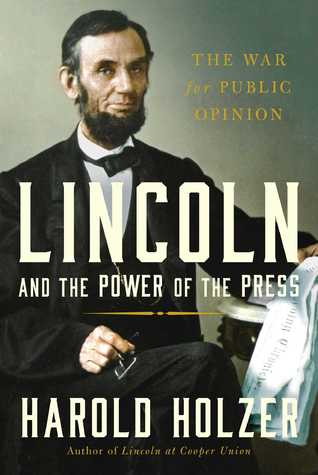
Lincoln and the Power of the Press: the War for Public Opinion, by Harold Holzer ****

lincoln and the pressThis book is for the serious reader. Well researched and creatively conceived, it traces the influence of the newspaper on young Lincoln, and then follows its role in his emergence as a politician, as a contender for the presidency, and later the complicated relationship between Lincoln and the press during the American Civil War. It raises thorny, thoughtful issues regarding censorship; when do we hold the First Amendment dearest above all, and when may its authority be abrogated for the security and integrity of the Union?

It starts a bit slow, and I began wondering whether this would be one of those rare books that I skim and then review, as opposed to reading every word. Still…LINCOLN. I stayed the course and was rewarded. Just be aware that the narrative doesn’t really wake up until about the 30 percent mark.

Lincoln had amazingly little formal schooling. Though this was common among pioneer families at the time, with settlements sparse and young males needed to help with a tremendous amount of hard physical labor, but knowing not only that he became US president, but that he was an attorney before that, I was surprised to learn that most of his reading skills were obtained by reading every single newspaper he could get his hands on, no matter how old it was by the time it made its way to Illinois, which was then considered the northwestern USA. A sister later recounted seeing him turn a chair over and lean against it while he sat on the floor and used the firelight to read by. How many people are sufficiently motivated today to teach themselves reading skills through this sort of very difficult total immersion?

He later fed his newspaper habit by becoming postmaster, and he used this office to read the newspapers being sent by mail before they were delivered to their intended recipients. (He would later use the franking privilege bestowed upon postmasters to send out his own campaign materials free of charge.)

Newspapers were tremendously influential, approaching the zenith of their importance during this time. There was no radio or any other media to spread the news of the nation besides word of mouth. Litigation for libel or slander had not yet blossomed, and so newspapers were often very loose with the facts, and this made it all the more important to read as many of them as possible in order to tease apart truth and rumor.

Young Lincoln left home hoping to become a journalist himself. He was well known as a gregarious fellow who always had a great story ready for whoever wanted to listen. I envision his parents throwing their arms up in the air: all that work to be done at home and where is their son? Off somewhere talking, talking, talking. I also found this tidbit interesting because it contrasts sharply with the haunted and often depressed man he would later become when authority and personal tragedy marked him.

As a congressman and also as a frequent writer of freelance articles and letters to editors, Lincoln marked out his position against the extension of slavery early and with great passion. He called the war with Mexico for what it was: a land grab that would primarily benefit the feudal rulers of the south. At one point he even suggested that the attack against US citizens by Mexican soldiers was a hoax, demanding to know exactly where on the map this had occurred. Folks in Washington DC, Illinois, and even New York sat up and took notice.

Holzer also traces the beginnings of the most notable newspaper publishers of the time. The unfortunate Elijah Lovejoy is dispatched with haste, just as he was in life. Greeley, the bootstrap newsman and fervent abolitionist, at least most of the time, at first spurned Lincoln. For most of both of their careers, they had a strong working relationship, but Greeley was both quixotic and a bit unstable, and he turned on Lincoln at some pivotal times, most noteworthy when the latter was running for re-election. Bennett, founder of the Herald and innovator of a number of the institutional practices that are still in place today, was conservative politically and represented Manhattan’s pro-secessionist, pro-slavery majority. Raymond was Lincoln’s most steadfast supporter and campaign manager the second time around, though he wavered for a brief but terrible time when the tide seemed to turn in favor of the Copperhead Democrats, who wanted to give the secessionist states independence in order to end the war.

In the land of Dixie, there was no debate about Constitutional rights to freedom of speech and the press; newspapers who even hinted at Union sentiments were quickly suppressed without qualm. Despite Lincoln’s suspension of Habeas Corpus and at times the suppression and/or closure of newspapers that either leant aid to the enemy by publishing battle plans before the fights had taken place, or by less overt and therefore more controversial antiwar editorials, he won his office in a fair fight, not attempting to tamper with the electoral process or outlaw the printed word that ran in favor of McClellan, a former general whom this reviewer regards as a treasonous scoundrel.

I confess it gave me a good deal of food for thought. I was a child during the 1960’s and a teen during the 1970’s, but I recall well the controversy regarding free speech, the Vietnam War, and Nixon’s enemies list. If I am in favor of free speech and press during contemporary times, why should it have been different during the Civil War? But I eventually concluded that it was indeed different, and the exasperation of General Sherman toward the press that gave away critical secrets all in the interest of a scoop and the bottom line was entirely correct.

But that’s just one reviewer’s opinion; thanks to Net Galley for the ARC. If you are willing to devote the time and attention this tome demands, you are sure to come away with a viewpoint of your own.

To those interested in the American Civil War, President Abraham Lincoln, or the history of the American newspaper, highly recommended.

Confederate Bushwhacker: Mark Twain in the Shadow of the Civil War, by Jerome Loving *****

confederate bushwhacker Good things come to those who wait. Jerome Loving established his credentials as an academic and historian a long time ago. I haven’t read the other biographies he has written, but they’re going on my list now.

Here’s what you have to know going into it: if you are looking for the sound bite, the cut-to-the-chase, you can’t have that wish. Loving uses induction rather than deduction, and brick by brick he builds toward his conclusion, taking the time to set context in a way that only a specialized biography such as this one, which focuses on the single year 1885, can do. And since I received this gorgeous little hardcover book as a Goodreads.com First Reads giveaway, I was impatient at first. “What the heck. Where’s the bushwhacking? Where’s Grant?”

Uh uh uh. No. Go back, reread. Everything that is in this book is there for a reason. If you hustle through the first part to get to the second, you may leave too many holes in the foundation. Do you want the wall to fall down? Of course not.

What I noticed, as I marched through with my sticky notes, is that the clusters were initially sparse, as the stage was set, and then suddenly ramped up around page 100, and by the end of the biography I was putting a sticky on every page and sometimes on facing pages.

I could tell you what he has to say; I went back and looked at all of those notes, but then, why would I wreck it for you? An author who builds up to the last page does not need a reviewer to hand over his punch line for him.

Instead, I can tell you that this is a careful, painstaking, well-documented analysis of a complex character. Twain’s ideas evolved between his 20’s and the end of his life, and of course, for most of us they do, but perhaps because his mind was open and searching, or perhaps because of his great fondness for “Sam” Grant, he watched what took place–including the Haymarket martyrdom, which I never knew had been an interest of his–and revised his ideas accordingly. Smart people can do that.

Perhaps the greatest measure of the success of this work is that it not only makes me want to see what else Loving has written, it also makes me want to revisit Twain. I had avoided much of Twain’s philosophical writing because of his anger toward the “damn human race”, to which I am much attached, thanks. But I want to see more about the connection between the events that played out during this time period and his changing perspectives.

One small correction is in order to Loving’s work, though I know this is a tiny, picky detail: Loving states that a huge redwood tree had been named for Grant. Ahem. It is a Sequoia tree. It is immense, but it is General Sherman’s that is the largest in the entire world. Sequoias belong to the same family as redwoods, but they are different. Having driven several days from Seattle to Southern California to see the tree; survived a four-car pile-up, rescued my luggage, bandaged and iced myself and my children, hired a rental car and driven onward to fulfill my mission, I can’t let it go by without mentioning it. Two great huge trees in honor of my two favorite American generals of all time. Sequoias. A hint is that they are located in Sequoia National Park. Makes sense, no?The biggest tree in the world!  50%

If you are reading this exclusively for the Civil War aspect, I will tell you that most of the book is not devoted to that time period; it says it is about 1885, not 1865, and when examining the book’s jacket, a knee-jerk reaction will leave you dangling. There is a small but meaty portion in which Twain discusses his part in the American Civil War, but this is not a Civil War history.

For those who read memoirs and biographies as rapaciously as I do, this is a must-read. For those who enjoy American history and literature, and most of all Twain, it is highly recommended. If you like Grant and maybe have even plowed through his remarkably readable autobiography, even better! But you can easily understand this book without it.

Many of my Goodreads.com First Reads will eventually be given away to my daughter’s school or some other good cause. Not this one; it will retain a place of pride in our home library. Thank you for writing it, Mr. Loving, and thanks to the University Press of New England for the free copy.

War On the Waters: The Union and Confederate Navies, 1861-1865 by James McPherson *****

This was my Mother’s Day gift from waronthewatersmy spouse last May, and boats are HIS thing. I thought, Psssh. RIGHT. But since I strive to be a scholar of the American Civil War and the navy is about the only stone (as opposed to gravel, metaphorically) that I’ve left unturned, I started in. No, I FELL in.

First of all, it has to be recognized that McPherson is undeniably the USA’s #1 living Civil War scholar. His status as professor emeritus at Princeton has been well earned. When he decides to delve into some aspect of Civil War history, he finds his primary sources wherever he has to go. So, though he is an old man, he went on those waters. He walked where soldiers trod in order to get to the forts he, too, visited. He believes that in order to understand how any battle unfolded, on land or sea, you’d better get a sense of the geography. This is what a serious scholar looks like.

Then he tracked down the letters and journals of the key players. Once his tools were out and he was ready to go, he stated his bold thesis and then methodically proved it. And it is something of a startling thesis to me. He says that without the navy’s contributions, the war could not have been won.

When Grant says it, one wonders if it was a diplomatic gesture toward the seamen who so tenaciously pounded away during the siege of Vicksburg. How many times have you heard someone who is receiving an award say, “I would not be here tonight if it were not for the support of…” (whoever)?

When McPherson says it, I sit back and say, “Whoa.”

He takes his case and spins it into an enjoyable narrative, for those interested in the American Civil War. There are maps with just exactly the right amount of detail to prove the point. Photographs are clear as a bell (remember that this is the first U.S. war in which photography was available, though not so much for action shots…but for a naval battle? Certainly!).

So although my husband never reads anything on this site, Honey? Sorry to have misjudged you. And I forgive you for stealing it back to read when I was thirty pages from the end. Do you forgive me for stealing it back? You can finish it now if you like!

And to other readers who are Civil War buffs: why are you still on this page? You should be on another screen, ordering the book!

I Freed Myself: African-American Self-Emancipation in the Civil War Era, by David Williams *****

IfreedmyselfWilliams is smoking hot when it comes to the role of African-Americans in the American Civil War. The overstatement that Lincoln freed the slaves rubs many of us, and his thesis that not only did the slaves largely set themselves free, but were pivotal to the Union’s ultimate victory, is a strong one.

In Marxist organizations, there is an expression for a political over-correction. It’s called “bending the stick too far back”. The idea is that you want the stick to be straight up, but sometimes when something has been done wrong, and once the evidence piles up until the reader cannot believe that anyone was dumb enough to think otherwise, it can cause other mitigating facts to be obscured; thus, the stick is bent too far the other way. And although I really like the work Williams has done here, and am making my 4.5 rating round up to 5 lest anyone not read this scholarly, well documented work, I do think he has made an error or two by disregarding the dynamics of the war and the decision-making process. It’s easy to do.

Actually, when I taught about this subject, I treated Lincoln and his role in it largely the way Williams does here, and that was a mistake. I used the same quotes Williams uses, and said that every American president basically does whatever he is pressured to do by those who hold the economy in their grip.

I was mistaken, and Williams is too, in this one way. Lincoln was such a friend to the Black man, in fact, that his name did not even appear on Southern presidential ballots (according to Catton, who notes it in the first volume of his trilogy). It was exactly because of this known fact that South Carolina gave notice of its secession even before Lincoln was inaugurated. And when Lincoln was being smuggled from his home to Washington, DC, plans for what to do once in office were prefaced by the qualifier, “If you live…” Because, despite the things Lincoln had to do to set the wheels in motion and set the stage for Emancipation, he was going to see the slaves freed.

The first thing Lincoln had to do, though, was protect the integrity of the Union. This was not a racist error; it’s hard to read about the things he said and did, but if the South were allowed to secede, or succeeded in its mission, it would become entirely dependent upon Britain for its manufactured goods, and largely so for its cotton market, and the slaves might well have remained in bondage much longer than they did.

The most graphic way to see it is this way: take a very basic political map of North America. Draw a line where the states end and territory begins as of 1861. Color all of Canada, which was a protectorate of Britain, red. Now color all of the Confederate States red. Mark the Border States with red stripes. Draw red arrows toward the eastern coast of North America pointing toward the USA. And once you have done all of this, put some red question marks on all of the western territory, and color the remaining Union states blue.

The result will be a very small piece of blue in the middle of all that red. If Britain were able to dominate North America so overwhelmingly, it would only be a matter of time before she began arming the borders, to the north, to the south, occupying harbors, and proceeding to take her “colonies” back. (Remember this had been attempted just 50 years before the Civil War during the War of 1812, when Britain burned the US Capitol to the ground.) So in many ways, this war started out being about maintaining national sovereignty, and could only be about freeing the slaves—which HAD to be done in order for Feudalism to die and capitalism to move forward, as history demands—once it was clear that the Union was safe. And the starting point there was keeping Maryland and Kentucky in the Union. (Color Maryland red and you will note that the entire Capitol city is now surrounded by the enemy; with the president and Congress on hostile soil, the war ends pretty quickly, and the slaves are still slaves, at least for the time being.) So I think that Williams is too harsh in his judgment of Lincoln at the outset of the war. It was like a chess game, in which everything had to be done in order. Had the South remained in the Union, slavery would still have had to end, and perhaps with less bloodshed. Most of Europe had ended slavery through government buy-out programs, and Lincoln quietly probed for this alternative several times, even after South Carolina had announced its secession. But the southern power brokers were having none of it.

But this does not diminish (as US history texts do) the role of the slave, the role of the free Black man, the role of the former slave, in the victory of the Union. And I learned a lot from Williams, because written US history has largely suppressed slave revolts, noting only the Nat Turner rebellion, and of course, the one led by John Brown, the only Caucasian male for many, many years that would fight and die for Black people. Williams fills out this missing piece of the puzzle admirably, and to my knowledge, no one else has adequately done so.

For the vast number of incidents documented here in one body for the first time that I am aware of, and done in such a methodical and scholarly fashion, all the while drumming away at Black empowerment and the role played by people of color, this book is worth your buck. If you have any interest whatsoever in the American Civil War; American history; or Black rights, this book should grace a place in your personal library.

And oh teachers, if you don’t have a copy of this in your classrooms—never mind that there is some difficult vocabulary here; when something is important enough, students will access the material—you should definitely dip into your classroom supply kitty, or if you don’t have one, your own wallet if necessary. African-American students have such a hard time dealing with the humiliating details surrounding slavery and the Civil War. They need to see this. They need to see that those who came before them stood up.

Black American leadership started during the American Civil War. Over 200,000 African-American men served as soldiers, and countless others did manual labor, served as spies and saboteurs, or simply walked away from the plantations. Others took ownership, literally, moving into the empty plantation houses and taking what they had already more than earned. (Would that the US government had enforced Reconstruction and kept it alive; but that is another story, a different book.)

Get this book. Read it. If you can afford to do so, get two copies so you can highlight one and write in the margins, and keep the other copy clean for visitors or family members. Its place in American Civil War history is unquestionable.

Rebel Yell: The Violence, Passion, and Redemption of Stonewall Jackson, by SC Gwynne ****

rebelyell

Available now! I had a sneak peek from Net Galley and Simon and Schuster; thank you twice, to both of them. Reblogging this for Memorial Day.

Gwynne describes his biography of Jackson as an amateur effort, and as such, it is a strong one. He documents meticulously, using both primary documents and highly respected secondary sources. It is a sympathetic portrait of Jackson, generally speaking, although the author maintains a reasonable professional distance and objectivity. Sometimes his point of view is that of the dispassionate observer, and at other times, he speaks as if he were Jackson’s friend, a quirky touch that I found oddly endearing.

Although I have read a good deal about the American Civil War (and taught about it), I have never read a Jackson biography before, so I don’t have a basis for comparison. This is a bare spot in my own Civil War scholarship that I hope to rectify.

I encountered one obstacle in reading this otherwise well written work, and also what I believe is a flaw. The obstacle–and it’s happened more than once and is no fault of Gwynne’s–is that history can’t be read really well on an e-reader. Elaborate battle plans are described, and then this teeny weeny map pops up. Even if I had been able to use the zoom feature (which on a galley is not offered), I still would have needed to see the whole picture at once to really understand what he did. If you are a reader who is satisfied to know that he did something unconventional and brilliant, this may not bother you, but much of the biography is devoted to specific military tactics, since it is primarily this that brought Jackson his fame. It only whetted my curiosity, and in one way or another, I will follow up at a later time and get maps of those battles on paper in a readable size. If you feel the same, and if you get this book, I strongly advise you to buy the hard cover edition rather than e-reader or audiobook (unless it goes to paperback, which would be both useful and more affordable).

The other thing that bothered me is that Gwynne tries to do too much. The first twenty percent or so goes off onto unnecessary tangents, trying to provide us with a thumbnail version of the entire Civil War from its inception to the time of Jackson’s death. This is both off topic, since the book is a biography, not a Civil War history, and of course also an inadequate history. At the end of the book he does the same thing, trying to thumbnail sketch the ultimate fate of every player in the parts of war in which Jackson participated, and some others also.

On the one hand, maybe this makes it more approachable to someone unfamiliar with the Civil War, but really nobody should plunge into a biography of a Civil War general without first becoming familiar with the basic facts of the war. I would have preferred he consider the basic outline of the Civil War to be assumed knowledge, and move forward, focusing exclusively on Jackson and whatever other information is necessary to set context.

I felt he did well in his detailed sketch of Jackson. His religion was an integral part of his personality, and though I am an Atheist, I have known others who have had the same capacity to carry their faith into everything they do. They don’t remind others constantly to give God the credit for whatever achievements bring them praise, but this is a different time; the period just after the Industrial Revolution saw a much wider and more visible Christianity throughout the US. Others were assumed to be Christians unless they went out of their way to say otherwise. Therefore I agree with Gwynne’s assessment that Jackson’s religious behavior was not a sign of mental illness, but merely a personal trait distinguished by its consistency.

Like other heroes of the Civil War such as Sherman and Grant (my own favorites), Jackson was not successful until the war broke out. He grew up poor and by his own determination succeeded in procuring a military education, which was tuition free. Afterward he became a teacher, but was by all accounts just dreadful. His delivery was mumbled and unenthusiastic, his discipline harsh even for the time, and his instruction consisted of assigning students to memorize passages of the text without his first explaining the meaning of the text or offering a chance for students to ask questions. Students called him “Tom Fool” behind his back and made fun of him in his presence.

The war transformed him, and somehow when it came to training soldiers, he was a wonderful teacher. Anyone who did not seem to understand what to do was drawn aside by Jackson and given one-on-one training. He wanted to invade the Northern states right away, under a black flag (so shoot everyone and take no prisoners). He found this entirely consistent with his religion, since like so many warriors before and after, he was persuaded that God was on his side. His most famous quote, perhaps, is to the affect  that it is good that war is so terrible lest we grow to love it too much. By all accounts, it lit him afire, with a light in his eyes that occurred at no other time. In modern times, he’d be known as an adrenaline junky, I suspect.

His men at first despised him for his long, forced marches through all kinds of terrible weather and terrain, but it was victory that made them love him. Most of them were young, and what better way to march into manhood than a structured situation in which one is guided in his actions, and meets with nearly immediate success? The battles were traumatic, to be sure, but given the circumstances, they would have been drawn into battle, one way or the other. Under Jackson they found an unassuming leader who took no luxuries for himself and didn’t ask his men to do anything that he himself would not do. He became the ultimate father figure for many.

His campaign in the Shenandoah Valley made him famous; his successes at both battles at Manasses (Bull Run), the 7 Days battle in the Wilderness, and others too numerous to list–in fact, I was surprised how many, since I had come to regard Jackson as a star who had shown brightly but briefly–made him a hero even Union soldiers would cheer, and the Confederate news source that claimed that “Stonewall” would become as much a legend as “Old Hickory” (Andrew Jackson) actually understated what posterity would hold for this humble man.

His fearlessness was due to his absolute and utter conviction that God had sent him on a mission, and nothing could happen to him until God was satisfied that his purpose had been fulfilled.

This gives me pause. At what point does one draw the line? He didn’t do anything clearly foolhardy such as jumping into raging rivers or leaping off cliffs, and yet he thought nothing of exposing himself to a hail of bullets near the front of the battle, convinced that he was covered by a magical shield provided by an omnipotent God. Again, I don’t say he was crazy, but it makes me curious. This is one character for whom I’d love to go back in time and have a conversation.

Gwynne’s writing style is lively, his transitions smooth as butter. Another book of his, which I’d like to read, was a finalist for the Pulitzer, and that word-smithery is evident here also. He turns a compelling narrative that at times may make one forget that this is nonfiction, not unlike The Guns of August (by Barbara Tuchman). If he were to refine his format to a more laser-like focus on Jackson, maybe he’ll be nominated again; hell, maybe he will anyway.

A wonderful read; get it in paper format!

Battle Cry of Freedom, by James McPherson *****

If you only choose to read one (challenging and sizable) resource on the American Civil War, this is the one. It won the Pulitzer, and although it is a large, serious piece of work, it is immensely readable. It begins with the Mexican-American War because that is where much of the Civil War’s military leadership is forged. It also makes it much more interesting to see whose fortunes rise, and whose fall (although these are, naturally, secondary to the issue of the war itself).

This is unquestionably the most thorough and accurate volume about America’s last righteous war. It requires a high level of literacy, but with that caveat, it is a surprisingly accessible narrative, from a man who documents everything and knows what he’s talking about.

One other thing: I find that in discussions about the Civil War (still referred to in much of the South as “the war between the states”), though it is long past, in some ways it isn’t over. Feelings are sometimes still surprisingly heated. And indeed, anyone who writes history is subjective, even if it is only by the facts they include (and which are emphasized); what sections or titles are named; and which generals are given the most air time. So though nobody is entirely objective, I think McPherson is the most reliable, knowledgeable, yet objective writer I’ve found yet.

Memoirs of General William T. Sherman, by William T. Sherman *****

memoirsofgeneralwmtshermanIt’s important to admit bias up front, and I will tell you that I went into this with a strong sense of near-adulation. Sherman has long been my greatest hero among American generals (and it’s a short list). I have no use for Civil War literature that waxes nostalgic for the “lost cause” of wealthy Southern Caucasians, nor can I stomach the revisionist notion that the war was really just a sad, sad misunderstanding that might have been averted with a little more discussion. I don’t see it that way. I see it as an historic necessity with material roots. Marxist historian George Novak wrote that the opportunity to avoid war and let the Industrial Revolution march forward unfettered by slavery was lost when the slave owners firmly declined all offers to compensate them for “their” slaves and let them go free, so that progress and humanity might take a great leap forward. And so I am a great fan of Sherman’s. His march through Georgia was correct and righteous, and the anger his soldiers unleashed upon the state that began the whole process in a premeditated and aggressive manner, South Carolina, was well placed.

Now that all of that has been dealt with, I can talk about his written record.

Sherman’s memoir is remarkable. He was one of those rare beings, both a soldier and an incredible scholar (in the mold of Lewis and Clark, perhaps). He headed a military academy in Louisiana when the South seceded, and after giving a moving farewell speech to his students–the man gives a sense of being capable of really creating personal bonds, while at the same time knowing that if he has to say goodbye forever, he’ll do it–and went to Washington to seek orders.

Sherman is an outstanding writer, and his voice comes through loud and clear. I confess my affection for him is marred slightly by his horrific perspective (probably not unusual, but this guy never did anything halfway) toward the American Indian. I decided enough was enough, and skipped forward to the Civil War. My husband, whom I will call Mr. Computer, was also reading it, as we had accidentally procured two copies, and he did the same.

The opening years of the war are incredibly frustrating to study. McClellan had been a big-deal general during the war against Mexico, and he was initially placed in charge, while Grant and Sherman lingered in the background out west, each having left the military under a cloud, Grant for his drinking during the Mexican war, and Sherman as having been perceived as crazy. (Today I think a nice bottle of Xanax or Valium would’ve done wonders for the man in peace time years, but I believe he merely suffered from anxiety, and there’s a lot of that out there)!

By reading Sherman, one does not get an account of the whole Civil War; he can’t rightfully provide such a thing, because this is a memoir, so he writes about the places he went and the battles in which he took part. He is lavish in his praise of competent or even excellent officers, and takes pains to mention as many as possible by name, sending them down in history as heroes alongside himself.

His most famous contribution, the 3-campaigns-in-one march of some 425 miles, from the siege of Atlanta, to its invasion, and his willingness to tell the truth and avoid the senseless pussyfooting of his predecessors, who had stupidly believed that by firing over the heads of the Confederates, they could scare them into submission, is an inspiration. He understood that in order to win a war and have it be over, the gloves must come off, and ugly things had to be done. He limited his attacks to Confederate soldiers until the local population began to sabotage his efforts, at which point, without hesitation, he burnt local homes, measure for measure. Inside the city, he endeavored to destroy any and all infrastructure that would aid the enemy, since Confederate weapons, clothing, and food were nearly all warehoused in this city. He personally supervised the destruction of the railroads that would otherwise keep supplies moving between Atlanta and the field, and cut his own supply line, a gutsy move unheard of previously. He soon learned not to trust Cavalry to destroy the railroads, because they’d just tear the tracks off, and someone else would put them back on. Sherman supervised the heating of the rails till they were white-hot and pliable, and created a tool for bending them around the trunks of trees, or into knots when no trees were nearby, so that no one would ever use them again.

Sherman has an unfairly tainted reputation regarding the Black people of the South, perhaps because he discouraged newly-freed families from following his train. The issue was a logistical one; he had enough food for his soldiers, thanks to their resourcefulness in foraging, and he welcomed single Black men to assist in noncombatant ways in order to free up his soldiers. (He was not willing to arm his Black enlistees, and was pleasantly surprised when he found others had successfully done so later). But when someone from Washington came down and privately interviewed former slaves to see who they trusted and who they didn’t, they gave their unilateral trust to Sherman. This is the proof for me, that although he was later unsure they were ready for the ballot before they became literate (with which I disagreed), he treated them with kindness and they revered him, viewing him alongside President Lincoln, as their liberator.

Grant was so eager to have Sherman back to help him fight Lee across the Potomac that he nearly boarded him and all his men onto ships once he reached the sea. Sherman talked him out of it, saying that he must go THROUGH the Carolinas in order for those insulated in die-hard South Carolina to see the might of the American army, and understand that resistance truly was futile. The newspapers (and Sherman’s feelings toward the press were as plain as everything else; on the one hand, I do love a free press, but they were publishing his battle plans, which were supposed to be secret, and so I can understand his hostility toward them!) of the South printed lies, saying that the South was winning its quest for separation, and Sherman felt that personal experience was the only thing that would really convince those who had first seceded, who had fired on Fort Sumter, and perhaps since they started all this, it was appropriate that they not be spared the privations that the people of Georgia, who were much less enthusiastic toward the Confederacy, had experienced.

Grant was smart enough to listen to him, and let him follow what he considered the best course of action. Lincoln was a true friend and leader who knew when to stop delegating. Again and again, lies came to him about Grant, that he was drinking again, etc. and should be removed, and Lincoln, who was well and truly done with the likes of McClellan, Pope, and Burnside, said, “I can’t spare this man. He fights”. I mention this, not as a digression but because Grant and Sherman were hand in glove. This partnership, this blending of mind and purpose, is part of what made victory possible.

Sherman and his men fought their way through woods, swamps, over quicksand, through areas previously considered impenetrable, and unlike many high-ranking officers, he gave himself no perks that he did not share with his men (apart from the rare invitation to dinner with a Union family). At the very end of his memoir, he devotes perhaps 20 or 30 pages to what constitutes effective leadership, and one thing I was struck by is that he believes a commanding officer should ride up front, because the men leading it have pride in the fact that they are leading, and that disorder and bad behaviors are limited to the rear. In short, he is safer with the men in front, and he has to see what is ahead to draw the correct conclusions about what should be done next. He sleeps on the ground, just like his men. At one moving point, he and his men sought refuge from a storm by sleeping in a church, and some of the soldiers found carpets and made him a little bed up by the altar. Sherman told them to give that bed to their division leader, because he was used to sleeping hard. “Then I fell down on a pew and was instantly asleep”.

After Lincoln’s assassination by a Confederate sympathizer, and attempts upon the lives of Seward, Secretary of War, and others, newly-minted President Johnson suddenly knocked Sherman’s legs from beneath him. Without a hint or clue as to why, Sherman was suddenly vilified, and the orders to his subordinates NOT TO OBEY HIM were released to the press. Such lack of appreciation for a man who gave his all to the Union took my breath away. Apparently Secretary of War Stanton, who replaced Steward once he was injured, was filled with paranoia and behaved both irrationally and unfairly. This was primarily his doing, and Sherman knew it. He reported to Grant, and ONLY to Grant.

Upon reaching Washington DC, each leading general paraded with his army before a massive crowd, and Sherman had his rightful place on the review stand once he reached it. He passed down the line, shaking hands along the line of others who’d been seated there…until he reached Secretary Stanton. At this point, he states that he publicly brushed past the outstretched hand offered him, thus returning the public insult that had been dealt him in the press. He snubbed the guy in as public a manner as possible, and I once again wanted to cheer. Well done.

“War is war, and not popularity seeking”, he responded to someone who questioned his destruction of Georgia, and the sieges that left rebel cities on the brink of starvation. And he was right. It can’t be over until someone has the courage to wage real war. His frankness and his affection for his troops, even though he knew some of them would fall, or maybe even more so because of it, was deeply moving, and I came away feeling that I had read one of the best memoirs ever.

One more thing I’d add, for those who get the edition that I read: if you flip to the last page, it says 490. Hmmmm. The book appears to be longer, but then, there’s a lot of small print, where he documents everything meticulously, using primarily the telegrams and letters from himself to his superiors and vice-versa.

But there’s something more. This was originally a two volume set. It’s less expensive to buy just one book, but it remains two volumes under one cover. Once you reach the FIRST page 409, There is a page that says VOLUME II and then you start on page 1 again, so that you are actually reading over 800 pages.

Put together with Southern historian Shelby Foote’s less-apt and rabidly pro-Confederate trilogy, this was a meal, yet I don’t regret reading them together, since it provided two perspectives (and I am finishing Burke Davis’s book on Sherman’s march to the sea, a smaller volume with a third perspective that is closer to Sherman’s own).

But if you ask me who I believe when facts collide: I believe Sherman.

Post script: Shelby Foote’s Civil War trilogy is not reviewed on this blog, because I only give space to work I respect and have rated at four or five stars on a one-through-five star scale.

A Blaze of Glory, by Jeff Shaara *****

ablazeofgloryI am a longstanding fan of Jeff Shaara’s. I see occasional criticism of his work that sometimes approaches hysteria, and frankly, I don’t get it. Like his Pulitzer-winning father before him, Shaara uses a combination of extensive knowledge of the war; a fertile imagination; and considerable writing skill to turn America’s most pivotal war into stories. Story, in turn, is a tremendously effective vehicle for teaching about history.

At this point, I should mention that I got my copy courtesy of the Goodreads First Reads program; my thanks go to the publisher. This copy will hold a place of pride in my personal library, alongside the other books of Shaara’s that were given me as gifts or purchased outright for full jacket price. Is it worth full price? I say yes, with this qualification. It’s worth it if you have a serious interest in the American Civil War, and if you are open to reading historical fiction. It’s so named because any time one takes the known facts and adds dialogue, or inner dialogue, presuming to know the thoughts of historical characters, then of course part of it is made up. If you can’t live with that, either stick to nonfiction or go away.

Interest in the Civil War is key here because nobody can turn the battle of Shiloh into a fun read. It isn’t a fun subject. It was tragic. So if you want a fluffy beach read, this book isn’t that.

I was somewhat surprised to note that my own Goodreads shelves had listed this book as read by me, and the rating as 4 stars. I think it may have been an error, because I usually write a review, even if the book wasn’t free to me. However, another possibility exists: if I read it on the e-reader I owned when this book was first published in 2012, a reader now moribund so I can’t go in and check, it might have negatively influenced my perspective. Don’t read this book on your e-reader! You need to be able to see the maps, which are pivotal to understanding the action as Shaara describes it. If you didn’t need it, the author and publishers would not have devoted the space to it. I flipped back a few times to give those maps a second and third glance as I was reading. I do love my (new) e-reader and I use it a lot, but when possible, I read military history and historical fiction on paper. It’s more effective.

When I taught American history, I always kept some of Shaara’s other work on my classroom shelves. Fiction is often more accessible to students who have come to believe that history is a meaningless list of names, places, and dates. When story is used, the reader comes to understand that what took place involved real human beings and sometimes, they even recognize that their lives today might be different from what they are if things had unfolded differently back then. And had I not read Michael Shaara’s The Killer Angels, I might not have decided to read The Battle Cry of Freedom, the Pulitzer winning nonfiction tome by McPherson. I found this was also true of my students, that fiction was often a necessary conduit that made them more willing to read nonfiction on the same topic. And once that bridge is crossed, it doesn’t matter that there was no actual soldier named Bauer who did the things Jeff Shaara’s foot soldier did.

This brings me to the last thing I want to say about this well researched, carefully crafted book. Is a writer of strong historical fiction bound to include only real players in the story he reels out before us? Of course not. It’s fiction; he can write anything he wants to.

Well then, if he invents a character and gives him as much breath and life as the others, who were real, is his writing unworthy of our time and attention? I stand by the writer in this case. There were so many fresh-faced young soldiers out there who won no permanent place in our nation’s history. The working class, the lowest on the totem pole, are often disenfranchised by the fact that their history goes unwritten. For Shaara to create a single character to show that these men are not forgotten is gutsy and laudable. While leadership was critical to winning the war, it’s very important not to forget all those unknown boys and men who marched, slept in the rain and the mud, and sometimes died of dysentery before the next day’s march began. Others can say what they wish, but I really appreciate what Shaara has done in helping us remember the common soldier.

The more good historical fiction I read, the more I am inspired to read more of McPherson, Sears, and Catton. The Shaaras inspired me to read the memoirs of Grant and Sherman; I have a biography of Stonewall Jackson as my next-in-line galley. But the more I read of these masters of nonfiction, the more credible Shaara’s work looks to me.

Again, is this worth your bookstore dollars, or is it something only to be read free or cheap? If you have a strong interest in both historical fiction and the battle of Shiloh, there’s nothing better. Buy the book and read it; if you have to pay the full cover price, do it. It’s a worthwhile investment, and maybe some young person in your life will be inspired to borrow it. What could be more important?