
The Children of Eve, by John Connolly*****

If Stephen King and James Lee Burke had a baby—an unnatural one, of course—it would probably look a lot like John Connolly. Connolly has a genius for creating tales that take place on Earth, and are in most regards realistic, while adding elements of the supernatural that go well beyond magical realism. There’s the mystery, and there’s the horror, and if we’re reading a Charlie Parker mystery, we cannot have one without the other, nor should we.

My tremendous thanks go to NetGalley and Atria Books for the review copy of The Children of Eve, the 22nd Charlie Parker mystery. This book is for sale now.

The story commences when Charlie is contracted to find and protect a man named Wyatt Riggins, who has disappeared. Riggins has thrown in his lot with some baddies, and may have bitten off more than he can chew. As Charlie—and we—pursue Riggins, we learn of some seriously nasty skullduggery that’s afoot involving international art thieves. Added to the mix are four missing children, believed to have been kidnapped. There’s not a single slow moment as Charlie tracks Riggins, and we see, through the third person omnipotent, the manner in which these thieves have fallen out, and the trail of bodies that are left in their wake. This is grisly business, and not for the squeamish, although I will say that some horror and hardcore detective novels do go places that I can’t, but Parker novels always manage to stay just inside my own boundaries.

Recurring characters Angel and Louis, perennial favorites, return briefly. At one point, Parker has been roughed up and is in the hospital. Angel and Louis have been listed as his next of kin, and they seem unlikely nurturers. While guarding Parker’s room, for instance, Louis amuses himself by making those that pass by him nervous. And when he is discharged on the condition that he not be alone for the next 24 hours, Angel and Louis make the doctor uneasy as well. She asks Parker whether he has “any other friends? Any at all?” I would have loved to see more of these two, but perhaps Connolly is keeping them in the shadows, lest they grow stale. That’s hard to imagine, but no other reason makes sense. I also enjoyed the brief glimpse of the Fulci Brothers, hired (but not brilliant) muscle men that resemble “bears in green leisure suits.”

Perhaps the most disquieting aspect of this novel—scratch that, not “perhaps”—is the development of Connolly’s dead daughter, Jennifer, who has come to him periodically and watches over him. I won’t say anymore about that, but I finished this book 2 days ago, have been reading several other books, and yet I can’t get Jennifer out of my head. For those that love gritty detective novels, and for those that are drawn to things that go bump in the night, this book, and this series is strongly recommended.
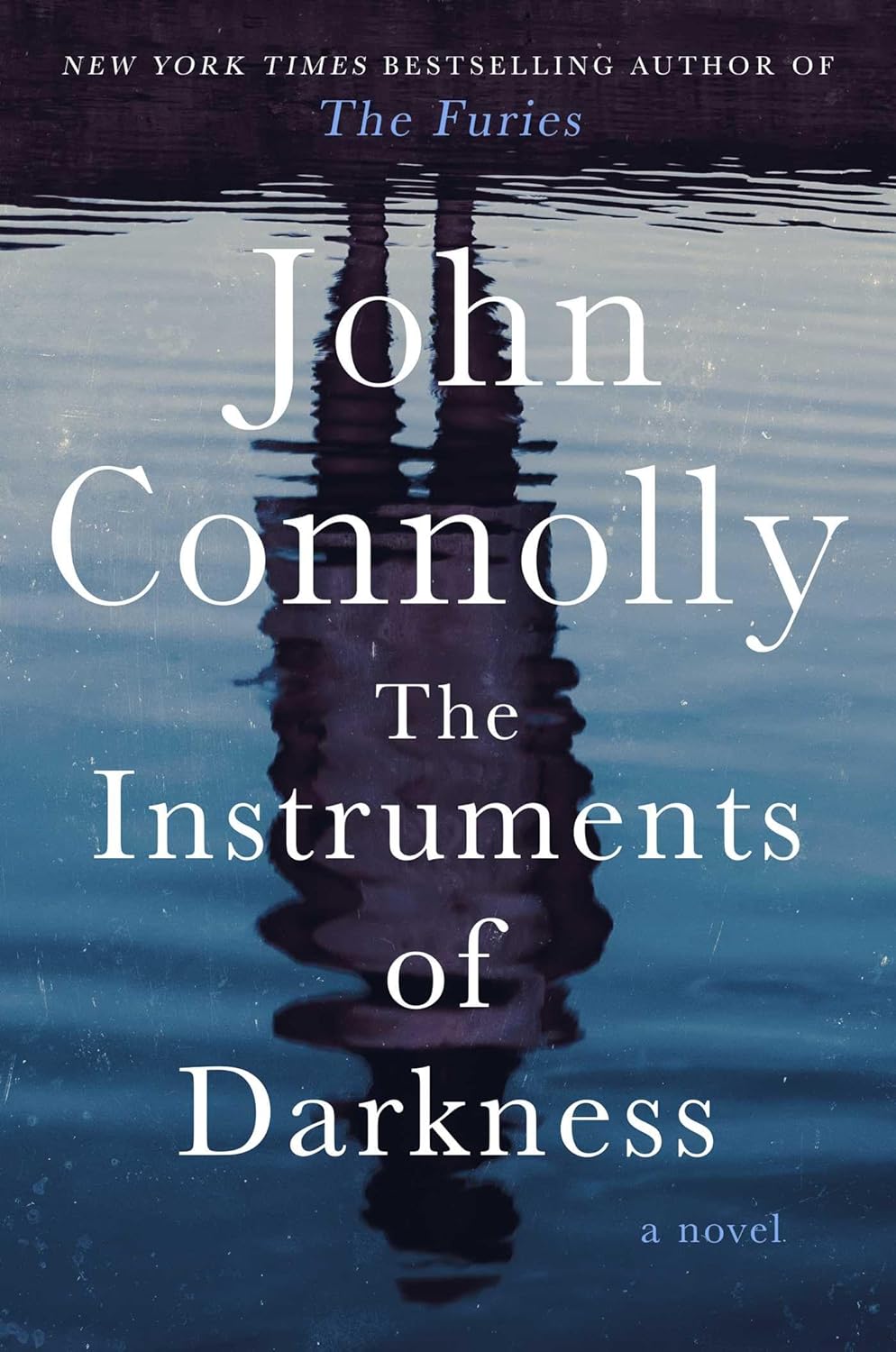
Instrument of Darkness, by Charlie Parker*****

It’s a funny thing about long running series, how some of them become stale after a time while others just keep building. The Charlie Parker series by John Connolly is one of the latter, and with every addition to it I am more riveted, more amused, and more engaged than I was before. The Instruments of Darkness is the 21st in the series. My thanks go to NetGalley and Atria/Emily Bestler for the review copy; that said, this is one of the rare times that I would have laid out full jacket price if that was the only way I could obtain a copy.

This book is for sale now.

Charlie Parker is a former cop turned private detective with a terrible past. He stepped out to buy a newspaper one morning and returned to find his wife and small daughter savagely butchered; the guilt at not being home to defend them was overwhelming, if irrational. He dedicated himself to finding the person that had done it, and making certain they never did it again. Since then, he’s served as a professional snoop on behalf of other wronged persons. Because he often upsets people with money, power, and twisted morals, he often brings along his own muscle when he works, or in some cases, contracts with them to bodyguard his clients during the process. So it is this time.

The job has to do with a young mother whose baby has been kidnapped from its crib during the night. Colleen woke from the first sound sleep she’d had in forever only to find the nursery window open, and Henry gone from his bed. Later her husband Stephen finds a blanket in the trunk of her car, soaked in blood, which, when analyzed by law enforcement, turns out to be the boy’s blood. Stephen tells the police that he is sure she must have done it, and he leaves her.

But she didn’t. Of course not.

In his last few Charlie Parker novels, Connolly has added touches of horror and magical realism, and it’s only made his stories better. In particular, he is adept at sentient houses or other buildings. Sometimes it really is the structure; at other times there’s some sort of being that lives there, unseen. In this case it’s an old house built from a Sears Roebuck kit over a century ago, and so he names it “Kit No. 174,” and after it appears a time or two in the story, generally as the opening of a new chapter, I get the shivers just seeing the name. The narration tells us, “No one had ever spent long in it—or no one had ever lived in it for long, which is not the same thing. No, not the same thing at all.” There are some minor references to other houses that have appeared in the series, and these will delight the faithful readers that remember them; it did me. However, newbies that are just starting this series will be fine.

The recurring characters shine brightly here. The attorney that often hires Parker, Moxie Castin, opens the book, and we get a resonant character sketch:

“Moxie Castin was easy to underestimate, but only on first impression. He was overweight by the equivalent of a small child, didn’t use one word in public when five others were loitering nearby with nothing better to do, and had a taste for ties reminiscent of the markings of poisonous insects or the nightmares of LSD survivors…He lost cases, but not many, and his friends far outnumbered his enemies.”

Other recurring characters are the Fulci brothers, and when I see their names, I smile. They’re described as “two wrecking balls in human form.” Another is Sabine, a shy, tortured psychic that just wants the dead to go away and leave her alone, and best of all, Angel and Louis, a lawless couple of friends—the word “couple” applies in two different ways here—that Parker hires when things get spicy. If I smile when we are joined by the Fulcis, I beam when I see Angel and Louis. And in a nod to series regulars, there’s a point when Parker simply tells someone, “They’re coming,” and he doesn’t say who, but of course, we know exactly who. (Later he explains them for the uninitiated.) There’s a favorite passage of mine in which Parker is concluding an interview, done in a restaurant, and when he and the other person emerge, she sees them and asks,

“Are they with you?’

“They’re my associates.’

“They don’t look like private detectives. Don’t take this the wrong way, but they look like criminals. If they came into the store, I’d lie down on the floor with my hands behind my head.’

“Sometimes that’s precisely the effect we seek.’”

Oh, there’s so much more, but you need to find these things for yourself. The story is on the gritty side, but not nearly as much so as some of the others in the series. In fact, I generally have a policy of not reading this series at bedtime, lest it enter my dreams. I violated that policy once, and I did indeed have a dreadful night afterward. And so I behaved myself until I hit the last twenty percent, and at that point, I knew I would read it until it was done, regardless of the time or proximity to lights out, because I had to see the resolution. I had guessed, long before, whodunit, but that felt beside the point. So I stayed up and saw it through…and I’m not a bit sorry.

Highly recommended to those that love the genre, and especially to Charlie Parker buffs.

The Dirty South, by John Connolly*****

A few years ago I read and reviewed my first book in Connolly’s Charlie Parker detective series, and I became immediately addicted. Since then I’ve never missed an installment, and after the 17th in the series, A Book of Bones, I more or less stalked the internet to find out when I could find the next in the series. It doesn’t disappoint. My thanks go to Net Galley and Atria Books for this, the 18th in the series. It’s for sale now.

Here, Connolly steps away from the crossed-genre, pants-on-fire entries he’s written recently to scribe a prequel. A couple of new readers have inquired whether to read this before all of the other Charlie Parker books, or treat it as the 18th.  The fact is, you can take it in either direction. On the one hand, I have reached back and read a couple of the first in the series and whereas they are perfectly respectable detective novels, they don’t hold a candle to those he’s written more recently. Once I had read the 14th, which is where I began, I was spoiled and a wee bit disappointed by the earliest books in the series. So whereas it makes sense to start reading with this prequel, I fear some readers will notice a dip in quality if they read this masterful literary mystery Connolly has just published, and then dive into his earliest Charlie Parker books. Again, they aren’t badly written. But they aren’t brilliant, and the most recent five in the series, including this prequel, are. So take that and do as you like with it.

Parker is reeling, as the book unfolds, from the vicious murders of his wife and daughter by a killer that intended to slay him, but found them instead. He is convinced that their murderer is a serial killer, and so he has taken a leave of absence from the police force back home and is touring the country by car, chasing down every murder anywhere that bears a resemblance to theirs. He is a dangerous man, because he has no sense of self-preservation. He sees himself as a man that has lost everything, and such men will take risks that more happily situated investigators would consider unthinkable. He also has a source none of the others can access: his wife, his daughter appear to him now and then, and they tell him things that relate to the case at hand, things that nobody else knows.

Those familiar with the series know that Connolly’s most recent Parker books have veered more in the direction of horror, and they include a number of supernatural events that his earlier work does not. Here he steps away from it, and once again his only information from the great beyond is what the spirits of his loved ones share. His adversaries are purely mortal ones. And as to which is better, it’s hard for me to say. His last book prior to this one is a monster, and it includes a tremendous amount of historical research that I find appealing, along with some hugely original, sinister characters that surely must come straight from the bowels of hell. It’s amazing work.

But there’s something to be said for books like this one, too. Most of Connolly’s work is so edgy and so full of violence that I have had to take it in small bites, lest it affect my overall mood. I didn’t have to do that here. I can crawl under a quilt and read for hours without needing to come up for air. I always make sure I read something less malign for a few minutes before turning out the light, but at the same time, this is a much more comfortable read.

Which is not to say that it’s tame. It isn’t. Someone has murdered Black girls in this tiny Arkansas burg, and Parker pulls into town right on the heels of the most recent one. Right away, it becomes obvious that there’s shifty business going on. The town is miserably depressed economically, and the local robber barons, the Cade family, have a deal in the works to bring a large manufacturer to town.  The Cades stand to make a great deal of money, and the locals, poverty-stricken and jobless or badly underemployed, are convinced that better times are just around the corner.

And so it seems that nearly everyone has a stake in keeping the waters calm. The dead girls had to go and get themselves murdered, just when the deal’s about to go through? How inconsiderate. Yes, their killer should be found and brought to justice; but that can wait until the big dogs have signed on the dotted line.  Prosperity is just around the corner. A scandal might ruin everything, and Parker refuses to cooperate, insisting on justice for the murdered children. The nerve of him.

Connolly’s signature elements—the malign, solipsistic, endlessly greedy local bourgeoisie; the poignance of Parker’s grief and his communication with his dead family; and the fast paced, complex plot with a zillion characters and some snappy banter are all here in spades. As usual, his writing style is literary, and so this may not be the best choice for someone whose mother tongue is not English.

As always, highly recommended. This is indisputably one of the year’s best. As for me, I’ll be keeping an eagle eye out for the 19th Parker book, because nobody else writes like this.