My Friends, by Fredrik Backman***-****

“Being human is to grieve, constantly.”

Well now. Fredrik Backman’s many fans ought to brace themselves for his latest novel. The feel-good stories he’s written, and written brilliantly, in years gone by are nowhere in evidence here; those of us that look to this author to bolster our sense of optimism and to remember that human beings are innately good are not going to find it. This book is far darker than anything he’s written to date, and I have no idea what is behind this sorrow and misery sandwich, but I am sorry it’s come to this.

My thanks go to NetGalley and Atria Books for the review copy. This book is for sale now.

Our premise is that a homeless teen artist, grieving the death of her best friend, befriends an older, dying street artist who turns out to be someone famous and revered in the art world. The artist senses in her a kindred spirit, and so his last act is to have his friend and business agent sell everything that the artist owns in order to purchase back one of his most iconic paintings and give it to her after he dies, because “She’s one of us.”

Okay. It’s a stretch, but it’s fiction, and after all, Backman generally delivers, so I’ll suspend disbelief and roll with it.

Nearly the entire remainder of the book consists of the friend, whose name is Ted, spilling his and the artist’s past to the girl, whose name is Louisa. He’s traveling by train, and so he takes her with him. We hear all about their childhoods together, along with the two other friends that made up their tightly knit friend group. At one point she runs off, and at another, they lose the painting and the artist’s ashes, but these constitute minor breaks in the otherwise unending conversation, which is nearly a monologue.

It didn’t take me long to be heartily sorry I had ever taken the galley; I finally bonded with the narrative at about the 60% mark, and from that point until just past the 80% mark, I was reading because I wanted to know what would happen next, or be said next, rather than from a sense of duty. For most of the final 20%, I was watching the page numbers and wondering if this thing was going to end, ever.

It’s hard to rate a book like this, because so much of my disappointment stems from my earlier admiration of Backman’s works. If this was written by someone with whom I was unfamiliar, would I rate it a little higher? But then, if the author wasn’t known to me, I likely wouldn’t have picked it up in the first place. The stark shift in the author’s world view is shocking, and I am still not entirely over it. I can only recommend this book to you if you need a grief book, because anyone in need of a good ugly-cry will surely find it here.

The Answer is No, by Fredrik Backman****

Who can resist a story by Fredrik Backman? His soothing tone and positive message about the nature of humanity is balm for the soul. So although I seldom read stand alone short stories, I leapt on this one right away. My thanks go to NetGalley and Amazon for the review copy. This book is for sale now.

This is one of those stories where you can see what’s about to happen, in broad strokes, right out of the gate. The blurb gives us the contours, telling us that our protagonist, Lucas, is about to have his life ruined by a frying pan; his life is perfect, single with no entanglements. He has no friends that he owes favors; no girlfriend; his life is simple and uncomplicated. He has a nice little apartment that’s his alone; after work, he can eat his Thai food and play his videogames without harassment. He doesn’t bother anybody, and nobody bothers him.

Then there’s a knock at the door, an insistent one; it’s a small klatch of people that introduce themselves as “the board.” Someone has disposed of a frying pan in an unauthorized spot, and they are determined to root out the culprit and penalize them. Everyone is considered guilty until proven innocent! Lucas protests his innocence and makes a few hapless suggestions in hopes of mollifying them, but instead, they draft him to head a committee, and they won’t let him out of it.

This is a pleasant enough story, consistent with Backman’s usual style, but at the same time, because it is a short story, it lacks some of the most agreeable aspects of a Backman novel. In his full length books, Backman creates and develops a massive collection of characters, and he always juggles them brilliantly, developing several and keeping each of them so distinct that the reader can’t forget who is who. Here he is forced, due to the limited length of the thing, to keep it down to a small handful of characters, and while some will likely appreciate this, I miss the complex stories with infinite character back stories and interrelationships. So, as short stories go, this perfectly fine, but for those of us that are fond of Backman’s epic tales, it feels just a trifle anticlimactic.

Recommended to those that read everything Backman writes, and to those that prefer a more streamlined story.

The Winners, by Fredrik Backman*****

“Do you want to understand people? Really understand them? Then you need to know all the best that we are capable of.”

The Winners is the third book in the Beartown trilogy by the iconic philosopher-novelist, Fredrik Backman. In the afterward, he tells us, “To you who have read this whole of the saga, I’d just like to say that I hope it gave you something, because I gave it absolutely everything I had.” I am one of them, and I believe him, and yes, it did. My thanks go to Net Galley and Atria Books for the invitation to read and review. It’s been an honor.

I began reading with a certain amount of trepidation, because everything I’d heard and read, some of it by the author himself, suggested that this wasn’t going to be gentle reading. Here’s how he opens it:

“August ends with sultry, ominous heat before autumn kicks the door in at the end of the month and the temperature tumbles in free fall. The natural world around us becomes erratic and aggressive, the dogs and hunters feel it first, but soon everyone else does too. We notice the warnings, yet still the storm arrives with such force that it knocks the breath out of us. It devastates the forest and blocks out the sky, it attacks our homes and our towns like a grown man beating a child.”

Woof.

The characters we’ve met in the first two books, Beartown and Us Against You, are all present and accounted for, and now that his faithful readers already know most of the central characters, Backman gives us a few more. The new hockey coach is Elizabeth Zackell, a quirky individual if ever there was one, and smart as hell. We are introduced to a family from Hed, the nearby town whose club is Beartown’s archrival; we become attached to these people, too. But ultimately, we see the way that great love and passionate loyalty can go hand in glove with violence and even evil.

It’s a story that can take your breath away.

I won’t try to address the whole story or individual characters; that’s Backman’s job, and he does it quite nicely. I had a quibble with the way the first book ended; I said in my review that it was over-the-top, bordering on glib. I see now that this was deliberate, and he wants us to see that not every family responds to a crisis as well as the Andersons have, and not every victim of a violent crime is able to see justice done; not everyone has the heroic instincts of Amet, the player that runs toward the fire rather than away from it.

The hallmarks that make Backman’s work so special are all here. I can count on one hand the number of male authors that genuinely respect women and are willing to go to the mat for women’s rights, and he is one of them. He is a vocal champion of the rights of gays and lesbians, and his prose shows keen understanding of the struggle they face, even now that their legal rights are protected in much of the world. His capacity to juggle a large cast of dynamic characters, developing nearly every one of them in a way that is consistent, along with their relationships with each other, makes me feel as if I could recognize them on the street; I don’t mean one character, or two. I mean at least a dozen of them. There are a number of characters that do bad things or make bad choices, but only a couple are genuinely bad people, and though we see little of them, they cast long shadows on these two communities.

He got the ending exactly right.

Can you read this book without reading the other two first? Don’t be a dick. Of course not. Without familiarizing yourself with the characters in the first book before the second, and the second before the third, you won’t be able to keep everyone straight; also, this third volume is about the same length as the first and second combined. Start with the first one.

Highly recommended.

Anxious People, by Fredrik Backman*****

He’s done it again, only better.

My thanks go to Net Galley and Atria Books for the review copies. You can buy this book today, and I suggest you do it. The world around us may have gone nuts, but Backman helps us to remember the good in ourselves and in those around us, even in the most unlikely people. For that alone, this book is worth its weight in gold.

We start with an attempted robbery at a cashless bank; as with so many crimes done on impulse, nothing goes the way it’s supposed to. There’s no money to be robbed, and with the cops on the way, the best thing to do is to duck out quickly…until you realize that the door you chose isn’t an exit. Then there are these hostages, an insurance policy to prevent your being swept away to prison, but “it’s harder than you might think to take people hostage when they’re idiots.”

Backman often creates complex situations with huge numbers of characters in his novels, and he does better than hardly anyone else when he does it. This book, by contrast, has a more manageable number of characters, and perhaps that’s a big part of its even greater success. We have the robber; the hostages, who are the people viewing an apartment for sale, and the seller and realtor; a pair of cops that are also father and son; the therapist that sees one of the hostages; and a couple of other people. The first that we meet is Zara, a sharp-tongued, wealthy woman that is viewing the apartment even though she is obviously too rich to want it. Just about everything that comes out of Zara’s mouth is smart, mean, and very funny; we gradually learn that she does this to deflect the conversation away from herself. With apologies to Dickens, Zara is as solitary as an oyster.

Besides Zara, the prospective buyers include two dysfunctional couples. There’s an older couple, man and woman; and there’s a pair of women, one of whom is hugely pregnant. When this is revealed I roll my eyes, convinced that the climax is almost certainly going to include the obligatory emergency birth. But I should know better, by now, than to underestimate Backman.  He doesn’t use tired tropes or formulas, and Julia isn’t going to give birth during this crisis.

I don’t want to give away any of the details here, but as we get to know our collection of hostages and others, it’s pretty clear, as the title suggests, that everyone’s misbehaviors come from their anxieties, and when they criticize and pick away at others, they are actually dissatisfied with themselves. But of course, Backman’s writing is much more magical than my own, and the result is the sort of feel-good denouement that doesn’t insult our intelligence or become maudlin. At this moment I can only bring to mind three writers that consistently do this for us. (The other two are Alexander McCall Smith and Amy Poeppel.) And right now, friends, we need all of this magic that we can get.

Buy this book if you can; if your wallet is too thin right now, then get on the list at your library. Highly recommended to everyone.

Things My Son Needs to Know About the World, by Fredrik Backman***

Purely by serendipity, Backman’s collection of essays came out in the US as my own son is initiated into fatherhood. My thanks go to Atria Books for the review copy; it’s for sale today.

Backman is known to me as a fiction writer, and I have read most of his novels, which are beloved worldwide. Here he delivers nonfiction with the same gently philosophical voice.  Despite the title, the essays are written for adults; this is not a children’s book.

Backman waxes eloquent on diverse topics, and it sounds sweetest—as always—when he focuses on what real men do. For example, all his life, he says he has been told to stand up like a man, but he wants his son to know that a real man should also know how to “stay seated, shut up and listen.”  Women the world over, myself among them, cheer this, and in saying it Backman helps make the world a better place. Other parts are funny as heck, as when he describes trying to change a diaper on an airplane.

The book’s only weakness is the overuse of the words “stuff” and “crap,” throughout the text, and knowing the author’s signature style, I suspect that this began as deliberate repetition for emphasis and as a form of figurative language that somehow didn’t translate effectively.

That said, it’s a sweet little book and a good read, and its timing begs for it to be a reverse-Father’s Day gift in the US, from fathers –or better still, grandfathers—to sons.

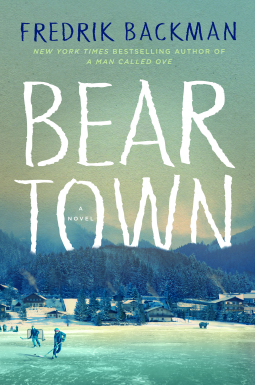
Beartown, by Fredrik Backman****

beartown“You can fuck any girl you like here tonight; they’re all hockey-whores when we win.”

Fredrik Backman is a sly writer, and he has a way of spiraling around his central point so that readers are mighty close by the time they recognize where they are. He writes with philosophical grace tinged with wit, and his novels are popular because of it. And so it cheers me to see him examine what might happen to a small depressed town whose hopes are all hinged on youth sports. Thanks go to Net Galley and Atria Books for the DRC, which I read free of charge in exchange for this honest review. Beartown is available to the public today.

In Beartown, everyone dreams of hockey, and those that don’t are stuck on the outside looking in. A man’s glory days are done before he’s 40; a woman has no glory days at all, since women cannot play on the men’s team and there is no women’s team. Everything comes second to hockey: education, social skills, and even the law are bent, sometimes to the breaking point, in order to accommodate star athletes. Hockey is the town’s only remaining business, and it seems to provide the only possible hope for young men that have grown up in the forest and don’t want to leave it to seek work.

Backman has a genius for drawing the reader in. Some of the scenes in this story actually make me laugh out loud. His respect for women is a breath of fresh air as well. In literary terms, though, the greatest success of this piece is the way a large number of characters are developed so that readers genuinely feel that we know not just a protagonist, but a whole town. We know who is related, what private baggage exists between individuals and families, which marriage is happy and which is not, and it’s delivered to us in a way that never feels gossipy or prurient. Rather, Backman makes us feel as if we are part of the town, and so everything is important to us as well.

Fans of Backman’s will be pleased once again here. My sole quibble is that I see a character at the end behave in a way that is so inconsistent with what we know of him so far that I can hear the violins play. It’s heartwarming, but if the same thing had been achieved more subtly, it would be credible as well.

Nevertheless, you won’t want to miss this book. Regardless of the ugly things that are said and done at various points, the author comes back, as he always has before, to the innate goodness of the human spirit, and it’s messages like this one that we need so badly today. Recommended to those that enjoy good fiction.