It’s a Privilege Just to Be Here, by Emma Sasaki****

Emma Sasaki makes her fictional debut with the darkly amusing story of a mother and daughter caught up in a scandal at a prestigious private school. My thanks go to NetGalley and Dreamscape Media for the audio galley. This book is for sale now.
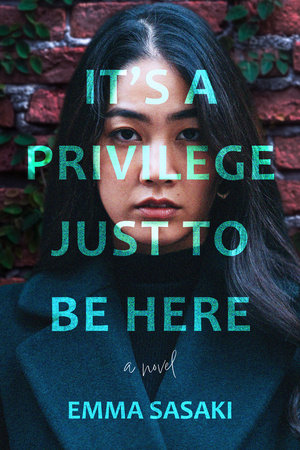
Wesley Friends School is the prep school to which presidents and other high placed politicos send their teens, a place where they are nurtured as completely as any hot house flower, and then sent onward, hopefully to an ivy league college. Aki Hiyashi-Brown abandons her PhD and accepts a teaching job there in order for her daughter, Meg, to be able to attend; otherwise the tuition would be impossibly expensive. The school is overwhelmingly Caucasian, and so perhaps it’s unsurprising that Aki finds her face prominently displayed on all of the promotional materials the school disseminates, along with those of the few other teachers of color.

That’s all fine and good until the day when the fence outside is vandalized by spray paint reading, “Make Wesley white again.” Aki is ready to do what she’s been taught from the cradle: keep her head down, do her job, and not say anything. But Meg and her classmates have no intention of remaining silent. Before she knows it, Aki finds she has been assigned to be the head of the Racial Equity Task Force, a token job on a token committee that has more to do with appearances than with any actual desire for change.

She is given a script to follow and told not to offer up any of her own observations or opinions.

Soon, things spiral beyond the control of Wesley’s administration, and Aki is caught between doing what her bosses want her to do, and supporting her daughter and students in their quest for genuine change.

This book, which the author notes is based on her own experience, has me at hello. Though I am not a wealthy or connected individual, I did send my child to a private school for a few years, one which was very white, and which used my half-Japanese daughter’s face on its pamphlets a lot. I can’t not read this book, and whenever I have earbuds in, this is what I listen to. I find it well paced and engaging, setting just the right tone without over-moralizing or becoming strident. There are some great side characters as well; I like Aki’s husband and mother particularly, and appreciate the bond between Aki’s half-Japanese daughter and her Issei (first generation) grandmother.

However, my own husband is also Issei, and I asked him to listen to the reader during one of the many passages in which the grandma speaks to Aki in Japanese. “Is this reader’s Japanese as good as I suspect?” I asked, somewhat proud of my first year Japanese skills. He listened to two lines, laughed, and shook his head.

For this, I really do have to knock one star off my original five star rating. Perhaps if I had a digital review copy I could have rated that version higher, but I have what I have, and it’s problematic. Nevertheless, I appreciate this novel and the message it delivers, and I greatly look forward to reading whatever Sasaki publishes next.

Happiness Falls, by Angie Kim*****

Angie Kim’s barnstorming best seller in 2019, Miracle Falls, showed us that she is a force to be reckoned with. Now she’s written something even better. My thanks to go Net Galley and Random House for the review copy. This book is for sale now.

I admired Kim’s debut novel, but because of its complex nature, it was a fair amount of work to read. Happiness Falls is every bit as brainy, but it’s streamlined, with just five important characters and a handful of secondary ones, so the reader can spend more time enjoying it and trying to puzzle out the solution, and less time trying to keep up with the plot and recall the intermittently appearing characters as it progresses.

As with her debut, this story features a main character with special needs. Eugene Parson has Angelman syndrome, a rare disorder that has rendered him incapable of speaking. This is a problem, because one day, Dad and Eugene go to the park for their daily walk, but Eugene comes home alone, bloody, disheveled, and tremendously upset. What happened? The family’s concern intensifies when Dad’s backpack is found floating downstream, but Eugene cannot speak. And so, the mystery that is interwoven into this family drama is established.

The story is told in the first person by Mia, Eugene’s older sister. Mia’s twin, John, rounds out the siblings, and their mother is the fifth family member. It’s set in Virginia during the pandemic; however, plot and character are much more important here than setting.

The mystery—what has happened to Dad—is wholly original because of the critical role played by Eugene’s communication challenges. Originality becomes more important to me every time I pick up a mystery; once you’ve read several hundred of these things, sameness can produce tedium. But this novel has much more going for it than that. The characters are absolutely believable. The teenagers are all convincing; they are age appropriate, bright but occasionally impulsive. Best of all is that there is no abuse story tucked in here. Their dad is or was a loving one, and the same is true of their mother. The parents have navigated bumps in their marriage, but by the time we hear of them, they’re fine. There’s no horrific baggage waiting to ambush us. These are nice people whose lives are complicated solely by the need to assist Eugene, whom everyone also loves. I make a point of telling you this, because I am sick to death of stories about terrible mothers. I’ve had enough of them, and am delighted Kim doesn’t go there.

Our narrator, Mia, is cleverly drawn; she is the family cynic, and she’s the family motormouth, and so if we occasionally wonder why Mia is telling us everything in such detail, it’s because Mia is a talker.

There are twists and turns all over the place. Just when I begin to think I might have a handle on this mystery, Kim throws in something else that leaves me gaping like a guppy. What? Huh? Oh. Well, there goes my theory. What now?

Because I came to this post-publication, I checked out the audio version at Seattle Bibliocommons to help me catch up. The audio is very well done. Initially I didn’t find Mia’s narrative voice appropriate because she seemed mighty chirpy for a girl that may have just lost her father; however, once Mia’s character is further developed, which doesn’t take long, I realize that the chirpiness is part of Mia’s denial. She’s very close to her dad, and she can’t bear to think that he is in danger, or worse.

I have rarely felt any interest toward any profound learning disability, but Kim made me care about Eugene and Angelman’s.

This novel is brilliant, a standout for 2023. I highly recommend it to all that love a good mystery or family story.

The Fortunes of Jaded Women*****

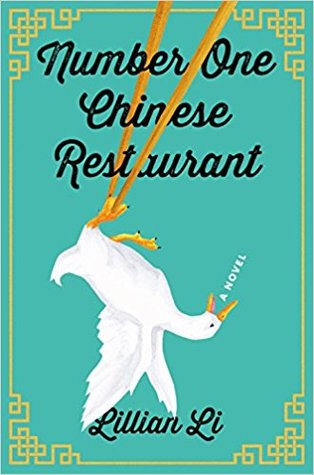
The Fortunes of Jaded Women by Carolyn Huynh, is hilarious and oddly touching. It’s the best debut novel of 2022, and it isn’t as if there was no competition. My thanks go to Atria Books and Net Galley for the review copy; this book is for sale now.

Mrs. Mai Nguyen was born in Vietnam, but has lived most of her life as a Californian. When we meet her, however, she has flown to Kauai, the home of a renowned Vietnamese psychic. The psychic tells her that the year ahead will be a pivotal one, the one in which she must repair her relationships with her sisters and her daughters. There will be one wedding; one funeral; and one pregnancy.

Well, now.

Nobody likes to be estranged from a family member, and yet it happens. But all of them? Both sisters, and her daughters, too? (No brothers, and no sons, either.) But surely, it isn’t her fault; after all, there’s the curse.

Chapter four is when everything kicks up a gear, and I have seldom laughed so hard. Mrs. Minh Pham is the first to arrive, and she has my attention from the get-go when she slips the waitstaff some money and explains there could potentially be a “small, tiny, little shouting match, with a propensity for small, tiny, little objects to be thrown through the air.” Mrs. Pham is the middle daughter, and is accustomed to being the mediator in any dispute. She takes all the precautions she feels are wise; she parks near the door for a fast getaway if necessary. She removes the sharp utensils as well as the chopsticks from the table, and requests paper plates and plastic cutlery. “Mai had a reputation for throwing things.”

As the women arrive at the dim sum restaurant, they flash their fake Louis Vuitton handbags and immediately set about trying to one-up one another with regard to social status and affluence, and especially—oh yes, especially—that of their respective daughters. Within three minutes, a donnybrook ensues, and the other diners, who are also Vietnamese and well acquainted with the curse of the Duong sisters, begin placing wagers on the winner. The sixty-something sisters commence throwing things at each other and are gently escorted out of the restaurant. They head for a bakery, and they get kicked out of there, too. Finally, the three of them end up on a park bench, their hair and clothing in dishabille, and yet none of them makes any move to leap up and go home.

These are not spoilers; this all takes place within the first 17 percent.

The chapters change points of view, moving between the sisters, their elderly mother, and their daughters, all in the third person omniscient. The fascinating thing is, these crazy behaviors, and the ways that they mold and shape their daughters and their relationships, all fit perfectly.

Although the setting changes, from Orange County, California to Hawaii to Vietnam to Seattle and beyond, this story is character based, and that’s my favorite type of novel. The skeezy men they date—mostly white boyfriends with Asian fetishes—make it even funnier.

The ending is perfect.

This is one of those rare galleys that I may actually read a second time for pleasure. One thing I know for sure is that Huynh is on my radar now. I can’t wait to see what her next book looks like!

Best Debut Fiction 2018

Image

                                                                                           Honorable Mention:

The Quantum Spy, by David Ignatius*****

“America is a country where race matters. The more people say they are, what, color-blind, the more it is a lie.”

thequantumspyDavid Ignatius writes gripping spy fiction, and this is his best work.  The basis of this one is the longstanding intelligence war between the CIA and its Chinese counterpart; the story is fictional, but his careful research ensures that this could have happened.  Lucky me, I read it free thanks to Edelweiss and W.W. Norton and Company Publishers. This book will be available to the public tomorrow, November 7, 2017.
Harris Chang is Chinese-American, raised to respect the red, white and blue.  He works for the CIA, and has been sent to investigate a leak in a quantum research lab. As the USA and China struggle to achieve technological dominance, tensions rise. Chang wonders if he has been chosen to investigate based on his ethnicity, since he knows very little about China or even his own family tree; why yes he has. The Chinese expect to be able to turn him because of it, and over the course of time, his bosses begin to suspect that it’s happened.  Harris is loyal, and he chafes at the unfairness of his treatment, but is determined to succeed. After all, what could prove his loyalty more clearly than to perform above the standard to which most of the Agency’s employees are held?

The setting changes constantly as spies chase other spies all over the world, but the story takes place primarily in Arlington, Virginia and in Singapore. There are also some especially tense, intriguing scenes set in Mexico, and I love the side details about Trotsky’s house, which is now a museum.

Ignatius dumbs down nothing for anyone, and so the reader should have literacy skills that are sharp and ready. Don’t read this one after you take your sleeping pill. Trust me.

The story can be read—and mostly will be, I think—as an enjoyable bit of escapism. With current events so intense, we all need some of that, and it’s what I expected when I requested the DRC. But I find it much more rewarding because of the racial subtext. It’s an area that’s important to me, and at first my back was up when I saw hints of it without knowing what the writer’s intentions were. So many are astonishingly clueless, or worse, when it comes to this aspect of fiction. But as I saw where he was taking it, I had to completely reevaluate my opinion. I would love to be surprised in exactly this way more frequently.

The ending made me want to stand up and cheer.

Highly recommended to those that love strong thrillers, and even more so for those that also cherish civil rights in the USA.


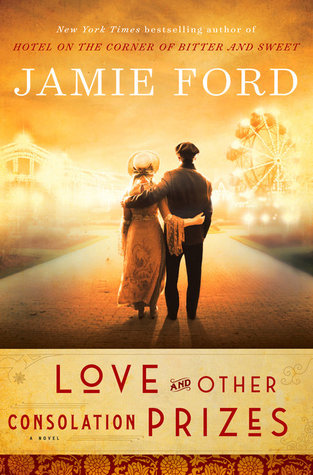
Love and Other Consolation Prizes, by Jamie Ford****

“‘We all have things we don’t talk about, Ernest thought. ‘Even though, more often than not, these are the things that make us who we are.'”loveandotherconsolation

Ford is the author of Hotel on the Corner of Bitter and Sweet, which is one of my favorite novels, and so I was thrilled when I saw he had written another historical novel set in Seattle. Thanks go to Net Galley and Ballantine Books for the DRC, which I received free in exchange for this honest review.

Ernest is a small child when his mother, who is dying, wrenches herself away from him and puts him on a boat to the USA. He attends a charity boarding school and then is raffled off, a free orphan to a good home, by the Children’s Home Society at the Alaskan Pacific World’s Expo. It is Flora, the madam of a Seattle brothel, that claims him and brings him to the city. There he is essentially a house boy, and he forms a warm friendship with two young women employed there, Fahn and Maisie.

The narrative is divided between two time periods, the first following Ernest as he leaves China and arrives in the USA at the dawn of the twentieth century, and the second in the early 1960s when he is elderly and his wife, Gracie, is suffering from dementia. There’s an element of suspense that is artfully played as we follow both narratives, trying to untangle whether the woman that becomes “Gracie” is Maisie, Fahn, or some third person.

But Ford’s greatest strength is in bringing historical Seattle home to us. The characters are competently turned, but it’s setting that drives this book, just as it did his last one. Ernest lands in the city’s most notorious area at the time, a place just south of downtown known as the Tenderloin:

He had never once been near the mysterious part of Seattle that lay south of Yesler Way, a street better known as the Deadline. His teachers had talked for years about sewer rats that plagued the area, and rattlesnakes, and about the wolves that prowled the White Chapel District, waiting to sink their teeth into the good people of Seattle, which a local song had dubbed the Peerless City. Ernest had imagined lanky, sinuous creatures with sharp claws and tangles of mangy fur, but as he looked out at the avenue, all he saw were signs for dance halls and saloons.


Ernest’s years at the brothel prove to be the best of his young life, primarily because the rest of it was so much worse. Every time a rosy glow starts to form around the brothel and the condition of the women that work there, Ford injects an incident that is stark and horrible to remind us that trafficking in human beings and their most intimate acts is criminal and should never be condoned. Miss Flora is a relatively benign madam because it is better for business, not because of any sentimentality toward the women she employs. This comes to us all the more starkly when her own daughter’s virginity is raffled off to the highest bidder.

All told, this is good fiction, poignant, warm, and moving. Two things give me pause: the ending seems a little far-fetched, and the depiction of the suffragists, who are some of my greatest heroes, is so hostile that it borders on the misogynistic. However, the latter is peripheral to the main story, winking in and out briefly, and overall this novel is an appealing read. It will particularly appeal to Seattleites and to Asian-Americans.

I recommend this book to you, with the above caveats, and it for sale to the public today. 

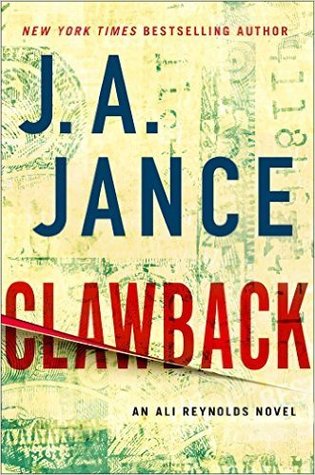
Clawback, by JA Jance*****

clawbackI’m a long time reader of novels by JA Jance, but until I read this new release, I would have told you that her Arizona series are second string efforts compared to the JP Beaumont titles set in Seattle. Not anymore! Thank you to Net Galley and Touchstone Publishers for the DRC, which I read in exchange for an honest review. The book will be available to the public March 8.

Ali Reynolds is our protagonist. Her parents have retired, investing their lifelong savings with a company that turns out to be involved in a Ponzi scheme. Ali’s father goes to see his investment agent, who has also been a close friend for decades, and finds him dying. In attempting to revive him and another person, Dad gets the victims’ blood all over himself, and so he is suspected of murder when he calls 911. In an effort to help clear her father, Ali, along with her parents and those with whom she works at High Noon, unravels one layer after another of deception and danger.

Those that read my reviews know that I am always sensitive to the subtext. In addition to telling a well woven, technically savvy tale of suspense, Jance is brilliant here in the way she crafts her female characters. She takes apart almost every conceivable stereotype without pausing the story’s pace or becoming preachy or conspicuous. As the mother of a half-Asian daughter, I particularly appreciated the development of Cami. But even for those that don’t care much about social issues as reflected in text, it’s a tightly wound tale that will leave any reader leaning forward in their easy chair, straining to get to that last page and the denouement.

Besides enjoying the mystery, I also learned some things. I had never heard of a “clawback”, a terrible law that has to do with penalties that are assessed victims of Ponzi schemes, and I had also never heard of a “Silver alert”. I read a lot of nonfiction, but Jance’s new book is a great reminder that we can learn things from fiction too, and it’s often more fun that way.

Highly recommended to everyone.