
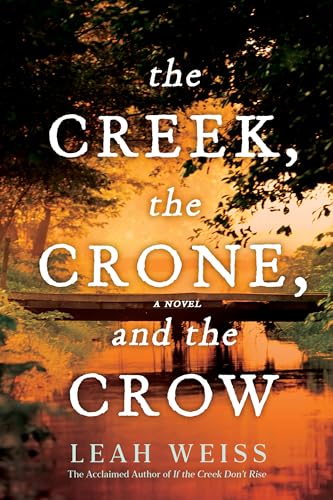
The Creek, the Crone, and the Crow is the newest novel by Leah Weiss, author of If the Creek Don’t Rise and All the Little Hopes. It’s her best one yet. My thanks go to NetGalley and Sourcebooks Landmark for the review copy; this book is for sale now.
Kate is a teacher, and she’s spent ten years as the sole instructor in one of the last one room schoolhouses, located in the tiny Appalachian hamlet of Baines Creek. But they say bad things come in threes, and that is certainly true for the people of Baines Creek, and for Kate as well. First, people from the state sweep in and declare that the schoolhouse must close and its pupils be bussed to a larger school. This is devastating, because locals use a folk dialect that will get them teased by more worldly children that are integrated into the larger society. These kids learn differently, and most parents are so afraid of what will happen that they resolve not to send their children anywhere at all. School’s out…period.
Next, Birdie, the elderly healer and wise woman of Baines Creek dies, leaving all of the homemade books she’s created for decades to Kate. Kate is bewildered. Why her? What to do with them? And Birdie was such a key part of the village that her loss is felt keenly.
And then little Loretty, a child that was being instructed by Birdie, and who is believed to have the same second sight that Birdie had, goes missing. She’s so young, and no one has any idea where she may have gone. Search parties are organized almost continuously, but there’s not even a clue where she may be.
Our second main character, Lydia, is a psychic whose gift vanished when her parents died. She travels to Baines Creek in search of Birdie, who she believes may be able to help her regain her gift. But first Birdie refuses to see her, merely saying that it isn’t time yet; then Birdie dies! However, Lydia’s presence is fortuitous, because she has ideas about all of those handmade books, and so she and Kate work together.
This is a wonderful story, the sort to sink into and lose oneself. For me, the only distraction has to do with setting. For the longest time I am unable to understand what time period we’re In here. Cell phones and personal computers, no; microwave ovens, yes. And Lydia’s niece comes to visit, and she’s described as a Goth, so that makes me think of the late 1980’s or early 1990’s. But then it’s revealed about halfway in that it’s 1978. What? There were no Goths in 1978. Fearing that perhaps my memory is betraying me, I look it up, and nope. Goth culture began in the UK in the early 80s, and it spread to the U.S. a bit later. I harrumph and move on.
The setting of Baines Creek is gloriously resonant, and indeed, all of Weiss’s books have been set in Appalachia. There are underground tunnels and moonshiners’ caves, and I won’t give details that would spoil, but there are a couple of caves in particular that are important to the story and tremendously memorable. The ending, which is always important, but more so in a story like this one, is pitch perfect. Highly recommended.
 I confess I was miffed when I wasn’t granted a DRC for this title, and after reading a couple of reviews, I decided I could live without it. I began to wonder about my choice when I saw it hover on the best seller lists where it remains as of this writing nearly a year after its publication, But the clincher came when my younger daughter came to me and said that she had read it digitally and believed I would enjoy it. She said it had to do with the culture of mining families, and that the dedication was to the writer’s “Mamaw and Papaw”.
 Seattle Book Mama