
4.5 stars, rounded up.
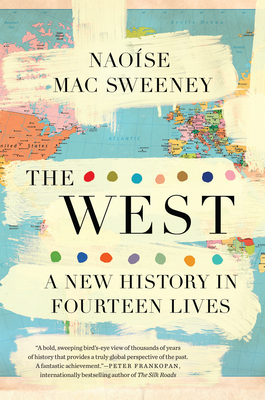
Those that have taken a course on Western Civilization—as college freshmen or otherwise—are familiar with its framework, that the modern world can attribute its earliest, most progressive, democratic, and technically superior attributes to the dead White European men that came before us. Archeologist and award-winning historian Naoise Mac Sweeney has taken a sledgehammer to this construct, proving that many of the smartest scientists, inventors, and social, military, and political leaders were not White, not European, and not male.
My thanks go to Net Galley and Random House for the review copy. This book is for sale now.
Mac Sweeney demonstrates her thesis by discussing fourteen key figures from the past that don’t fit into the standard framework. She begins with Herodotus and ends with Carrie Lam. Some chapters read like a college text or lecture, one where I know that this information is important, but my mind keeps wandering, and I check to see how much longer the chapter will be. Others woke me up. In chapter seven, she features Safiye Sultan of the Ottoman Empire. She was not legally able to become sultan following her husband’s death, so she saw her son installed, and then “summarily executed” his nineteen younger brothers to prevent anyone from contesting his right to rule. Another that made me sit up and take notice is Njinga of Angola. I was riveted by this one, to the extent that I actually shouted at one point. (It’s all right; I was at home.) If we judge her work by whether she has proven her thesis, then unquestionably she has done so.
There are two aspects that I didn’t care for here. The first is a mannerism. The use of the Victorian “we” is grating. “As we shall see…” “We have discussed…” No. She has already seen, and the only one doing the discussing within the pages of this book is the author. Also, since the title itself identifies this tome as a history book, Carrie Lam of Hong Kong, whose quotes date from 2021 and 2017, has no business being included here. History is defined as what has occurred fifty years or more prior to publication. Mac Sweeney knows this.
In a fit of pique over these two flaws, in addition to the snoozy parts of the narrative, I initially rated this book with four stars, but this is a groundbreaking body of work, and after reflection, I changed my rating to 4.5 stars, rounded up.
Highly recommended to students and to anyone interested in world history.

 Hannibal was the first general to defeat the forces of Rome, and Hunt is the man qualified to tell us about it. I read my copy free and early thanks to Net Galley and Simon and Schuster. This book becomes available to the public July 11, 2017.
 I surrender! Thanks go to Net Galley and Open Road Media, from whom I received a DRC in exchange for an honest review; however, try though I have, I cannot push past the molasses-like allegory and other figurative language to locate a plot. After painfully forcing my way through the first 20% of the book, I went to Goodreads to see what other reviewers had to say about it. Some felt as I did, but others swore that if the reader could endure the first two-thirds of the story, the last third would not only be so amazing, it would also enlighten us as to why the earlier part was necessary. Seeing this, I vowed to persevere. By the 25% mark, I found I was avoiding this DRC, because just about every other galley in my possession was either more enjoyable to read, or more rewarding, or both.
 The first week or two after Christmas is a sumptuous period for me as a reader. Nearly every book I read these days, fiction or non-, is a DRC, or Direct Reader’s Copy sent to me digitally by publishers via Net Galley in exchange for an honest review. However, each year there are invariably half a dozen titles, sometimes more, that I really want to read and haven’t been able to obtain free of charge. Sometimes I discover a book after it’s already been published some time ago, and sometimes it’s a book that I couldn’t get as a DRC. These books land on my wish list, and my family is faithful in purchasing them and placing them, clad in pretty paper and ribbon, beneath our Christmas tree. By Christmas night, I’m snuggled deep beneath a pile of fluffy covers, my spouse and hound dog snoring sonorously while I immerse myself in the books I am just about guaranteed to love, bathed in a soft yellow bedside light. This ritual is as significant to me as the more widespread traditions of feasting, wrapping gifts, and hanging stockings. I can’t recall a Christmas without it.
 Seattle Book Mama