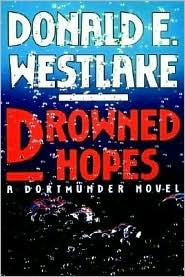
Drowned Hopes, by Donald Westlake *****

drownedhopesA guy gets out of prison, and he goes to get the loot where he buried it. Unfortunately, he’s been gone quite awhile. A dam has been built and the water for a whole town is on top of it now. In order to get to it, he just may have to drown the whole town.
The protagonist is the guy he goes to see about it. Our protagonist, of course, is not a big-time hoodlum with a heart of flint. Westlake doesn’t write that way. No, our guy is callous, certainly; selfish, no doubt. But he does not have anywhere CLOSE to the hard-heartedness required to drown a whole town. And so it devolves upon him to find a way to get the loot, but not kill the town.

Good luck with that.

Funny as hell, but of course, in a slightly dark way, like all of Westlake’s comic capers.

I confess that when a really amazing writer dies, I feel the impulse to review their work to reduce the possibility that it will fade into obscurity. I discovered Westlake’s work about a year after he died. He wrote for fifty years; his Dortmunder series, of which this novel is the seventh, is where most of his funniest stories are found. This title is my favorite among them…and yes. I hunted down every one of them, and when I could not buy them second hand, I asked for them as Christmas and birthday gifts until I had sucked the entire series dry.

I hope you’ll enjoy them as much as I have.

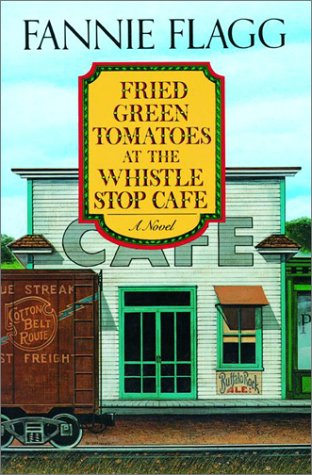
Fried Green Tomatoes at the Whistle Stop Cafe, by Fannie Flagg *****

friedgreentomatoesIf I had to whittle several decades of reading down to thirty favorite books, this one would make the cut. It is wonderful on so many levels. Flagg has published a number of glorious, whimsical yet not shallow novels, always set in the deep South. This one is the jewel in her literary crown.

Have you seen the movie? If you have, this book may be easier for you to read. I read it, and absolutely (as you can see) loved it. The issue for other readers I’ve talked to is that the book hops back and forth in terms of setting, including time period, and it doesn’t provide an obvious heads-up that this is what is happening.

There are two stories being told, one that of a contemporary woman who is unhappy with her life, menopausal and fearful that she is losing her husband’s attention, bored and feeling worthless. She is spending part of her weekend at a nursing home where her husband’s wife resides, but the woman hates her and won’t let her in the room. It is in the lobby where she is faithfully stationed, downing the candy stash from her purse for comfort, that she meets one of the home’s residents, who tells her pieces of her life story, a little more each visit. But in the book, we are taken back in time in other ways. Suddenly we are reading a small town newspaper, and if you are a person who skips chapter headings, you’re likely to find yourself entirely confused.

I won’t give away more of the plot, but for the time in which it was written, this novel bravely took up one progressive (IMHO) cause about which not much was being written. It’s very subtle. Other parts of the story will leave you laughing so hard that you either can’t catch your breath, or if you are old enough, you may not hang onto…something else.

Highly recommended.

I Freed Myself: African-American Self-Emancipation in the Civil War Era, by David Williams *****

IfreedmyselfWilliams is smoking hot when it comes to the role of African-Americans in the American Civil War. The overstatement that Lincoln freed the slaves rubs many of us, and his thesis that not only did the slaves largely set themselves free, but were pivotal to the Union’s ultimate victory, is a strong one.

In Marxist organizations, there is an expression for a political over-correction. It’s called “bending the stick too far back”. The idea is that you want the stick to be straight up, but sometimes when something has been done wrong, and once the evidence piles up until the reader cannot believe that anyone was dumb enough to think otherwise, it can cause other mitigating facts to be obscured; thus, the stick is bent too far the other way. And although I really like the work Williams has done here, and am making my 4.5 rating round up to 5 lest anyone not read this scholarly, well documented work, I do think he has made an error or two by disregarding the dynamics of the war and the decision-making process. It’s easy to do.

Actually, when I taught about this subject, I treated Lincoln and his role in it largely the way Williams does here, and that was a mistake. I used the same quotes Williams uses, and said that every American president basically does whatever he is pressured to do by those who hold the economy in their grip.

I was mistaken, and Williams is too, in this one way. Lincoln was such a friend to the Black man, in fact, that his name did not even appear on Southern presidential ballots (according to Catton, who notes it in the first volume of his trilogy). It was exactly because of this known fact that South Carolina gave notice of its secession even before Lincoln was inaugurated. And when Lincoln was being smuggled from his home to Washington, DC, plans for what to do once in office were prefaced by the qualifier, “If you live…” Because, despite the things Lincoln had to do to set the wheels in motion and set the stage for Emancipation, he was going to see the slaves freed.

The first thing Lincoln had to do, though, was protect the integrity of the Union. This was not a racist error; it’s hard to read about the things he said and did, but if the South were allowed to secede, or succeeded in its mission, it would become entirely dependent upon Britain for its manufactured goods, and largely so for its cotton market, and the slaves might well have remained in bondage much longer than they did.

The most graphic way to see it is this way: take a very basic political map of North America. Draw a line where the states end and territory begins as of 1861. Color all of Canada, which was a protectorate of Britain, red. Now color all of the Confederate States red. Mark the Border States with red stripes. Draw red arrows toward the eastern coast of North America pointing toward the USA. And once you have done all of this, put some red question marks on all of the western territory, and color the remaining Union states blue.

The result will be a very small piece of blue in the middle of all that red. If Britain were able to dominate North America so overwhelmingly, it would only be a matter of time before she began arming the borders, to the north, to the south, occupying harbors, and proceeding to take her “colonies” back. (Remember this had been attempted just 50 years before the Civil War during the War of 1812, when Britain burned the US Capitol to the ground.) So in many ways, this war started out being about maintaining national sovereignty, and could only be about freeing the slaves—which HAD to be done in order for Feudalism to die and capitalism to move forward, as history demands—once it was clear that the Union was safe. And the starting point there was keeping Maryland and Kentucky in the Union. (Color Maryland red and you will note that the entire Capitol city is now surrounded by the enemy; with the president and Congress on hostile soil, the war ends pretty quickly, and the slaves are still slaves, at least for the time being.) So I think that Williams is too harsh in his judgment of Lincoln at the outset of the war. It was like a chess game, in which everything had to be done in order. Had the South remained in the Union, slavery would still have had to end, and perhaps with less bloodshed. Most of Europe had ended slavery through government buy-out programs, and Lincoln quietly probed for this alternative several times, even after South Carolina had announced its secession. But the southern power brokers were having none of it.

But this does not diminish (as US history texts do) the role of the slave, the role of the free Black man, the role of the former slave, in the victory of the Union. And I learned a lot from Williams, because written US history has largely suppressed slave revolts, noting only the Nat Turner rebellion, and of course, the one led by John Brown, the only Caucasian male for many, many years that would fight and die for Black people. Williams fills out this missing piece of the puzzle admirably, and to my knowledge, no one else has adequately done so.

For the vast number of incidents documented here in one body for the first time that I am aware of, and done in such a methodical and scholarly fashion, all the while drumming away at Black empowerment and the role played by people of color, this book is worth your buck. If you have any interest whatsoever in the American Civil War; American history; or Black rights, this book should grace a place in your personal library.

And oh teachers, if you don’t have a copy of this in your classrooms—never mind that there is some difficult vocabulary here; when something is important enough, students will access the material—you should definitely dip into your classroom supply kitty, or if you don’t have one, your own wallet if necessary. African-American students have such a hard time dealing with the humiliating details surrounding slavery and the Civil War. They need to see this. They need to see that those who came before them stood up.

Black American leadership started during the American Civil War. Over 200,000 African-American men served as soldiers, and countless others did manual labor, served as spies and saboteurs, or simply walked away from the plantations. Others took ownership, literally, moving into the empty plantation houses and taking what they had already more than earned. (Would that the US government had enforced Reconstruction and kept it alive; but that is another story, a different book.)

Get this book. Read it. If you can afford to do so, get two copies so you can highlight one and write in the margins, and keep the other copy clean for visitors or family members. Its place in American Civil War history is unquestionable.

One of Ours, by Willa Cather *****

OneofoursI always seem to love Willa Cather’s writing. Just imagining the country as it was a hundred years ago or more is time-travel of the imagination, and Cather can help a person get started, with her meticulous research and careful, thought-provoking shaping of the protagonist and other characters as well. I feel that the cover description provided on this site is a spoiler, since it takes the reader at least halfway through the book; if you haven’t read it yet and like strong historical fiction, save the goodies as a surprise.

I don’t have any publishers to thank here. I bought this novel on my annual pilgrimage to Powell’s City of Books in Portland, Oregon, where I grew up. Once I’d read the first chapter, I wondered why I hadn’t read it before. It’s not as if I’ve ever been too busy for books.

Claude is a wonderful protagonist; he is flawed, and I find myself wanting to go up to him, as if he were before me, and tell him he needs to stand up for himself. And I want to yell, “Don’t DO it! Don’t marry her!” But he is at Cather’s mercy, and she shows us what love and beauty look like, but poor Claude also sees some real heartbreak. As a mother of grown sons, I identified somewhat with his mother, even though she is not a main character.

Darling Jim, by Christian Moerk****

The writer makes his English novel writing debut with this book, which I snatched off a sidewalk cart for two bucks. Wow! It is, as he explains in the back pages of the book, like a Russian doll: a story, within a story, within a story, within a story, 4 plots nested inside of one another.

Some writers just start writing and see what comes out, then edit just a little. (Stephen King, a personal favorite of mine, comes to mind). But this writer begins with a 75 page outline with snippets of dialogue, all planned out carefully, before he commences writing. Truly remarkable. On top of it all, it was originally written in English, although the writer is Danish, and the story set in Ireland. (The Danish publication came out first, but the English draft was submitted first; the writer did the Danish translation himself).

If you like memoirs; ghost/werewolf/vampire stories (or at least an implication);or if you have a soft spot for the outlying regions of Ireland, where a latte is available but legends and superstitions sometimes still hold sway, find a copy of this book in whatever language you like (just about) and snuggle before the fire. Eat first, and have something to drink with you; you’ll be awhile.

Tipperary, by Frank Delaney *****

Aside

review “The most eloquent man in the world”? It’s entirely possible.

This hyper-literate narrative inside a narrative inside a narrative unfolds as a simple tale at first, then becomes more complex as this deft tale-spinner pulls the scope out one notch at a time.

In addition, we are provided with a passionate re-telling of the atrocities visited on the Irish by the Anglo and Irish-Anglo ruling class. Delaney puts such genuine feeling into the narrative of the republican movement as it progressed in the early 20th century that I am surprised the writer doesn’t find himself on the do-not-fly list. His honesty and appreciation of the struggle is refreshing, at times surprisingly witty, and disarming.

At the story’s beginning, I really do not care much for Charles O’Brien and his stalker-like behavior toward April Burke. No means no. What’s WITH this guy?

But then later, the narrator (who is a character within the story) says more or less the same thing, and in due time, I find myself warming toward this awkward but well-meaning fellow. And as the narrator’s camera zooms out and encompasses so much more, I read more closely.

Occasionally I made the error of trying to read it AFTER I took the sleeping pills, and found I had to go back the next time and reread. It is not a story for the short attention span or one who wishes to multitask; it is absorbing, and requires one’s entire focus. But I found it rewarding enough to devote the necessary time and attention, and even found myself doing web-crawls to see how much of one or another historical detail was true, and how much was fictional or unknown.

In the end, my book was jammed full of sticky notes, and I felt as if I had traveled over oceans and centuries. An eloquent story, indeed!

Rebel Yell: The Violence, Passion, and Redemption of Stonewall Jackson, by SC Gwynne ****

rebelyell

Available now! I had a sneak peek from Net Galley and Simon and Schuster; thank you twice, to both of them. Reblogging this for Memorial Day.

Gwynne describes his biography of Jackson as an amateur effort, and as such, it is a strong one. He documents meticulously, using both primary documents and highly respected secondary sources. It is a sympathetic portrait of Jackson, generally speaking, although the author maintains a reasonable professional distance and objectivity. Sometimes his point of view is that of the dispassionate observer, and at other times, he speaks as if he were Jackson’s friend, a quirky touch that I found oddly endearing.

Although I have read a good deal about the American Civil War (and taught about it), I have never read a Jackson biography before, so I don’t have a basis for comparison. This is a bare spot in my own Civil War scholarship that I hope to rectify.

I encountered one obstacle in reading this otherwise well written work, and also what I believe is a flaw. The obstacle–and it’s happened more than once and is no fault of Gwynne’s–is that history can’t be read really well on an e-reader. Elaborate battle plans are described, and then this teeny weeny map pops up. Even if I had been able to use the zoom feature (which on a galley is not offered), I still would have needed to see the whole picture at once to really understand what he did. If you are a reader who is satisfied to know that he did something unconventional and brilliant, this may not bother you, but much of the biography is devoted to specific military tactics, since it is primarily this that brought Jackson his fame. It only whetted my curiosity, and in one way or another, I will follow up at a later time and get maps of those battles on paper in a readable size. If you feel the same, and if you get this book, I strongly advise you to buy the hard cover edition rather than e-reader or audiobook (unless it goes to paperback, which would be both useful and more affordable).

The other thing that bothered me is that Gwynne tries to do too much. The first twenty percent or so goes off onto unnecessary tangents, trying to provide us with a thumbnail version of the entire Civil War from its inception to the time of Jackson’s death. This is both off topic, since the book is a biography, not a Civil War history, and of course also an inadequate history. At the end of the book he does the same thing, trying to thumbnail sketch the ultimate fate of every player in the parts of war in which Jackson participated, and some others also.

On the one hand, maybe this makes it more approachable to someone unfamiliar with the Civil War, but really nobody should plunge into a biography of a Civil War general without first becoming familiar with the basic facts of the war. I would have preferred he consider the basic outline of the Civil War to be assumed knowledge, and move forward, focusing exclusively on Jackson and whatever other information is necessary to set context.

I felt he did well in his detailed sketch of Jackson. His religion was an integral part of his personality, and though I am an Atheist, I have known others who have had the same capacity to carry their faith into everything they do. They don’t remind others constantly to give God the credit for whatever achievements bring them praise, but this is a different time; the period just after the Industrial Revolution saw a much wider and more visible Christianity throughout the US. Others were assumed to be Christians unless they went out of their way to say otherwise. Therefore I agree with Gwynne’s assessment that Jackson’s religious behavior was not a sign of mental illness, but merely a personal trait distinguished by its consistency.

Like other heroes of the Civil War such as Sherman and Grant (my own favorites), Jackson was not successful until the war broke out. He grew up poor and by his own determination succeeded in procuring a military education, which was tuition free. Afterward he became a teacher, but was by all accounts just dreadful. His delivery was mumbled and unenthusiastic, his discipline harsh even for the time, and his instruction consisted of assigning students to memorize passages of the text without his first explaining the meaning of the text or offering a chance for students to ask questions. Students called him “Tom Fool” behind his back and made fun of him in his presence.

The war transformed him, and somehow when it came to training soldiers, he was a wonderful teacher. Anyone who did not seem to understand what to do was drawn aside by Jackson and given one-on-one training. He wanted to invade the Northern states right away, under a black flag (so shoot everyone and take no prisoners). He found this entirely consistent with his religion, since like so many warriors before and after, he was persuaded that God was on his side. His most famous quote, perhaps, is to the affect  that it is good that war is so terrible lest we grow to love it too much. By all accounts, it lit him afire, with a light in his eyes that occurred at no other time. In modern times, he’d be known as an adrenaline junky, I suspect.

His men at first despised him for his long, forced marches through all kinds of terrible weather and terrain, but it was victory that made them love him. Most of them were young, and what better way to march into manhood than a structured situation in which one is guided in his actions, and meets with nearly immediate success? The battles were traumatic, to be sure, but given the circumstances, they would have been drawn into battle, one way or the other. Under Jackson they found an unassuming leader who took no luxuries for himself and didn’t ask his men to do anything that he himself would not do. He became the ultimate father figure for many.

His campaign in the Shenandoah Valley made him famous; his successes at both battles at Manasses (Bull Run), the 7 Days battle in the Wilderness, and others too numerous to list–in fact, I was surprised how many, since I had come to regard Jackson as a star who had shown brightly but briefly–made him a hero even Union soldiers would cheer, and the Confederate news source that claimed that “Stonewall” would become as much a legend as “Old Hickory” (Andrew Jackson) actually understated what posterity would hold for this humble man.

His fearlessness was due to his absolute and utter conviction that God had sent him on a mission, and nothing could happen to him until God was satisfied that his purpose had been fulfilled.

This gives me pause. At what point does one draw the line? He didn’t do anything clearly foolhardy such as jumping into raging rivers or leaping off cliffs, and yet he thought nothing of exposing himself to a hail of bullets near the front of the battle, convinced that he was covered by a magical shield provided by an omnipotent God. Again, I don’t say he was crazy, but it makes me curious. This is one character for whom I’d love to go back in time and have a conversation.

Gwynne’s writing style is lively, his transitions smooth as butter. Another book of his, which I’d like to read, was a finalist for the Pulitzer, and that word-smithery is evident here also. He turns a compelling narrative that at times may make one forget that this is nonfiction, not unlike The Guns of August (by Barbara Tuchman). If he were to refine his format to a more laser-like focus on Jackson, maybe he’ll be nominated again; hell, maybe he will anyway.

A wonderful read; get it in paper format!

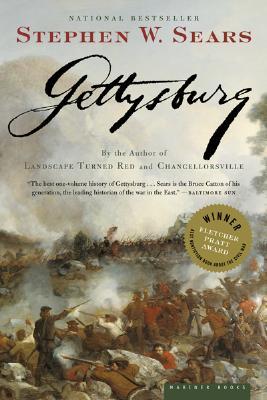
Gettysburg, by Stephen Sears *****

gettysburgThis is the most thorough and brilliant account of the Battle of Gettysburg (all three days, plus the approach and the departure) I have ever read.

I have to laugh at the reviews that claim there is too much detail here. Hey, folks, look at the title, and look at the number of pages. If you aren’t ready to have the complete, detailed account, you should know before you buy it or check it out from your library that this isn’t for you.

I used to teach about the American Civil War, and it continues to be a strong area of interest for me. I wouldn’t have wanted this to be my first, second, or third book about this war; actually, for the serious reader who is just getting started, McPherson’s Battle Cry of Freedom (which won the Pulitzer) is the best starting point. For those not interested in as thorough an account, it may be easier to start with historical fiction, and then move to nonfictional accounts of the war to help you straighten out the facts from the frills.

For me though, I was ready to get down and resolve some conflicting ideas I had read. Some who specialize in the Confederate angle blame JEB Stuart for not coming in when Lee expected him with the intelligence that was needed. Some blame Longstreet for not enthusiastically embracing and supporting Lee’s plan of attack. And still others say the buck stopped with Lee, who after all was in charge and made the call.

Sears says this was overall (from the Confederate side) a case of great overconfidence. Earlier in the war,Stuart had ridden all the way around Union commander McClellan’s forces twice to upset him and cut off his communications. This was intended to be trip #3, and it was expected to net similar results, apart from the foraging. The rebels were looking forward to gaining food and other supplies from the well-fed Pennsylvanians. Indeed, when Stuart did finally return–too late to do any real good regarding Gettysburg–he had an enormous trainload of wagons filled with the things Lee had sent him to get. But the Union’s forces had cut Stuart off, had come between him and Lee, and he and his cavalry had the very devil of a time safely making their way around the Union and back to Lee. Overconfidence; Sears makes a convincing case.

Another blunder attributable to overconfidence was in waiting an extra day to attack, if they were going to attack without further intelligence from Stuart. Sears makes an excellent case that if they were going to attack Union forces, it should have been later (once Stuart was there to fill them in) or right away, because there were a lot of Union forces making their way toward Gettysburg (and the Confederates knew this much) that would be there the following day–when the battle actually began–who were not yet there. And Ewell, in general a strong commander, makes a terrible, terrible blunder in telling Lee that the Yankees who occupy Cemetery Ridge will be rendered harmless because Jubal Early is occupying the hill that is east of them, and higher. He reasoned that if the rebels had Seminary Ridge to the west and Culp’s Hill, the Union would be wedged in between opposing forces and rendered harmless. But the critical mistake is in giving Jubal Early “discretionary” orders to occupy this hill, and not telling Lee this. Early waits, deciding to send another force under him, headed by Johnson, to occupy Culp’s Hill, and in the time wasted, the Union takes the ground, changing things dramatically.

Shifting to the Union perspective, we see that the forces are led overall by Meade, who has led the Army of the Potomac for exactly four days. Through intrigue among the generals below him, Hooker, a good general whose rank and file loved him but whose immediate inferiors found abrasive, was robbed of the glory of taking the field after he had made the plans and set them in motion.

On the second day of battle, Sickles, a political general (meaning that he was given command because of his high governmental office, rather than military leadership or experience) refused Meade’s orders repeatedly. And this is one thing I greatly appreciate about Sears: some writers will tread softly when criticizing a commander who later becomes a casualty, as though printing word of the officer’s stubbornness or stupidity and its consequences for the men beneath him might be a breach of etiquette.

But the fact is, a lot of men there got dead because of the stupidity or wrong-headedness of those who exercised authority over them, and in the case of this battle, both sides have let their own men know that flight or failure to fight will result in their summary shooting, so it isn’t as though a man could just duck behind a log and wander away from battle, as happened in some other really poorly conceived fights. The truth should be told exactly as it occurred, and in a thorough, well-documented, linear way, Sears lays the story, the exact truth unvarnished, before us.

As things unfold, the carnage for which this three day battle is known takes many of the bravest and best down right away. John Reynolds, one of Meade’s ablest generals who was offered overall command and refused it,was shot through the throat and died within the first hour of battle. John Bell Hood was injured and incapacitated, but recovered to fight again, but not at Gettysburg.

The most notable action on the second day is the Union’s Chamberlain’s decision not to retreat or surrender when faced with the fact that they are surrounded and completely out of ammunition. Looking down at the desperate rebs trying to climb that hill, he shouts, “Fix bayonets!” and with this, the rebels surrender. A heroic moment!

On the second day, Union efforts are hampered by the “continued obtuseness of Slocum” and Sickles’ failure to occupy the ground assigned. By the time Meade gets to Sickles in person after Sickles has refused orders sent to him multiple times, it is too late for Sickles to move, and the damage is done. When Sickles loses his leg,an officer in the Second Corps remarks, “The loss of his leg is a great gain to us, whatever it may be to him.” Hancock, a far more capable commander, is placed in command, and he does the job right.

The statistics, both regarding loss of able leaders on both sides as well as the rank and file, particularly for the rebels on the third and most gruesome day, are appalling. Many times Sears refers to this as “Fredericksburg in reverse”, and indeed, Union soldiers can be heard crying out, “Fredericksburg!”

The aftermath is controversial. Initially, Lincoln was gravely disappointed to hear that Meade had let Lee and the rebels that still lived “escape”. Yet I cannot help but wonder, if he had stood in the pouring rain that came down on a sea of bodies, one acre of which was completely covered with corpses, some three days dead, and more than one body thick in places; if he had seen that there were only four of the original ten commanders still alive and fit to serve; if he had watched the 17-mile long hospital train of wounded Confederates that groaned away toward the Mason-Dixon line; if in viewing all of this, Lincoln himself would not have said, “Enough. Enough for now. Let’s bury our dead and treat our wounded, and get in out of the rain.”

I hope I have conveyed the level of detail you can expect from this tome. If my review is a mite lengthy, you may not want to read five hundred pages plus notes on the topic. Sears writes better than I do, of course, but this is a study only for those who can already tell Sickles, Slocum, Sykes and Sedgwick apart. If you are still getting to know the players, this ballgame may be too long for you. But it is the ultimate detailed account for those who know some, but don’t feel they know enough.

I often am forced to give books away because of the finite amount of space in the home library my family has collected, but this particular volume will retain a place of pride as long as I am here.

Neptune: The Allied Invasion of Europe and the D-Day Landings, by Craig Symonds *****

Eloquent, thorough, focused, and well documented; Neptune, by Craig L. Symonds, is a definitive work regarding maritime’s most immense project, the invasion of Normandy during World War II.

That said, I urge the reader to get a hard copy of this book, because the e-reader version as I saw it had charts that were useless; in addition maps, so important to a work like this, are simply impossible on a tablet. For a book of this importance that should hold a place of pride on the shelves of any professional or serious personal library, it is worth the investment to procure a hard cover copy.

Symonds’ narrative opens with strategizing and secret diplomacy regarding American aid to Britain, which is in far worse condition during the war against Nazi Germany than I had ever understood. Just as a plan begins to gel, word comes that the Japanese have bombed Pearl Harbor. Months of careful planning must now be carefully reexamined and new plans made. Should the USA fight on one front, or on two? Should it attack Japan first, or go straight to Europe (as most US advisers were inclined to do), or follow Churchill’s suggestion that the fight begin in Northern Africa? Americans tended toward quick action and massive investment of resources; the British were careful in husbanding materials and preferred to examine every aspect of every possible plan before moving forward. Frankly, I am glad I didn’t have to be there during the debate.

Symonds has put together a narrative different from any other I have read regarding this period, and the only work I have read that deals exclusively with the invasion of Normandy from the naval viewpoint. I have also never seen any writer try so valiantly to balance the perspectives, the strengths and challenges of both Britain and the USA. It was in reading the ways in which cultural attitudes not only created friction but directly impacted military positions that I realized how completely American I am. He further explains how the decisions that were made came about and all of the careful compromises and considerations that went into the events as they unfolded.

Because this is such a momentous work, I found myself marking far too many pages—a weakness when I become overly enthusiastic—and now it would be too much to go back and refer to all of them. The vantage point was enormously enlightening, and I came away feeling as if I had only just begun to grasp the enormity of this horrific conflict.

Highly recommended…in hardcover, not tablet form.

Dead Little Dolly, by Elizabeth Kane Buzelli ****

  This is the first title I’ve read of this engaging cozy mystery series created around Dolly, the local sheriff of a tiny mid-western town. The setting, located in Northwestern Michigan, is original and well conceived; the pacing and transitions are deft and clearly the work of an experienced writer. Best of all are the characterizations, which are colorful and distinctive without being so wildly eccentric as to become caricatures or stereotypes.

I will admit that when it comes to cozy mysteries, I am a hard sell. I want working class protagonists, first off; no wealthy people on cruises or in drawing rooms for me (Dame Agatha Christie as the legendary, sole exception to my rule). I don’t like to see improbable individuals solving crimes that go right over the heads of the police, and I will not read a cozy mystery I even suspect may contain a recipe somewhere. If a novel needs recipes to sell, it’s not much of a novel.

Dead Little Dolly meets all of my snooty criteria. The title character, Dolly, is the sheriff of her tiny town, and has all sorts of family baggage that comes into play. Her mother abandoned her as an infant to join some religious cult in France, and now that she is a single mother, she sternly rejects her grandmother’s wish to contact said long-gone mother. I loved what Dolly had to say about her mother’s lack of responsibility and what might have happened because of it: “How’d she know I’d turn out so good?” This really cracked me up.

There are a couple of somewhat weak spots: the notion that Emily, the journalist, must keep news of our crime prominent in the local press “to keep the pressure on” is nonsense. When this is done, on whom is the pressure supposed to be placed? On THE POLICE. In this case, the police–a force of one–is the victim, and already highly motivated to solve the crime. Are we seeking the assistance of the FBI? No. There is no basis for it, and it is not mentioned. So this particular chunk of motivation is weak.

However, the story is so riveting and such great fun that I was ready to overlook that bit, and indeed kept reading well past my bedtime.

A particularly delicious secondary plot was the coming nuptials of an 80-year-old bride. Her mother had been against the match, and they had waited till her death to wed. The old bird lived to be 101 years old, and now a certain amount of haste was required to give the newlyweds a maximum period of wedded bliss. (I confess this made me think a bit of my favorite aunt, who was widowed at 30 and remarried at 70.)

Dead Little Dolly is a good fun romp, exactly what the doctor ordered when you need a beach read or a little something to take your mind off of your own worries. If you enjoy a good cozy mystery, this one is highly recommended.