Teacha! Stories from a Yeshiva, by Gerry Albarelli ****
I came away from reading this novella-sized (just over 100 pp) nugget somewhat ambivalent. There were aspects of it that I enjoyed, but please note that I read it free, courtesy of Net Galley. If I had paid full hardcover price, I might well have felt cheated. A buck or two for my e-reader? Maybe.
Albarelli spent a year teaching afternoon classes in a yeshiva. I had seen the word used in text without a lot of explanation in other works, and had heard friends and colleagues refer casually to having sent their children to a “small, private Jewish school” when living in New York City. So I came into this—and volunteered the time to read and review it—because I had questions, as well as the slightly voyeuristic curiosity I always seem to experience when examining a culture that is very different from my own.
Several other reviewers on Goodreads.com expressed frustration. They expected Albarelli to come to some sort of conclusion. I felt the same way at first, but after some thought I realized that he had a conclusion. The problem with it is that it’s buried in the middle of what are separate, journal-like chapters, each of which depicts a particularly interesting (to the author, and often to me also) incident or important day at the yeshiva.
Did I get my questions answered? I think so. I did not understand that there are Jewish families living in present-day New York City who speak no English at all, only Yiddish. Chassidic Jews, ultra-conservative, keep themselves apart even by choosing not to learn the language of the dominant culture, but they see value in having their choldren learn it.
Our writer is one-year part time instructor among several who did not blend in culturally due to dress, their lack of facial hair, and the many singular details that demonstrate belonging to a carefully structured in-group. He and the other English language teachers weren’t Jewish, and the kids could tell.
In describing how this yeshiva ran, Albarelli painted a picture that I, as a retired public school teacher, found horrifying. (The rabbi who hired this guy said that public school teachers did not do well in his yeshiva; I can certainly see why.) A large room of 8 year old boys spent the entire morning unsupervised by even a single adult in the room with them. They had a pattern of behaviors that resembled The Lord of the Flies (my comparison, not the author’s), except less organized and more random. Furniture was broken and left in corners; garbage was not always cleaned up, but left on the floor. The students—all boys—disrespected teachers openly when they arrived or during assembly and class time,, spitting on them, throwing things at them, and worse. They did this in full view of other teachers and the head rabbi, none of whom corrected them in any way. If anything, the teacher must be to blame.
Some of the other reviewers took issue with Albarelli’s smug implication, unmistakable, that he was the most favored English teacher, abused least because he was so much better than any other English instructors, and that the other teachers all more or less had it coming. What a joy he must have been to have for a colleague! Don’t let the door hit you on your way out at the end of the school year.
But there were passages suffused with the joy of the teachable moment, when he was able to get some of his students to engage. At times, we are led to believe that every child in his over-sized class was longing to participate during the whole lesson. Given the other things he says, it strains credibility, and yet there can be no doubt that he enjoyed these sessions; they are his main motivation for writing this, at least to my eye.
The conclusion that is buried in the text is that this chaotic, at times bizarre system of education works for this set of children because it is consistent with the way things are done at home. He doesn’t back this theory up with anything factual like home visits; we are to take his word for it.
Because it gave me a glimpse inside a culture that I’d been curious about, I am rounding my 3.5 review up to a 4.0, albeit reluctantly. I would encourage the writer to be more clear about his objectives and organization.
To readers, I advise that if you’re interested, you might check your local library if you believe you’d like to read more, but don’t go out and pay a lot of money for this muddy though occasionally informative and entertaining bit of reminiscence.
I Kiss Your Hands Many Times: Hearts, Souls, and Wars in Hungary, by Marianne Szegedy-Maszak *****
Poignant and painful; beautiful and wrenching…Szegedy-Maszak takes us through a time and place in a way nobody else could. If you are a serious historian, please consider this a must-read.
When I applied to receive this story as a Goodreads giveaway, I did so as an historian, conscious of a blind spot in my own education. I knew too little of Hungary and its past, apart from that it had become a part of the Soviet block at some point, and then became independent once more. I wanted to learn more about the country’s political and economic history, and if I had to read a love story to do that, then I would.
When the book arrived, I gasped as I pulled it from its envelope. Beautifully bound in hardcover with folio-cut pages and a pearlescent cover featuring the family about which she writes, I held it in my hands, showed it to my family, and then swore my head would not be turned by the beauty on the cover, and the painstakingly aesthetic manner in which the interior is designed. The family tree at the start of the book actually turns out to be essential, because many people are mentioned many times here, and to keep them straight, I would have to keep flipping back. But I didn’t know that yet. I saw the literary (and as it turns out, highly appropriate) quotes that adorn each chapter’s beginning, along with images from the past, snapshots of what is no more.
So…incredibly good taste, and no expense has been spared. But can she write? Oh yes! And by the time I was done, I had no fewer than fifty sticky-noted pages, and worse, every single one of them marks a passage that seems really important. Now I must pick and choose, which is a dreadful predicament.
Be aware that this is a hyper-literate read, not necessarily accessible to every reader. And to get to the good part, you’ll have to do a lot of work at first, plodding through the dull stuff at the start and trying to remember who everyone is.
Though it tells a good deal of what took place behind the scenes before, during, and after the second world war in Hungary (albeit from the very conservative perspective of considerable material interest and self-involvement), it is also a deeply personal story, told well by an already accomplished writer with a literary pedigree a mile long and granite solid. This is her first book, but Szegedy-Maszak is already a respected writer and journalist. Her love of family and the details that governed their lives in Hungary, Europe, and the USA are what makes this memoir compelling. For many, this will be a more palatable way to learn history as well.
Because of the role of extended family, which is inextricably intertwined with that of her parents, the reader must wade through lengthy genealogy in the beginning. I have read other reviews saying that the reviewer gave up on the book because of the initial level of detail, and indeed, at first it is tempting to wonder why anyone who is not related to the author would have an interest. Though the author has doubtless already hacked away at the introductory chapters and removed portions that it hurt her heart to pull and cut, a little more pruning at the start would make this book more readable. It’s a 4.5 on my very picky scale anyway, though, because what comes after its somewhat tedious beginning is remarkable and well told. It is a very scholarly yet heart-felt telling of how world events have impacted her family, and vice versa, and it is when she describes poignant experiences in a painterly, often painful way that her family’s story becomes most absorbing.
The writer grows up in a multigenerational household in which children are almost irrelevant, seated below the salt at the long formal dinner table. Everything the elders value and discuss has come and gone. Her mother descends from the Weiss and Kornfeld (later to become “de Kornfeld”) families, and her mother’s grandfather was once the most wealthy industrial and agricultural baron in all of Hungary. Now most of the empire is gone, and the family sighs wistfully and speaks about the past, when they were someone, when a mere phone call or visit from Weiss or Kornfeld could cause a policy change, or change someone’s life.
*consider everything after this to be a spoiler alert*
Her parents had been very different people. Her mother had grown up in a vacuum of sorts created by immense wealth and privilege. Even as the Nazis stormed across Europe, Hungary was, by the author’s telling, insulated for a long time, unlike their unlucky neighbors, the Poles. Hungary wanted the land that had been lost to Czechoslovakia in the Treaty of Trianon following the First World War, an immense piece of real estate inhabited primarily by Hungarians, and which had been taken from them. When Nazi tanks rolled into Austria and boundaries were redrawn, the Hungarians held their breath. They understood that with the USSR fighting as an Allied nation, they would see no restitution of land from the Allies. Thus, they became an Axis power, at first tentatively, with the hope that if enough munitions were produced by the Manfred Weiss Works, makers of tanks, munitions, and later in the war, airplanes, the Germans would see no need to invade and supervise Hungary. And this was the Hungarian argument against occupation: we can do so much for you independently, oh Germany. Don’t trouble yourselves coming here. It’s all good.
In the midst of all this, Hanna Kornfeld, the writer’s mother, meets a brooding intellectual and politician, Aladar Szegedy-Maszak. When he signs his letters to her—first formal, then impassioned, but with the restraint decorum required—he concludes with “I kiss your hand”, which is merely the equivalent of the Western “yours truly” (when we aren’t) or “sincerely” (even less so). It was a format, until it was more.
He is an intellectual, a scholar, and a very busy man. He is anti-fascist, and trying to somehow involve the Allied forces, so that Hungary can make its separate peace with Britain and the US, but Britain holds off, regarding Hungary as not of primary importance strategically (and in fact, they are surrounded by fascists, so it would be a stretch by the time Hungary makes its entreaty), and also, Hungary is regarded as opportunist.
Here the author bristles, and I think she doth protest too much.
My sense is that the time to contact the Allies was when Hitler invaded Poland. One doesn’t offer Hitler endless munitions, and then complain to the Allies when he sends his troops in to do exactly what they’ve done everywhere else in Europe.
Aladar, however, is not offering endless munitions; he is trying to persuade anyone who will listen to him that the fascists must be resisted at all costs. He is arrested for his anti-fascist activities and sent to Dachau. He survives , partly because he is treated as a political prisoner, which for some reason is considered a relatively (RELATIVELY!) privileged category, and also because the fascists don’t cast their eye toward Hungary until near the end of the war.
And when they come, they do it in the way only fascists can. The Danube runs red with blood. This is not allegory, but a literal reference. Despite every record that was burned, every photograph that was destroyed, there is still plenty of documentation, and the author provides it all, the child of the scholar become scholar herself. The bibliography at the book’s end, along with the notes for each chapter, is impressive.
Once Aladar is free, his experience leaves him brooding, nearly broken, and overcome with survivor’s guilt. It is with trepidation, then, that he contacts Hanna once more when the war has ended, because as he tells her, he is not the same man he was before the war; he has no money and no job; yet the one thing he knows is that he loves her and wants to marry her if she is still interested. He kisses her hands many, many times.
Interestingly, Hanna is fine. Her family has swung a deal. They will sign over all of the factories, the real estate, in fact the large majority of the family fortune, in exchange for their lives somewhere outside the Nazi realm. Let us go to a neutral country, and you can have it all.
The fascists want to hold a few of the family back as hostages. It is here that the writer’s aunt blanches and almost does not sign. Yet the family understands that there is really nothing to keep the Nazis from taking everything and having every last one of them killed. With the coolness that generally characterizes the ruling class, the family cuts its losses and runs. Who can blame them? Others would surely have done the same, given the chance. They go to Portugal initially; later some will try to rebuild a life in Budapest, others in Switzerland.
But it is Aladar whose political practices and courage open the door to the United States. It is remembered after the war that he has pleaded all along, from the very beginning, for Hungary to become a part of the Allied umbrella. He had met Hitler, and he had heard him speak. He knew the guy wasn’t someone you wanted to rule your people. He did everything he could to take Hungary into Allied hands, but it didn’t happen. He nearly died in the undertaking, and now, the US gazes at him with a bit more focus. He is a friendly face in war-torn Europe, and might make an excellent liaison with the new Hungarian government
When the war is over, is appointed minister to Hungary for the USA. With a moue of distaste at the notion of leaving Europe, and understandable grief at leaving her family at such a wrenching time, Hanna agrees to marry Alastar and move to the USA. Numerous family members will later follow.
But small countries all lose when enormously powerful countries sit down, victorious, to divide the post-war map, as if it were a smallish birthday cake where everyone at the table ought to get a little piece. Hungarians will not determine the fate of Hungarians. The USSR has paid dearly in human flesh and material loss, and now it will build itself a buffer zone to protect its turf against future incursion.
The Allied nations understand the nature of Stalinism (and this is my own historical interpretation; the writer embraces the Cold War era view of “totalitarianism” with regard to the now-moribund USSR). It is ultimately conservative; the USSR was not interested in expanding across the globe, only in holding onto its own power base. Just as France gained back land it had lost, and just as the US experienced unprecedented power and influence over the globe, so would Mother Russia see to it that her own needs were met. Hungary was diced up even finer, since a fair amount of anti-Stalinist sentiment prevailed there. When they were finished, Yugoslavia, Czechoslovakia and other satellite states stood like sentries on the Soviet perimeter.
As for the heroic Aladar, he refuses to recognize the new Hungarian government. He welcomes the wife of the deposed head of state, one who was friendly toward a capitalist system. The Smallholder Party that Aladar favored has gone down, but he is not out of the fight yet. Soon, the newspapers in the Stalinist orbit will display a photograph of the Hungarian minister kissing the hand of this woman as she leaves the US, and he is branded a traitor.
His courage gets him nothing in the US except the opportunity to remain with his family as a US citizen (small potatoes for the writer’s family, yet something that is held dearly and hard to get these days!)
I was chagrined to see that he went to work for the right-wing (my characterization, not the author’s) Radio Free Europe. He had the integrity to resign when he learned this enterprise was CIA-run, but the Voice of America cannot be regarded by a Marxist (of the non-Stalinist variety) such as myself.
The writer is at her strongest when she injects the deeply personal moments into her narrative: a family member explains to her that when she views the photographs of bodies piled high at the death camps, she searches the faces of the corpses to “see if one knows anyone.” Suddenly the Holocaust becomes up close and personal in a way only trumped by Schindler’s List and Night. Family members have died there; this was not as clean an exit for her family as it is made out to be in the press.
Though despondent over the loss of his country’s autonomy; his own survivor’s guilt, including his inability to save the members of his family in Hungary who were killed or hurt by the Stalinists in retaliation against his activities abroad; and finally, the death of his and Hanna’s first-born and namesake, Alastar still travels to Hungary with the writer, his daughter, in the late 70’s, and he is still sharp enough mentally to shush her when she naively inquires about the number of police all over the airport. Marianne Szegedy-Maszak points out that he must have been clinically depressed, but not enough medical advances had been made for him to have anything to help him beyond Valium, a drug that’s great for anxiety, but doesn’t really do much for depression.
Though the writer seems perhaps most deeply attached to the female members of her family, I find myself more taken with her father, who despite his political leanings that are almost opposite to my own, was clearly a man of principle and integrity, and who knew how to roll up his sleeves and do what needed doing. In retirement, he finds that he needs to see things grow; he loses himself in the family garden, and visitors mistake him for the gardener.
There is so much more to see here, and this is clearly a work wrought from love of family and origin rather than something done primarily for fiscal gain. For those interested in the Holocaust; Hungarian history; or for women like Szegedy-Maszak (and me) who find that we understand our mothers so much better only after they grow old and die, this book should not be missed. The first few chapters are slow, but forge on, and you will be rewarded.
One of Ours, by Willa Cather *****
The Yankee Club, by Michael Murphy ****
Seldom Disappointed: A Memoir, by Tony Hillerman *****
Hillerman was one of my favorite writers. I am so darned sorry he is gone. I read this partly because I enjoy autobiographies and memoirs (especially at bedtime; they are so linear that I can keep track while I am getting sleepy) and also because I had read all of his mysteries and had none of his novels left to read. But this one is an award-winner in its own right, which I did not know before diving in. It’s a real treasure.
Hillerman grew up in Oklahoma, and he grew up around American Indian kids. He learned a fair amount that way, but once he began writing about them, he felt he had not served them well enough, and so he wrote another novel with the same focus in an effort at getting it right. And so it went. He is the only Caucasian writer ever to have been named a Friend of the Navajo by that tribe, though I found this information on one of the fly-leafs of a novel, not in this book; he is humble and unassuming.
The name of the novel came from a saying of his mother’s: “Blessed are they that expect little, for they shall be seldom disappointed.”
Hillerman talks a lot about his experiences in World War II, and at first, one may think it is just an old man telling war stories. He tells his better than most, of course. But there’s more to it than that. He was badly injured in this war, and he considers himself fortunate to have been an artilleryman, since he says that riflemen got killed fastest; I always had heard that artillerymen got dead quicker than anyone, but that’s not what he says, and who knows whether this is just modesty or whether World War II was different from the general rule (or whether what I read that military historians recorded was wrong information, for that matter).
But Hillerman’s bent isn’t actually military history, it’s his own story, and this was a major part of it. He has a way of coming full circle with various points in his tale. Things that are mentioned at the beginning of the book show up at the end, changed yet the same. (Check the detail with which he describes a game of marbles during his childhood; it’s going to show up again.)
There are two things I really like besides the fact that the guy was really great with the written word. One is his working class trajectory. This comes out in his novels (and instead of mansions with tennis courts, his heroes live in thin-walled aluminum trailers or hogans with no running water), and his dedication to his wife. I have never seen a man wax so effusively over a woman he’s been married to for decades; it says a lot about his character.
I’ve read a lot of this genre, but this is one of the finest of its example I’ve read to date. Highly recommended (and never disappointed).
The Jungle, by Upton Sinclair *****
It’s not your best beach read, but it’s an important bookmark in the history of American literature.
The second wave of immigrants who came to the USA around the turn of the century (our setting is 1905) came mostly from Eastern Europe. Political turmoil and poverty were the push factors for myriad Italians, Greeks, Slavs, Turks and others who needed to get away, and the still vivid hope of the American dream, the possibility of social mobility unthinkable in Europe, was the pull factor. The Statue of Liberty still meant something back then.
It wasn’t as simple as it seemed, though. One of the primary large cities to which immigrants flocked was Chicago, and one of the chief industries that would offer them work–as usual, work that those born here would not do–was meatpacking. It looked like good money, even after meeting coworkers who had fewer body parts at the end of their tenure at the packing plant than they’d had going in. It was bloody, nasty, inhuman, and heartless, both toward the workers and the animals. And the stuff that landed on the conveyor belt went into the product to be sold at the supermarket, whether it belonged there or not.
I’ll let that sink in a moment.
Sinclair’s novel was intended to be a workingman’s call to arms. Cast off the bonds of wage slavery. Let the people who do the work own the means of production, set the time tables, and divide the spoils. He’d been reading Karl Marx and Frederick Engels, and believed his book would be a revolutionary vehicle. After all, working people read back then, and their attention spans had not been reduccd by the instant gratification that television and video games would later provide. He hoped it would be effective.
It was, but not the way he planned. When Americans read about all of the disgusting stuff that was landing in what they intended to serve for dinner, they revolted, and the Food and Drug Administration was born.
Today, meat packing workers are still among the most injured and the lowest paid, and they are still largely manned by immigrant workers.
The bottom line: read this for its historical importance and its place in American literature, but don’t expect to enjoy the experience. It’s pretty grisly material, but rightly so.
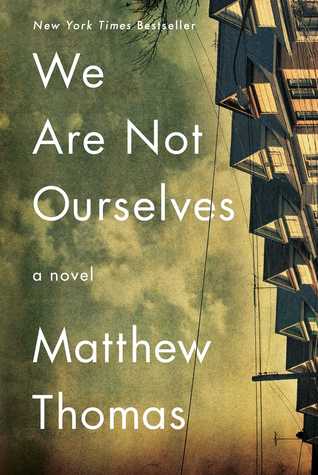
We Are Not Ourselves, by Matthew Thomas *****
A haunting, epic story that stays with the reader long after the final page has been turned; Thomas has created a masterpiece. Thank you once and once again to Net Galley and Simon and Schuster for the ARC.
When I saw that some goodreads reviewers had marked this book at three stars, at first I wanted to grab those people, shake them by the shoulders and ask, “What is wrong with you?”
But eventually, I came to understand, or at least I believe I do, what it was that bothered them. Our protagonist is not always a lovable one. She’s deeply flawed and hard to bond with. Those who equate a lovable character with a well written book may indeed be disappointed, not only by this story, but by many of the Great Books.
As for me, I am impressed. My measure of extraordinary literature is that I am still thinking of, or even wishing I could have a conversation with the main characters after I have finished reading. I’ve moved on to other books, and yet this one remains with me. Aw, geez; poor Ed. We didn’t know. And what’s up with Connell, anyway? It speaks to me on a deeply personal level as I find myself comparing my own family and relationships with the Leary family. Given that I am a reader who absorbs a dozen books a month and sometimes more, this says a great deal.
Our protagonist is Eileen, who grows up in an Irish immigrant family that cuts across the typical large, boisterous, poor-yet-loving stereotype of the New York Irish. Instead she is the only child in a chilly, quiet apartment. Relationships are often strange and distant despite the fact that her parents love each other and her. The second bedroom is taken, for most of her childhood, by a tenant. Her father is a genial man, well loved among the Irish workingmen’s community, a union man and a hard drinker. Her mother is lonely, hardworking, and bitter until she also takes to drink; yet her parents don’t drink together, but apart. The only fun time is when relatives from Ireland come across the ocean and spill over into her family’s wee apartment as their final pit stop before finding a place of their own.
Eileen grows up knowing that she wants more.
As her hormones work their alchemy and her body grows and changes, she becomes disarmingly beautiful, and she understands that marriage may be her ticket to better things. Once she finishes college and becomes a nurse, she wants to marry a man of great capability and ambition. She believes she has found him when she meets Ed, a brilliant young scientist with a promising career ahead of him. Between the two of them, they ought to be able to bring in the money needed to live the good life. By the time children come, he should have climbed far and high enough that she can stop working and be happily domestic in a magnificent home. It is the dream of the 1950’s, though she wants something a bit finer than a suburban house with a picket fence.
Eileen’s grasping nature and her harsh behavior, at times, toward Ed and their son are off-putting. When their only child brings home a test marked 95%, her husband exudes praise while she asks what happened to the other five percent. I cringe. At times she seems to understand that she is showing no more warmth than her own mother did, yet the habits are ingrained. She does not reach out for the hug, does not easily part with praise. And as it becomes clear that her goals and Ed’s are not really the same, the marriage begins to founder.
The harder she pushes, the more irritated I grow with her. It’s like watching a relative who is bent on self ruin; I want to talk her out of this. I want to hit the “escape” key for her. I want her to be more empathetic, more flexible. But the one thing I absolutely don’t want to do is put the book down.
Then the unthinkable happens, not at all what I expected though, and everything that has gone before takes on new meaning. As events unfold, Eileen must change also.
To say more would be to spoil the read, and you should read it. Happily, this is one book that works just fine on a digital device, and I am grateful to the publisher and Net Galley for letting me read it that way. But if you are a reader who needs the tangible object in your hands, I will tell you that this is worth investing in. All you need is an attachment to excellent literature.
Absolutely brilliant. I look forward to seeing more of Matthew Thomas’s work in the future!
Six Million Accusers: Catching Adolph Eichmann, by D. Lawrence-Young *****
Please lower the safety bar in front of you, and make certain your belt is securely fastened. We will be traveling at an astonishing rate of speed; keep your hands firmly on your book or digital reader. As you finish Six Million Accusers: Catching Adolph Eichmann, you may be disoriented and need to remind yourself where you are and what day it is. It’s that gripping.
My deep gratitude goes to Mr. Lawrence-Young, his publishers, and NetGalley for letting me read and review this amazing novel.
David Lawrence-Young packs a powerful story into a well plotted, brilliantly paced narrative in order to tell the story of the capture of Adolph Eichmann, one of the nastiest and most powerful Nazis responsible for the deaths of six million Jews in eight nations, not to mention millions more who were Gypsies, political opponents, disabled, gay, or who were mistaken for somebody else. And of course, these numbers don’t include those who died in the battlefields, seas and skies of the European theater of World War II. Only Hitler and Himmler were above Eichmann in the fascist pecking order.
Because story is such a potent vehicle for the truth, the author has chosen historical fiction over a more expository nonfiction format. I think he chose well. He has a long list of previously published books that precede this one, from Shakespeare to an English textbook to other works of historical fiction, but he says this one was the most difficult, and I believe it. As is true of the finest writers of this genre, he has a bibliography at tne end of his work to let us know that the story is absolutely true; he has filled in the cracks by inventing the dialogue instead of paraphrasing as he would have to do with a work of nonfiction, but this is the real deal nevertheless. This is what happened.
Once this was made plain (I always read the introduction, and I also read the author page before I begin), I dug myself into my favorite reading corner and prepared to concentrate, convinced that while compelling, the historical journey would require full focus and strong literacy skills. I was surprised to find that he wrote in a manner that will be accessible to just about anyone who wants to read it, and the need to focus is moot, because from the get-go, he has our eyes and full attention automatically. The pace builds in a glorious arc, reaching breakneck speed as we close in on Eichmann along with the team of spies and undercover representatives of Israel’s government.
The questions that arose in my mind were answered. Given that these agents slip into Argentina with the assumption that they will need to act outside that nation’s unfriendly rules of law, and are essentially going to kidnap Eichmann, I wondered why the fuss. If they were willing to go that far (not that they shouldn’t), why not just sail in under a black flag and cap him behind the ear? Why all the fuss and bother to smuggle him back to Israel to be tried?
And it became clear. Many other SS officers were dealt with in the manner I had been thinking of, but this man was so utterly symbolic of the Holocaust that the world had to see him tried, and Israel and her people had to lay out the facts, document them irrefutably, and wisely so, because half a century later would come the Holocaust deniers who would want to pretend the whole thing was a hoax, sham, or exaggeration, and the Nuremberg Trials make it much harder for anyone to do so.
A thing that gave me great pleasure was reading about the agents, including our nominally fictitious protagonist, Haim, who DID get out of Germany or other parts of Europe in time to avoid arrest, torture, and maybe death.
I was surprised, and surprised to be surprised, about the news that Israel had had to fight for its independence. As a history teacher, how is it that I did not know this? I think it’s simple. It was too recent to be in the curriculum, but since I had barely been born when it took place, I was too young to remember. And independence from Britain was important. On the surface, it looks as if they bit the hand that fed them; hey, they put up a Jewish homeland to help people escape Hitler, and now you’re going to shoot at them?
But it turns out this was very necessary. Part of Britain’s game plan was to limit how many could come out. They were more generous in their immigration policy than the USA, but that’s not saying much. Israel needed independence in order to have a nation where all Jews could safely exist. (I won’t even go into the Palestinian question which is worth many other books, a huge issue unto itself.)
Like a lot of academics, I have many Jewish friends, and though all are too young to have experienced the horror first hand, they have family stories, even legends. (“My grandmother personally rescued one of the last remaining Torahs from a burning synagogue”, a colleague told me.)
But even if I had not had their friendship, simple justice would have permitted me to sigh with satisfaction, once when Eichmann was in custody, and again when he was convicted.
Don’t just read this book; keep it. Share it with your children. The world must never, ever permit such a thing to happen again. It is by educating the next generation, and they the one after them, that we keep the neo-Nazis firmly on the fringes, which is the best place for them to enjoy the First Amendment rights they would gladly grind beneath their hobnailed boots for the rest of us if permitted to do so.
The Five People You Meet in Heaven, by Mitch Albom *****
This book was my grief book. That may sound bad, yet you’ll note that I gave it five stars. I had unfinished business left buried deep down, while I lived an extremely busy life and dealt with other things. This book was my resolution.
My mother died while my husband was near death, and while sitting by his bedside and urgently questioning doctors and searching his medical files to see what, if anything, they weren’t telling me, my mother, 200 miles south and 80 years old, was in intensive care. She had to be a side issue. I was glad my sisters were with her when she died, but because I was so intensively involved in my husband’s care and his ultimate recovery and my own little family at home, all I had time to do for my mother was to phone her briefly to say I loved her, and have quick conversations with my sisters regarding critical decisions that had to be made.
A year and several months later, a friend and administrator at the middle school where I taught recommended this book to the whole staff, and when she asked who would like to borrow it, my hand shot up.
I should point out here that I am an Atheist. But many times, we read fiction and we buy into a premise that we would not adopt in ordinary life. So it is with Albom’s heaven, and its five greeters. And on the last page, to my absolute astonishment, I burst into tears and grieved for my mother. I had thought that I was finished grieving; after all, she was quite elderly, and had been in poor health for quite awhile; her death was hardly unexpected. But I was very much mistaken. Our mother is our mother, and it’s likely to pack a punch when she goes.
I still don’t believe in an afterlife; I put my faith in humans, and so far it’s worked out well for me. It makes sense to base our beliefs on the material world, and to realize that the bad things that do happen are due to material conditions rather than some almighty hand from who-knows-where deciding to zap us. When people tell me that everything happens for a reason, I generally don’t say anything, but I don’t believe it for a minute. Sometimes bad things just happen. Period.
But once in awhile, when a loss is powerful and visceral, it can take the edge off of the sorrow or in the case of young people who die suddenly, the stark horror, if we pretend for a little while that we will someday meet again. It’s only natural to wish for such a thing.
You will notice there’s no place on this page wherein I thank the publishers and some other source for a free galley. There wasn’t one. A friend figured out that I should read this book, and she loaned it to me. It was the right book at the right time. If you have unfinished business, or even just like a good three-hanky cry, this might be a gentle way for you to get there.
This may not be “the” grief book for everyone, but it deserves strong consideration. It is an enormous consolation for some of us when there has been too much loss at one time, and we have had to be a little too strong.