The Sleeper, by Robert Janes***

thesleeperThe Sleeper is an espionage thriller set just before Britain enters World War II. David Ashby is living in Germany with his family, but international tensions become so compelling that a British citizen is unable to live there safely anymore. Splitting from his German wife, he grabs their seven year old daughter and goes back to the UK with her. The German government is determined to retrieve the child, and the struggle over little Karen is the basis of the story. Thank you to Net Galley and Open Road Integrated Media for the DRC, which I received in exchange for an honest review.

This one is tough to review, because it has so much going for it, and yet other aspects hold it back. Foremost among the latter is the premise; would Hitler really send this much firepower after one kid locked in a domestic dispute? Youth were a big part of his recruitment campaign, yet it’s hard to conceive of all this time, money, and attention being lavished on the retrieval of one solitary child—and at that, a girl, who by Nazi definition is bound for motherhood, church, and her kitchen. But once we just leap in and let ourselves believe either that this could be true, or that there may be a secondary reason as yet to be revealed to us for Hitler’s diligence, it’s an enjoyable read.

Janes is painstaking in his attention to historical detail. The culture, the more formal reference to others, with the salutation of Miss, Mrs., or Mr. (or their equivalents in other languages) rather than the common use of first names used in Western nations today resonates, along with technology and a host of other historical minutiae. His attention to all aspects of setting is equally outstanding. He weaves a complex, hyper-literate plot that at times is compelling, but the story would be better served if he were to streamline it a little, because there are a lot of side details that lend nothing to the story. For example, whether Ashby has a gay relationship has no bearing on the main story or its outcome. In fact, there is way too much of who is sleeping with whom; I can see why his ex-wife would be motivated partially by jealousy, but the reader is treated to the romantic or sexual inclinations of just about every woman in the village, and it’s distracting rather than useful, and it gets in the way of stronger character development. I also found many of the transitions ragged, sometimes startling, but this may very well only be true of the galley; sometimes the DRC doesn’t include little dividing marks that will be in the final copy to cue the reader of a change of scene; thus I didn’t include this issue in my rating.

About halfway through , the style of writing changes, becomes less fluent and takes on some odd quirks that made me flip to the author page to see whether the writer was perhaps not a native English speaker and the book translated from another tongue. However, since he credits two others with helping him with the brief bits of dialogue in German and French, that doesn’t seem likely. There is one particularly distracting feature of the grammar that I tried to ignore, but after awhile found myself highlighting its frequency to see whether it was really occurring as often as I believed. The specifics of this I will send to the publisher, in the hope that perhaps it can be mitigated by the time it comes out. With this distraction removed, the book would be 3.5 stars, maybe even 4.

The climactic scene in the mine tunnels is absolutely riveting, and the stilted language and grammatical quirks that occur roughly from the 50% to 80% portions are nowhere to be found during this critical part of the book. It is largely Janes’s outstanding word-smithery with regard to setting that makes the climax so palpable and taut.

Should you invest in this novel? I guess that depends on your fondness for WWII fiction, and how deep your pockets are. There are other novels in the same vein that I recommend more highly, but it’s such a large field, and you could certainly do worse.

This title becomes available for purchase December 15, 2015.

Newly Released: Nirvana, by JR Stewart Excerpt

Nirvana

After a big-time rewrite and vast improvement, this hot new novel hits the shelves today. Below is an excerpt, courtesy of the publisher:

The shrill five a.m. siren jolts me awake to the usual calamity. The bunker’s stale air; the pelting of dust balls and stray debris. I groan and hear Andrew’s chuckle. When I open my eyes, he’s getting dressed.
“Are you leaving already?” I ask.
Andrew leans down for one long kiss. “It’s eight o’clock.”
I bolt up in bed. “The five a.m. just went off.”
“Nope. You slept through that one.”
I groan. “I’m late.”
He leans over me. “You always are, Kenders.”
I rub my eyes. “When will you be home?”
“Late. I’ve got a meeting with my boss.”
I let out a long yawn. “Cheating on me again?” I wink.
He laughs and pulls out my photo from his breast pocket. “I’ve got
this framed on my desk.”
“You should get a better picture.”
“The green dress matches your eyes.”
I turn up my nose. “My grad photo is outdated.”
“It says everything about you. No one dictates what Kenders does. You wouldn’t wear school colours like the rest of the class did. Your green dress stood out, just like you do.”
He’s right. Our punk band was protesting the loss of habitat for bees, and this wardrobe choice was one of many anti-establishment statements we made that year. Since 2080, when Hexagon became the university’s major sponsor, it had been a new tradition to wear school colours. We boycotted that convention, and even at graduation we were handing out flyers, standing up for what we believed in.
Andrew kisses me on the lips. “I’ll see you at lunch.” About an hour later, I wake up to a softer buzzing. This time, Andrew has set the alarm for me. He knows me well enough to be sure that I’ll drift back to sleep the moment he leaves. I jump out of bed to get ready. I run a comb through my tangled bangs, and pull up a mat of brown hair, covered in dust. That’s what happens when you hit the shower too late: no water in the reservoir, not even enough to brush my teeth. I rub at the dark splotches of dirt until my pale skin turns bright pink, and then give up on my hair and pull it into a ponytail while I step into my uniform. I stop for a moment before heading out the door, and pull Andrew’s sweatshirt over my head. It drapes in a large fold over my narrow shoulders. I rush to jump onto the bus rumbling down the road, but it’s already passed by my compound.

Flashpoint, by Lynn Hightower*****

flashpoint“Anybody talk to a doctor?”
“Guy came out of emergency and talked to the brother.”
“Hear what he said?”
“Just that they were very concerned with Mark’s condition, and were doing all they could.”
“Shit. Mark won’t make it then. They’re already hanging the crepe.”

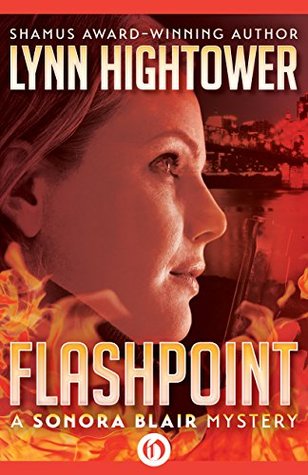
Sonora Blair is one of the most kick-ass female detectives to hit the shelves in a very long time. Lucky me, I read it free, thanks to Net Galley and Open Road Integrated Media. The original publication date was 1995, and so the initial publishers must have dropped the ball big-time when it came to promotion, because I know this is the kind of story that resonates with large numbers of people, especially women. And I am glad to see it being resold by Open Road, because they know how to do the job right.

So back to Sonora. No wait, let’s go back to Hightower first. What a total bad-ass when it comes to setting! I loved seeing her enter the home where her children were asleep, and the explosion of naked Barbie doll parts in her daughter’s room. I loved the moment when her elderly dog had an accident in the living room, and she was so distracted by the hundred other things, personal and professional, all colliding at once, that it was not even the first thing she took care of once she found it.

So we have two interesting threads here. One is the problem. A killer out there has murdered a man by handcuffing him to the steering wheel of a vehicle and setting fire to it…and him. It’s grisly business, but Hightower doesn’t overwork the detail to where it triggers my “ick” button; in other words, although it’s terrible, it is never so terrible that I just don’t want to read it anymore. And the problem just becomes thornier and trickier the longer she works on it. Clues drop here and there, and the stakes go up.

The other thread is Blair’s personal life, and the problems she faces in dealing with home and work. It sounds like a tired old song when I put it that way, but like any really skillful writing, it sounds brand new when the author rubs her own brand of English on it and sends it spinning.

After having read several hundred mystery, crime fiction, police procedural, and thriller novels—okay, if I had starting keeping track sooner, I know it would be well over a thousand—there are a handful of devices that are so frequently used that my eyes auto-roll when I see them utilized. I was watching for them. But Blair never gets tossed into the trunk of anybody’s car; she never gets the phone call saying the killer has her kids; there is never a moment when we realize she has been framed for the killing herself, and has to solve it to save her own butt. I’m not saying a great writer can’t get away with any of those; there are some Grand Masters out there that have done it and before my eyes could make the full roll, they were glued back to the page. But once someone reaches into that worn, soiled bag of tricks, it becomes a lot harder to engage me, and I was delighted that Blair never went there.

Her facility with setting is consistently brilliant throughout the book.

One tiny odd bit: for the first chapter or two, I was convinced that Blair was African-American. When she turned up blonde later, I had to mentally reinvent her. It didn’t take long though, because I was riveted and had to get back to the story.

For fans of outstanding detective fiction, this is a must-read. Order it now for yourself, or as a gift for someone you know will love it.

An Undisturbed Peace: A Novel, by Mary Glickman**

anundisturbedpeaceThe blurb for this novel reads, “A Jewish immigrant, a Cherokee woman, and a black slave find love, friendship, and redemption in the midst of the tragedy of the Trail of Tears”. I thought it sounded interesting, and it might have been, but really, not so much. Just as a truly great writer can take the dullest of topics and make it shiny and fascinating, so may an interesting concept leave the reader squirming and thinking of other things she might want to do or read, if the narrative doesn’t flow well. And although I usually have tremendous sympathy for writers, since I write a little now and then, I just couldn’t find any redemptive quality in Glickman’s novel. It feels as if someone has gone to a lot trouble to research the topic, and the whole story is going to be strung together around that research, come what may. In other words, instead of assisting the writer with the story, the story appears to be there as a forum to present research. And so thank you, just the same Net Galley, and thank you also, Open Road Integrated Media, but I can’t recommend this book to anyone. And if I felt this way after slogging through a galley I received free of charge, how might I have felt if I had paid for it?

The story starts out with sex, which rather startled me, and it didn’t seem to fit the rest of the story in overall tone, but hey, they say sex sells, so maybe the editors wanted her to open the story with sex. Fine, fine. I got through the first chapter and set the book aside so I could start fresh once my irritation had ebbed.

But the start of the story is only the start of the book’s problems. The figurative language is often trite—“buxom beauties”, and a Cherokee whose face is—what else?—“chiseled”. Description should drive the story forward, but it doesn’t happen here. There are huge stretches of nothing but narrative, and then impossibly long monologues in other places. There is an occasional interesting description of setting, but it comes undone as soon as we go back, as we must, to characters and plot.

It’s kind of a mess.

I found myself wondering whether the author might not find greater success in writing narrative nonfiction, where she could focus on her information, but spin it out in the format of a story, but I just didn’t see anything here that showed promise.

Could be this will be the next National Book or Pulitzer winner and I will have been the one that said the book was hopeless; stranger things have happened. But I have to call them as I see them, and although no doubt a lot of worthwhile research has been conducted, the story itself fails to flow. It feels cobbled together, forced, and contrived. If I felt a little editing here and there would be useful, I’d say so, but it’s pretty much the same from start to merciful end.

Not this time.

The Last Good Place, by Robin Burcell****

Oh hey, look at all the great books being released today! This one is for sale now, for all you mystery lovers out there.

seattlebookmama's avatarSeattle Book Mama

thelastgoodplaceWhat a treat! They say all stories have already been told once, but I’m telling you, this one hasn’t. Oh, trust me! And my thanks go to Net Galley and Brash Books for a wonderful DRC. This one will be up for sale November 3.

Some may recall the TV series “The Streets of San Francisco”; the show was based on a set of police procedurals by Carolyn Weston. Characters Casey Kellog and Al Krug became TV characters Steve Keller and Mike Stone. In bringing the series back to us in the twenty-first century, new co-author Robin Burcell was asked to update it, since some of the over-the-top methods used originally could get a cop fired these days, and the old methods would not resonate with the public. Burcell has a lengthy background in law enforcement, and now I know that she is also a capable novelist. The pages flew…

View original post 481 more words

For the Dignified Dead, by Michael Genelin****

This one goes up for sale today. You should read it!

seattlebookmama's avatarSeattle Book Mama

forthedignifieddeadThere’s a murderer on the loose, one that has killed across international boundaries. The weapon of choice? An ice pick. Happily, the case is assigned to total bad-ass Commander Jana Matinova, the best new female detective I’ve seen in emerge in crime fiction in decades. Thank you to Net Galley and Brash Books for the DRC. This title will be available for purchase November 3.

Part of what initially attracted me to this novel was the setting. Though Matinova finds herself crossing into various parts of central Europe, she is based in Slovakia, a country not even on my personal radar. By way of apology, I will point out that for most of my life, a giant swath of Europe and Asia was designated as USSR, and the satellite states lined up like faithful guardians around its perimeter included Yugoslavia and Czechoslovakia, both of which have been carved into different…

View original post 368 more words

Glory Road, by Bruce Catton*****

This must-read for Civil War buffs and students is available for purchase today.

seattlebookmama's avatarSeattle Book Mama

gloryroadBruce Catton was known as a popular historian when he first published books about the American Civil War, because of his narrative nonfiction format. All of the books being released digitally now are ones previously published in a non-digital age. This reviewer hunted down Catton’s three volume Centennial History of the Civil War at a used bookstore some time back, and although they were among the best I have ever read by anyone on this topic, I was convinced that anything he had published earlier on the subject was probably repackaged in this trilogy, and so I stopped reading Catton, thinking I was done. Thank goodness Net Galley and Open Road Integrated Media posted the galley for this second volume of Catton’s Army of the Potomac trilogy. Now that I am disabused, I will have to find the first and third volumes also, because Catton is so eloquent that he…

View original post 609 more words

U.S. Grant and the American Military Tradition, by Bruce Catton****

This one is now available for purchase!

seattlebookmama's avatarSeattle Book Mama

usgrantandtheamericanmilThis brass-tacks biography of US Grant, who served as America’s finest Civil War general and also two terms as US president, was originally written for young adults. Now it is something of an anomaly, and yet not a bad read for the right audience. Thank you, thank you to Open Road Integrated Media and to Net Galley for providing me with the DRC. This book will be for sale in digital format November 3.

Reading this nifty little book reminded me—not entirely happily—of how much sturdier literacy in the United States stood during the 1950’s, when this biography was originally written, compared to now. True, it was a less egalitarian, less inclusive school house that could throw this level of reading at its teenagers, and that is a different debate for a different day. Right now, I just have to tell you that Catton’s boiled-down biography is going to be…

View original post 650 more words

Petty, by Warren Zanes*****

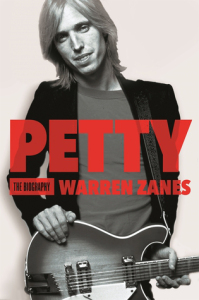
pettyOh my my, oh hell yes! If Tom Petty and the Heartbreakers is a band that lights your fire, you have to read this biography, which comes out Tuesday, November 10. You’ll be happiest if you can do it near a source of music, and the very best of all is to be near a desktop or other screen where you can view and hear the music videos as you read about their inception. Petty made it big just as I graduated from high school. By the time my first-born entered elementary school, I had a backseat full of little kids who bounced their heads along to the unquestionable rhythm of his music playing on the radio. And right about now I am supposed to tell you that I got this DRC free for an honest review, courtesy of Net Galley and Henry Holt Publishers.

Zanes has really done his homework here, interviewing Petty extensively, and also interviewing members of the band past and present, as well as other musicians (Stevie Nicks foremost among them) with whom he occasionally partnered. This was my first exposure to the Traveling Wilburys, a superstar group formed just for the sheer joy of it and consisting of George Harrison, Roy Orbison, Tom Petty, Bob Dylan, Jeff Lynne, and Jim Keltner. Well, here:

and after Orbison died, his chair was represented in the circle, with his guitar (I assume it’s his anyway):

Petty’s story is one of the ultimate success in spite of everything. Born into the kind of messed up, abusive, impoverished Southern home that America’s shot-to-hell social work system can’t even begin to repair, with a father that got along better with alligators than children and a mother who was stricken with both cancer and epilepsy, Petty was ready to get the hell away from the swampland and Florida immediately if not sooner. Petty tried school several times, but English (oh yeah, poetry right?) and art were the only courses that held any magic for him. He had one marketable skill, and unlimited ambition. As it happens, that was plenty.

If you want to read his story, this is the place to get it. Zanes has filled it with lots of vignettes, some of which are very funny. When a particular episode or situation is remembered differently by different musicians, producers and what have you, he tells what each has to say.

What you won’t find much here is his family, and that is oddly appropriate. Petty himself recognizes that when a guy is a professional musician doing the album cycle—write the songs, record the songs, make whatever changes need to get made, release the album, then go on tour to promote the album, and come back and do it all over again—family just gets left out. His first wife Jane developed some serious problems with chemical dependency and mental illness, and he experienced serious guilt over leaving their two daughters with her, but what else was there to do? Taking them on the road wouldn’t exactly be a healthy environment. Even if he quit making music, who’d pay the bills then? And so it went. So his elder daughter Adria puts in her two cents here and there, but mostly this is a story of Tom’s life as a musician. But reading about Jane’s addiction issues and then watching this video gave me chills (not great for small children, if you have them near you):

There aren’t really any slow parts to this biography; the least interesting to me were the various bands he formed or joined prior to his success as a soloist and then as the leader of the Heartbreakers.

That much said, this is the first, the VERY first time this reviewer (and all the reviews on this site are mine) has ever gone back to read a galley a second time before reviewing it, not because I didn’t get enough notes (oy, the notes!) but because it was just so much fun to follow Petty’s music and read the stories behind the songs.

If you don’t like Tom Petty, I question why you are even still reading my review. But if you’re a fan, this is a great bio to read, intimate without being tawdry or prurient, carefully researched, tightly organized. I am glad I didn’t have to edit it, because he probably had a mountain of extra information that was either cut or not included in the first place. But from anyone that loves good rock and roll, it’s uplifting and absorbing.

The ultimate holiday gift for someone close to you that loves Petty’s music would be his giant discography, the Traveling Wilburys DVD and CD, perhaps the documentary (which is on my own Christmas list), and this book. Rock and roll forever!

My Name is Lucy Barton, by Elizabeth Strout*****

mynameislucybartonElizabeth Strout is the Pulitzer winning author of Olive Kitteridge and The Burgess Boys. Her new novel, My Name is Lucy Barton, may be her strongest work yet. I was lucky enough to get my DRC free of charge from Random House and Net Galley in exchange for this honest review. My thanks go to both of them.

Right about here is where I often start examining various aspects of a new novel: setting, plot, character development, as well as its political undertones, if there are any, and there usually are. But this book defies that sort of compartmentalization. If you want a label for it, we could call it a fictional memoir, but that doesn’t really do it justice either. In fact the entire work is a gloriously detailed character sketch. The setting exists only to develop the character. The dialogue exists for the same purpose. Lucy Barton is developed as much by what is not said—or maybe more so—as by what is. The plot, which also exists to develop character, is fluid, apart from the fact that Lucy’s story begins in the hospital following an appendectomy and she is out by the conclusion. But in between, we bounce around to various times in the character’s life; we share her dreams, her memories, her phobias…and because Strout is part author, part magician, we just can’t put it down.

Well, that’s not completely true. I was reading the first half at night, and suddenly realized that this was not a story I wanted impacting my own dreams, so I deliberately put it aside, choosing to reread a celebrity memoir before I turned off my light. I could fall asleep with Tom Petty in my head, but I would surely have nightmares with Lucy Barton.

Lucy is so pathetically lonely that she hangs on the kind words of the doctor in the hospital, almost as if he were a surrogate father. There has been so little affection in her life.

“Lonely was the first flavor I had tasted in my life, and it was always there, hidden inside the crevices of my mouth, reminding me.”

Strout uses repetition as figurative language in a way I haven’t seen done before. I’ve seen it used many times by other writers for emphasis; I’ve seen it used in a house-that-jack-built way by a couple of really strong writers to create suspense. Strout writes in the first person, as should be clear from the title, and in this case, repetition is used to build mood; in a number of places, I get the feeling that repetition is being used to make us believe something that may not be true. She protests too much; she is repeating herself either to convince us, or to convince herself. Hell, maybe it’s both. She repeats the same thing about a character from her past so often that I am half convinced the person she speaks of is imaginary; one has to wonder.

Barton’s back-story is one of stark, terrible white rural poverty. The protagonist and her entire family lived in a rented garage; one room, freezing cold. The children in the family were so badly dressed, so badly groomed that other children would not sit next to them on the school bus, and they were whispered about at school, “equally friendless and equally scorned”.

To some extent this could be called a mother-daughter novel, because almost all of the dialogue and much of the plot consists of the shared memories between Lucy and her mother, there in the hospital. As they echo one another, there is a cadence that shows that no matter what happened while Lucy was growing up, there is closeness between the two of them; Lucy would have more if it were offered. But the conversation is a kind of almost church-like call and response, a sort that is often seen among family members in smaller snippets. Much of the conversation is just neighbor gossip, but so much more is said in the way that Lucy and her mother speak to each other.

Barton is thrilled to have her mother there, nearly cannot believe she has actually come to sit with her, and as they converse, bits and pieces tumble out, and other bits are suppressed, but our protagonist thinks about them, and so we are in on all of it. And the sense of horror builds, builds, and builds some more. Brief snapshots of horrific events blink in and back out again, juxtaposed with that which is common and normal—the terror of being locked in the truck as child, and then we are talking about Lucy’s own children going to a play date, and about Lucy’s appendix. And by giving us the briefest glimpse of the horror, and letting us know in the author’s own brilliant way that this snapshot is not the half of it, there’s oh, so much more—the effect is tremendously chilling, and at the same time, oh so human.

And ultimately, whether her mother visits her or not; whether Lucy is financially well off or stone cold broke; whether she is married or single; Lucy is alone. Her solitude is positively visceral.

This novel won’t be available until January 2016, and that’s a shame, because it’s an amazing October read. But we will take a good case of the shivers along with stellar literary fiction when we can get it, and this novel comes highly recommended. Absolutely brilliant!