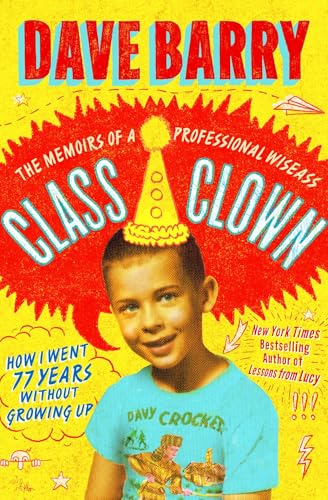
Class Clown, by Dave Barry****-*****

4.5 stars, rounded upwards.

The first time I read a Dave Barry column, it was 1984, and a friend sent it to me. We had only snail mail back then, but it was so funny that she snipped it out of the airline magazine she’d read on a business trip and mailed it to me. I don’t remember which column it was, but it left me gasping for air, I laughed so hard. This was a difficult time for me, a young mother with two small children, a third on the way, and almost no money, and I floated along on the laughter that article brought me for a solid month. I hung it on the fridge where I could reread it whenever the urge struck me. That is how I became a Dave Barry fan.

Since then, his work has either hit or missed for me; almost all of the time, it has hit and although times are easier for me now, laughter is always a balm. When he misses—which is rare—he misses bigtime. But this time he’s golden, the Dave I remember reading that first time.

My thanks go to NetGalley and Simon and Schuster for the invitation to read and review. This book is for sale now.

It strikes me again how frequently the funniest humorists, be they journalists, novelists, standup comedians, or comic actors, have tragic backgrounds. Barry has experienced more than his fair share, with a schizophrenic sister who’s been institutionalized, a father that died too young, and a mother that couldn’t recover from his loss, and took her own life. Barry wrote about her when it happened, and he reprints some of it here.

He reprints some other things, too, and I expected that. I don’t think that it cheats the reader when he documents parts of his professional journey by reprinting some of the things he wrote; he’s been writing prolifically for thirty years, and it seems to me that it was probably a lot of work just choosing what to include and what to leave out. It feels strangely like a school reunion, rereading the excerpts from drop dead funny columns that I enjoyed for the first time when they were originally published. Oh, my heart, “Ask Mr. Language Person!” I’m an English teacher, and I’m in stitches all over again.

The thing about an autobiography is that the author is also the subject, and so when he decides what parts of his own life to write about and what to keep private, we readers need to accept that. At the same time, it does seem disingenuous to completely pass over his marriages and divorces. A paragraph for each, maybe? Just give us the benchmarks.

I hadn’t known that he was responsible for Talk Like a Pirate Day, and both I and my middle school students owe him for that one! But the thing that is most striking to me, and that I appreciate most, is his reflection about the political discourse in the U.S., and the way we have become polarized and too often, uncivil. In the past—and he cites the Kennedy/Nixon campaign—arguments between family and friends were “heated, emotional, sometimes angry, but never nasty. At the end of the night everybody hugged everybody, because they were friends, and they understood that they could disagree about politics without believing the other side was evil. Mistaken, maybe. Evil, no.” All I can say about that is thank you, Dave, and amen.

Because I was running late, I checked out the audio version from Seattle Bibliocommons. Barry does his own reading, and it’s even better that way.

There are a lot of hilarious experiences he recounts, but the thing about Barry that binds all of the experiences, the columns, and the books he’s written is his refusal to take himself too seriously, and it is his complete and delightful intolerance toward pretentiousness that keeps me coming back. I cannot imagine Dave Barry snubbing anybody, ever. Wouldn’t the world be a better place if everyone was like that?

Highly recommended.

The Rulebreaker, by Susan Page*****

Barbara Walters was a force to be reckoned with. She was the journalistic pioneer who singlehandedly smashed the glass ceiling that kept women from anchoring network news; over the years she would conduct television interviews with heads of state, criminals, otherwise reclusive stars, and anyone else she deemed newsworthy. She was ruthless in the pursuit of a story, but during interviews, she used velvet gloves to deliver the most searing questions, and her subjects responded.

My thanks go to NetGalley and Simon and Schuster for the review copy. This book is for sale now.

Page has written a full, epic autobiography, starting with Walters’s childhood, which was fraught with uncertainty, and ending with her death. She has written it the way the story of a luminary should be written, touching on the many remarkable aspects of Walters’s life without lingering too long on any one of them. She keeps the pacing brisk, and the tone respectful but frank, never fawning. I can’t imagine anyone doing a better job, including Walters herself; the autobiography, Audition, is the most cited source in the endnotes, but Walters had a tendency to drone while telling her own story, particularly about her childhood, while Page keeps it moving.

Walters grew up in a show business household; her father, Lou Walters, produced live shows, and when they were successful, the family lived in style; when they weren’t, it was hand-to-mouth genteel poverty. His gambling addiction caused the family terrible hardship on numerous occasions, and once she made it in the industry, Barbara was forever writing checks to bail him out of debt. Her younger sister, Jackie, was intellectually disabled, and needed constant care and attention. Barbara remarked that in looking back, she doesn’t feel that she was ever young, as she carried so many adult responsibilities at such an early age.

Breaking into mainstream journalism—not fashion or cooking stories, but hard news—was a tough road. She did it at a time when women weren’t expected, or allowed, to do much of anything outside of mothering, housekeeping, and a small number of stereotypical positions. Any female that dared step outside these tight confines was labeled, not as an attorney, manager, or journalist, but as a “lady journalist,” and so forth. Her job on the Today show was announced—with a bit of urging from Barbara herself—in the New York Journal-American thusly:

“’Dawn Greets Barbara, A Girl of Today,’” the headline over the story read. ‘A very attractive, shapely, well-groomed, coiffed and fashionably frocked feminine member of NBC’s dawn patrol” …adding that she had ‘no wish to become a personality.’ She wants to remain as she is…the prettiest reporter in television.’”

That didn’t last, if it was ever true at all. She fought, tooth and toenail, for every single advancement in her career; mainstream news anchors, male of course, resented her and resisted her, particularly when she was hired to appear as a co-anchor. Her early career was marked with restrictions, with Harry Reasoner and Walter Cronkite subjecting her to endless bullying and requirements of when she could speak on the air—not until they had—and other petty, petulant rules.

But she never gave up, and she never went home.

As is often true for anyone that lives for their career, Walters wasn’t able to maintain any of her marriages or raise her own child. She was busy. This is the one regret she voiced at the end of her life, when she found herself alone, with only her longtime paid assistants to see to her needs.

Page narrates her own audiobook, which I checked out from Seattle Bibliocommons in order to catch up, and I immediately noted how much her voice and intonations resemble those of her subject, albeit without the speech impediment. I enjoyed listening to her.

Perhaps my favorite moment in this book is the moment when a very elderly Barbara Walters falls on a marble staircase after refusing to take the arm of the younger woman offering it. She faceplants, is badly injured, but when she regains consciousness, the first thing out of her mouth is an imperial order: “Do not call an ambulance. Do not call an ambulance.” (Of course they did. They had to.)

Although Walters was never a feminist crusader and generally looked out for herself, her family, and friends rather than her younger peers, we women owe her a debt of gratitude. She forced doors open that were bolted shut, and the ripple effect was immeasurable.

Highly recommended to those interested in Walters, feminist history, and anyone that just enjoys a good biography.    

Somewhere Toward Freedom, by Bennett Parten*****

Bennett Parten is a fine historical writer, and here he examines General William Sherman’s renowned march through Georgia during the American Civil War through the lens of the formerly enslaved people that followed him. It’s a job that needed doing, and I’m glad that Parten was the one to do it. My thanks go to Simon and Schuster and NetGalley for the review copy. This book is for sale now.

The Union’s approach to formerly enslaved people evolved considerably over the course of the war. (This is your reviewer talking, not Parten.) In the beginning, when both North and South thought the conflict would be a brief one—ending, of course, in their own victories—anyone that left a plantation without permission to follow the Union army was promptly returned to their owner. But this was problematic from the start, if only logistically, as such practices slowed the army’s pace and drained resources from it, all in service to the enemy. For a while, then, everything was unofficial, as gradually, the formerly enslaved were sometimes folded into the army as support staff, helping cook, set up camps, pave roads, and whatever other noncombat roles needed to be filled. Eventually the practice was codified, not because slaves were declared free—not yet—but as “contrabands” of war. The idea was that by taking the enemy’s property that one runs across, be it livestock, crops, or (wince!) human beings, one’s own forces were strengthened, the enemy’s weakened. And after the Emancipation Proclamation, the formerly enslaved could theoretically go wherever they chose, but since guns and dogs can render such a proclamation from a far away and often unrecognized authority, it seemed like a wise plan for the formerly enslaved to follow the Union army.

Prior to reading this book, I was unaware of the relative size of the crowd of followers as opposed to the army itself. As Sherman’s forces made their way through Georgia waging total war, razing fields and burning cities, the crowd behind it grew from hundreds, to thousands, to tens of thousands!

Sherman’s first obligation, as he saw it, was to win this war. The army had to be his focus. Yet, as enthusiastic followers swarmed, they needed food, shelter, and sometimes other assistance. Initially, the troops were instructed not to give food to anyone other than those followers tapped to serve the army, but it proved difficult to enforce. There were children there, and they might well starve if not fed. The army had, as an intentional strategy, denuded the farms and villages of food and other necessary resources, so telling the followers to go find their own food was disingenuous. The army had nearly all the food there was; unfortunately, it wasn’t enough for thousands of extra mouths. And at times, Sherman and his generals made an effort to prevent, or to at least not help, the followers from remaining with them.

The greatest scandal was the one at Ebenezer Creek. (Sherman himself was not physically present for this, but what happened was consistent with his policies.) Georgia was full of rivers, swamps, creeks, and bogs, and in order to cross them, sometimes the engineers constructed bridges, and then either burned them behind themselves to prevent the enemy from following, or retrieved them for later use. In this instance, the enemy was close at the rear, and the order was given to pull up the bridges just as soon as the last soldier was across. The result was horrifying: with the hounds baying behind them, the desperate followers used every possible means to try to stay with the army. Some drowned; others were captured and either returned to slavery or killed. Women and children perished in those muddy waters, and later, the Federals launched an investigation.

There were other less dramatic, yet still tragic, incidents of the same sort.

In order to solve this conundrum, Sherman ordered a series of abandoned plantations in Port Royal, an island in South Carolina, to be turned over for the use of the freedmen and women. The book goes into a fair amount of detail about how these were run, with a fierce competition between two sides for control. Despite an overly colonial administration, formerly enslaved people were able to farm for themselves, and in some cases were able to buy land with the money they earned. It was a sound, if flawed program that was ultimately destroyed when Lincoln was murdered and Andrew Johnson, a sympathizer of the South, became president and gave the plantations back to their original owners, making no provision whatsoever for the farmers that now worked them.

It is this aspect of which I knew nearly nothing. Part of this is because I am a coward; I have a dozen or more books about Reconstruction that I say I will read, but then I don’t, and that is because I know the ending will be heartbreaking. But there’s also this: conventional histories of the Civil War tend to follow one or another army, general, and so forth, and very few tell the story of what happens after the army marches onward. And so I learned a good deal from this portion of the book; and yes, my heart broke, but not as much as those of the people that were first assisted, and then abandoned by the U.S. government.

Finally, I want to comment on the notes and sources used here. They are beyond reproach, with many primary sources used, multiple sources per endnote in most cases, and well-integrated. I particularly appreciated the quotations of the followers themselves.

I highly recommend this book to all that are interested in the American Civil War, Reconstruction, and the many social and racial problems that have continued to weigh on American society ever since.

Carl Perkins, the King of Rockabilly, by Jeff Apter*****

“’I had only three childhood idols,’ John [Lennon] would tell a friend. ‘Elvis, Carl Perkins, and Jerry Lee Lewis.’ Paul McCartney would go one step further: ‘If there were no Carl Perkins,’ he’d state, ‘there would be no Beatles.’”

When I saw this book, I felt a slight buzzing at the back of my mind. Huh. Carl Perkins. Have I heard of him? Sounds familiar, but…? And then I read the synopsis, which said that he wrote Blue Suede Shoes, and was the first one to perform it. I went to my streaming service and typed it in; since he wasn’t the one to have made the song iconic, I figured his rendition of it would sound lame. But no! No, it didn’t. So now I knew that I had to read this biography.

My thanks go to NetGalley and Kensington Books for the review copy. This book will be available tomorrow, November 26, 2024.

Perkins was born in 1932,  grew up the son of a Tennessee sharecropper, and starting at age 6, he worked in the cotton fields with his family all day, “from can to can’t.” Had he not, he and his family might have starved. This was a time when no governmental safety net existed, nor did child labor laws. The man who would become his closest friend, John Cash—who would perform and record as Johnny—lived in nearly identical circumstances across the Mississippi River in Arkansas. The only good aspect of this grueling life was the singing. His family sang with the other field laborers, who were mostly African American, and while still a child talked his father into purchasing a guitar.

Perkins was 21 years old when he went to Memphis, where Sam Phillips, founder of Sun Records, had advertised that he would record anyone, anywhere, any time. He had some original music that Phillips liked; not long afterward, he and his wife, Valda, heard his record on the radio. Perkins said, “Valda, she dropped the baby, and I like to fainted.”

Phillips had three other promising musicians signed, and they got to know one another well, sometimes performing together. The other men were Johnny Cash, Elvis Presley, and Jerry Lee Lewis. The first two became Carl’s lifelong friends; Lewis was unpredictable, sometimes violent, and Perkins avoided him when he could. But on one occasion, when the four were together, Lewis complained that the three men with guitars could move around, whereas he was stuck at his piano. Perkins asked him whether he could play standing up, and suggested he “make a fuss” while he did it, advice which altered and improved Lewis’s career.

Perkins’s hit original song, “Blue Suede Shoes,” sold millions, and Perkins was on his way; but just as his momentum was growing, he and his brothers were in a serious car wreck and hospitalized. Once Perkins was able to play again, he felt that loyalty demanded he wait for his brothers—his bandmates—to heal. By the time they could play again, Elvis had also recorded the song, and his career was catapulted into the stratosphere. For a while it appeared that Perkins’s career was finished, but soon help came from an unlikely source: The Beatles wanted to meet him. They wanted to record his songs. They looked up to him as a mentor, and became his lifelong friends.

Reading about Perkins, I am amazed at his capacity to remain grounded and retain the values with which he was raised. Some men would have resented Elvis, but Perkins was delighted for him—and enjoyed the royalties when Presley recorded and performed Perkins’s music. How many men, raised in such horrifying poverty, would place family loyalty over fame and fortune? How many could be so reasonable? Perkins later said that when he saw Elvis perform, he could see why the man was rising so quickly. Elvis was immaculately turned out, and the girls went crazy for him. Perkins wasn’t much to look at, and he knew it, and he would never flirt with his audience, because “I was a married man.” And indeed, he remained faithful to Valda for all the decades of their lives together, and he counted himself lucky to have her. Meanwhile, the royalties from the Beatles, Elvis, and others enabled him to buy a modest but much loved house for himself, Valda, and their growing family, and later he would be able to do the same for his parents. And as it happened, his career as a performer was not dead, only sleeping.

I have read many musicians’ biographies and memoirs, and all of them had greater name recognition than Perkins; but from what I can see, Perkins was the most decent person among them. This is not to detract from others, but seriously…what a nice guy!

Meanwhile, author Jeff Apter writes in an intimate, conversational way that makes this book surprisingly hard to put down, and his research is beyond reproach. Highly recommended.

The Chinese Question, by Mae M. Ngai****-*****

Mae Ngai is an award-winning author and a professor at Columbia University. In her third book, The Chinese Question, she examines the race relations and to some degree, the economic underpinnings of the Chinese diaspora.

My thanks go to NetGalley and W.W. Norton and Company for the review copy. I am disgracefully late, but when I began reading this book I realized that if I were to absorb and retain anything here, I would need to take it in small bites. That said, this is an unusually well researched work, and it’s well worth the time and attention of anyone interested in the topic.

Usually when I see research having to do with Chinese immigration, it is within the context of immigration to the United States, or an examination of the push factors of emigration, examining why Chinese chose to leave their native land and embark upon an expensive, dangerous, and uncertain journey to a place they’d never visited—in most cases—and where they usually did not speak the language. Instead, Ngai examines it as a global diaspora that includes English speaking nations, namely South Africa, the United Kingdom, Canada, Australia, and the United States. In doing so she is able to highlight the similarities of treatment, to put it politely, and also to dismantle some of the stereotypes that have rooted themselves in English speakers’ knowledge of history.

For starters, she wants us to know that Chinese immigrants were not necessarily “coolies” or indentured workers, and they didn’t always face conflicts with Caucasian powerbrokers. But there certainly were a great many blood chilling abuses, sometimes brought about by White fear of the “other,” but oftener from greed and the desire to exploit the Chinese working class and eliminate competition from the businesses of better off Chinese.

This study is adjacent to my own graduate study topic of many years ago, when I examined the “Model Minority,” and the attempt to counter the demands of U.S. Civil Rights activists of the 1950s and 1960s with the suggestion that Black people quietly accept abuse and quietly climb the economic ladder, or not, as Asians of Chinese and Japanese descent had supposedly done. Ngai demonstrates that Chinese immigrants weren’t all that quiet, and they weren’t all that accepting of maltreatment at the hands of employers and local officials. This is interesting material indeed, and I wish I had known these things sooner.

As a general read for a wide audience, this may be a four star book because it is dense and has an academic approach that not all pleasure readers will appreciate; however, for those with a strong interest in the topic, whether for academic research or personal knowledge and growth, it is hands down the best work I’ve seen in decades.

Highly recommended to those passionate about the issue.

Left for Dead, by Eric Jay Dolan***-****

When I saw this book, I was eager to read it. Shipwreck, treachery, and survival? It doesn’t get a lot more exciting than that. I signed myself up for both the digital and audio galleys, and settled in to immerse myself in history.

My thanks go to NetGalley, RB Media, and W.W. Norton and Company for the galleys. This book is available for purchase now.

The book is well paced and well researched, with plenty of quotes from primary sources. The events described take place during the War of 1812, and involves British and American ships and crew members, none of them particularly lovable, but definitely resilient and ingenious at surviving in extremely dangerous conditions. The men on the American ship have been at sea since before war was declared, and are astonished to find themselves prisoners of war when they are rescued by the British at one point. There are a great many twists and turns, and this is one of those stories that would be considered completely unrealistic if written as fiction. What an experience these sailors endured!

Nevertheless, I am not the best audience for this story after all. I came into it thinking of history and survival, but when I applied for the galleys, I didn’t appreciate the word “sealer” in the ship’s description. Sealer, as in clubbing the seals to death. Hundreds! So easy! Filling the hold of the ship and…I will spare you the rest, since I was unable to spare myself. I sternly reminded myself that this was a different time period with different societal expectations. No animal had been declared endangered, and there had been no technologies that would render the need to wear animal skins for warmth obsolete. People need to stay warm and dry; seal skins will do that for them. I vowed to let it slide past and focus on the rest of the book; but it never slid past, because it was mentioned again, and again, and again, not with a tremendous amount of detail, yet far more than I needed or wanted to hear.

Yes, a baby is born on the ship, but that babe gets about three sentences. Yes, there’s a dog on board, and he saves the crew members many times over, but his heroics don’t show up until the last portion of the tale, and although other reviewers have said that the book is worth reading for this alone, I must respectfully disagree.

Clearly there are a number of people that appreciate and enjoy this book, and I agree that it’s important to document historical events, but I finished reading this thing weeks ago, and I still get a sour gut remembering. If you still want to read it, then do so, but it’s important to go in with your eyes wide open.

Codename Nemo, by Charles Lachman****

3.5 stars, rounded upward.

Code Name Nemo is the true story of how U.S. Naval Commander Dan Gallery and his men captured a German U-boat during World War II. My thanks go to NetGalley, Diversion Books, and Dreamscape Media for the review copies. This book will be available to the public June 4, 2024.

German U-boats were brilliantly engineered submarines that were the terror of the seas for Allied forces in the Atlantic theater during World War II. They were extremely difficult to detect, and were responsible for sending not only Allied ships, but also Merchant Marine vessels and other commercial craft to the bottom of the ocean. Until Gallery took the initiative to capture one, the U.S. Navy had been hard pressed just to sink the treacherous subs rather than be sunk by them. To capture one was an intelligence coup of the highest order, providing the Allies with not only the technical details of the U-boats themselves, but also a host of military secrets kept onboard, including the codes that in turn led to the plans and locations of other German subs.

No Naval officer had even attempted such a thing before. Nazis were expected to destroy their subs rather than allow them to be taken; this, even if it meant all or part of the crews had to drown with the vessels. But lately, it was known that there were sailors that were conscripted and who were not Germans, men from conquered European nations. Gallery believed that some of these men would now choose to surrender and live, rather than drown themselves for the Fuhrer. Gallery was right.

Lachman does a presentable job of describing the events leading up to the sub’s capture, and he chooses to tell it from dual perspectives, and so we see it through both American eyes and those of the Germans. I am not a fan of this trend. For starters, I don’t see this as a good time, if such exists, to depict Nazis as warm and fuzzy fellows that just happened to be on the losing side of history. Furthermore—and I’ve said it before, so forgive me if you are my longtime reader and growing sick of my saying this—you never see historical writers take this tack when detailing the events of the Pacific theater. It’s as if there’s an implied requirement, saying, Look here. We are all (Caucasian) human beings, after all.

That aside, I enjoyed this book, particularly the most exciting part when they board the sub and have to prevent its exploding, or sinking fast along with the U.S. sailors that have come on deck. There is a certain amount of information dumping up front that slows things down a bit up front, and that might also confuse a reader or listener trying to remember the many names and personal histories of those involved. I can see the reasoning behind all of it; some of those mentioned in this book will have descendants that swell with pride as they hear of the courage and cleverness of their great-great whatevers, and who may be devastated to see their late relative omitted. However, the narrative would flow better if the details were streamlined.

I primarily use the audio version, with the Kindle version as backup for rechecking facts. Some of the time I used both at once. Qarie Marshall is the reader for the audio, and does an outstanding job of taking me back in time, once the story gets moving.

The research is adequate, but not stellar. Certain sources get the lion’s share of use, primarily Dan Gallery himself, who has written at length about his experience. I found myself wondering, from time to time, if I would have been better served to read his own account rather than this one. But by then I had this one well underway, so I went with it.

Those that enjoy military history might enjoy this story, and for them, I rate this book four stars. As a general read for history buffs, it may be more of a three star read. If you are the latter and considering reading it, you may want to get it free or cheap, rather than investing full cover price.

Longstreet, by Elizabeth Varon*****

Longstreet: The Confederate General Who Defied the South is a biography that focuses on Longstreet’s military service in the American Civil War, and his political life thereafter. It’s meticulously researched, and the documentation is among the best I’ve seen anywhere. Students, Civil War buffs, and other interested readers won’t want to miss it.

My thanks go to NetGalley and Simon and Schuster for the invitation to read and review. This book is for sale now.

James Longstreet was one of the most able and respected generals for the Confederacy, serving as General Robert E. Lee’s right hand officer. Lee called him “my old war horse.” However, a disagreement between them about strategy at Gettysburg has made Longstreet a convenient scapegoat for Lost Cause types that accuse him of treachery, of deliberately sabotaging the deadly three day fight, and thereby causing the rebels to lose a key battle. Varon sets the record straight, and then goes on to explain what he did following Lee’s surrender and the Confederacy’s failure.

When I saw the subscript in the title, I wondered whether Varon might be overstating Longstreet’s postwar behavior in order to draw readers. Having read it, I can say that she has not overstated one single thing. This is a fair and balanced account. In essence, Longstreet recognized that, while the Confederate Army fought long and hard, it had in fact lost, and there was no good to be gained from further destruction at a time when reconciliation was more important. He basically said that having lost the war, the best thing for the South to do is recognize that the war is done, and proceed to obey the laws of the United States and rebuild the ruined Southern states.

I was unaware, before reading this biography, how extensively defeated Caucasian Southerners were inclined to sabotage the U.S. government. Guerilla actions were common, along with the passage of local laws that directly conflicted with Federal ones. Acts of terror against African American former slaves, as well as free Black Southerners, were frequent whenever Federal troops or other peacekeepers were not present to see to their safety and their rights. And though I had not realized it, Longstreet hailed from Louisiana, which seems to have had the ugliest resistance of all, with the White League and the Knights of the White Camelia wreaking havoc against Blacks that occupied governmental posts, became too prosperous for the liking of local Whites, or that in any way displeased any White person of any social standing. Longstreet did his best to shut that down; he failed.

Varon discusses the role played by Longstreet’s personal friendship with U.S. Grant, one which predated the war; he was best man at Grant’s wedding to Julia. She suggests that although the friendship was important, Longstreet was also acting on principle.

Varon doesn’t overstate her case, and is measured and fair in her assessment. She points to the occasions when Longstreet folded and cooperated with the local racists in that well-traveled road of U.S. politicians: I have to do this terrible thing in order to get elected, or I can’t do any good for the former slaves or anything else. This habit, both past and present, sets my teeth on edge, but she doesn’t defend it. She also points out that had the Confederacy won the war, Longstreet would have remained a Dixie racist for the rest of his life, more likely than not.

Those looking at the length of this book—over 500 pages—should be aware that about the last twenty-five percent of it is endnotes, with documentation, bibliography, etc. And while it may be more than a general reader that simply enjoys a good biography might appreciate, those interested in the Civil War should get this book and read it.

Charlie Chaplin vs. America, by Scott Eyman*****

Charlie Chaplin rose to fame over 100 years ago, but his fame hasn’t faded over the years. One of the most visionary movie makers in modern history, he rose from desperate poverty and homelessness during his childhood to become one of the wealthiest and most respected men in his chosen profession. And yet, for some odd reason, the U.S. government relentlessly pursued him as if he were an enemy agent, eventually forcing him to retire abroad. It’s a bizarre episode in U.S. history, and a fascinating one.

When I saw that Scott Eyman, an author whose biographies of actors I have previously enjoyed—John Wayne, Jimmy Stewart, Henry Fonda—had written about this case, I had to read it. My thanks go to NetGalley and Simon and Schuster for the invitation to read and review. This book is for sale now.

Charlie was born in 1889 in London. His mother Hannah was an actress, a loving mother whose health was dreadful. In addition to more conventional illnesses, she was sent repeatedly, and for longer stretches each time, to mental hospitals; it has been speculated that she suffered from syphilis, which eventually had devastating effects on her brain. Charlie’s father was a businessman who left the family and refused to pay a single shilling of child support because one of Charlie’s brothers was conceived with another man. And as an aside, if there is an afterlife, I sincerely hope that Charles Chaplin, Senior is roasting eternally in the flames of hell.

For a while, Hannah’s relatives cared for Charlie and his older brother, Syd, but eventually the boys found themselves in a workhouse, beaten, abused, sickened, and barely fed. It was his brother Syd who first discovered that acting could keep him out of the workhouse and put food on the table, and once he was so employed, Syd took his pale, sickly little brother to the theater and persuaded his boss to use Charlie, too. Thus was a star born.

His tremendous suffering during his childhood gave Charlie a lifelong sympathy with the working class, the impoverished, and the down and out. Early in his career, a director gave Charlie a costume and told him to come up with a character, and this was when he invented The Little Tramp.

I’ve known for most of my life about Charlie’s expulsion from the U.S., but I’ve never been sure whether he was a Communist. I’ve known people brought up in Communist households in America, and for many years, they existed strictly underground, so I wondered, did Chaplin deny his affiliation because he wasn’t a Communist, or because he was? Eyman’s meticulous research demonstrates once and for all that Charlie was not political. He told the truth about himself: “I am not a Communist. I am a peace monger.”

Nevertheless, once he gained prominence in the American movie industry, he had a target on his back. It’s difficult to understand why politicians and bureaucrats in California and in Washington, D.C. hated him so fiercely.

“A month after the revocation of [Chaplin’s] reentry permit, the FBI issued a massive internal report documenting more than thirty years of investigations focused on Chaplin, a copy of which was dispatched to the attorney general. The report revealed that, besides the FBI, Army and Navy Intelligence, the Internal Revenue Service, the Central Intelligence Agency, the Department of State, and the U.S. Postal Service had all been surveilling Chaplin at one time or another. In short, the entire security apparatus of the United States had descended upon a motion picture comedian.”

Eyman has done a wonderful job here. Because I had fallen behind, I checked out the audio version of this book from Seattle Bibliocommons, and I alternately listened to it and read the digital review copy. Of course, anyone reading this book for the purpose of academic research should get a physical copy, but those reading for pleasure may enjoy the audio, which is well done; this is a through, and a lengthy biography, and the audio makes it go by more quickly.

I confess I haven’t read any other Chaplin biographies, so I cannot say for certain whether this one is the best, but it’s hard to imagine a better one. For those sufficiently interested to take on a full length biography, this book is highly recommended.

A Fever in the Heartland, by Timothy Egan*****

Timothy Egan, winner of the Pulitzer Prize, is one of my favorite historians to read. His most recent book, A Fever in the Heartland occupied the bestseller lists for months, and rightly so. I took my time with it because it is a very uncomfortable read most of the way through, with the first half being much rougher than the last. I learned a lot from it, and this is clearly a case of truth being stranger than fiction.

The Klan was originally formed by former Confederate officers after the Union’s victory in the American Civil War. However, it was stamped out during Reconstruction, and was gone for fifty years. It was revived on Stone Mountain, Georgia, and the horrifically racist film by D.W. Griffin, The Birth of a Nation, which depicts African-American men as crazed rapists that drink to excess and lose their minds when a Caucasian woman is anywhere nearby, not only aided its reincarnation, but contributed one of its most feared symbols. No crosses were burned until it showed up on movie screens around the United States; the pointy hoods were shaped that way to make the men underneath them appear taller. Later, the women’s organization had robes with cardboard forms in their own pointy hats, because a night of terrorism is no excuse for a woman to let her hair get out of control.

At one point, one Caucasian man in three belonged to the Klan. There was even a children’s organization, with activities similar to boy and girl scouts.

The woman that is at the center of this story, Madge Oberholzer, was the secretary in the office of D.C. Stephenson, the Grand Dragon of the newly revived Klan. Despite the hugely moral speeches he gave around the country extolling traditional values (for the time) including the avoidance of alcohol; women that remain virgins until marriage and then live their lives in service to their husbands and young children; Protestantism, with regular church attendance; Caucasian separation from other races and ethnicities; and unquestioning patriotism, Stephenson himself was a drunk, as well as a serial rapist and sexual sadist, fond of using his teeth to mutilate the women that he savaged. Madge was the one victim that would not crawl into the shadows, and she literally used her last dying breaths to expose him.

I was given a hardcover copy of this book when it was at its height of popularity, but it took me a long time to get through it, because I could only stand to read a few pages at a time. The end was enormously satisfying, however, and even in the worst parts, there are occasional moments that made me want to stand up and cheer. For example: the Klan plot to go the University of Notre Dame—a Catholic university– and burn the golden dome there was foiled by its football team, and the melee that ensued when they physically attacked the Klan is the origin of their nickname, The Fighting Irish. (The dome survived.)

Often when I read nonfiction history, I can’t help imagining how much more interesting it would be if it were written as historical fiction. That was never the case here. Firstly, if this were a fictional account, reviewers everywhere would have been brutal, because nobody would ever believe a story like this one. But the fact is, it’s entirely true, and Egan is second to none when it comes to research. Also, his conversational narrative style is as interesting as the best historical fiction; the pace here is slowed in places, not by any lack of authorial fluency, but by the horrifying nature of this true story.

For those that have the capacity to read something like this without becoming morbidly depressed or coming unstuck, this book is highly recommended. For everyone else, I recommend finding something lighter and more uplifting to alternate with it, and to never read this at bedtime. You won’t want it in your dreams.