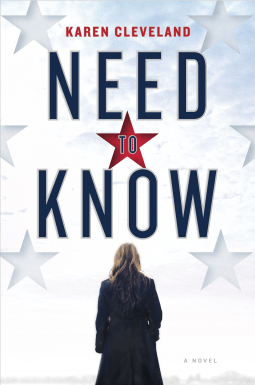
Need to Know, by Karen Cleveland***

NeedtoKnow

“My God, Vivian, what’s it going to take for you to trust me?”

 Need to Know is an espionage thriller written by a former CIA analyst. I read it free and early thanks to Random House and Net Galley. This book will be available to the public on Tuesday, January 23, 2018.

Our story is told in the first person by Vivian Miller, a CIA analyst with a mortgage to meet and four small children. In the course of her research she comes across the identity of someone she knows and then the whole house starts to tumble, as she makes one bad decision after another, punctuated with the occasional wise choice to heighten suspense.  Around the sixty percentile I found myself reading it for giggles as it becomes increasingly clear that our protagonist is as dumb as a box of rocks.

With this in mind, I have devised a drinking game for rowdy book clubs that meet in real life. Here are some ideas:

  • Take a drink every time Vivian refers to Matt as her “rock”.
  • Take two drinks every time she refers to Matt as their children’s “rock”.
  • Take a drink every time you run across the word “ringleader”.
  • Spin around three times and take a drink for every rhetorical question you find in the narrative.
  • Take a drink for every stereotype you see.


Spoiler alert (*snerk*): you may want to clear your calendar the day after your book club meets, because it’s going to be a rough one.

Now I understand that there may be abstainers in your drinking book club, patient souls that either really like the people in your club, or that can’t find a book club made up of tea-totters. For those people I have special instructions:

  • Take a drink when you find a well developed character.
  • Take a drink when you find a positive female role model .


Another spoiler alert: provide this second group of people with water, because otherwise they are going home thirsty.

I can also recommend this title to women that are newly divorced, mad as hell, and looking for something to throw. For these ladies, I recommend obtaining a hard copy, because you won’t want to ruin your expensive electronic devices. Before commencing with this title, remove pictures, monitors, and china from the wall where you’ll be reading. Broken glass is nobody’s idea of a fun Tuesday night.

“They’re good, the Russians.”

Newly divorced, mad-as-hell, book-throwing women that have recently divorced a Russian man may even want to pre-order a copy. I’d do that right now if I were you.

Купить книгу.

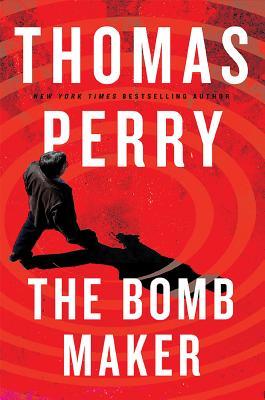
The Bomb Maker, by Thomas Perry****

TheBombMakerThomas Perry writes some of the most terrifyingly suspenseful novels of any writer alive, and he never has a dud. In this story, a retired bomb squad cop is asked to come back to work when half the current squad has been wiped out by someone that wants to kill bomb specialists. I was able to read it free and early thanks to Edelweiss and Mysterious Press. It will be available to the public January 2, 2018, just in time to start the new year with a bang.

Dick Stahl has just returned from carrying out a tricky job in Mexico. Retired from the bomb squad and police work, he owns a consulting firm and is ready for a rest. But someone out there—most likely not a terrorist, since nobody claims credit for the carnage—has taken out half of the bomb squad, and clearly the technicians themselves were targeted.  More attempts are made; there are numerous explosive devices planted in a given location. The guy that plants these things wants them to be found, and so there’s an obvious, textbook-type incendiary left in plain view. The bomber’s intention is for the technicians to relax, believing they have destroyed the threat, and it is then that the real bomb—or chain of bombs—is triggered in order to take out as many bomb techs in one blow as is possible. Stahl has his work cut out for him when he is called back to duty to foil this killer and aid his capture.

In addition to Stahl, we see the bomb maker’s thinking and what he is planning. Perry’s villain is a cold, calculating schemer, and there’s a chilling sense of remove in this part of the narrative. The pacing is tight, with minimal word-smithery to get in the way. Perry doesn’t paint anything; he just tells us what’s about to happen…maybe.

Side character Diane Hines, a member of the squad that becomes romantically involved with Stahl, is an interesting addition, a smart, savvy professional. Whereas I am sorry to see the only important female character used primarily as a sexual entanglement that complicates Stahl’s career, I give Perry retrospective credit for his Jane Whitefield series, which is legendary and features a strong female lead.

That said, the journey here is a lot more interesting than the destination. On the one hand, Perry doesn’t cheat the reader by throwing something out to left field and making the conclusion impossible to predict. Perry’s treatment here is respectful of his readership. On the other hand, I am sorry to have such a fascinating story unspool to such an anticlimactic ending.

It’s worth noting that although this writer has produced a lot of books, he never uses any obvious formula. No matter how many I read, I don’t walk away feeling as if I have read the same book packaged differently.

Recommended for Perry’s fans, but get it cheap or free unless your pockets are deep ones.


The Spy Who Never Was, by Tom Savage*****

TheSpyWhoNeverI love Savage’s work, and this title is his best to date. I got my copy free and early thanks to Net Galley and Random House Alibi. You can get it January 9, 2018.
Nora Barton is our protagonist, and she is recruited by Edgar Cole as an unofficial CIA agent—she has been helpful to the Agency before—because of her physical resemblance to someone being targeted by the enemy, an enemy known as TSB.

“Edgar Cole was using her as bait: here, kitty, kitty. Now Nora was in Paris with TSB, and the two of them were playing an elaborate game of I-know-you-know-and-you-know-I-know, and Nora wondered what would happen next in their little charade.”

Nora isn’t allowed to tell her husband, who is an intelligence agent himself, but she tells him some of it anyway. I smile, knowing I would do the same. He tells her not to accept this assignment—absolutely not—but Nora doesn’t take orders from him, and she makes the decision to go.

Savage writes true thrillers. Like his other novels, this one grabs you by the hair on the first page and doesn’t let go. I am accustomed to the traditional story arc, rising toward a climax, but that’s not what we get here; instead, there’s a huge surprise around every corner. My pulse raced while I read this thing, and my blood pressure rose. There are several places in my notes throughout the book that say “Holy crap!” or, “My heart!”

Once in Paris, people start getting dead. That agent that was attacked because he was guarding her—wait a minute, was he guarding her? Nora isn’t sure who she can trust, but happily, she has a personal friend, an elderly fellow now retired from intelligence that lives in Paris. Her friend’s message to her is sobering indeed: “Go home, Mademoiselle.”

Every now and then Savage breaks up the tension for a split second with humor, and I love this. Her mentor in Paris prides himself on his English use, and he misuses idioms in ways that are charming and sometimes very funny, and this is done in a way that doesn’t mock the French or anyone else. Savage is a pro, handling this delicate characteristic deftly. The mentor tells Nora that a spy known as “Le Faulcon” is here to kill her; he is a “Russian hitting man”.

Whoa now. Frankly, I would be on the plane back to the States in a jiffy; but then, I would not have gone at all. Nora, on the other hand, is a badass.

This leads me to my very favorite aspect of Savage’s work, which is becoming a literary signature: women generally don’t get saved by men here. Women either save themselves, or they save others. But in this regard, Savage is the ultimate anti-noir author. There are no helpless women. Three cheers for Savage’s powerful feminist fiction.

Last, let’s look at the side characters. There are a host of them, and a number of them are known by multiple names, so this is not a beach read. I quickly learned not to read this story after I took my sleeping pill, because if I did, I would just have to read it again the next day. In addition to our colorful older French mentor, Savage introduces a new character named Fanny that I would love to see again.

Get it digitally or get it on paper, but if you love a well-crafted psychological thriller, you have to read this book.

Best of the Year: 2017

Gallery

This gallery contains 3 photos.

2017 has been a stellar year for literature, and when I sat down to rate my top ten, I found myself stymied. Working up to it by offering the best of each genre seems more approachable, although still daunting. Most … Continue reading

The Quantum Spy, by David Ignatius*****

“America is a country where race matters. The more people say they are, what, color-blind, the more it is a lie.”

thequantumspyDavid Ignatius writes gripping spy fiction, and this is his best work.  The basis of this one is the longstanding intelligence war between the CIA and its Chinese counterpart; the story is fictional, but his careful research ensures that this could have happened.  Lucky me, I read it free thanks to Edelweiss and W.W. Norton and Company Publishers. This book will be available to the public tomorrow, November 7, 2017.
Harris Chang is Chinese-American, raised to respect the red, white and blue.  He works for the CIA, and has been sent to investigate a leak in a quantum research lab. As the USA and China struggle to achieve technological dominance, tensions rise. Chang wonders if he has been chosen to investigate based on his ethnicity, since he knows very little about China or even his own family tree; why yes he has. The Chinese expect to be able to turn him because of it, and over the course of time, his bosses begin to suspect that it’s happened.  Harris is loyal, and he chafes at the unfairness of his treatment, but is determined to succeed. After all, what could prove his loyalty more clearly than to perform above the standard to which most of the Agency’s employees are held?

The setting changes constantly as spies chase other spies all over the world, but the story takes place primarily in Arlington, Virginia and in Singapore. There are also some especially tense, intriguing scenes set in Mexico, and I love the side details about Trotsky’s house, which is now a museum.

Ignatius dumbs down nothing for anyone, and so the reader should have literacy skills that are sharp and ready. Don’t read this one after you take your sleeping pill. Trust me.

The story can be read—and mostly will be, I think—as an enjoyable bit of escapism. With current events so intense, we all need some of that, and it’s what I expected when I requested the DRC. But I find it much more rewarding because of the racial subtext. It’s an area that’s important to me, and at first my back was up when I saw hints of it without knowing what the writer’s intentions were. So many are astonishingly clueless, or worse, when it comes to this aspect of fiction. But as I saw where he was taking it, I had to completely reevaluate my opinion. I would love to be surprised in exactly this way more frequently.

The ending made me want to stand up and cheer.

Highly recommended to those that love strong thrillers, and even more so for those that also cherish civil rights in the USA.


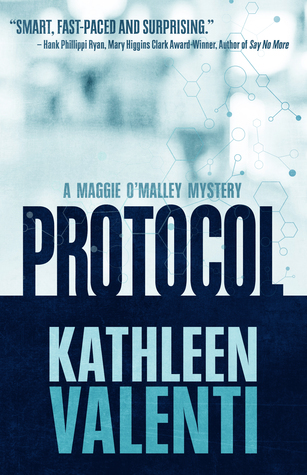
Protocol, by Kathleen Valenti****

Protocol“It was all so clear. She’d been so stupid…Cue the flying monkeys.”

The Maggie O’Malley series has taken wing. Thanks go to Henery Press and Net Galley for the DRC, which I was invited to read free in exchange for this honest review. In a crowded field, Valenti stands apart. Her snappy wit and precise pacing combine to create a psychological thriller that’s funny as hell. I didn’t know it could be done until I saw it here.

Maggie’s career is off to a promising start when she is recruited to work as a researcher for a major pharmaceutical firm. It’s a perfect chance to make the world a better place, and the beefy salary lets her take care of herself and send desperately needed funds to save her ailing father’s restaurant. It seems too good to be true, and we know what that means.

She’s barely through the door when she receives a mysterious meeting reminder on her refurbished new-to-her cell phone. Who is this person, and why would she meet her? And then, quick as can be, she sees the woman she is supposedly about to meet, die. Since the meeting reminder vanishes from her phone once it’s played, and since the reminder itself isn’t sinister, the police brush her off…until it happens again. Eventually, of course, she herself becomes a suspect.

This is a page turner, and we look over Maggie’s shoulder all the way through, wondering whether this friend or that one is to be trusted. Which date is a godsend, and which one is a snake in the grass?

The most notable difference between this story and others is the way Valenti sets up what looks like an error either on the part of the author or stupidity on the part of the protagonist, and then on the back beat, we see exactly why that was there, and that she anticipated our reaction all along. She does it over and over, and it’s hilarious. I feel as if the author is speaking to me as I read, howling, “Gotcha again!” It’s zesty, brainy writing. Valenti is the new mystery writer to watch.

This book is for sale now, and I recommend it to those that love funny female sleuths.

Crime Scene, by Jonathan Kellerman and Jesse Kellerman***-****

crimesceneCrime Scene is the first in the Clay Edison series, written by a father and son team. Big thanks to Random House Ballantine for the DRC, which I received in exchange for this honest review. I rate this mystery 3.5 stars.
Edison is a coroner’s investigator, and he finds himself drawn into an ugly, complicated murder, seduced by the lovely Tatiana, who I found myself disliking much earlier than the protagonist does. There’s the psychological component here that’s similar to the movies, where the audience yells, “Don’t go through that door” as the main character strolls obliviously forward; however, where the Kellermans take the story once Edison has wised up is interesting, original, and well played.

I enjoy the snappy banter that I associate with the elder Kellerman’s other novels, and there’s a hugely entertaining side character named Afton that I’d love to see again. The setting of the down-and-out neighborhood is resonant enough that I am convinced at least one of these men has actually spent time in such a place.

That said, the first half of the story is better paced than the second, and there’s a racial component that appears well-intentioned but awkward.

This promising series is now available to the public, and is recommended to Kellerman’s fans.

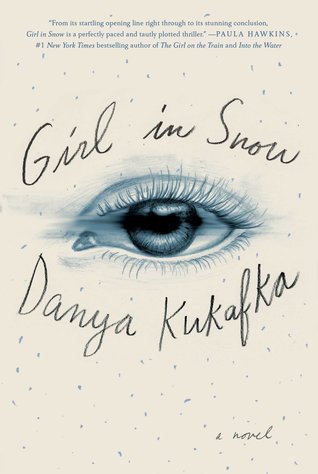
Girl in Snow, by Danya Kukafka*****

GirlinSnow

“’You can only see fifty-nine percent of the moon from the earth’s surface. No matter where you go, in the entire world, you’ll only see the same face. That fifty-nine percent.’
“‘Why are you telling me this?’
“’I’m just saying. We know this fact, but it doesn’t stop us from staring.’”

Half a century ago, a young writer named Harper Lee took the literary world by storm with To Kill a Mockingbird, a story that centered itself on justice, on a child trying to do the right thing, and on a strange, misunderstood fellow named Boo Radley.

Today the literary world meets wunderkind Danya Kukafka. Get used to the name, because I suspect you’ll be seeing a lot of it. Her story also revolves around misunderstood characters with dark pasts, and a small town’s often misdirected quest to see justice done and safety restored.

Thank you Simon and Schuster and also Net Galley for inviting me to read and review in exchange for this honest review. I’ve read and reviewed a lot of galleys this summer, but right now this is the only one I want to talk about.

So back to our story. We have three narratives, all from unhappy characters, all of them watching, watching, watching. Our protagonist is Cameron Whitley, a troubled, “Tangled” adolescent that has spent his evenings secretly following a popular, attractive classmate named Lucinda. He watches her through the windows of her house. He stares at her in her bedroom, and he does other things, too. Cameron has a troubled past, his father gone now after a storm of controversy destroyed his reputation and left his family hanging in tatters. And now that Lucinda is dead, the investigators have to look hard at Cameron. We do, too. We can see that Cameron is grieving, but of course, people often grieve the people they have killed. Grief doesn’t always denote innocence.

“Cameron stood outside Maplewood Memorial and wondered how many bodies it held that did not belong to Lucinda. How many blue, unbending thumbs. How many jellied hearts.”

As the story proceeds, we hear a third person omniscient narrative of Cameron, though it doesn’t choose to tell us everything. Not yet. We also hear two alternate narratives, those of Jade, Cameron’s classmate, and of Russ, the cop that was Cameron’s father’s partner before things unraveled.

Jade is friendless and frustrated, an overweight teen with iffy social skills, unhappy in love. Her home life is disastrous, her alcoholic mother monstrously abusive. Jade could be out of that house in a New York minute if she’d out her mother, but instead she turns her anger toward herself. After all, she provokes her mother. The bruises, the cuts, the blackened eye all signs that she has pushed her mom too far.

And so, bereft of healthier peer relationships, Jade watches Cameron watch Lucinda. She doesn’t have to leave home to do it; she has a box seat, so to speak, at her bedroom window. Standing there and looking down on a good clear night, she can see Cameron sequestered behind the bushes or trees, and she can see Lucinda, who doesn’t seem to know what curtains and window blinds are for. Ultimately Jade befriends Cameron, who is frankly afraid to trust her. And he may be right.
Russ is the third main character whose narrative we follow. As a child, he always thought it would be awesome to carry a gun and put handcuffs on bad guys:

“He memorized the Mirandas…playing with a toy cop car on the back porch…Russ had a lisp as a kid. You have the wight to wemain siwent.”

So his dream has come true; why isn’t he a happier man? Again and again we see the ugly things Russ does and the ugly reasons he does them, but just as it appears he’s going to become a stereotypic character, Kukafka adds nuance and ambiguity, and we see that underneath that swinish exterior is the heart of…no, not a lion. He’s really not that great a guy. But we see his confusion, his dilemmas, the aspects of his “bruised yellow past” that motivate him. He isn’t a hero, but he is capable of loving, and of doing good. And he doesn’t want to frame a kid for Lucinda’s murder, especially not his partner’s kid. He wants to know the truth.

Interesting side characters are Russ’s wife, Ines, and Ines’s brother Ivan, the school custodian that is caught in the crosshairs of the investigation.

Ultimately, though, the story is about Cameron, and Kukafka’s electrifying prose makes my thoughts roll back and forth like a couple dozen tennis balls left on deck when the ship hits choppy seas. Poor Cameron! He didn’t do this…and then, whoa, Cameron is seriously creepy here. Maybe he actually did it. I spend much of my time trying to decipher how deeply troubled this lad is—those of us in education and other fields that work with teenagers would undoubtedly deem him an ‘at-risk’ child—and how far he has gone.

Is Cameron the Boo Radley of 2017, misunderstood and falsely vilified; or is he a Gary Gilmore, a John Wayne Gacy?

Clearly, I’m not going to tell you. That would ruin it for you. The one thing I will say is that the ending is not left ambiguous. This isn’t the sort of book you throw across the room when you’ve read the last page.

In addition, know that there is plenty of edgy material here. Those considering offering this book to a teen as summer reading may wish to read it themselves before passing it on. I would cheerfully have handed it to my own teens, but your standards and mine may differ.

If you can read this book free or at a reduced price, lucky you. If you have to pay full freight: do it. Do it. Do it. It’s for sale today.

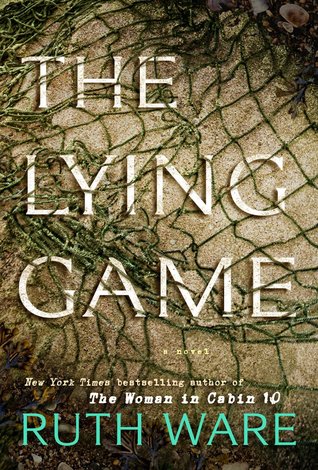
The Lying Game, by Ruth Ware****

TheLyingGameIsabel, Fatima, and Leah receive a text from Kate saying that she needs them. It’s been 17 years, and yet they answer in the only possible way:

“’I’m coming.’
“’I’m coming.’
“’I’m coming.’”

This one had me at hello. How many of us have a friend from childhood, adolescence, or the early years of our adulthood that could draw this response from us? I know I do, and although mine are from different times and places in my life, if I received that text I’d be on a plane, a train, or in the car. Thank you Net Galley and Gallery Books for the DRC, which I read free and early in exchange for this honest review. The book was published last week.

Our protagonist is Isa (“It’s to rhyme with nicer”), and as you might infer, this is British fiction. Isa leaves Owen, a good sport if ever there was one; grabs Freya the baby, who is breast-feeding; and hops on a train. And that baby will ramp up the stakes, mostly in subtle ways, over and over throughout the story.

Kate has called them because human bones have been found in the Reach. All of them immediately know what this means, although the reader does not.

We learn about the lying game played by the foursome during their years at school together. There are points given according to whether the lie is believed, whether the victim is new, and further byzantine details; but the big rule is that they must never lie to each other. The game revives itself at odd moments during their reunion, sometimes to lightened effect for the reader, but sometimes becoming sinister.

Throughout this well-crafted tale, Ware doles out bits and pieces of what is to come, and every time my experienced eye spots a sure-fire red herring, it turns out it isn’t. I read a lot of mysteries—probably too many—but this one is fresh and original conceptually, and it becomes more riveting as the characters are developed, adding layer after layer like papier-mâché. The ending completely surprises me, and yet is entirely consistent with the rest of the novel.

There are times when I am astounded at the risk-taking behaviors exhibited by the four as adults approaching middle age once they are together again; at times I step away and ask myself whether the doctor that Fatima is now would actually do this, and whether Isa, an attorney, wouldn’t show more caution. But the foursome persuades me—are there points for this, I wonder—and I am drawn back in before the curtain twitches. There’s never a time when I see that the Great and Powerful Oz is seen back there at the control panel; the magic holds. There are times I am astonished at the risks Isa takes with Freya, going for a swim in the Reach with her pals, leaving her defenseless baby alone, asleep, in that hideous, falling down shack, but it’s consistent with the girl she used to be, the girl that is awakened to a degree as she returns to the time and place in which she came of age.

The fifth star isn’t here because the foreshadowing is too heavy-handed at times, and threatens to become funny rather than scary, which is clearly not intended. But every time I see it veering toward the ridiculous, Ware pulls back again, and so the overdone moments are a blip on the radar.
Those that love Ruth Ware’s work, and those that love a good mystery—especially women—will want to read this book. You can get it now.

A Game of Ghosts, by John Connolly*****

AGameOfGhostsJohn Connolly writes two kinds of books. Some of them are good; some are damned good. This is one of the latter. It’s the fifteenth in the Charlie Parker series, and it marks a turning point; previously a thriller series with mystic overtones, it’s now a stew combining multiple genres. Connelly heats his cauldron and pours in a healthy dose of suspense, mixes in some detective fiction, and blends in horror and fantasy as well, along with a pinch of humor. The overall result is deliciously creepy, the kind of story that stays with me after I’ve read a dozen other less memorable books. Big thanks go to Net Galley and Atria for the DRC, which I read free and early in exchange for this honest review. The book is for sale now.

Parker has a haunting past indeed; in the first book of this series, his wife and daughter Jennifer are murdered by a man that has come looking to kill Parker. Our hero sets out to find and kill the man that did it, and he succeeds; yet his thirst for stark, take-no-prisoners justice is not satisfied. Now the father of another daughter, Samantha, that lives with his ex, our current mystery finds Parker in a conversation with the girl’s uncle, who asks hard questions about Parker’s risky behavior. He wants to know why Parker keeps chasing bad guys now that his initial quest has been fulfilled. Why hunt down evil-doers when he might adopt a lifestyle more in line with the best interests of his still-living child? Parker responds,

“I do it because I’m afraid that if I don’t, nobody will. I do it because if I turn away, someone else might suffer the way I have. I do it because it’s an outlet for my anger. I do it for reasons that even I don’t understand. 
“But mostly,” said Parker, “I do it because I like it…
“We can’t leave these people to wander the world unchallenged.”

The premise here is that Parker is sent by FBI agent Ross, who he has agreed to work for under terms mostly his own, in search of Jaycob Ecklund, a man also employed by Ross who has vanished. Once Parker’s search for Ecklund commences we learn that the missing man was a ghostbuster of sorts, a man with a basement full of files on the paranormal. Many others are interested in Ecklund also, and the plot ramps up quickly and doesn’t relent until the last page is done.

The plot here is complex, and Connolly weaves in a host of characters, both living and dead. We have The Brethren, most of whom are alive yet already damned. We have Angel and Louis, a pair of characters that have appeared throughout the series that work with Parker; their darkly amusing banter helps lighten an otherwise almost unbearably intense plot. We have clairvoyants; we have The Brethren; the hollow men; we have a number of murder victims, before, during, and after their deaths; there is the Collector, who is tied to Parker like a falcon, and must always return to him.
And we have organized crime figures Phillip and his Mother, who abduct him in order to find out what Parker does and what he knows, in a civilized way, of course.

“There will be tea.”

Mother is the best villain this reviewer has seen in a long time.

The entire book is brilliantly conceived and flawlessly executed. And although Connolly’s series is worth reading from the get-go, those that hop in without having read earlier books from this series will be able to follow and enjoy this shapeshifting mindbender of a novel just fine, but those that genuinely believe in ghosts may not want to read it at night.

Highly recommended to those that love excellent novels of suspense.