All Quiet on the Western Front, by Erich Maria Marque *****

This has been labeled the best anti-war novel ever written. I agree. We see the first world war (“The Big One”) through the eyes of a young German soldier.

Some have held “Johnny Got His Gun” to be the best anti-war novel; I disagree, because that novel holds out no hope. When all is lost at the beginning and never gets better, it fails to draw the reader’s emotion. Marque is singularly skilled at reaching right down into the reader’s chest and wrapping his scholarly fingers right around our heartstrings. (Don’t look for this term in a physiology text.)

AQWF, on the other hand, develops character and setting sufficient to take us there, to nearly climb inside the skin of someone going through the experience.

Is there such a thing as a war worth fighting and dying in? I think so…but very rarely so, and this novel helps us understand the need for restraint and caution.

Note to teachers: though this is outstanding literature and many students enjoy it, it requires a very strong reader in terms of ability and vocabulary.

A Permanent Member of the Family, by Russell Banks *****

Nobody writes like Russell Banks. His short story collection has the harsh beauty of a Yankee winter. I was lucky enough to get my copy courtesy of Goodreads.com’s first reads program. Tales of loneliness, alienation, disorientation or sheer, stark horror are the writer’s stock in trade. His characters, ordinary working people so real that they stand before the reader, live lives of disappointment, near-misses, and sometimes terrible endings.

Think of “The Lottery”. There you have it, but in a contemporary setting.

Why read stories grim enough to bruise the psyche? What keeps us coming back once our eyes and hearts are seared by the cruel world he exposes? Maybe it’s because he recognizes the working men and women who make the world go around, or maybe we revel in real-life tragedy: that could have been us. As we close the cover and walk away, life seems a little sweeter. Just enough poignancy is injected into his tales to make us treasure our lives, without giving way to corny sentimentality. And there is never a stereotype anywhere. Banks has too much respect for the working class to let that happen.

Occasional moments of wry humor, such as the “invisible” product being marketed by the traveling preacher, break up the tension to some degree.

I have read other reviewers who feel burned out by Banks because of the painful quality of his stories. If like me, you love great writing but feel the need of a break from the sorrow there, this volume is perfect. Read a short story; then go get another book by someone else that’s a little less dark and foreboding. Come back and read another short story by Banks when you are prepared for it. With the short stories, it is easy to find a place to pause, then return.

Banks has been translated into twenty different languages, and he is widely recognized as one of the best writers in the world. Don’t let this opportunity to read him pass you by!

Trailerpark, by Russell Banks *****

Aside

Who but Banks would even go there? He makes his characters real and gives them credible back stories. None of the stereotypes generally dealt out to people who live in mobile homes surface here. His respectful attitude toward every day, working class people, or in some cases, people who have slid from a position of greater prosperity, makes this book work. The transitions are so smooth, so subtly crafted that when one character, one I felt almost as if I knew them as family, eased into the life of another who had been separately introduced, it was close to magical.

I have no doubt that Banks is one of America’s greatest novelists. When he publishes something, I read it (and I recently got to write an advance review; see A Permanent Member of the Family). But one hallmark of his novels–all of them–is tragedy. If you want a good three-hankie-narrative, he’s your writer. I once went on a jag of reading nothing but Russell Banks, and found myself nearly ready to go put my head in the oven. (That would have been a painful way to go, since my oven is not gas, but electric.) From this, I learned that it’s best to read Banks alongside a little of something else. That way I can enjoy his genius without having to carry all of the novel’s despair.

At one point, I said Cloudsplitter was my favorite Banks novel. Now I think it may be a tie. Read them and see what you think, if you like well-developed, real characters, and can deal with (often) unhappy endings.

Between, Georgia by Joshilyn Jackson *****

Jackson’s folksy, humorous love story is more complex than it appears at first glimpse; its entertainment value is instantly obvious. She has taken the town of Between, Georgia, which exists midway twixt Athens and Atlanta, and used it to create a fictional haven for a plethora of characters drawn so deftly that they all but materialize in front of the reader.

Nonny, our protagonist, is between many things. In fact, the deeper one looks at this supposedly light romance, the more “betweens” there are in the story, in setting, in plot, and above all, in character. The teacher in me wants to assign an essay question about it. You are excused from the essay, but you ought to read the book, even if, like me, you generally pass on romances. And for goodness sake, pay attention!

In some ways, this is a story that could have been set in just about any Between in just about any English-speaking setting as long as it was in a small town (and anyone who sniffs at the story as failing to accurately represent Georgia and Georgians completely misses the fact that this is not really a story about Georgia at all). How many of us have dealt with the question of nature versus nurture? How many of us have alcoholics, anxious individuals who are prone to harming themselves, yet keeping “four baby steps” out of the psych ward, neat freaks, slobs, and feuding relatives in our lives? Are you nodding yet? And how many of us have a small person in the family we suspect is being raised by the wrong relative? Then there are those of us who are between relationships, and the world that exists between the hearing and the deaf, the blind and those whose visual acuity is dandy. I am only scratching the surface here. There is so much of life jammed into this one work of fiction that it leaves me breathless.

It is the commonness and humanity in this tale that ultimately makes it so empathetic and readable, but the writing is brilliant. The prose are so fresh and original that they make me question several of the five star ratings I have given to other writers.

Jackson has written a real gem. Sometimes I conclude my reviews by saying that a book is worth reading if you can get it free or cheap. Not this story, not this time. Open a window and order it, or get in the car and go get it. You have to read this book. Whether for depth of literary analysis or pure fuzzy joy, you’ll be richer for doing so!

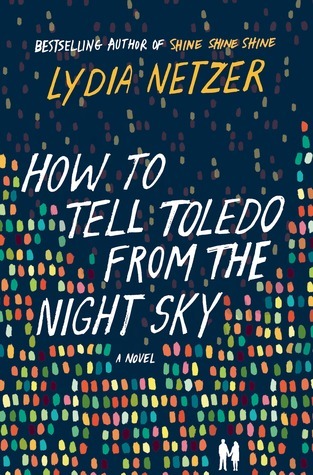
How to Tell Toledo from the Night Sky, by Lydia Netzer *****

  Imagine a complete collection of the Great Books. Add in all those that have won Pulitzers and the National Book. Do you see room for one more? If not, you’ll need to grab the title you never really thought belonged in this collection and toss it. Now, go ahead and slide this title in there, because it is where How to Tell Toledo from the Night Sky belongs.

The story is about a pair of astronomers who were meant for one another on a whole lot of levels, but if, like me, astronomy bores you, this wonderful, quirky romance won’t. It contains a number of story elements that don’t usually appeal to me; the presence of a very unscientific sort of clairvoyance is one that usually causes me to close my book abruptly. This time, the story had me from hello, and it was going to take a lot more than that to turn me away. In the end, I didn’t want to.

I received my copy electronically via Net Galley in exchange for a review. I’ve read and written about dozens of free books either there or via the Goodreads first reads program, and I have never suggested that any other book was worthy of a place among the timeless classics by which we define ourselves as a society and pass down to our children. I’ve read some really good books, but I haven’t read one this great in years.

The suggestion that ancient Babylon was once where Toledo is seems a bit cheeky in some ways; typically American to assume it must be here somewhere. Those who hail from other countries won’t find it nearly so disturbing, I imagine, as will New Yorkers. But for our story’s purpose, the setting shouldn’t be anywhere except Toledo.

Irene, the protagonist, returns to Toledo from her position in the south to take a prestigious position. She also arrives in time to deal with her dead mother’s remains and clean out the house.
From there, nothing takes the trajectory that Irene has anticipated. A warm story that manages to be sentimental yet never maudlin, it pulled me in and I had to stay with Irene once I hit the halfway mark. I never thought once about character development, plot plausibility, pacing, transitions, or anything else. And once I was done, all I could think of was who else I should buy it for.

Don’t miss it.