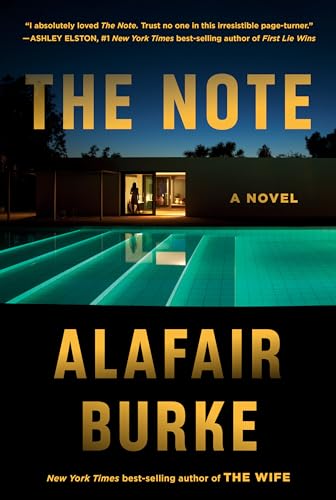
The Note, by Alafair Burke**

The Note by Alafair Burke is a thriller that sends three lifelong female friends on a gal pal vacation together; they have skeletons in their closets, scandals from their pasts, and that’s part of the bond. But try though I might, I couldn’t bond with any of them or care about their dilemmas.

My thanks go to NetGalley and Knopf Publishers for the review copy. This book is available now.

The internal narrative was so flaccid that I kept having to go back to reread parts of it, because I realized that I’d zoned out while reading and had no idea what had just happened. Once I had the plot straight, I struggled to recall the names of all three women. (Kelsey, May, and…?)  These characters struck me, when they struck me at all, as vapid and self-absorbed. The dialogue seemed banal.

When I saw in the promotional blurb that these three women would be vacationing together in The Hamptons, it gave me pause. I don’t like reading about rich people, and with a rare exception now and then, I don’t like rich people, period. But there have been a number of times that a terrific novelist has made me forget all about my no-no list, so I crossed my fingers. I’d read one other of Burke’s novels and it was pretty good, so I thought I’d give this one a go; it was a mistake.

I’m trying to think of a saving grace, some positive aspect that I can insert here in order to keep this review from being brutal, but honesty, I come up dry. I cannot recommend this book to you.  

I’ll Be Right Here, by Amy Bloom***

I’ve been a reader of Amy Bloom’s novels for decades, and so when I see a new one is coming out, I leap, usually without even checking out the synopsis. Just the author’s name is enough to get me moving. This time was a little different. I began reading, but had trouble engaging, and my mind wandered. I decided to get the audio from the library, once the publication date had come and gone, and that was how I eventually finished it.

My thanks go to NetGalley and Random House for the invitation to read and review. This book is for sale now.

We start out in Europe during World War II. Gazala emigrates from Paris to New York, and becomes friends with a pair of sisters; later Samir, Gazala’s brother, joins her. Now here’s where it gets icky, (to use a highly literary term.) Gazala and Samir become a couple. They don’t tell people they meet that they are related, so they are accepted. Their friends also become involved in—to be charitable—unconventional relationships. In looking back at the synopsis, it’s all right there: “the lawlessness of love.” Hoo boy. It definitely is.

So, after forcing myself to finish listening to this thing, I nearly give it two stars, but the nugget that saves it for me is the concept that occurs when they are grieving a loved one, the notion of a “dead people’s party.” I love thinking about this! I have already started imagining my own such party, having lost too many people I cherished, when my sister dies. Her death is not altogether unexpected, as she was a great deal older than I am and has been in ill health for many years, but it still packs a punch. The thought of my sister’s dead people’s party—complete fantasy, as far as I am concerned, but who cares? Is what has helped me through a dark time.

So Bloom gets an extra star.

Nevertheless, I don’t recommend this thing unless the reader has carefully read the synopsis and is still interested. Yikes! I’ll probably read Bloom again, but this time I’ll be more careful before I commit.

The Dilemmas of Working Women, by Fumio Yamamoto**

I haven’t been this disappointed in a book in quite some time. The Dilemmas of Working Women is Fumio Yamamoto’s collection of five stories about women that work (or that should but don’t,) and it is immensely successful and highly regarded in her native Japan. As I read, I kept looking for the greatness, a bit like scrounging for coins lost under sofa cushions, but it has completely eluded me, and my rating and review can only be based on my own experience and reaction.

I thank NetGalley, Blackstone Audio, and HarperCollins for the review copy. This book is for sale now.

As suggested in the title, each of the five stories focuses on a woman that has a problem. None of them makes a serious effort to do one damn thing about it. Lazy, neurotic, or…? Who can say. I sure can’t. One might expect a book that’s written by a woman and that has exclusively female protagonists to have a little feminist swagger, but this feels like the opposite. I found it hard to root for any of them, because they were all so useless.

When I took the galley, I expected there to be some humor. Look at the cover! It’s been years since I was taken in by a hilarious book cover that masked a crummy read, and I won’t do it again anytime soon.

I was given access to both the digital galley and the audio. The reader, Yuriri Naka, does as good a job as possible with this collection.

Not recommended.

The Wages of Sin, by Harry Turtledove**

Before reading this book, I had always enjoyed Harry Turtledove’s alternative history novels, which have a sci fi vibe and usually a good dose of humor, sometimes of the laugh out loud variety. When I saw that this one was available, I leapt on it. What a freaking disappointment!

Nevertheless, my thanks go to NetGalley and ARC Manor Publishing for the review copy. This book is for sale now.

The premise is that HIV—renamed The Wasting– erupts in the early 1500s, but instead of dismissing it as a disease spread by gay men, English society sequesters its women in the home, never to be permitted friends or visitors, never allowed to go out and do their own shopping without extreme cloaking of bodies and faces, and extreme risk for committing the social sin of venturing out of the house. Viola is supposedly our protagonist, a young, intelligent woman of marriageable age who fumes under her constraints and entertains herself by reading her physician father’s collection of medical books.

Peter, whom we actually see a good deal more of, is the young man that the parents have arranged to marry Viola. The two of them are permitted to meet (in Viola’s home of course) in order to determine whether they are compatible. They are. Now Peter is off to university, and for the most part, we go with him.

Immediately we meet Peter’s obnoxious, wealthy roommate, who is masturbating when we encounter him. Turns out this guy never thinks of anything except sex. Peter is determined to wait for marriage because of the Wasting. There’s no treatment and there’s no cure; he doesn’t want it, and he doesn’t want to give it to Viola. His roommate, however, frequents brothels on an almost nightly basis and talks about it, graphically, interminably. Think of every vulgar, disgusting, disrespectful term you don’t want to know about women’s anatomy and the various sexual positions, and this jerk uses them all. All. The. Time. Repetitiously, constantly, and for no reason except, apparently, to make us hate him, which we do, and possibly as filler.

Have you ever known someone that makes up excuses to use objectionable language, because, see, they’re quoting someone? That’s how this feels to me.

There is no character development of any kind here. The book is short, but it feels interminable. I made it halfway through, then read the last twenty-five percent to be sure there wasn’t some redemptive element at the climax or the end. But there is no climax. There’s no story arc. For that matter, there are no gay people or bath houses, but hey, it’s alternative history, it’s fiction, and if Turtledove wants to leave out the gay people, he can do that.

But the disease? It comes from Africa. Oh, of course it does. Blaming the Black people for everything has apparently made it through from our time period to Turtledove’s invented world.

There is no redemptive feature to be found here, and frankly, the second star in my rating is there only as a wistful nod to this author’s earlier works. I recommend this book to anyone forced to purchase something for a horny, obnoxious male that wants a socially acceptable way to read porn. That’s it.

The Bitter Past, by Bruce Borgos***

2.5 stars, generously rounded upward.

The Bitter Past is the first in the Porter Beck series by Bruce Borgos, and if I liked it, I’d be thrilled to read more. On balance, though, I don’t. Nevertheless, my thanks go to Net Galley and St. Martin’s Press for the invitation to read and review. This book is for sale now.

The setting is the hinterlands of Nevada; part of the story takes place in the 1950s, and part of it is in the present. I rate the historical threads as 3.5 stars, and the contemporary part as 1. The premise is that Porter Beck is the local sheriff who is called when a grisly murder is discovered; in addition, a sister-wife goes missing. Sana Locke is the woman that the Feds send in, uninvited. The premise for the other thread is that a Russian operative named Georgiy Dudko lands in Nevada, tasked with entering the nuclear test site and stealing a nuclear warhead. Toward the book’s conclusion, we see how the two stories are joined.

Before I am even twenty percent of the way into this story, my hackles are up. I haven’t seen an author write with such brazen disrespect for women in a very long time, and I hope not to see it again. You see, Beck is God’s gift to women, and it’s a good thing, too, because none of them prove smart enough to find their butts with both hands until he sails in and fixes everything. From the instant Agent Sana enters the narrative, introducing herself as FBI, Beck is the guy in charge, and Sana is his li’l buddy, his sidekick. Good thing he is here to educate her. It is Beck that finds a hidden room in a house they’re searching; it is Sana whose eyes “go big.” He has to dive quickly to save her from the bad guy with the gun. He tells her what to do, and she does it. Here are some quotes that set my teeth on edge:

“Before [Sana] can speak, I place a finger over her lips.”

“Sana appears confused.”
“I bring my finger under her chin. ‘Look up.’”

And no collection of sexist bilge is complete without the old saw about how women are unable to get along with other women: “[Sana’s] still miffed about Brinley, [Beck’s sister] and it’s clouding her judgment…I glare at Brin, a warning to her to retract her claws.”

Beck feels completely free to comment on Sana’s physical features, particularly her “exquisite ass,” but of course, Sana likes that in a guy. She’s in the sack with his middle-aged, um, butt in no time flat.

For a long time I hold out hope that things will turn around, and the author will prove to us that actually, Beck is about to get his just desserts, and Sana had been sent to take him down for some reason, but the only comeuppance she deals him at any point is when she pulls a jujitsu move on him, and that’s only once.

What else? Ah yes, the sister-wife. The girl’s husband is a good FLDS neighbor, Beck tells Sana. They don’t force anyone to marry. She’s seventeen years old, so it’s fine.

What the fuck. Seriously? Excuse me while I grab my blood pressure medication.

In addition to all of this, there is the constant use of the word “illegal” to describe a person that is in the U.S. without documentation. They don’t even call them illegal immigrants, or illegal residents. They don’t merit a full grammatical description.

The thread that takes place in the past is more palatable. Georgiy needs into the nuclear test site, and so he befriends a scientist that works there, and is introduced to Kitty, the scientist’s daughter, whom he courts and accidentally falls in love with. Kitty is not developed as a character any more than Sana is, but at the same time, during the 1950s in the U.S., marriage and motherhood were very nearly the only acceptable path for women, so within the context of time and place, this is believable. I like Georgiy much better than Beck, that’s for sure!

There’s a twist of sorts at the end, but it’s not all that impressive, and it mitigates nothing.

I was provided with the digital review copy and the audio as well, and so I listened and read at the same time. Narrator James Babson does a fine job portraying the characters as they are written, and he isn’t to blame for the way I feel as I read.

That’s it in a nutshell. If all of this sounds just fine to you, then go ahead and get this thing, and stay away from me. Does anyone have any matches I can use?

The Things We Do To Our Friends, by Heather Darwent**-***

2.5 stars rounded upwards.

The Things We Do To Our Friends is a debut thriller by newbie Heather Darwent. Our protagonist is Clare, a young woman who’s studying art history at a university in Edinboro. She’s new and knows no one, but is soon swept up in a small, elite group of students she meets in one of her classes. Before she knows it, they are her main curriculum, and her classes become secondary.

My thanks go to Net Galley and Random House Ballantine for the invitation to review. This book is for sale now.

At the outset it’s easy to relate to Clare, who tells us her story using the first person limited. She has never lived here before, and she doesn’t have a lot of resources. She gets a job at a nearby bar, and the everyman proprietor, Finn, punctuates the story now and then with an objective take on Clare’s life and her new friends. She is soon invited to join a clique of students that are flashier, louder, and more confident than most of her classmates, and she wants desperately to become one of them. Tabitha is the ringleader, and it is she that Clare most wants to please.

The opening chapters here make me wonder if we are about to rehash Ruth Ware’s most recent mystery, The It Girl. The elements are certainly there. But there’s an undertone that builds here, teasingly referencing Clare’s unfortunate past. We don’t know much except that she’s estranged from her parents, who don’t want to hear from her.

That can’t be good.

The clique goes to Tabitha’s family home in France over the winter break, and Clare is thrilled to be included. But while they are there, she is pressured to join with them on a moneymaking venture that isn’t entirely legal. They let her know they are aware of her past, so she’d better cooperate.

Here is where the book starts to lose me. Clare is essentially being extorted, and yet her emotional attachment to the group only intensifies. At one point, she tells us that she sometimes forgets whose skin is whose, so tightly bonded are they, and in particular, she and Tabitha. But this makes no sense. Tabitha has threatened to harm her, as have the others. Why does she love them all the more for it?

More and more tidbits from Clare’s past are revealed, and yet Clare herself isn’t developed much. Neither is anybody else. We are told a lot, but shown only a little. I love books that are about character, and if there’s not much plot, I’m fine with that, but these characters are all static. At the 50 percent mark, I become impatient and skip to 62 percent; from there, I read to 72 percent, which is where things should begin to feel urgent, but they don’t. I skip again to 90 percent and read the ending. I seldom skip anything when reading, and on the occasions when I have done so, I sometimes find things when I skim the last half that convince me to go back and read it completely. That didn’t happen here. There are loose threads dangling, and plot elements that appear to have no purpose. Worst of all—and to be fair, this is probably not the author’s doing, but it rankles, nevertheless—is that this weak tale of warped humanity is billed as a “feminist page-turner,” which is what drew my interest initially, and as a lifelong, card-carrying feminist, I can assure you that this is absolutely not that.

I cannot recommend this book to you.

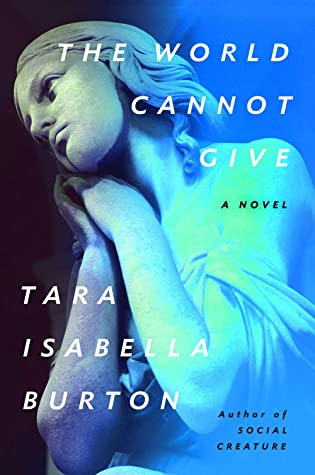
The World Cannot Give, by Tara Isabella Burton**

Four years ago, I read Tara Isabella Burton’s Social Creature, a novel that was one of my favorites that year. I said it was “full of sass and swagger…genius pacing…a novel that should take all of us by storm…the makings of a cult classic.” Did I love it? Yes I did. So imagine my excitement when I saw that she had a new one coming out. Sad to say, The World Cannot Give doesn’t reach the same level. It’s dull, and it takes itself far too seriously.

Nevertheless, my thanks go to Net Galley and Simon and Schuster for the review copy. This book is for sale now.

Laura Stearns arrives at St. Dunstan’s Academy; she is inspired by a novel written by a long-ago alum named Sebastian Webster. Laura yearns to find the “shipwreck of the soul” she finds in Webster’s book. Indeed, Webster has an enthusiastic band of followers at St. Dunstan’s, and so in a sense, Laura has come to the right place.

So we have these elements: a private boarding school—and this setting is in danger of being overused lately, but nothing that excellent writing cannot overcome, although that doesn’t happen here. We also have a slavish clique and hyper-religious students; and we have a whole lot of navel gazing. Or, as the synopsis tells us, “The World Cannot Give is a shocking meditation on the power, and danger, of wanting more from the world.”

If anything here makes your pulse quicken, by all means, go get this book. As for me, I tried. I did. When I couldn’t push myself through my digital copy after multiple tries, I checked out the audio version from the library; if anything, it was more pretentious and obnoxious than the written version. Yikes. I stuck with the audio version through the first two torturous hours, and then I threw in the towel.

This shipwreck is available to the public now.

An Honest Lie, by Tarryn Fisher**

Nope.

An Honest Lie is a thriller by Tarryn Fisher. Thanks go to Harper Collins for the review copies; I wish I had something good to say, but the truth is, this is one of the worst written novels I have seen in my many years of reviewing and blogging.

Our protagonist is Rainy, although we learn that her given name is Summer; she fled a terrifying cult earlier, and she changed her name to make herself harder to find. Now she is living in an upscale home on a mountain in eastern Washington State with her boyfriend; her boyfriend is trying to integrate her into his friends’ group, and has pressured her into going on a “girls’ trip” to Vegas while he is travelling on business. She goes, though only because she sees no way out. He bought her a ticket; she should be a good sport.

The story changes point of view from present, to past, etcetera, and we see the cult where she was more or less imprisoned in the Nevada desert during her childhood. However, adult Rainy doesn’t develop much, at least during the initial sixty percent, which is as far as I am willing to read. Fisher has wrapped Rainy’s character and the suspenseful aspects of the story together to such an extent that she can’t let us see much of the character without giving away plot points that she is saving for later. Consequently, I get tired of Rainy’s whiney anxiety fairly early in the book. But that’s not what limits this story to a two star rating.

Here’s the insurmountable problem. As noted, Rainy is an anxious mess, and the mere idea of setting foot in Nevada nearly undoes her. When they get to their swank hotel, the women discover that all of the bedrooms but one has a gorgeous desert view; the last one, the one with the view of the parking lot, is the one Rainy requests, because just looking out the window and seeing the desert is triggering for her.

And yet, somewhere shy of the fifty percent mark, Rainy hops into a cab and pays the driver to take her to the little town closest to the compound from which she escaped, and suddenly she’s playing detective, asking questions and snooping around. And reader, there is no development that explains this; there’s no aha moment where she gathers her wits and develops a plan of some sort. We aren’t even all that clear what it is that she hopes to achieve, out there in the scary, triggering desert all by her lonesome. Our protagonist goes from I-can’t-look-at-the-desert-or-I’ll-have-an-anxiety-attack-and-nightmares, to I-think-I’ll-go-see-the-place-and-maybe-seek-vengeance with no segue way, no clear goal, even.

If I were to guess, I’d say maybe the author changed a whole section of the story during the latter stages, and the sequencing and character’s motivation got messed up due to sloppy editing, but I don’t really know what went so badly wrong. It isn’t my job to know why this book is a train wreck. Whatever the reason, the result is an insult to the reader’s intelligence. I feel this way, and I got to read it free. How might others feel once they’ve shelled out the purchase price?

This book is for sale now, but I don’t recommend it to you.

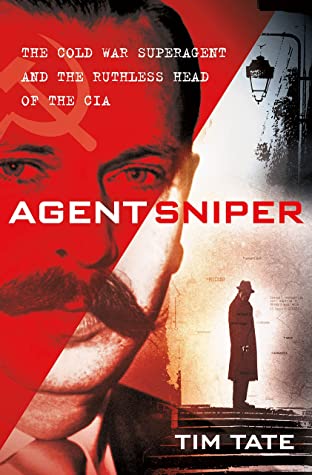
Agent Sniper, by Tim Tate***

I was invited to read and review this book by Net Galley and St. Martin’s Press. I accepted because I do love a good spy story, and there aren’t many of them being published at this time. Tim Tate has had a long, illustrious career as a documentary filmmaker and as an author, but is new to me.

So, when I began reading and found my attention wandering, I thought it was a personal problem. Too many distractions. I tried again, and when that didn’t go well, I procured the audio version and listened to it while I prepared dinners during the week. Eventually, I threw in the towel and admitted that this is simply not an engaging book. The topic sounds fascinating, but just as a gifted, dedicated author can spin dull material to gold, so can an indifferent one tell an electrifying spy story in a way that leaves the reader checking the page numbers and the clock—is this thing over yet?

It’s not all bad news: the research here is top drawer. For the researcher, this book has use, although I would caution the uninitiated into reading carefully, because history is always politically charged. Every fact that is included, and every fact that is not; the interpretation; the language used, all give a biased account, even when a researcher and writer is endeavoring to be as balanced as possible. I don’t care for this writer’s interpretation, which makes him sound like a hardened right winger, but I have no doubt that the facts that he uses are accurate ones.

Then we come to the audio, and I must wonder why, if we’re primarily dealing with the CIA and its agents, we have a narrator with a clipped English accent (and a few pronunciations that sounded very odd to me,) telling the story. I found it disorienting, but if this had been a more engaging story, I would have overlooked it.

Ultimately it comes down to wordsmithery, and I didn’t find much of it. Those interested in dabbling in this genre would do better to read Ben McIntyre and Tim Weiner.

This book is for sale now.

The School for Good Mothers, by Jessamine Chan**

So much build up; so much promise. What a crying shame. This dystopian novel is conceptually strong, addressing the invasive nature of facial recognition software and government access to what should be private digital communication, but the execution is abysmal.

I received a review copy from Net Galley and Simon and Schuster.

Frida Liu is a new mother, and she’s got problems. She has severe postpartum depression, and she’s home alone with her baby, all day and all night, trying to work from home. She doesn’t want childcare; she wants to be with her daughter, Harriet, but she’s overwhelmed. The original plan was for her to be the stay-home mother, with her husband supporting the family, but at the same time Harriet was born, her husband fell for someone else.

One day—“just one bad day”—she is summoned in to work. She could have brought Harriet with her, or she could have called a sitter, but instead, she leaps into the car, leaving the baby in her bouncy chair at home, all alone. She tells herself she will quickly drop off and pick up info, and then she’ll zip back home, but instead, she allows herself to be caught up in reading and answering emails. Eventually, her phone rings. The caller tells her that her baby has been removed from her home by the police; neighbors were alarmed by the baby’s nonstop screams. Now, Harriet is going to live with her daddy and that woman, and there’s not much that Frida can do about it.

At the outset, I think this is a brave scenario for an author to choose. Leaving a baby under the age of two, which some would contend is the very worst age to leave a child unattended, is no small matter, and I am eager to see how Chan will play this. How will she keep me on Frida’s side in all of this?

Turns out she won’t.

I have seldom seen a less sympathetic protagonist, and clearly, Chan doesn’t intend for Frida to be a villain. Yet in all of the puling, the whining, the self-pity, Frida’s prevailing concern isn’t for her child’s well-being, it’s for herself. She needs her baby. She wants her baby. She wants her baby to want her. And so it goes.

But wait, there’s more. The worst thing of all is that this eighteen-month-old baby is not accurately depicted developmentally. Discussions around the care of Harriet are premised on Harriet’s ability to understand abstract concepts that no child this age is capable of. At first, I anticipate that it’s only Frida that holds these expectations and that others—her ex, or the professionals within the child welfare system—will set her straight, but no, they all buy into these assumptions as well. Then I wait to see if there is some aspect of this futuristic, dystopian world that renders children different from those in our real world today; nope! At one point, Harriet bites someone, and Frida tells her to “apologize at once!” This is a kid barely old enough to walk. Give me a fucking break!

The plot wanders and Frida wallows; at about the 30% mark I commence skimming. I read the last 25% carefully to be sure there’s no grand aha, no surprising event that causes all of this to make sense, or at least to mitigate it, but there’s no redemption to be found. Where are the editors? There are editors, right? How did this wasted trainwreck of a novel end up on Oprah and other prestigious lists and websites? I just don’t get it.

Not recommended.