Rebel Streets, by Tom Malloy *****

This is the first novel I have read about what are referred to in Belfast as “The Troubles”. The protagonist, Jimmy Fitzgerald,is a Catholic youth and a member of the IRA. Virtually all the young men in the Catholic (i.e., working class)neighborhood there belong. And in the opening scene, Jimmy is being tortured. He is being treated in ways that the Geneva Convention was created to prevent, yet it doesn’t. He is a “terrorist”, and so he can be treated any way they like, proof or no proof. The scene goes so far as to have him placed in a helicopter after the beating is over and he has regained consciousness. They drop him from the helicopter…and he goes only ten feet before he hits the ground. He is broken. After spitting in their faces, after beating after beating in which he will only swear at his interrogators or say “I love Ireland”, he is broken. He only wants to live, and to be gone, and we might hope that the information he gives them is false…but it isn’t. He gives up safe houses. He gives up friends. He does it with the condition that his closest friend since boyhood, Louis Duffy, will be spared.

When it’s over, he is assigned to be an informant.He must meet with Detective Ian McDonald, whose perspective we also gain later in the book. He is outwardly an ordinary man, a man who can look himself in the mirror and like what he sees every morning, one who is responsible for enforcing the law, upholding order, and stopping the Irish attacks on the British troops that make their lives hell. He has a wife and a little boy he loves, and he thinks that he is a good person. Some might see him as merely cynical. I went into this book with a bias, and I see a monster there. I hope that others who read this book will think so, too.

Catholics are considered a lower class, Finian dirt on the floor of Belfast. We learn early on of a job Jimmy and his “Da” were given cleaning out the coal cellar of a Protestant family. The family, clearly enjoying a much higher standard of living, is converting to gas central heat, but they warn Jimmy and his Da that they have inventoried and expect everything to be there when they are done. Jimmy and his father are horrified and seething at the suggestion that they might walk off with their one-day-employer’s coal in their pockets. This kind of rage beats in the hearts of most native Irish (as opposed to the Orangemen imported generations ago by the Brits to give some credence to the lie that Belfast is majority Protestant).

Later, much later in the story, after British cops have kicked in doors all over the neighborhood looking for IRA members, after the family furniture in one residence (and we can infer, many others) has been shredded, mirrors broken, the family’s only television set smashed, an Irish mother turns to her small son and asks, “Who was it put your Grandpa in prison?”
The lad replies,”The Brits”.
“Who?”
“The Brits.”
“Aye…Who wants to get your Da and lock him away?”
“The Brits.”
“Who?”
……..
“Why did they do this to ye?”
“Because I’m Irish.”
“An’ who is it that hates the Irish, who is it robs the Irish, who is it murders the Irish?”
“The Brits.”
(first person, quoting author here)”She took his head in both her hands to whisper, “An’ who will protect yer mother from the Brits when he’s a strong young man?”
“I will.”
“Why?”
“Because I’m Irish.”
The mother calls her son a “wee man” and a “brave Belfast boy”.

This novel spoke to me deeply. I was a supporter of Sinn Fein during the hunger strikes of the 80’s, and I, along with many other Irish Americans of whatever generation, gave money for humanitarian aid. Two-thirds of the funds that paid for Irish independence came from Irish American pockets. The same has held true for the cause of making Ireland free and united once more.

Not everyone will appreciate this novel as I did. The IRA has had press that likens them to serial killers when “The Troubles” took place, and very few rejoinders sent to large newspapers ever saw the light of day.

But if your heart beats for one united Ireland, or if you enjoy one helluva ride and you are neutral or undecided on the Irish Question, then buy this book. Read it. You haven’t read anything like it lately, I promise.

The Struggle Against Fascism in Germany, by Leon Trotsky et al *****

Trotsky wrote this while he was in exile. Lenin was dead, and Stalin had come to power in the Soviet Union, striking a death knell for world revolution as he moved to consolidate the gains that the working class had won and establish an elite, privileged power structure, corrupt and bureaucratic.

In Germany, the revolutionaries, courageous to the bitter end, were rounded up and for the most part, exterminated.

Trotsky offers a convincing argument regarding the causes of fascism. He does not see this as mass hysteria or a “quasi-religious” movement, to quote others on the topic, but one with a purely economic basis.

It is not light reading. It is an historical treasure and possibly instruction for what the future may hold if workers, farmers, students, and social activists who care about the world are not wary and careful. The best way to read it is with the television set off and some sticky notes or a highlighter in your hand.

I was stunned to see I had not reviewed this sooner, as I have read it multiple times. Alongside the work of Daniel Guerin, I consider this the best analysis of the causes of fascism ever written.

The Autobiography of Mother Jones, by Mary Harris Jones, Mary Field Parton (ed), Clarence Darrow (intro) *****

autobiomotherjonesMother Jones has been called “the most dangerous woman in America”. Some refer to her as an anarchist, but in her autobiography, she denounces anarchism, though allows that these folks have their hearts in the right place. She has been called a syndicalist (which is probably closer to the truth), but the fact is that she was motivated by what she saw right there on the ground in front of her. When the Russian Revolution unfolded, she was by her own account past 90, and by the account of another biographer, in her mid-80’s, so either way, she was very, very elderly, yet she championed its achievement at the Pan-American labor conference held in Mexico:

“…a new day, a day when workers of the world would know no other boundaries than those between the exploiter and the exploited. Soviet Russia, I said, had dared to challenge the old order, had handed the earth over to those who toiled upon it, and the capitalists were quaking in their scab-made shoes.”

Jones’ career as a political organizer began shortly after she turned 30. She was a married woman, her husband an iron worker, and she stayed home with their four small children. “Yellow fever” (which I think is malaria) came and killed her whole family, and then as if that wasn’t enough, the great Chicago fire swept away her home and all her possessions.

Some would have turned to suicide. Some would have gone looking for an elderly widower to marry. Some would have gone off to find distant relatives and live with them as little more than domestic servants.

Jones reinvented herself and gave the next fifty-plus years of her life to making the world a better place.

Still clad in a widow’s black garments, she put her hair up in a chaste bun and left Mary Harris Jones behind. From this time forward, she would be “Mother Jones”. Think of it! The cinders from the American Civil War were barely cold, and women had no position in American political life, including the labor unions. Yet by becoming a mother to workers everywhere, including the women and small children laboring in mines and textile mills, she became a force to be reckoned with. It was a brilliant piece of theater, entirely sincere in its intention and in many cases successful. She was one of the most ardent champions of the 8 hour day:

“The person who believed in an eight-hour working day was an enemy of his country,a traitor, an anarchist…Feeling was bitter. The city [Chicago] was divided into two angry camps. The working people on one side–hungry, cold, jobless, fighting gunmen and policemen with their bare hands. On the other side the employers, knowing neither hunger or cold, supported by the newspapers, by the police, by all the power of the great state itself.”

When Mother speaks, people feel they should listen, and if she speaks in their better interests, they listen harder. And in the early days, at least, the boss’s goons and the local law thought twice about putting a hand on Mother. It wasn’t nice!

Later, as her impact on their wallets hardened their resolve, they would deal with her less gently. She didn’t care. She spent nights in jail when she could have left town instead. Sometimes she traveled into a coal mining enclave where every bit of property besides the public roads was owned by the mine owners. Even homes that had been rented to miners were closed to her, as was made clear enough to break almost anyone’s heart. She describes a mining family that held a union meeting at which she was present in the coal fields of Arnot, Pennsylvania. The following day the company fires and evicts the family, and “they gathered up all their earthly belongings, which weren’t much…and the sight of that wagon with the holy pictures and the sticks of furniture and the children” made the local miners so angry that they decided to strike and refuse to go back to work till their union was recognized.

The quote most well known that shows up on tee shirts, posters, and coffee mugs among the liberal and radical milieu today is knocked clean out of context, in my view. “Pray for the dead and fight like hell for the living” was delivered in order to get working men out of the local church, where the priest was trying to cool down the heat and persuade the coal miners to wait for a reward in heaven. “Your organization is not a praying institution,” she reminded them, “It’s a fighting institution!” She tells them to leave the church and meet in the local school, which their own tax dollars had bought. And she later tells other miners that striking is done to provide “a little bit of heaven before you die.”

From Chicago to the coal fields of West Virginia, from New Mexico to Pennsylvania, she was found among railroad men and their families, machinists, textile workers, and above all, miners. She had no use at all for union officialdom, and though she occasionally praised a senator or governor who saw the light of day and called off the hounds of vengeance so that unions could be organized and the workers represented, more often than not she saw them as perfidious and untrustworthy.

When Eugene Debs became a candidate for U.S. president, she embraced his campaign, though she stayed among the workers, which I think was the correct thing to do. But when Debs comes to speak to coal miners and the union officialdom wants to meet his train quietly with a few representatives, Jones proposes all the union members go to greet him. They stampede down to the train, leap over the railings, and lift Debs onto their shoulders, she says, shouting, “Debs is here! Debs is here!”

I could have been finished with this slender volume quite quickly if I hadn’t been making notes (most of which, as usual, I cannot fit into my review, but then I should leave you some choice tidbits to find for yourself, and there are still many of them!) The chapters are brief, and so the book can be read just a few minutes at a time. And the introduction is written by one no less auspicious than Clarence Darrow himself.

You may look at the price and wonder whether you should pay that price for this slender little volume. The answer is, oh hell yes. Please remember that the words of the woman herself are worth twice as many from some armchair hack who wants to pick it apart and wonder whether she was really 83 or 85 at such-and-such moment? Spare yourself the blather and go straight to the primary source. It’s worth double the cover price!

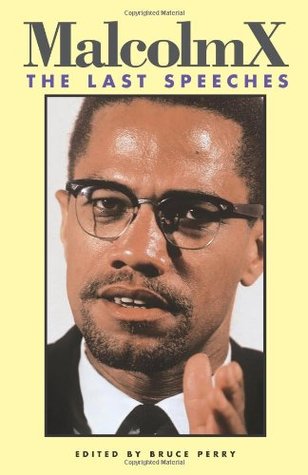
Malcolm X: The Last Speeches by Malcolm X, Bruce Perry (ed.) *****

malcolmxlastspeechesIf you read The Autobiography of Malcolm X, the most widely-read of the books about Malcolm, you will get an idea of the general development of his self-education in prison, and of his attraction to, and eventual prominence in, the Nation of Islam. This volume, in contrast, shows the speeches he made when he broke with the Nation of Islam and decided that the struggle for racial equality was tied to class struggles, and that this meant that people who were not Black could still be part of the fight that he believed was necessary. It shows his attraction to socialist ideas, and these are speeches that were not published until recently, when his widow found them buried amongst a lot of other things in storage, and called the publisher she wanted to distribute these ideas.

For example, for awhile there were posters and tee shirts available for sale showing Malcolm X and Dr. King standing together. The implication inherent in overemphasizing this photograph is that the two were comrades and brothers in struggle. I can’t believe the number of young people I taught believed that Malcolm “wanted peace”. Whereas this is true in the long run, it isn’t what he talked about. When middle class Caucasians were interviewed on TV and they pontificated that it was important for those Black demonstrators walking across the South, being confronted with tear gas, firehoses, police dogs, and arrest, to remain nonviolent, Malcolm responded, “I will be nonviolent when the White man is nonviolent.” In contrast to the ideas of Dr. King, Malcolm was ready to fight for his rights. It was in the last year of his life that he realized that the material interests of the entire working class dovetailed, and he targeted the ruling rich as his oppressors, (correctly so in my view), rather than blaming all members of any ethnicity or race. This was an enormous change from the belief system he had espoused while he was with the Nation of Islam. These speeches serve as the clearest documentation of this change.

These speeches are important, though their context was quite different from today’s, because they break up the myth that mainstream media and US government sources have built up surrounding Malcolm X.  If you can’t stamp out someone’s speeches and memory, what do you do instead? You co-opt them, sanitize them, find a way to make more in tune with what you wish they’d been. And that’s what has been done to Malcolm X’s legacy, by and large.

For those who are seeing a big difference between his earlier speeches and the ones published here, it is not hypocrisy, it is development. It takes a lot of integrity for someone who is famous and controversial to admit he has been in error, and explain what his new viewpoint is, and why he has changed his way of thinking. If you don’t read this book, you will not know the whole evolution of the ideas and political program embraced by Malcolm X over the span of his life.

All of this has more relevance than ever now that we are in the midst of a second, perhaps even more vital civil rights movement. Malcolm’s philosophy and political perspective should be widely read. He’s been gone for a long time, but nothing can kill his ideas, and we need them now.

S Street Rising: Crack, Murder, and Redemption in D.C. by Ruben Castaneda *****

sstreetrisingThis book is remarkable, and I am not the tiniest bit surprised that its writer has won multiple awards. He began life as a journalist, and in part, that’s what this is about. It is a memoir at least four times over. Seamlessly, Castaneda weaves the history of S Street, a formerly down-and-out part of Washington, DC that holds deep personal meaning for him; his own personal story ; the history of local police and in particular, the use of gratuitous violence and what happens to those who try to shut that shit down; and also the memoir of a local street ministry and after school program linked to S Street and the area’s revival. It is braided together evenly and I cannot find a flaw in it (and I am picky). At the end, he ties the whole thing together and puts a bow on it, and my jaw dropped. Did he just do that? Yes, he did!

Many thanks to Net Galley and Bloomsbury USA for the DRC.

My initial thought was that it takes titanium cojones to not only write about the DC crack epidemic while being addicted to it (as well as alcohol), and THEN to come out and write a risky but much lauded magazine article about his own journey doing same, and his subsequent recovery (sixteen years, at the time this was written), and then, after all of that, to write a book about it.

But it’s not just about guts. There are multiple essential messages he wants us to receive, and his strong word-smithery and pacing make it easy to keep turning the pages. The narrative is smooth as glass, transitions so natural they are hard to find. Twice I went back to the opening pages to make sure this was actually nonfiction, because it bears the crafting of a well-paced thriller. And it is highlighted by the journalistic integrity of the writer in what he recognizes is a dying craft: the investigative newspaper reporter.

Looking through the pages of my own city’s less-than-laudable local press as well as TV news coverage, I see two types of journalists, for the greater part. One is the phone-it-in writer. Typically, it is an article about a corporation or organization and the subject of the piece has really done the writing. It shows up as news without anybody double checking the self-aggrandizement done by the firm in question. Easy story.

The other is the heartless story-at-all-costs. Castaneda confesses to being an adrenaline junkie, and the reader must recognize that to keep the hours a journalist keeps for the salary provided, there would have to be a secondary payoff, that of satisfaction. But I do see journalists who go too far, the ones who will approach a mother whose babies have perished in a fire moments before, stick a microphone in her face, and bark, “Tell us how you are feeling at this time, ma’am.” Our author has a couple of sticky ethical decisions he has to make, decisions of integrity versus alpha-journalistic behavior, and he comes down more often than not on the side of the angels, and at least once, he does so at great cost to his career. This is really admirable.

I have read over 200 memoirs, and yet there has never been one like this one. I cannot recommend it highly enough.

The Wrong Carlos: Anatomy of a Wrongful Execution, by James S. Liebman ****

Has anyone ever been proved to have been executed in the USA for a crime s/he did not commit? I would have thought this was a no-brainer, but then, I have watched the so-called criminal “justice” system ruin basically good kids and incarcerate exponentially larger numbers of people—primarily people of color—for doing small things that would never touch a white person of material substance. I’ve seen it unfold in multiple cities and in diverse situations. It’s endemic. It amazes me that anyone felt a study needed to be done in order to demonstrate what is naked before our eyes in any major city and a lot of smaller towns, too.

However, apparently some academics at Columbia University believed the answer was less than clear, and so in the chillingly clinical writing of the intelligentsia, they lay out, sometimes minute by minute, sometimes hour by hour, the entire case of the murder of Wanda Lopez. Wanda was a convenience store clerk; Carlos Hernandez appears to have been a sadistic sociopath who enjoyed using his knife on human beings. (After being sent up once for using a gun, he drew the only natural conclusion: in the future, kill people using a knife, not a gun. Logical, right?)

There is testimony; there are photographs; and if you want to go online and watch videos (heaven help us all), you can do that too.

DNA tests should hypothetically be definitive in capital murder cases today, but they are very expensive and (as the recent Amanda Knox trial in Italy demonstrates), they can also be ambiguous. For example, one can argue whether a person’s DNA is present in a given place for a good reason; then too, DNA must be matched to someone who’s on file, and if the person in question has never been in trouble and got away clean, you might as well be holding yesterday’s newspaper as the DNA of who-knows-who.

Ultimately, as this case demonstrates using eerily dry language rather than the kind of compelling narrative one might generally expect, the courts spend more time and effort on those who are in a position to hire competent counsel, garner community support, and have others actively advocating for them. On the other hand, those who are alienated and dispossessed; those who fear law enforcement too much to come forward in someone else’s defense; those who don’t have the funds for transportation or who fear taking time off and losing the hard-won job that represents the thin, dim line between barely scraping by and being out on the street; these folks get sent up easily, and a case is closed.

Neither Carlos was an angel, goodness knows. The innocent-of-murder Carlos was a convicted rapist who pleaded no contest and admits that he tore a woman’s clothing off her body so he could force her to have sex. With the inclusion of such facts, the man who was executed becomes a much less sympathetic character, but the point of the Columbia scholars is not to restore the good name of Carlos DeLuna or to excoriate the memory of Carlos Hernandez (also dead now); it is to prove the point they set out to prove: at least one person has been sent to his death when he was innocent of the crime for which he was executed. If anyone doubts the truth of this statement, I invite them to read this cold, horrible indictment of the US “Justice” system.

For some of us, there was no doubt to begin with.

The Trials of Lenny Bruce ***** by Ronald K.L. Collins, David Skover

 thetrialsoflennybruce I cannot remember the last time I felt so strongly about a book I had bought. I have never, ever felt this strongly about a CD! I found, by a rare bit of luck, this hardcover book in brand new condition, in a used book store. The CD inside the cover was still sealed. It is not just an actor on the CD; it is actual footage of Bruce’s voice performing (along with narration by someone else). It cost me all of five bucks. Unbelievable!

If you are a champion of free speech, you have to know that this amazing (though oh yes, profane) comedian broke new ground. It could be (and has been) argued that he paid with his life, that performing in a nightclub LINED with cops all up and down ultimately broke him, but he did not go gently.

The first time I heard the material was in the movie “Lenny”, starring actor Dustin Hoffman in the title role. I knew it was good, but I was also young, had very tender ears, and I think there were times when the one-two punch of some of the words that I hadn’t heard much, caused me to miss some of the point. Even then, I understood that this was a powerful thing, though.

This book and ESPECIALLY the CD, which provides not only the words, but the all-important inflections (transcribed, for those who miss some of what goes by in the snappy nightclub patter, in the book), is one of the most important pieces of primary evidence I have ever been privileged to hear, see, and own. I cannot believe the clarity of the sound! For those, like me, to whom the early sixties are not within the realm of memory, the book is essential for context. There are people who were well known at the time whose names go by like gunshots in his routine; two who come to mind were a cardinal and a bishop. The context that the CD does not provide is in the book.

The text itself is 442 pp. in length; the rest is meticulous documentation. Pictures of everyone…this is a treasure!

Buck: A Memoir by M.K. Asante *****


There are spoilers coming. There’s just no other way to review this one.

MK Asante was born in Zimbabwe, but the first time we meet him is in “Killadelphia, Pistolvania”. His family is out of control, and consequently, so is he. His brother is deep into gang life, running guns and drugs. By the time he is 12, MK has “favorite” porn artists, is sexually active, and doesn’t think twice before leaping into a stolen car alongside his brother, who goes by “Uzi”. He adores his brother. His brother is 16 and assumes that he won’t stay long behind bars for the things he does because he is a minor. We never learn for sure whether he is sent to live with a relative in Arizona to keep his influence from affecting MK (too late) or because the local heat has a real itch for him. Once he is there, however, he is tried as an adult for rape, for having sex with a 13 year old Caucasian. He thought she was 16. It’s a huge blow to everyone when he draws hard time.

Let’s pause here a moment. If you know absolutely no street lexicon (USA), and if you regard the Philadelphia police force as brothers and comrades, keep your wallet in your pocket. If you aren’t sure, or have seen the cops in major metropolitan cities do low-income teenagers (and even those from the middle class) irreparable harm and no good (or not much), you might be in the right ballpark.

I hope you are, because this is a powerhouse of a memoir. But there is no glossary, so for example, if the word “blunt” means something that is not sharp-edged, and nothing else, you may get dizzy and give up. If you don’t know the difference between “nigga” and the N word, and who can say it and who can’t, move on to the next selection on the shelf. But if these things have become either part of your own lexicon, or are familiar because of young people in your life who say them, you can read this just fine and Google any parts where you have difficulty. It’s well worth it.

Oh, and lest I forget, here it is: YES! I got this book free, from the Goodreads giveaway. If this had been a lousy read, my gratuity would have been withholding my review. Nobody gets five stars out of me unless I think what they have to offer is worth five stars.

The one question I have about this one, is where this urban jewel has been hanging for the last several years. All of hip-hop lyrics, the songs of urban protest, are from the 90’s. It is true that Tupac lives on forever, but in 2013, it seems to me that some years have gone missing nevertheless. I hope Random House hasn’t bought the rights to this book and then parked on it for awhile, and I hope it comes out soon.

I began reading within 48 hours of the Trayvon Martin verdict. My own large family is multiracial, and my youngest son, who is African-American and 25, was just packing to move out of the house and in with some friends. Reading the first chapters of this book gave me such an anxiety attack that the man did well to get out of the house before I started sewing name tags into his hoodies and packing him a plastic lunch box to take to school and work. I’m exaggerating, but only a small amount. I think this is a time when family members of young Black men are watching their own closely and holding their breath.

Carole/Amina, the mother who provides counterpoint to Malo’s (MK’s) narrative, is anxious too, but mental illness and a deteriorating marriage have deprived her of her voice. She loves her son, but has lost all authority and communication with him. She begs him to take care of her, and he recognizes, when his father leaves, that he is the “man of the family”. He has been deprived of his childhood somewhere along the way.

He learns his mother’s thoughts only by reading her diary. He is chronically truant from the private Quaker school she and her husband have sent him to, but she isn’t worried about that. She isn’t worried about the fact that he and a friend regularly steal her car and ride around in it until dawn, even though he is way too young to even have a learner’s permit.

I want to scream at her, “Why the hell not???”

That’s the easy part.

The school principal wants to talk to his family, but nobody is available. Ultimately, MK’s mother attempts suicide (not for the first time) and is institutionalized, as her daughter has already been. When she comes home, Malo’s father, a man known and respected as a civil rights activist and scholar, leaves her. His sole remaining child is enraged by his abdication. Every time his father loses control of the household, his response is absence.

The hard part is to say, “What would you do here?”

Can you correct the problem with social workers and foster homes? I don’t think so. Most foster kids vote with their feet. They stay for dinner, maybe try to round up some cash, then hit the bricks and don’t go back.

Can you fix the problem with a good school?

Yes, no, and maybe.

I send my own children to a really wonderful alternative school. It has made a huge difference for my kids who were at risk, and also for the child who was always the perfect example. But if other things get bad quickly enough, the school can’t do a damn thing.

The Quaker school was majority Caucasian at a time when the author of “Why Are All the Black Kids Sitting Together in the Cafeteria” says is actually when Black teens need an immersion experience to foster their sense of self. The Quaker school, though some of the staff appeared to mean well, either wrote Malo off as a bad seed (and face it, how many academics want to hear “fuck you” from an angry student?), or decided that he could not produce, as the high school basketball coach gives him permission to spend his class time shooting baskets if he’d prefer.

A gym is a safer place than the streets…but what kind of education is that? Is this really the best a gifted young Black man can expect? Not only no, but hell no!

The alternative school is one his mother finds after he has been arrested. He agrees to give it a try, and for (amazingly) the first time, he is asked in a friendly, personal yet not invasive environment to write something–anything.

As a retired language arts and history teacher, I find this dreadful. Every kid should be given this type of opportunity. I am appalled by the public school teachers who flatly tell the students they don’t want to be there and only show up for the paycheck. Are they expecting the students to react with understanding? I taught in high poverty schools, too, and you can bet your bottom dollar that I apologized to my students if there wasn’t a desk for everyone, and I found a spot for everyone to sit down until I could rectify the situation. Malo was robbed both by the Quakers and the public school system.

The alternative school helps him find his own voice. He discovers that until he has begun to read, he has no vocabulary, and without a good vocabulary, he wasn’t able to express himself.

But the other critical factor is the reemergence of his father, who to be fair has been trying to call him, trying to get in touch with him, but Malo has been unable to forgive him for abandoning the family and leaving his mother to flounder unaided in an untenable situation. When Malo is arrested, he refuses to phone his father, not wanting to give into his own need, or to see his father’s disappointment. His father finds out and comes to pick him up anyway. And though I have given away a large part of his story, I will leave the climactic scene between the two of them for the reader.

Later, Malo performs at a spoken word session when his girlfriend signs him up. The poem “Buck” is one of his own. He tells us that he finally understands why it was illegal to teach a slave to read and write, because there is so much power in the written word. And he decides that he wants to be a writer.

He is.


John Brown, by WEB DuBois *****

johnbrownThe class I took in college that featured John Brown as a small figure in American contemporary history dismissed him fairly quickly. He meant well, but was not stable, they said; in the end, he took extreme, hopeless measures that were destined for doom. He remained a hero to Black families (they admitted), South and North alike, as the first Caucasian man who was willing to die for the rights of Black people. Whereas many White folks (those with enough money for a fireplace and a portrait to go over it) featured a family ancestor or a painting of George Washington, Black homes often had a picture of John Brown.

The problem with that education is that no African-American scholars were included in this very central, pivotal part of the prelude to the American Civil War. I doubt anyone would doubt the credentials of this writer, whose urgent and compelling defense of Brown as a selfless but sane man with a perfectly good plan that went wrong due to a couple of the people in key positions of responsibility for the taking of Harper’s Ferry held my face close to the book (it is not the edition pictured; mine is so old, we’ve had it for so long, that the plastic lamination on the paperback has half peeled off, and it is not featured here!). The writer’s words forced me to read it, though I am no longer a student, with a pen in hand to underline and star key passages.

It’s tempting to leave it here, but I think I need to give you a couple of instances that may draw you, if you like history, care about the rights of Black people in the USA–because the oppression that started here is still not over (that’s me speaking; DuBois died in Ghana in 1963), if you are interested in the Civil War or Brown in particular, you have to read this book.

Tidbits that do not spoil, then: Harriet Tubman planned to be there with him. She became seriously ill and was confined to bed; otherwise, she meant to fight alongside him.

White writers have all assumed that his escape route was impossible. They have the WRONG escape route; DuBois explains the actual plan.

The Underground Railroad was run almost entirely by Black people, some of them wealthy, in the Northern US. DuBois points out that free Blacks owned over a million dollars worth of property, free and clear.
It was this same large body of free Blacks who provided the funding for Brown. He would have had more, if he had not become ill, and the loss of momentum removed most of his Canadian backers. Indeed, DuBois states that Brown most likely went to Harper’s Ferry physically ill and “racked with pain”, that he was very gaunt due to illness and poverty, but felt that to wait longer would be to lose his support and those he had gathered (a small group) for the initial attack.

To say might make you feel as if you have little reason to read this book. It is eloquently laid out as only a wordsmith such as DuBois is capable of doing. I am deeply sorry I waited so long to find time for it.