
A Death in the House and Other Stories, by Clifford D. Simak****

adeathinthehouse.jpgClifford D. Simak wrote fiction, mostly science fiction in the form of short stories, for more than fifty years.  Thanks to Net Galley and Open Road Integrated Media, I’ve been binge-reading for the better part of a year. I received this DRC, as I did the others, in exchange for an honest review.  This is my fourth Simak collection; most of its stories are brilliant and have stood the test of time, though a couple of them haven’t aged as well as the rest.

The collection begins with one of his best, “Operation Stinky”, which is about a skunk with supernatural ability. A hallmark of a truly brilliant science fiction writer is his capacity to take a truly preposterous premise and make us not only believe in it, for a short time, but respond to it emotionally. I laughed out loud at least once at a wry moment here, and in other places I was really moved. Simak does that to me a lot.

Another favorite was “Green Thumb”, about a plant that comes from outer space and is horrified to learn that its new host is actually—dear heaven—eating plants! Again, Simak plays this string like the sweetest violin, and at the end I had to put my reader down and assimilate what I’d read before I could read anything else. “The Sitters” made me think of Stephen King, though of course Simak’s story was written before King had published a novel at all. I also enjoyed the title story as well as “Tools” and “Nine Lives”, but the one I liked best was “Target Generation”, a longer story about a huge spaceship that had hosted so many generations of people, many of them born right there on the ship, that an entire origin myth had become the basis for the ship’s culture and the beliefs of its residents…all but one. When the character—if we can call it that—called ‘The Mutterer’ came, I could not move until that story was done.

That said, there were some weak places. In some respects this may be unfair of me, because I don’t think Simak wrote with the knowledge that anyone would ever sit down and binge-read his stories end to end; he submitted one story at a time to magazines and earned his living that way. Nevertheless, I really wish he’d write more stories in which nobody gets named “Doc”.  And the story titled “War is Personal”, while I am sure it was well received by many readers when he wrote it during World War II, really upset me. I found the “J” word a couple of times and together with the overall flavor of the story, was disturbed enough to straight-up skip to the next entry. I began the lengthy novella, “When It’s Hangnoose Time in Hell”, and was absorbed, but part way through it was shot through with some unbelievably bad dialogue and trite expressions. And although “The Birch Clump Cluster”, the final entry, wasn’t bad, it didn’t measure up to most of his work.

Two stories give unfortunate titles to disabled people and refer to them in a disrespectful way. Again, it was common at the time the stories were published, but as a society we are more enlightened now, and so this aspect of his work hasn’t aged well.

Unless you are a diehard Simak fan, skip the introduction. It was written by a close friend of his and has to do with a break from writing on the part of the author. I didn’t care at all and decided not to finish it, because trying to slog through it was going to prevent me from getting to the stories themselves.

The good news is that most of the stories here are fantastic, and this collection was published this summer, so you can have it now. Recommended for those that love good science fiction.
Good Night, Mr. James: and Other Stories by Clifford D. Simak*****

goodnightmrjamesSimak was a prodigious writer of science fiction during the middle of the twentieth century; he was the third Grand Master of the Science Fiction and Fantasy Writers of America, and won numerous other awards, among them the Nebula and multiple Hugo Awards. His short stories are being republished digitally, and as fast as Open Road Integrated Media can publish them, I snap them up, having already read two volumes; this is volume eight. Thanks go to ORIM and to Net Galley, from whom I received a DRC in exchange for this honest review.

There’s a special sort of satisfaction that comes from reading science fiction written during the era that followed World War II, and in seeing what technology science fiction writers imagined might be around the corner. Many times we read stories of passenger flights to other planets and galaxies, stories of mind control, and yet nobody ever imagined that one day we would each have a small telephone in our pocket that would double as a camera, wristwatch and telegram service. But the musings and imaginings of old school science fiction are just plain fun, and they don’t require the technical proficiency that some of today’s writers often require in order to read, understand, and enjoy the stories they produce.  Sometimes a bit of philosophy and world view sneaks into these stories, and we may find kindred spirits in the most unlikely places.

The title story used to open this collection is a fun one, and the tension that accompanies Mr. James as he approaches the enclosure where he believes he’ll find the ‘puudly’, a creature from another world unwisely snuck into the present one, is almost unbearable.  What follows on his journey home is absorbing as well. But this wasn’t my favorite story. There are two others I found even better, but first, let’s get this other news out of the way.

The bad news is that there is just a trace of the racist stereotyping common to white folk of this time period, but it’s limited to one story, and it’s scarce. If you read my reviews often, you know that if I see it, I call it out, and my tolerance level is much lower than that of most reviewers. It’s in one story which isn’t all that good anyway, and it pertains to Asians that are featured briefly. The story is “The Gunsmoke Drummer Sells a War”, and it’s a cowboy tale of the sort that was popular in the USA during the 1950’s. A man of Chinese origin is referred to as ‘The Chinaman’, and during his short tenure in the story, he is untrustworthy.  He speaks in a “sing song” cadence. This story cost the book half a star, but it’s my view that you could buy this collection, skip this story, which is overlong and contains some less than stellar dialogue, and you’d still get your money’s worth. That’s all the bad news there is here.

“Reunion on Ganymede” made me tremble with mirth, nearly causing me to wake Mr. Computer, who slumbered peacefully beside me. In this story Gramps is dying to go to the reunion of veterans of a war that took place between the “Marshies” (Martians) and the “Earthies” .  His family is trying to dissuade him from taking his flame gun with him. They tell him the weapon is too old to be trusted, but clearly it isn’t the gun, but rather the owner that they’re worried about. As developments take an unexpected turn, it becomes obvious that there are some things for which one just can’t plan. Eventually we see that Gramps and other characters unforeseen by his kinfolk are on a collision course, and what follows is pure poetry.

However, my very favorite story is “Kindergarten”. A man has bought a cabin and retreated to it; he’s been told he has a short time to live, and so he’s determined to do it in pastoral solitude. Imagine his surprise when he goes for a stroll one day and finds the mysterious machine on his property! It’s certainly not a saucer, yet it’s also not from Earth. It couldn’t be. And the whole thing unspools in a way I interpret as being subversive and delicious. Please note that the entire collection is edited and introduced by a close friend of the author’s, the latter having died in 1988. The editor’s spin on this story is completely different from my own, and yet knowing this didn’t make me enjoy it any less.

If you’ve had the pleasure of reading the We Install story collection, or Grotto of the Dancing Deer collection, you know what kind of prose Simak spins, and if you like old school science fiction, you almost have to like most or all of his. If you haven’t dipped a toe in the water yet, hop on in. Between this collection and at least nine others, there’s plenty to keep you reading happily for quite some time.

As a last note to teachers looking for suitable classroom stories, there’s no sex or foul language here, but be prepared to discuss or explain some of the slang of the period in question.

Highly recommended and available to the public now.

The Fat Artist and Other Stories, by Benjamin Hale*****

Happy release day! Today this title and another winner, Everyone Brave is Forgiven,  hit the shelves. I don’t reblog all titles upon release; only the ones I really like. Don’t let the cover scare you away, because once I had gotten into the title story, I understood why this was exactly the right cover art. Happy reading!

seattlebookmama's avatarSeattle Book Mama

thefatartistI like short stories. My Goodreads library tells me I have munched my way through 89 collections and anthologies; yet I can tell you that there is nothing even remotely similar to what Hale offers here. Thanks go to Simon and Schuster and Net Galley for permitting me to view the DRC for the purpose of an honest review. You should get a copy May 17, 2016 when it is released, so that when it is immediately banned by various school boards you will know what they’re screaming about.

The ribbon that binds these brilliant, bizarre tales is that each of them features a social outlier as a protagonist. We start with the airline flight from hell in “Don’t Worry Baby”; you have doubtless flown at least once on a flight with a small child whose mother you long to smack upside the head for her dreadful parenting skills, but…

View original post 473 more words

The Fat Artist and Other Stories, by Benjamin Hale*****

thefatartistI like short stories. My Goodreads library tells me I have munched my way through 89 collections and anthologies; yet I can tell you that there is nothing even remotely similar to what Hale offers here. Thanks go to Simon and Schuster and Net Galley for permitting me to view the DRC for the purpose of an honest review. You should get a copy May 17, 2016 when it is released, so that when it is immediately banned by various school boards you will know what they’re screaming about.
The ribbon that binds these brilliant, bizarre tales is that each of them features a social outlier as a protagonist. We start with the airline flight from hell in “Don’t Worry Baby”; you have doubtless flown at least once on a flight with a small child whose mother you long to smack upside the head for her dreadful parenting skills, but this one wins the prize. The second story that deals with Judgment Day didn’t work for me; first there were some hyperliterate science references that zinged right over my head, and then the sick factor got the better of me, and so I skipped that one and moved on to the title story. Having read the rest, I am inclined to chalk that second one up to my own quirks rather than Hale’s skill set.

When I came to “The Fat Artist”, I could only bow in awe. I was overcome with frustration because no one else in my household enjoys literary fiction, and so I couldn’t share. In a nutshell, the protagonist, a performance artist, seeks to eat himself to death while setting a worldwide fatness record. I actually gasped several times while reading this one.

Although the writing within this collection provides outstanding examples of every imaginable literary device, those that teach high school literature would be wise not to place it on classroom shelves unless you work at an alternative school. A very alternative school. A very, very, very…well, hopefully my meaning is clear. There is so much edgy material, from language, to explicit sexual description, to sexual roles and gender ambiguity, that I can see the villagers coming with their torches, their hot tar, their feather pillows. Teachers, don’t do this to yourselves. Get a personal copy; take it home and enjoy it; then pass it on to someone that can be trusted to appreciate it. Seriously.

Four more stories follow, and they’re all strong. “Leftovers” deals with a middle aged man in the midst of an extramarital affair when his problem child unexpectedly appears, ready to ransack the family vacation home for valuables to sell in order to feed his addiction. The way this tale unfolds gives me goose bumps.

The next two tales deal with sexual roles and ambiguity. I came away from “Beautiful Boy”, which made me realize, whether by the author’s intention or not, that men that choose to cross dress only as a diversion are looking at the best of both worlds, never having to confront the glass ceiling because they’ll be at that office meeting clad in their conservative suit and tie like always; it reminds me of white actors that wore black face.

The final story of a troubled brother that lands in the basement of his brother, the MIT researcher, and is provided with a job driving squid from the docks to the laboratory, is as brilliant as all the others, and equally esoteric.

Hale is wholly original, but if I were to compare his writing to any other author, it would be to that of Michael Chabon.

Bring your literary skills to the feast that Hale has laid for you; you will need them.  It’s one hell of a banquet.

The Pier Falls: and Other Stories, by Mark Haddon*****

thepierfalls.pngMark Haddon has already left his mark on the world with his well known novel and play, The Curious Incident of the Dog in the Night-Time. I haven’t read that book but I will now, because this new collection is impressive. Thanks go to Net Galley and Doubleday for the DRC, which I received in exchange for a fair and honest review.  At times like this, when I get to review stellar writing, it’s a great pleasure to do so.

Note the title first, because it serves to set the tone for all of the stories here. It’s dark out there. On the one hand, a collection filled with cataclysmic tragedies and crimes can make our own troubles look small; yet the reader that tends toward serious clinical depression might be better served to read something lighter. I could imagine how immersing oneself in these stories, which seem quite immediate because they’re so well done, might make a depressive start dwelling on other things, like whether to reach for the rat poison or the razor blades. So if that’s you, get a different book, seriously.

For the rest of us, this is amazing fiction. The title story is the best:

The noise, when it comes, is like the noise of a redwood being felled, wood and metal bending and splitting under pressure. Everyone looks at their feet, feeling the hum and judder of the struts. The noise stops and there is a moment of silence, as if the sea itself were holding its breath. Then with a peal of biblical thunder…a woman and three children standing at the rail drop instantly. Six more people are poured, scrabbling, down the half-crater of shattered wood into the sea.

The story is written so intentionally that not a word is wasted. The result is a tale that is like having a pile of snapshots fall out of your wallet. There it all is in one cruel moment after another, laid bare for all to see. And you have to see it, because once you start, you cannot possibly look away.

Haddon’s capacity to develop a character within a short space is part of his magic, as is his brilliance with setting. The Gun has won an award already, and reminds me somewhat of Peter Straub’s spellbinding facility in combining children with horrible circumstances; the distinction between the protagonist and the new friend that his mother has warned is a bad influence point to class difference and the sometimes-terrible pragmatism that poverty creates. And in two other stories, Bunny  and Breathe, we see a crackling combination of genuine good intentions in a protagonist grappling with great pressure and suppressed rage.

None of it is pretty, but it’s too good not to read!

Another personal favorite is The Woodpecker and the Wolf, which veers into science fiction, starting off gently with the notion of space travel that involves sitting on a sofa, playing Scrabble a lot, and not doing much but observe, but then there are other developments and once again, things grow darker.

There have been times when I have had to speculate about whether it would be worth the purchase price of a book to read one really good short story that’s in the collection, or two really good stories. That’s not an issue here. While I confess that I didn’t finish The Island because it was so horribly dark—and one could perhaps argue that Haddon just did his job a little too well for me there—everything else here is simply admirable.

This outstanding collection is available to the public May 10, 2016, and it’s highly recommended.

Interior Darkness, by Peter Straub****

interiordarknessPeter Straub is a legendary writer of horror, and has been publishing novels and short stories for decades. Those that have followed him everywhere and sought every new thing he has written won’t find much joy here. This new collection draws on earlier collections. So for fans of Stephen King looking to add a second horror writer to their favorites list, this book is a winner, and it is for this new generation of horror readers that I mark this collection 4 stars. For die-hard Straub fans like me that are looking for stories that haven’t been published before, it may be a disappointment. I read my copy free courtesy of Net Galley and Doubleday in exchange for an honest review.
The first story, Blue Rose, is one of the most chilling, most terribly great stories Straub has ever written. This is probably why once I was partway into it, I suddenly remembered the middle and ending exactly after all these years, with over a thousand works of fiction read between then and now. I also suspect this story may have been featured in multiple collections, although I don’t know it for a fact. Likewise, the stories featured from his Houses Without Doors collection were all stories I remembered having read more recently.

However, I found three stories that had been published earlier in Magic Terror that had somehow slipped my attention. In particular, “Porkpie Hat” and “Mr. Clubb and Mr. Cuff” are  well done. I became a Straub fan before I finished college, and also before I was a literature teacher. It is great fun to go back and look at all the miraculous ways he uses imagery and other devices in these two stories to build dread in the reader and connect us in a nearly-visceral way to his protagonists. There is only one story in this collection that pushes my ick button—that part of my gut that turns over when something goes from being sick in an entertaining way to being sick in a way that makes me really feel sick and regretful at what I’d read; this is “The Ballad of Ballard and Sandrine”, originally published as a novella.

One sad thing in coming back to Straub’s work with more depth of knowledge than I had when I first read it is that I see a problem I didn’t notice before. Straub cannot develop female characters, and falls prey to every stereotype imaginable. There is one story in the “Noir” section where he deliberately uses stereotypes tongue in cheek, but this apparently hasn’t caused him to notice that he practices many of the same habits in the rest of his prose. It is this failure that denies him the fifth star in my rating.

Horror writers love to use kiddies, and Straub is no exception. If you cannot bear to read stories in which fictional children are subjected to cruelties in order to move the story forward, don’t read this book. In fact, if that’s the case for you, this may not even be your genre. Sometimes Straub rescues the kid at the end of the story, but then again, sometimes he doesn’t. And sometimes, it’s gruesome. I would not have cared to read these tales when I was pregnant or raising young children; I was way too close to his fictional characters at that time in my life. I mention this in case it’s true for you right now.

Conservative Christians won’t like this book.

Most of these stories were written for the book buying public of the late twentieth century, the majority of which was Caucasian and perhaps more clueless than most white folks are today. I could not help but notice that none of his scary characters had blue eyes. However, there’s one nicely done story involving allegory as well as wry humor titled “Little Red’s Tango”. In this story a Japanese book buyer turns up and stays awhile; Straub avoided every stereotype and the character was both believable and respectfully drawn. I appreciated it.

Between what I have said here and the table of contents that you can find online, you should know now whether this collection is in your wheelhouse and whether it’s something you want to pursue. It is available for purchase now.

Bad News and Trouble, by Maxine O’Callaghan****

badnewsandtrouble.jpgI am always on the lookout for a new, well written female detective series. There are some Grand Masters out there that I adore, but the problem is that I can read faster than they can write. So when I was given the opportunity to check out Delilah West, a sleuth whose stories originated during the latter half of the 20th century, I jumped on it, and I am so glad I did. Thank you, Brash Books Priority Reviewers Circle, for the free DRC. This book is available for sale now.

Delilah West may be cozy at times, but she is never cutesy or smarmy, and “never pert”. She never wonders why she didn’t bring her gun, because she always has the sense to have it with her. In Bad News and Trouble, we are treated to seven short stories, each of which is a separate case that Delilah describes to us. The suspense is thick, but now and then the feverish pace slackens just long enough to bring a good, hearty guffaw from the reader. Each episode is set primarily in California. She is a lone wolf, independent and smart as hell. She knows how to get things done, and she never has to call on a big strong man to save her personal ass. Believe it.

My favorite among the stories is second to the last, “Going to the Dogs”, a case in which a client is convinced that someone out there is trying to steal one of her dogs. I won’t give away the goods, but I will tell you that it kept me on the edge of my seat, made me laugh out loud more than once, and the ending was unusually satisfying.

You’ll have to excuse me now. Brash has more Delilah West stories on tap, and I am going to go find them. You should do the same.

The Complete Flying Officer X Stories*****

thecompleteflyingofficerxHE Bates wrote these stories during WWII; he served in the British Royal Air Force and received the unusual commission of author. His whole job was to write one short story after another. He was stationed with British pilots from 1941-1942, and he sat with them when they were between flights and listened with a sympathetic ear. He listened well, and the result is a collection of nearly 30 short stories, one of which is novella length, and they are strong, resonant fictional stories whose protagonists were inspired by actual pilots. Thank you twice to Net Galley and to Bloomsbury Publishers for the DRC. This collection is for sale now.
When I told my spouse that I was reading a collection of short stories about RAF pilots during this time period, he asked if that wasn’t a lot of stories to plow through, all on the same subject. I can understand why he—and maybe you—might think so, but the stories are all so different, and their characters so richly drawn, that it’s a bit like asking a mother of a very large family whether she might not like to trim a few sons and daughters from the herd. Although I can tell you which ones are my favorites, I also have to say there is no filler or weaker material here. Everything is very well written, and each story distinct in setting and characters from all others.

I sat down and read it start to finish, but once you have the collection, you can jump around however you like. The stories are not in any particular order. If your household has a book tucked into the bathroom or the guest room, a solid short story collection like this is a good choice, because the person that’s in that room won’t be there that long; this gives them a look at something they can finish. Most of the short stories are just a few pages, with just one toward the end in the part labeled as extra stories that might qualify as a novella.

Although I do have favorites, mine might not be the same as yours. I was drawn to “There’s No Future in It”, a story in which a father tries to dissuade his daughter from becoming involved with a pilot. It’s dark and resonates strongly. I also loved “K for Kitty”, a poignant tale about a pilot that strongly preferred one particular fighter plane; “The Young Man from Kalgoorie”, whose parents attempted to hide the very existence of the war from their son by keeping him busy on the farm and away from newspapers; and “O’Callahan’s Girl”, a young woman that loves a shy young flyer who only wants France to be restored to its previous state.

A happy surprise, given the era in which it was written, was the inclusion of a female soldier (in what is referred to as the “Russian” army, though the fact is it was the USSR and therefore Soviet Army at that time). This was a welcome addition. Unfortunately, there are two racist references, and if the stories were being written today, I would have knocked more than half a star off the rating because of them, but from the World War II generation’s Caucasians, I know (my parents having been among them) that the terms they used were thoughtless but made from ignorance rather than malice.

For example, in one story there is a brief mention made of a West Indian “boy” that used to work as a barrister. I blinked for a moment, not getting it at first. What kind of prodigy must that boy have been to have had a law career already and be out doing something else now? And then the penny dropped, and I realized this is actually a man, but he was referred to this way because of his race and ethnicity.

The second reference is to a brave pilot who nevertheless is described as being unusually ugly; his features bear some unflattering characteristics of the “Red Indian” and the “Mongoloid”.

Both of these go by in the blink of an eye, yet it’s only fair you be told in advance.

Finally, the thing that impressed me the most about these stories is that every last one of them had an unusually strong closing. The first few that left me gaping at their brilliance on the last page, last paragraph, last line were noted, but eventually it became clear that all or most of the collection was going to be like that, and of course I am not going to quote them here and ruin the stories’ endings for you. But one thing I will also say is that short stories that end with planned, maddening ambiguity are my pet peeve. For example, if a man is about to go through a door to either meet special delight or certain doom and the writer ends the story by having the man go through the door and gasp, and that’s the whole thing, he may be gasping with delight, or with horror, and we will never know which…? I hate that! And this set of short stories has none of it. Some end poignantly, some beautifully, some tragically, but every ending is in one way or another deeply satisfying and free of ambiguity.

For those that love military fiction, highly recommended.

The Future Never Lasts, by Phillip Gardner****

ThefutureneverlastsI do enjoy a good short story collection, and make no mistake, this collection is a good one. The marketing blurb says that these tales are “the finger on the pulse of collective secrecy”, but they could just as easily be tagged as stories of alienation. Almost all of them feature protagonists in dysfunctional marriages; some could easily land in an anthology of horror stories, or of crime fiction. But when all is said and done, if you like good writing, you should buy this book when it goes up for sale January 4, 2016. Thank you to Net Galley, Biting Duck Press, and Boson Books for the DRC, which I was given in exchange for an honest review.

Usually a collection like this one features its best work first and last, but this time I don’t see it that way. The first one is decent, but there are occasional moments when the dialogue goes awry, becoming at times either awkward and pretentious, or like a mouthful of mashed potatoes. The story itself wasn’t bad, it was specifically the dialogue that didn’t sit quite right.

The second story made the entire collection worth having. “This Time Comes From That Time” is a story of a Vietnam veteran who’s gone to pieces and commenced digging his own tunneled command center beneath his grandmother’s home. The jumbled trauma of that time—the murders of the Kennedy brothers and Martin Luther King, Junior; the war; demonstrations and riots that burned in cities across the nation—combine with the protagonist’s combat experience to leave him disoriented and seriously off kilter. Toss in some strangely comforting TV shows of the 1960’s, and the stew that Gardner makes of it is fascinating indeed. The prose is lean, the words well chosen. The man knows how to use figurative language like a champion; in particular, the use of repetition to drive the plot forward, to create a sense of urgency that is both visceral and memorable, is hard not to notice. At times it creates a take-me-to-church cadence that leaves the reader helplessly enthralled.

The titled selection was my second favorite, a story in which stone cold murder and every day irritations are juxtaposed in such a way as to leave a trail of shivers down even the most hardened reader’s spine. Yet there is also a place—I don’t want to give anything away, so I will refrain from being specific—in which a particularly obnoxious character’s comeuppance made me laugh out loud. This was made all the more amusing by the rapid way the author led us from the chamber of horrors to this brief, comedic moment, entirely unanticipated. And from there, things gradually chilled—even froze—not unlike the corpse in the story.

Gardner’s use of foreshadowing is sometimes predictable or mechanical, but at other times, it is used in the best way possible, building tension and suspense to the point where the reader has no option when the phone rings or a family member beckons, but to ignore them and keep on reading. “A Crime of Opportunity” is particularly strong in this respect, and was another favorite of mine.

Every single story in this anthology is hip-deep in booze. If you’re on the wagon right now and struggling, get yourself a different book.

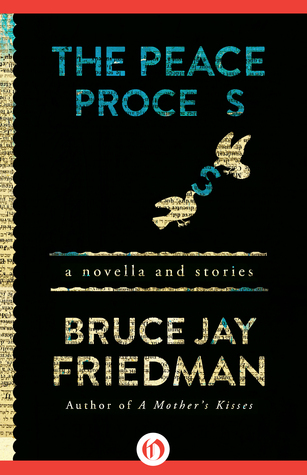
The Peace Process, by Bruce Jay Friedman ****

thepeaceprocessThe Peace Process is actually a collection of short stories plus one novella at the end. The writing is edgy all the way through and in a number of places it’s very, very funny. Thank you to Net Galley and Open Road Integrated Media for providing me with a DRC to read in advance. This collection will be available to the public October 13.

If any work of fiction you have read in the past five years or so has offended you in any way, the first selection in this collection is guaranteed to do so. It did me. Frankly, I am such a consistently fast, thorough reviewer that I could blow one off right now if I was disturbed enough by it, and I came pretty close. I don’t like to spoil things, but at the same time you ought to be warned. Is incest—even imagined incest, and with details—offensive to you? Is there a way to make a boy’s graphically imagined incest with an older sister acceptable, even funny? If so, then this is your collection. As for me, I almost wrote to the publishers to tell them that I wasn’t reading or reviewing one more story in this nasty little book; fortunately for me, I looked at the table of contents, figured out how much more of the book there was left to read, and decided to stick with it for one more story. And the next story, “The Storyteller”, was funny enough that I forgot—well, almost forgot–how mad I’d been a few minutes before.

But I seriously question the editor’s choice to put that one dreadful story right up front. It’s almost like begging the reader to throw the book out the window.

Moving on, the writing in all the other stories, from the second on through the last, is really strong. My imaginary red teacher’s pen sometimes comes out when I’m reading a galley, and I’ll think how much better the work would be if we could just nip this part here and take a meat-axe to another section. Not so for Friedman. Every word is well chosen, and the pacing is taut and brisk. Besides “The Storyteller”, my other favorites were “The Choice” and “The Strainer”. The endings always surprised me, and a couple of times, had I not had someone sleeping beside me as I read, I would have moaned aloud when I reached the denouement.

If I were to advise someone with tastes like my own as to whether to read the collection or leave it go, I would say get the book; skip the first story; read the rest of it. But then, you have to decide these things for yourself. I’ve done what I can, and the rest is up to you.

For fans of edgy, dark fiction, recommended with the caveat mentioned.