
Silence, by Anthony Quinn*****

silenceSilence is the third in the Inspector Celcius Daly series, but I read it alone and didn’t realize I had missed anything until I got online and looked. I received my copy free from Net Galley and Open Road Media in exchange for this honest review. It’s been for sale for almost a year and I apologize for my tardiness; the book had been out for several months before I received my DRC, and so I kept setting this review aside in order to write about stories that were about to be published immediately.  None of this should keep you from rushing out to order a copy; as you can see I rated it five stars, and I am picky these days.

I am immediately drawn to this book because of the setting; it takes place in Northern Ireland during the Troubles of the 1970s. Although I am impatient with the trite expression used by the journalist in the story—“sectarian violence”—I find the setting resonant and the characters credible. The entire thing is wholly original, but it’s complex, so it’s not something you can read while you’re trying to do something else.

Our protagonist is the Inspector Daly, a lonely man with kind intentions and deteriorating mental health. We have a dead man in the priest’s hotel room, but then we learn the dead man isn’t Father Walsh. If that’s not Father Walsh, where has he gotten to, and who is our victim? Last is our villain, Daniel Hegarty, an IRA man captured and turned by the Special Branch.

I particularly appreciate the moment with the sheep.

The field of mysteries, thrillers, and others of this ilk are thick with mechanisms that make me want to throw things. I think everyone that’s read many books in this genre has a private list. I am simply ecstatic to find that no one here is trying to solve the mystery either because they themselves are framed for something they didn’t do, or because a loved one has been threatened; no one in our tale is kidnapped, blindfolded, gagged, and tossed into the trunk—er, boot—of a car.  It’s refreshing.

Of course, to get a five star rating takes more than just a lack of irritating features. The setting, in the dark, in the muck, and sweating past police checkpoints, is both visceral and at times, scary. It’s the sort of story that makes a reader snuggle under the covers and be grateful for a safe, warm place to lie down. The characters are not always lovable, but they are entirely believable. That’s what counts with me. And the ending is a complete surprise, yet also makes sense.

For those that like literate, complex mysteries, it’s hard to beat. Highly recommended.
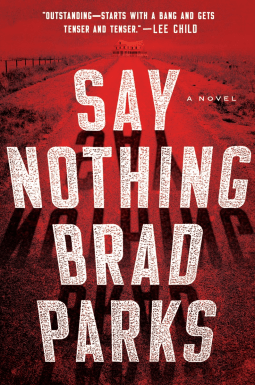
Say Nothing, by Brad Parks***

saynothingEvery parent with a baby or toddler has this one terrible, dark fear: that someone will take that baby.  In Say Nothing, that horrific event is doubled when Sam and Emma, twin sons of Scott and Alison, are taken and the note that sends frozen tendrils of fear up their spines instructs them not to tell anyone. No police; no one at all can know. “Say nothing.” Thanks go to Net Galley and Dutton Penguin for the DRC, which I received in exchange for an honest review. The book came out last week and is now available for purchase.

This story takes off like a rocket.  Scott Sampson is a Federal judge, and some devious criminals that know the family’s every habit snatch the children and send him a text message before either parent knows they are gone. Someone has impersonated Alison, swept by their preschool, and whisked the little ones away. How absolutely terrifying!

The purpose is soon clear: the kidnappers want to manipulate a major case on the Federal docket, assigned to Scott Sampson. Contacting police is out of the question. They’ve threatened to cut off their little fingers, one by one, and mail them to their parents.

Parks is a champ at building suspense. For me, the thrill is tarnished when I see a repetitive error—one many people won’t even notice—that has the effect of sweeping aside the curtain and showing me that the Great and Powerful Oz is just a guy in a chair. In this case, having had a judge in the family for many years and seeing the mistake in the text makes it hard to maintain the premise.  You see, when one is in court, the judge is “The Honorable” and is addressed as “your Honor”; in private life, his employees, friends and family all call him John, or Mr. W—. We used to eat out with this man frequently, and there was always a little family eye roll and slight smile when the obsequious maitre d’ at a downtown restaurant where we often ate came dashing out to the valet parking area calling, “Oh, Judge W—! Judge W—! We have your table ready now!”

In private life, if you need a title, a Supreme Court judge is called “Justice Jones”. Everyone else is called “Mr. Jones” or “Ms. Jones”.

I try to push past this obstacle but the error is made often in the dialogue, and so the memory of my relative’s patient courtesy is always lurking in the margins of my perception of the story. The upshot is that for me, it really gets in the way.

That said, I like the pacing of this story, and the solution is elegant and plausible.

Recommended to fans of the author’s Carter Ross series.

The Roanoke Girls, by Amy Engel*****

Happy release day! I read and reviewed this title back in December and called it “…smoking hot, a barn burner of a book.” Today it’s for sale. You won’t find anything like it out there.

seattlebookmama's avatarSeattle Book Mama

theroanokegirlsAmy Engel makes her debut as a writer of adult fiction with this title, having begun her career writing fiction for young adults. The Roanoke Girls is smoking hot, a barn burner of a book, diving into some of society’s deepest taboos and yanking them from the shadows into the bright rays of Kansas sunshine, where the story is set, for us to have a look at them. It’s not available to the public until March 7, 2017, and frankly I don’t know how you are going to wait that long. I received a DRC for this title from Net Galley and Crown Publishing for the purpose of a review.

Lane grows up in New York City, raised by a mother that shows no sign of warmth or affection, a woman that seems to either cry or sleepwalk through most hours of most days. When she hangs herself, Lane bitterly…

View original post 638 more words

The Devil’s Country, by Harry Hunsicker****

thedevilscountryHarry Hunsicker is the former executive vice president of the Mystery Writers of America as well as a successful author. Reading this suspenseful and at times almost surreal tale makes it easy to understand why so many people want to read his work. I’d do it again in a heartbeat. Thanks go to Net Galley and to Thomas and Mercer for the DRC, which I received in exchange for this honest review. This book will be available to the public April 11, 2017.

Arlo Baines, a former Texas Ranger, is on the road when it all unfolds; he’s stopped at the tiny town of Piedra Springs, traveling from one place to another by Greyhound Bus, and he doesn’t intend to stay. He finds a place to get some food, sticks his nose in a copy of Gibbon, and tries to ignore everyone around him. Friendly conversation? Thank you, but no.

Unfortunately for him, there’s a woman with kids, and she’s in big trouble. Clad in an outfit that screams sister-wife, she is terrified, tells him she is pursued, and next thing he knows, she is dead. What happened to the children? Before he knows it, Baines is hip deep in the smoldering drama of the Sky of Zion, a cult that has deep tentacles into the local business and law enforcement establishments.

The narrative shifts smoothly back and forth between the past and the present, and Baines’s motivation is revealed. He is on the move because his wife and child were murdered by corrupt cops, who he then had killed. One particularly chilling scene, the one in which Baines is told to leave town, gives me shivers. In general, however, I find that the scenes taking place in the present are more gripping and resonant than those in the past.

Interesting side characters are Boone, a retired professor with a crease on his head and flip-flops that are falling apart; the local sheriff, Quang Marsh; journalist Hannah Byrnes; and the bad guys in Tom Mix-style hats, with the crease down the front. Setting is also strong here, and I can almost taste the dust in my mouth as Baines pursues his quest in this little town with quiet determination. Every time I make a prediction, something else—and something better—happens instead. In places, it’s laugh-out-loud funny!

Readers that love a good thriller and whose world view leans toward the left will find this a deeply satisfying read. Hunsicker kicks stereotypes to the curb and delivers a story unlike anyone else’s. I would love to see this become a series.

Chaos, by Patricia Cornwell*****

chaos Patricia Cornwell has a publisher that doesn’t love bloggers, but her books kick ass. For this reason, this white-knuckle thriller was one of perhaps half a dozen books on my Christmas wish list for 2016. So here, in this spot where I traditionally thank the publisher and the site that facilitates them, I will instead thank Benjamin, his lovely wife Amie, and their baby boy. Between them, they gave me three delicious books, but this is the one I had to flip open as soon as the Christmas celebration was over; excuse me everyone, but I am off to bed with my box of Christmas candy and Patricia Cornwell. I am just now getting to the review, since DRCs get first priority, but I gobbled this book up before the New Year holiday.

Authors like Cornwell that write strong, long running thriller series have their work cut out for them. Whereas a debut novel and perhaps a few that follow can run along traditional lines, being trapped in a dark building with a killer on the premises somewhere; stuffed into the trunk of a vehicle (or the back seat with a gag and blindfold); held at gun point; family members kidnapped; it cannot go on forever. Eventually even the most faithful of readers is unwilling to buy into it anymore. Oh come on. No you didn’t.

The best of these writers—here I am thinking of Cornwell along with Sue Grafton, Sara Paretsky, James Lee Burke, GM Ford, and I know you are thinking of several more as you read this review—find a way to make the series deeper and richer through character development. There’s more inner narrative perhaps, and the tension is more of the psychological variety than constant action. And at this point in a series, the reader that really does want nonstop action will howl and toss down their book, but many others, myself among them, find myself more bonded to the character. And so it is with Kay Scarpetta, one of my favorite long running series protagonists.

This story is set in Boston, and at the outset, Kay is receiving some disturbing communications on her phone. The worst thing about them is that they play without her choosing to open them, and then they vanish, so she has no proof they were ever there. It doesn’t take long for her to conclude that the hack has been effected by nemesis Carrie Grethen, ex-lover of her beloved niece Lucy, whom she raised like a daughter and loves like no one else. Grethen has become Scarpetta’s Moriarty over the last several novels in this series. And Scarpetta wonders what these have to do with the young woman murdered in the park, a woman she spoke to briefly at an art exhibit and ran into later.

One of the things I love about this series is that Cornwell is unafraid to use her vocabulary. If someone out there doesn’t have the literacy level for it, let them stretch themselves to read this, or let them go away. In this era in which some writers are dumbing down their prose to meet the marketplace of American consumers with decreasing literacy levels, it’s a joy and a pleasure to find one that does not. The prose is richer, the descriptions more resonant than if she’d done otherwise.
As the story progresses, this psychological thriller takes on the contours of a nightmare in which everyone dear to Scarpetta—husband Benton, who’s with the FBI, Lucy, and Pete Marino—are all behaving in ways that make Scarpetta wonder whether they are deceiving her. Since every one of them has done so once before, the reader doesn’t regard Kay as paranoid, but rather fears for her.
Added into the picture is Kay’s sister Dorothy, who is Lucy’s mother. Kay and Dorothy hold a great deal of antagonism for one another, and an added twist is thrown in regarding sister Dorothy provides a huge surprise.

I note that cop Pete Marino, depicted in episodes gone by as a deeply flawed and disturbed individual, has been rehabilitated. Cornwell has tidied him up and Scarpetta has mostly forgiven his misdeeds of the past.

Should you pay full freight for this title? If you are a fan of the series and enjoyed the last one or two before this one, the answer is emphatically yes. Those new to the series might want to go for an earlier entry, as the series is much more fun when read in order. As of this writing, I also note that it’s available used online for less than five bucks, plus shipping charges. For others that are unsure, do remember that to develop character, Cornwell has to include a lot of details that have to do with the protagonist’s personal life. Some mystery readers just want the corpse, the puzzle, the guns, the action, and so if that describes you, see if you can read a sample before investing.

For fans of the series and of psychological thrillers, this book is highly recommended.

Every Dead Thing, by John Connolly****

everydeadthing“Our ancestors were not wrong in their superstitions; there is reason to fear the dark.”

This is the first entry of the Charlie Parker series, and I recently read and reviewed the newest one, so it is interesting to go back and see how the series begins. Thank you to Net Galley and Atria Books for the DRC, which I read free in exchange for an honest review.

The story commences with flashbacks to the brutal murder and mutilation of Parker’s wife and daughter. I have to confess that it went over the top for me and at times was too grim to be an enjoyable read. This newly released edition begins with introductory notes by the author in which he acknowledges that many readers also felt this way, so I know I am not alone. Everyone has a threshold. But I went into the story knowing that I want to read this series and that although it will always remain gritty and violent, it won’t always be this harsh, so I moved on, and I am glad I did.

The fact is, Connolly is an outstanding writer.

Parker is a shipwreck of a human being, a former cop with a sorrowful heart and not much to lose. He is determined to find the psychopath that killed his wife and child, and it appears that the same killer has taken a woman named Catherine. Her phone records show numerous calls, shortly before her disappearance, to the tiny southern town where she was born and raised. He grabs his wallet and heads south with two terrifyingly competent assistants, Angel and Louis, guys that are shady but loyal, and strong as hell. They are also a couple, and this adds an interesting twist, not to mention crushing a stereotype. Actually, these two characters are my favorites in this story, and I especially enjoy the scene in the auto shop.

Another wonderful feature is the swamp witch in the bayou.

Some aspects of this novel seem a bit derivative, in particular the long cast of characters with unusual names seems a lot like James Lee Burke. Ed McBain, iconic author of the 87th Precinct series, has a prominent character named Fat Ollie, a name Connolly uses for one of his characters here.

But there’s no denying the lyrical quality to the work that is entirely Connolly’s own, and as I have already seen, it just gets better from here. The plotting is complex, tight, and intense. It’s a strong debut.

Those that love good mysteries that run on the gritty side will want to read this series. You can read them out of order; I started with the fourteenth and didn’t feel there were enough missing pieces to prevent my understanding the story line. On the other hand, there’s nobody out there that can write as fast as we can read, and so why not start at the top and run all the way through the series?

This re-released edition of Every Dead Thing is for sale now.

The Mercy of the Tide, by Keith Rosson****

themercyofthe The Mercy of the Tide is Keith Rosson’s debut novel, and it’s a strong one. Set in a tiny, depressed town on the Oregon Coast during the Reagan Administration, things start out dark, and they’re about to get a whole lot darker. Thank you, Net Galley and Meerkat Press for the DRC, which I received free of charge for this honest review. This book will be for sale February 21, 2017, and those that love good fiction with a working class perspective will want a copy.

The tiny town of Riptide, Oregon is knee deep in grief. A recent head-on collision claimed the lives of Melissa Finster, mother of Sam and Trina, and June Dobbs, the town’s beloved librarian and wife of Sheriff Dave Dobbs. The blow has left everyone reeling and on edge.

Someone else is missing Melissa too, though he can’t say so. Deputy Nick Hayslip–a Vietnam veteran who has no patience for the madness associated with that category, a vet who figures that you go home when the war is over, you put on your clothes and go to work and therapy is for losers–is coming unstuck. Nobody knows about his past with Melissa, and he finds terrible ways to keep her memory alive.

The teaser for this novel tells us that the story centers around Sam and Trina, and since the author generally writes the teaser, that must be his intention. However, I found Trina to be the weakest element here, and it was the other characters that made this story work for me. Part of this is just pure fickle bad luck for the author; I actually taught deaf kids of the same age as Trina, as well as gifted kids that age; and in one instance, a gifted deaf kid that age. It’s true that the gifts of highly capable children vary widely in scope and range, and that every child is unique, but the vocabulary and abstract concepts Rosson bestows on this kid are just not within the realm of the possible, and so Trina isn’t real to me until later in the book, when things other than her obsession with nuclear holocaust are used in the development of her character.

The most interesting character and unlikely hero here is Hayslip. Also beautifully developed are Sheriff Dodds and Sam’s closest friend, Todd, known familiarly as “Toad”. Alternating points of view from the third person omniscient give us ready access to their thoughts, impulses, and feelings.

An interesting side character is zealous Christian wingnut Joe Lyley, who says in a somewhat uncharacteristic understatement, “These are unlovely times.” I also liked Leon Davies, whose role I will let the reader discover, because it’s such a fun surprise.

The setting is almost an anti-tourist brochure. The Oregon Coast is well known for its wild, rugged beauty, but Rosson chooses to introduce the other reality, that of the many local denizens that endure a hardscrabble working class existence in small, chilly, damp coastal communities that rarely see the sun. The moldering smell of rotting wood, porches and floors with a sponge-like give under foot are dead accurate, although the town of Riptide is fictitious; the recession of the 80’s plunged small beach towns into a depression from which there has never been a moment’s relief.

This is a strong story with a tight, tense climax and a powerful resolution. This darkly delicious novel shows that Rosson is a force to be reckoned with; I look forward to seeing more of his work in the future.

Heartbreak Hotel, by Jonathan Kellerman*****

Happy release day! Fans of Kellerman’s are in luck; this one is for sale today.

seattlebookmama's avatarSeattle Book Mama

heartbreakhotelThis is #32 in the Alex Delaware series, and Kellerman’s writing just seems to get better with every entry. Thanks go to Net Galley and Random House Ballantine for the DRC, which I received free in exchange for this honest review.

For those unfamiliar with the series, Alex Delaware is a semi-retired child psychologist who’s also an adrenaline junkie. His nest is already well padded, his wife still happy in her career, and so he spends most of his time assisting his best friend, an LA homicide detective named Milo Sturgis. The premise is the hardest thing to swallow, but Kellerman makes it easier by letting us know how affluent Delaware is, and recently there’s the added twist that because Sturgis is gay, nobody on the force really wants to be his partner. Thus it seems more natural—for the sake of a good yarn—for Delaware to slip into that position…

View original post 275 more words

Heartbreak Hotel, by Jonathan Kellerman*****

heartbreakhotelThis is #32 in the Alex Delaware series, and Kellerman’s writing just seems to get better with every entry. Thanks go to Net Galley and Random House Ballantine for the DRC, which I received free in exchange for this honest review.

For those unfamiliar with the series, Alex Delaware is a semi-retired child psychologist who’s also an adrenaline junkie. His nest is already well padded, his wife still happy in her career, and so he spends most of his time assisting his best friend, an LA homicide detective named Milo Sturgis. The premise is the hardest thing to swallow, but Kellerman makes it easier by letting us know how affluent Delaware is, and recently there’s the added twist that because Sturgis is gay, nobody on the force really wants to be his partner. Thus it seems more natural—for the sake of a good yarn—for Delaware to slip into that position. After all, he’s been doing it for years.

This story involves the homicide of a nearly one-hundred-years-old woman that has consulted Delaware. She paid him generously for his time but confided little about what she planned to do with the information he found for her, and so when she is found dead in her bed, he smells a rat. Sure enough; she was suffocated! Now who would do that to a sweet old lady like Thalia Mars?

Our story takes a million deft twists and clever turns, and in general shows us that what we think we see isn’t always real. We encounter some underhanded, sleazy real estate practices as well as insurance fraud along the way. The case also takes in some interesting LA history.

One aspect of Kellerman’s work that I often forget and then am happily surprised by all over again, is the humor he threads through the narrative, and I laughed out loud more than once.

Although it’s only one page in length, some readers will also want to be aware there’s one graphic, brutal rape. Consider your trigger warned.

At the end of the day, stories such as this one can be curiously comforting. It’s true that tax season is just around the corner, and my toaster just died. But after reading this novel, I can find comfort in knowing that no villains are likely to turn up in my bedroom tonight and burk me in my sleep.  Perspective! There you have it.

This fun story, which went by way too quickly, will be available to the public February 14, 2017. Highly recommended to those that love a good mystery.

Turbo Twenty-Three, by Janet Evanovich**-***

turbotwentytI’ve been a big fan of the Stephanie Plum series since Evanovich launched it over twenty years ago.Twenty? Whoa now, that hardly seems possible. But the first book in the series landed a host of great-first-book awards in 1995, the year before my youngest child was born.  I haven’t missed a single book nor even read any of them out of sequence.

There was a point somewhere along the way when the series started to lose its zip and some of the new fuel the writer injected turned sour. Does anyone recall the bit where Stephanie’s sister moves home from out of state, and one of the sister’s daughters thinks she’s a horse? It was beyond stupid to my way of thinking, but the point is that our author pulled it all back around within the next couple of books and it was funnier and fresher than ever. The last in the series, Tricky Twenty-Two, was an absolute scream, and so although I rarely purchase a book for myself anymore, I plunk #23 onto my Christmas wish list without a moment’s hesitation. And when Christmas is done, I scurry off with my four much-longed-for new books—three of them mysteries– and prepare to feast.

So this is a crushing disappointment. Sad, sad, sad. It isn’t funny enough to actually laugh at even once, and there are aspects of it that actually offend. I consider this sort of odd, given that since her movie deal, Evanovich has actually sanitized a lot of the spicier aspects of her work. The language isn’t nearly as blue as it was when she was new at this thing and had little to lose; the sex isn’t as steamy; and all told, it seems as if her imagination has an agent of its own whispering into its ear, asking just exactly how much revenue she’s willing to risk losing if she pursues this, that, the other creative but risqué notion.

How is it possible then that for the first time in a career of over twenty years and nearly two dozen published mysteries in this series alone, this author has been so politically tone deaf?

As I read one scene involving Stephanie and Lula, a pairing that’s almost always good for a laugh, my face was in a tentative smile, the expression one wears when expecting something funny to happen any minute. And that’s the moment when Lula claims to be extra lucky when seeking employment, because she can check off three boxes; she’s Black, she’s female, and she’s large in size. These should just about ensure that she’ll be hired. And then she tops it off by allowing that the only better thing that could happen would be if she were in an altercation with a cop and got beaten up and landed on YouTube.

Once I see this, I’m not laughing, and now I’m not smiling anymore either. It’s time to put the book away, read something else, and come back later when my blood pressure has settled.

The story continues; it isn’t funny, but it also isn’t dull. My attention is held, and I’m still somewhat convinced that it’s just about to get funny. And that’s when Lula says she is going to make money online by pretending to wake up one day “feeling like I’m a dude” and go use the men’s restroom. She’ll go in, “have my positive experience”, capture it on film and get rich. And of course, there are trans people all over America getting filthy rich just by identifying with a different gender than the one assigned them by nature and their parents…right?

Not so much.

I do find two amusing parts in this story. The first is some understated business with Stephanie’s parents. It’s the only subtle humor she employs, and maybe that’s why it works so well. I love seeing her mom and dad respond to uncomfortable situations.

The second is an entirely unexpected yet believable twist on the whole Morelli-or-Ranger thing, which had begun to go stale. I won’t spoil it for you, because you may still want to read this book.

One other obvious twist is that the writing, which has always been accessible to a reader that’s made it part way through high school, has been dumbed-down considerably. I find myself distracted by the number of four and five word sentences; where’s the fluency? I check the vocabulary and recognize that she’s dialed it down to a fourth grade level. I’ve administered vocabulary tests to fourth and fifth graders, and I find myself having flashbacks of the sort a retired teacher doesn’t really need. What the hell, Janet? Are we marketing to the functionally semi-literate now?

Nevertheless, I’ll be reading #24 when it comes down the pike; but not until I can get it used or free. My wish list is now reserved for other things.