
 Paul Kalanithi was a promising young physician who had nearly finished completing ten years of training as a neurosurgeon when he was diagnosed with Stage IV lung cancer. His twin ambitions had been to become a neurosurgeon and to write. When he realized how little time was left of his too-brief life, he decided to spend his remaining time writing this book. Thank you, Net Galley and Random House Publishing House for the DRC. Dr. Kalanithi died in March 2015, but he left this luminous memoir behind as part of his legacy. It is available to the public January 19, 2016.
The memoir starts with fond adolescent memories that left me dumbfounded, not only at the level of privilege he was born into, but the assumptions that go along with that. I was afraid I would fall into the uncomfortable place of not being able to generously review a dead man’s memoir. To make matters worse, I read two other memoirs that bitterly recounted the arrogance of doctors. I set this one aside about a third of the way into it until I could look at it with fresh eyes, and I am glad I did.
The spell of entitlement is broken by the forty percent mark; in fact, when he decides to continue in college simply because he isn’t done learning—a luxury that would never occur to most of us—I find myself interrupted mid-eye-roll when he mentions that in order to afford his apartment, he has to take a part time job. Now we are back in the realm of the real, and I can relate to the author.
With deft pacing and remarkable eloquence, he takes us into the world of the medical student, and we go with him to his first dissection and learn a few basic facts about the brain, including what tumors, both benign and malignant can do, and what priorities are generally set in maintaining its function. He explains why doctors sometimes recommend against heroic measures to continue a patient’s life when the patient inside is forever gone. There is information that should be shared, and information that should sometimes be saved for later; we see this from a much more personal vantage point later on.
And upon Kalanithi’s own diagnosis of terminal cancer, which has invaded his lungs and his brain, he is left “searching for a vocabulary with which to make sense of death.” Once his medical options are gone—oh, so swiftly!–he delves into poetry, philosophy, and even religion in order to come to terms with what he knows will happen, as well as the frustratingly ambiguous aspect of not knowing how long that will take.
Despite the fact that his death interrupted his writing, Kalanithi’s work is eloquent and absorbing, and it really didn’t feel as if it were under length to me. Maybe its brevity is what prevents it from becoming too emotionally taxing for the reader to absorb. It should rank high along with the work of Mitch Albom and Randy Pausch as a story that helps us learn to let go. Because as he points out, death will come for each of us. It always wins; the only question is when.
This book contains an epilogue written by his wife Lucy, but it stands quite nicely on its own.
Recommended for those facing death or dealing with loss, as well as for those who just like a powerful, hyper-literate memoir.
 Take a former journalist; make him a paramedic in a high-poverty, high-danger area for a decade; then turn him loose again to write about it, and he will play his readers like violins and make us like it. A Thousand Naked Strangers is a high octane, gloriously visceral ride in an ambulance and out of one, through Southeast Atlanta, Georgia. Thank you to Net Galley and to Scribner for the DRC. Since I read multiple galleys at a time and I loved this one best, I tried to feed it to myself in small nibbles, like Mary Ingalls hoarding her Christmas candy, but it was just too riveting and I could not stay away.
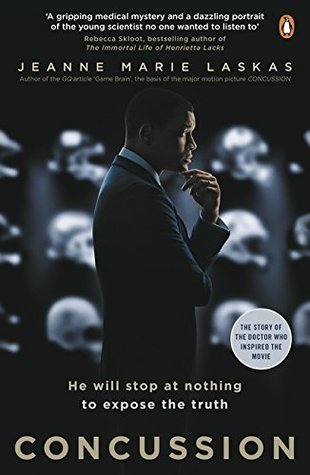 You don’t have to enjoy football to appreciate Concussion, the riveting new biography of Bennet Omalu, the Nigerian neurological pathologist that discovered CTE, a type of permanent brain damage caused by repetitive concussions, such as that experienced by football players. Not only the content, but the engaging voice with which it is told, make it worth everyone’s while. I was fortunate enough to read it free, courtesy of Net Galley and Random House, but when it comes out Tuesday, November 24, I recommend you get a copy for yourself. It’s information everyone really ought to have, especially those that play American football, or have family members that do.
