
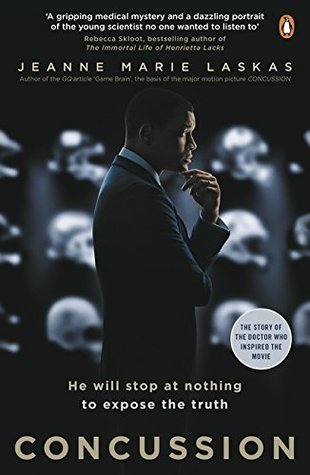
 You don’t have to enjoy football to appreciate Concussion, the riveting new biography of Bennet Omalu, the Nigerian neurological pathologist that discovered CTE, a type of permanent brain damage caused by repetitive concussions, such as that experienced by football players. Not only the content, but the engaging voice with which it is told, make it worth everyone’s while. I was fortunate enough to read it free, courtesy of Net Galley and Random House, but when it comes out Tuesday, November 24, I recommend you get a copy for yourself. It’s information everyone really ought to have, especially those that play American football, or have family members that do.
As for me, several years ago the middle school where I taught was rocked by the news that a young man we had taught had been killed on the football field while playing for the high school next door to us. DeShawn had died in a way the Seattle Times assured its readers was unheard of, a terrible tragedy with little explanation other than that of the coroner, who said he died of a traumatic brain injury. Our in-house football coach, whose frustrated students were stuck playing the “dumb”, safe version known as flag football, opined that maybe DeShawn hadn’t burped his helmet. One of DeShawn’s team members, a friend of my son’s and a frequent guest at our home, considered that DeShawn hadn’t “kept his head down like Coach said”. But the fact is, he was gone, and he wasn’t coming back. Dead at 16.
So I was interested indeed to read about the discovery made by Omalu, the pathologist that by coincidence was in charge of the autopsy of Iron Mike Webster, who played for the Pittsburgh Steelers. But I was equally interested in Omalu’s own story, a man of great enthusiasm and character, a faithful Catholic who used “Gee!” and “Gosh!” with youthful vigor as he uncovered one discovery after another, certain, so very certain that the NFL would want his discovery announced right away so that they could modify the game and make it safer. That poor man.
Omalu left Nigeria, which some Boomers will remember as having once been Biafra, home of genocide and terrible corruption, and he could not wait to live the American dream. The USA was free and open; there were no checkpoints at any of the highways; it was the home of Michael Jackson and Whitney Houston. Oh yes, he could shake the dust of Africa off the soles of his shoes and never look back. He had a full scholarship to the University of Washington, so although he had no idea where Seattle was, he had a ticket through the gates, and he would never live anywhere else.
Laskas uses Omalu’s own narrative in places, a wonderful thing given his buoyancy and eloquence:
Having seen this game [football] played on satellite TV on a few occasions in Africa, all I knew was the players ran into one another a whole lot and banged their heads repeatedly like guinea pigs running around…What an odd and inelegant game…If it hurts so much that you have to bubble-wrap your body, maybe you should play something different.”
But until he examined the brain of Iron Mike, the local hero who had lost his sanity following retirement, tasering himself in the hope he would be able to sleep, trying to fix his rotting teeth back into his own mouth with crazy glue, this was a side issue. His interest was in pathology, in the stories the dead had to tell.
But to Bennet, it seemed obvious enough, when the topic arose, because
“Anybody who knew anything about the anatomy of the head knew…It was a simple matter of physics. The brain floats, is suspended in a kind of thick jelly inside the skull. If you hit the head hard enough, that brain is going to move, no matter what kind of protection you put around the skull. A helmet protects the skull. A helmet can’t keep the brain from sloshing around in that skull. If you hit your head hard enough, the brain goes bashing against the walls of the skull.”
The helmet, it turns out, is more a weapon than protection for the brain.
Huh. No wonder Europe didn’t rush to join us in playing this sport.
Omalu’s story, from beginning to old age, is vividly told, and he is such a fascinating individual that you won’t want to put this story down once you’re into it. I could tell you more, but why ruin it? You really just have to read it. Order it now, or go out next week and buy a copy. You won’t be sorry!

 Seattle Book Mama