Broken Country, by Clare Leslie Hall*****

I am late to the party, but it would be a crime not to review Broken Country, the stirring love story by Clare Leslie Hall that can make even the hardest cynic weepy-eyed. My thanks go to NetGalley and Simon and Schuster for the review copy. This book is for sale now.

The story is set in a small village in Britain during the mid-1900s. The setting bounces back and forth between the present day and the past; it’s easy to keep track of, partly because the author takes care to delineate which chapter is which, and partly because there are few characters to keep track of. Our protagonist is Beth, and she and her husband, Frank, are farmers, have lived in the same community for their whole lives. A farm accident claimed the life of their only child, Bobby, a few years before, but they are both still fragile, ragged in their grief.

Then, oh my my, who comes back to town but Beth’s old flame, Gabriel, a man that came from money and went on to make a name for himself as a novelist. Gabriel has inherited the family house and land, and in the wake of his divorce, has brought his son Leo to live here. Here. Right next door to Beth and Frank.  And to complicate old feelings all the more, his son Leo is about the same age as Bobby was when he died.

Is it possible to be in love with two men at the same time? Beth would tell you that it is. Frank can see what is unfolding, and he tries to reason with Beth, but she assures him that everyone is grown up now, the past is the past, and there’s no reason that they and their new old neighbor cannot be friends.

Well.

I seldom reach for novels like this one, wary as I am of schmalz and schlock, but reader, I see none of either one in this story. The writing is disciplined and restrained, yet oh, so intimate. When a formula or trope comes into view, Hall goes the other way instead. And though I may have thought I knew where we would all end up, I was mistaken; the ending is beautifully planned and executed.

Because I had fallen a bit behind, I checked out the audio version from Seattle Bibliocommons; reader Hattie Morahan does a stellar job with the narration.

Highly recommended.

The Rulebreaker, by Susan Page*****

Barbara Walters was a force to be reckoned with. She was the journalistic pioneer who singlehandedly smashed the glass ceiling that kept women from anchoring network news; over the years she would conduct television interviews with heads of state, criminals, otherwise reclusive stars, and anyone else she deemed newsworthy. She was ruthless in the pursuit of a story, but during interviews, she used velvet gloves to deliver the most searing questions, and her subjects responded.

My thanks go to NetGalley and Simon and Schuster for the review copy. This book is for sale now.

Page has written a full, epic autobiography, starting with Walters’s childhood, which was fraught with uncertainty, and ending with her death. She has written it the way the story of a luminary should be written, touching on the many remarkable aspects of Walters’s life without lingering too long on any one of them. She keeps the pacing brisk, and the tone respectful but frank, never fawning. I can’t imagine anyone doing a better job, including Walters herself; the autobiography, Audition, is the most cited source in the endnotes, but Walters had a tendency to drone while telling her own story, particularly about her childhood, while Page keeps it moving.

Walters grew up in a show business household; her father, Lou Walters, produced live shows, and when they were successful, the family lived in style; when they weren’t, it was hand-to-mouth genteel poverty. His gambling addiction caused the family terrible hardship on numerous occasions, and once she made it in the industry, Barbara was forever writing checks to bail him out of debt. Her younger sister, Jackie, was intellectually disabled, and needed constant care and attention. Barbara remarked that in looking back, she doesn’t feel that she was ever young, as she carried so many adult responsibilities at such an early age.

Breaking into mainstream journalism—not fashion or cooking stories, but hard news—was a tough road. She did it at a time when women weren’t expected, or allowed, to do much of anything outside of mothering, housekeeping, and a small number of stereotypical positions. Any female that dared step outside these tight confines was labeled, not as an attorney, manager, or journalist, but as a “lady journalist,” and so forth. Her job on the Today show was announced—with a bit of urging from Barbara herself—in the New York Journal-American thusly:

“’Dawn Greets Barbara, A Girl of Today,’” the headline over the story read. ‘A very attractive, shapely, well-groomed, coiffed and fashionably frocked feminine member of NBC’s dawn patrol” …adding that she had ‘no wish to become a personality.’ She wants to remain as she is…the prettiest reporter in television.’”

That didn’t last, if it was ever true at all. She fought, tooth and toenail, for every single advancement in her career; mainstream news anchors, male of course, resented her and resisted her, particularly when she was hired to appear as a co-anchor. Her early career was marked with restrictions, with Harry Reasoner and Walter Cronkite subjecting her to endless bullying and requirements of when she could speak on the air—not until they had—and other petty, petulant rules.

But she never gave up, and she never went home.

As is often true for anyone that lives for their career, Walters wasn’t able to maintain any of her marriages or raise her own child. She was busy. This is the one regret she voiced at the end of her life, when she found herself alone, with only her longtime paid assistants to see to her needs.

Page narrates her own audiobook, which I checked out from Seattle Bibliocommons in order to catch up, and I immediately noted how much her voice and intonations resemble those of her subject, albeit without the speech impediment. I enjoyed listening to her.

Perhaps my favorite moment in this book is the moment when a very elderly Barbara Walters falls on a marble staircase after refusing to take the arm of the younger woman offering it. She faceplants, is badly injured, but when she regains consciousness, the first thing out of her mouth is an imperial order: “Do not call an ambulance. Do not call an ambulance.” (Of course they did. They had to.)

Although Walters was never a feminist crusader and generally looked out for herself, her family, and friends rather than her younger peers, we women owe her a debt of gratitude. She forced doors open that were bolted shut, and the ripple effect was immeasurable.

Highly recommended to those interested in Walters, feminist history, and anyone that just enjoys a good biography.    

The Ballad of Jacquotte Delahaye**-***

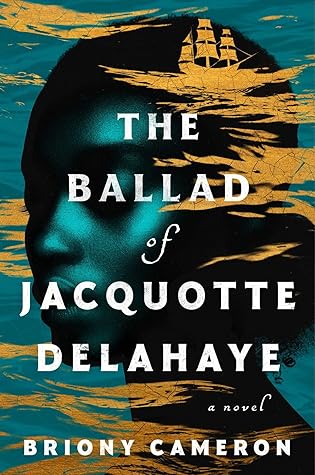
The Ballad of Jacquotte Delahaye marks Briony Cameron’s authorial debut. She is a talented wordsmith, and my thanks go to Atria Books and NetGalley for the invitation to read and review. While I enjoyed several exciting passages—I do adore a good pirate tale—in the end there were issues with credibility that got in my way.

 This story of a pirate woman’s derring do is for sale now.

When I read that Jacquotte Delahaye was a real person and that the book is based on true events, I was all in. However, there are passages that made me raise an eyebrow, and since there didn’t seem to be any notes that would indicate what is true and what is the author’s invention, I took to Google to find out more. This is where I learned that actually, she may have been a real person, or she may be only legend. The stories surrounding her life and exploits are also legend. There’s virtually no verified historical information on this character.

I love good historical fiction, which is where actual, documented facts are given warmth and life by an author that adds dialogue and perhaps fleshes out a few areas where the record is sketchy. Then, if the author is sharp and professional, there will be end notes that explain what is a matter of historical record, and what has been invented. That’s my happy place. Even better is when sources are provided for interested readers. Of course, a writer of any kind of fiction isn’t required to provide footnotes or other documentation, but when they do, it’s the cherry on the sundae, and it makes me love them all the more.

Because this story is not nearly as closely aligned to historical record as the promotional materials would have me believe, I nearly dropped my rating to two stars. I felt, and still feel, that the synopsis provided is misleading. I don’t like feeling as if I’ve been played. However, I realize that the author probably is not in charge of her own promotional blurb, and I can’t see penalizing her for what the publicist has chosen to do.

Do I recommend this story? Not so much. Had it been written in such a skillful way that I felt no need to do research of my own, I might not know that this is pure fiction based on little more than speculation. That’s not the case, though. It doesn’t ring true in a number of places, and that’s partly because it isn’t. However, should the reader decide to pursue it, I would advise that you get this book free or cheap, unless your resources are endless ones. Don’t pay full cover price.

Somewhere Toward Freedom, by Bennett Parten*****

Bennett Parten is a fine historical writer, and here he examines General William Sherman’s renowned march through Georgia during the American Civil War through the lens of the formerly enslaved people that followed him. It’s a job that needed doing, and I’m glad that Parten was the one to do it. My thanks go to Simon and Schuster and NetGalley for the review copy. This book is for sale now.

The Union’s approach to formerly enslaved people evolved considerably over the course of the war. (This is your reviewer talking, not Parten.) In the beginning, when both North and South thought the conflict would be a brief one—ending, of course, in their own victories—anyone that left a plantation without permission to follow the Union army was promptly returned to their owner. But this was problematic from the start, if only logistically, as such practices slowed the army’s pace and drained resources from it, all in service to the enemy. For a while, then, everything was unofficial, as gradually, the formerly enslaved were sometimes folded into the army as support staff, helping cook, set up camps, pave roads, and whatever other noncombat roles needed to be filled. Eventually the practice was codified, not because slaves were declared free—not yet—but as “contrabands” of war. The idea was that by taking the enemy’s property that one runs across, be it livestock, crops, or (wince!) human beings, one’s own forces were strengthened, the enemy’s weakened. And after the Emancipation Proclamation, the formerly enslaved could theoretically go wherever they chose, but since guns and dogs can render such a proclamation from a far away and often unrecognized authority, it seemed like a wise plan for the formerly enslaved to follow the Union army.

Prior to reading this book, I was unaware of the relative size of the crowd of followers as opposed to the army itself. As Sherman’s forces made their way through Georgia waging total war, razing fields and burning cities, the crowd behind it grew from hundreds, to thousands, to tens of thousands!

Sherman’s first obligation, as he saw it, was to win this war. The army had to be his focus. Yet, as enthusiastic followers swarmed, they needed food, shelter, and sometimes other assistance. Initially, the troops were instructed not to give food to anyone other than those followers tapped to serve the army, but it proved difficult to enforce. There were children there, and they might well starve if not fed. The army had, as an intentional strategy, denuded the farms and villages of food and other necessary resources, so telling the followers to go find their own food was disingenuous. The army had nearly all the food there was; unfortunately, it wasn’t enough for thousands of extra mouths. And at times, Sherman and his generals made an effort to prevent, or to at least not help, the followers from remaining with them.

The greatest scandal was the one at Ebenezer Creek. (Sherman himself was not physically present for this, but what happened was consistent with his policies.) Georgia was full of rivers, swamps, creeks, and bogs, and in order to cross them, sometimes the engineers constructed bridges, and then either burned them behind themselves to prevent the enemy from following, or retrieved them for later use. In this instance, the enemy was close at the rear, and the order was given to pull up the bridges just as soon as the last soldier was across. The result was horrifying: with the hounds baying behind them, the desperate followers used every possible means to try to stay with the army. Some drowned; others were captured and either returned to slavery or killed. Women and children perished in those muddy waters, and later, the Federals launched an investigation.

There were other less dramatic, yet still tragic, incidents of the same sort.

In order to solve this conundrum, Sherman ordered a series of abandoned plantations in Port Royal, an island in South Carolina, to be turned over for the use of the freedmen and women. The book goes into a fair amount of detail about how these were run, with a fierce competition between two sides for control. Despite an overly colonial administration, formerly enslaved people were able to farm for themselves, and in some cases were able to buy land with the money they earned. It was a sound, if flawed program that was ultimately destroyed when Lincoln was murdered and Andrew Johnson, a sympathizer of the South, became president and gave the plantations back to their original owners, making no provision whatsoever for the farmers that now worked them.

It is this aspect of which I knew nearly nothing. Part of this is because I am a coward; I have a dozen or more books about Reconstruction that I say I will read, but then I don’t, and that is because I know the ending will be heartbreaking. But there’s also this: conventional histories of the Civil War tend to follow one or another army, general, and so forth, and very few tell the story of what happens after the army marches onward. And so I learned a good deal from this portion of the book; and yes, my heart broke, but not as much as those of the people that were first assisted, and then abandoned by the U.S. government.

Finally, I want to comment on the notes and sources used here. They are beyond reproach, with many primary sources used, multiple sources per endnote in most cases, and well-integrated. I particularly appreciated the quotations of the followers themselves.

I highly recommend this book to all that are interested in the American Civil War, Reconstruction, and the many social and racial problems that have continued to weigh on American society ever since.

Good Dirt, by Charmaine Wilkerson*****

Charmaine Wilkerson is the author of the massively successful Black Cake. Her sophomore effort, Good Dirt, carries some of the same components—an impending marriage, a family heirloom, secrets and betrayals—but is nevertheless a very different story, and it’s an even better one. My thanks go to Random House Ballantine and NetGalley for the invitation to read and review. This book will be available to the public on January 28, 2025.

Our protagonist is Ebby Freeman, which is short for Ebony. She lives with her parents in an affluent neighborhood in New England, but there was a fourth family member, her brother Baz, who was murdered during a home invasion; Ebby witnessed all of it, and has long carried the guilt of survivors. Could her ten year old self have done something to save Baz?

Now Ebby is grown, and plans to be married, but things don’t go as anticipated.

As in her previous novel, Wilkerson packs so many points of view into the story that I eventually stop counting, and although I am skeptical about this choice through much of the book, by the end I have to admit that she has carried it off nicely. Some points of view are urgently necessary to carry the plot forward; others, like that of the intended groom, Henry, are straight-up hilarious in places. Once again, we move not only between points of view, but time periods as well, reaching back into an earlier century, when some of her ancestors were enslaved. These passages aren’t entertaining, but they are necessary to provide clarity and urgency.

Ordinarily, I don’t read stories with wealthy protagonists, and make no mistake, Ebby’s family has a great deal of money; but having the family be African-American, and self-made rather than heirs to massive, often ill gained fortunes helped a great deal. Ultimately it was easy to bond with Ebby. When she experienced pain and rejection, I felt it, too. I carried her around in my head in a way that I usually don’t; over 1,000 reviews are in my rearview mirror, and only the truly special ones take hold of me as this one has.

Highly recommended.

The Briar Club, by Kate Quinn*****

I had never read a novel by Kate Quinn, but my friends on Goodreads raved about it and I was overcome by the fear of missing out. Happily, I was not too late to get a review copy; my thanks go to NetGalley and William Morrow, along with my apologies for lateness. From the get go, I could tell this book was too good to speed read, and so I set it aside for a time when I could sink into it and appreciate it. This fall I was able to get the audio version from the library to help me along; narrator Saskia Maarleveld is outstanding, and those that enjoy hearing their books should strongly consider ordering that format.

Our story takes place just after World War II, and it takes place almost entirely within the confines of Briarwood House, a women’s boarding house owned by the selfish, odious Mrs. Nilsson. The book’s prologue comes to us from the point of view of the house, and for a brief spell I wonder whether the house itself will become the main character. It doesn’t, and that’s probably just as well, because the women that rent its rooms, along with Pete and Lina, Nilsson’s two children, fill the story quite nicely, and all are beautifully developed, some more than others, with Nilsson herself being the only truly static character. In fact, I could argue that even the house’s character is developed somewhat.

I seldom do this, but the prologue is so juicy that I’m going to reprint a considerable chunk of it here, because Quinn’s voice—and okay, the house’s—provide a more convincing incentive to read on, than anything I can offer:

If these walls could talk. Well, they may not be talking, but they are certainly listening. And watching…Now its walls smell of turkey, pumpkin pie, and blood, and the house is shocked down to its foundations. Also, just a little bit thrilled. This is the most excitement Briarwood House has had in decades. Murder. Murder here in the heart of sleepy white picket fence Washington, D.C.! And on Thanksgiving, too. Not that the house is terribly surprised by that; it’s held enough holidays to know that when you throw all that family together and mix with too much rum punch and buried resentment, blood is bound to be shed sometimes…This was a very enthusiastic murder, the house muses. Not one moment’s hesitation from the hand swinging that blade…Briarwood House doesn’t like Mrs. Nilsson. Hasn’t liked her since she first crossed the threshold as a bride, complaining before she’d even shaken the rice out of her hair that the halls were too narrow (My halls! Too narrow!), and still doesn’t like her twenty years down the road. No one else in this kitchen does, either, the house knows perfectly well. It knows something the detective doesn’t. The killer is still very much in this room.

Now that the murder has been mentioned, I must caution you not to identify this story foremost as a murder mystery; it isn’t. The murder doesn’t come till nearly the very end, and the reason that it affects us so deeply is because of the author’s success in making every character here feel tangible and known to us. By the time anyone is enraged enough to swing anything, we know all of these women, or most of them at least, well enough to feel as if they are family. Boarder Grace March is revealed to us more slowly than the other women, but there are reasons for that, and by the end, I may love her best of all. No, this is first and foremost a stellar work of historical fiction.

At the outset, no one knows anyone else. Some are married, waiting for spouses to return from the conflict; some are single; some are professionals. Almost everybody has at least one serious secret. But as they grow to know one another, bonds are established that in some cases are stronger than those of blood relatives.

I won’t go through the plot or describe individual characters; as far as I’m concerned, that would be gilding the lily. Instead, I urge you to get a copy of this outstanding novel in whatever form is your favorite, with a slight nudge toward audio if you’re undecided. Highly recommended!

Emperor of the Seas, by Jack Weatherford*****

How much do you know about the Mongol empires? If you grew up in the U.S., chances are you answered, “Absolutely nothing.” The world is a big place, and world history has never been much of a priority in American schools; we study various phases of U.S. history, state history, and in a wild flurry of internationalism, some districts now teach a semester of Canadian history. The single year of world history in high school is usually devoted to World War II, which is impossible to teach without including information about Europe, and a smidgen about Japan along with, yes, more American history. There you go. Here’s your diploma.

In my retirement years, I have reveled in the freedom to learn about the history that wasn’t on the syllabus for what I studied, and later, what I was hired to teach. Having marched my way through various other times and places, I realized that I knew nothing about the Mongol khans. I read one novel about Genghis, and I was hooked.

My thanks go to NetGalley and Bloomsbury for the review copy. You can buy this book now.

If you’re going to read a single nonfiction book about the Mongols, this would be a fine choice. Jack Weatherford’s research is outstanding, including works in several non-English languages that most of us couldn’t hope to read on our own. His scholarship is so meticulous that he has been awarded both of Mongolia’s top national awards. Not half bad, for a boy from South Carolina. And while this book is not written as narrative nonfiction, the tone is conversational, the language accessible. I read it daily at lunch time, and it wasn’t long before I was shouting out random, amazing facts to family members that dared venture into the kitchen.

It began with Genghis, a young man whose family was left homeless, left to freeze or starve when his father and protector died. With desperation, talent, and ruthlessness that he learned well, he turned it around, and as he grew up he vanquished his enemies, brought the most talented and trustworthy elements to himself, and let the devil take the rest. His instinct for military strategy was a thing of pure genius. But this book is mostly not about him; it’s about his grandson, Kublai Khan, who expanded the empire Genghis began until his domain stretched from Baghdad to the far shores of China.

Until Kublai arrived, Mongols were an inland people, but it was Kublai who realized that in order to expand and become a world power, he had to have ocean-going vessels and people that knew how to use them. The peoples of Southern China were tough to defeat, but once it was done, he was able to use their technologies in ways that were of immeasurable value.

The progression looked like this (in a very simplified version): Genghis conquered, and took no prisoners, with a few rare exceptions. Kublai conquered, but also used diplomacy, highlighting the potential benefits of becoming a Mongol subject; he didn’t routinely kill everyone he defeated. And under Kublai’s son Temur, the Mongols segued from physical battle to economic dominance, making China’s ports the ideal destination of merchants from all over the world.

One of the most interesting things I learned had to do with the authority that was vested in the women of the highest placed families. When the men rode off to conquer, it was women that looked after the business interests and saw to local governance. It worked out nicely; Europeans should have taken note.

I can’t compare this book to others because I haven’t read any others on this topic cover to cover, but I wouldn’t let that stop you. If the Mongols are persuaded that Weatherford has done the work and done it well, who can argue? I learned a great deal and enjoyed it, and so I highly recommend it to you.

Crook Manifesto, by Colson Whitehead*****

The Ray Carney mystery series is among the most exciting new series to emerge during the past decade, and that is hardly surprising, given that it’s written by Colson Whitehead, who has two Pulitzers and a host of other prestigious awards to his credit. The first in the series is Harlem Shuffle, which came out in 2021. Crook Manifesto is his second. I was unable to get the galley this time, but happily, my son bought it for me for Mother’s Day. I mention this because it’s rare that I pursue a book once I’ve been denied the galley. In this case, it was worth it!

Ray Carney, when we met him first, was a man who’d sometimes been known to bend the law in the past, but as a family man, it was important to him to lead a straight, steady life now. Carney owns a furniture store, financed by money his father had socked away before he died. Ray politely refused to deal with the sort of merchandise that, you know, fell off a truck. That had been a big part of his father’s life, but it wasn’t his.

The place is, of course, Harlem, in New York City; the time is the 1970s.

Ray’s dad had lived on the wrong side of the law. Decent, above board jobs were hard for a Black man to come by in Harlem, so when something needed to exchange owners, or a decrepit building needed to be set ablaze, Mike Carney was your guy.

But not Ray.

I seldom read a book printed on paper anymore, so when I do, I put it in the bathroom. No novel that remains in the bathroom from start to finish can have five stars. In the case of Crook Manifesto, it emerged immediately, but after a few chapters, it went back in, and it managed to stay there until an electrifying moment at the 78% mark, when I sat bolt upright and dragged the book over to the bed.

It all starts out with a corrupt white cop who forces Carney to accompany him on a shakedown. There’s the carrot, and there’s the stick. On the one hand, he can give Carney tickets to see the Jackson 5 live in concert; Carney’s daughter has a birthday coming up, and would give a great deal to see that concert. Tickets are impossible to get, but the cop has some. And then there’s the stick; the cop can make Carney’s life very, very difficult. And so Carney has no real choice.

But among all of the wrongdoings occurring in Harlem, there’s an arson that nearly kills a boy, puts him in the hospital. Carney is obsessed with this. It’s over the line, and he wants to find out who did it and make them pay. And in the process, which involves side business and some interesting new characters, he is forced to reckon with exactly how his own father managed to support his family.

And so that whole middle section of the story, which is atmospheric but relatively low key, is the calm before the storm, but oh honey, that storm is coming. Believe it!

I cannot wait for the third book in the Ray Carney series to come out. When it does, I’ll be ready. If you love this genre, you should start with Harlem Shuffle, then advance to Crook Manifesto directly. Highly recommended.

The Love Elixir of Augusta Stern*****

Augusta Stern is about to turn eighty, and she’s being forced into retirement, darn it. Her beloved niece persuades her to leave New York and spend what remain of her golden years in a Florida seniors’ community. From there, a wave of surprising events unfolds, changing Augusta’s life.

My thanks go to NetGalley and St. Martin’s Press for the invitation to read and review. This book is for sale now.

Loigman’s debut novel came in 2016, and as of now, she’s published three more. Every single one is golden. This author writes with warmth and intentionality, and although the first was wonderful, each subsequent one has been better than the last. And so, although I have gone on to read other novels by other authors since I finished this one, this is the one I’m still thinking about.

You see, in 1922, Augusta’s mother became gravely ill. Try though they might, neither the doctors nor her pharmacist father were able to help her, and she died. Augusta, her sister, and her father were all plunged into a dark and terrible place without her.  Great Aunt Esther showed up to run the household, and she brought with her a case full of herbs and tinctures; Esther was an apothecary. Her methods, which were sometimes unconventional, put her at odds with her nephew, but they got results, sometimes where conventional medicine had failed. Soon Augusta was spending her hours after school helping her father in the pharmacy, and sneaking out of bed in the middle of the night to observe Esther devising natural concoctions of her own. Esther declared Augusta to be her heir; she had a loving heart and a healer’s instincts.

Her social life was very limited, absorbed as she was with the family business, but the brightest spot in her day was when Irving Ripken, her father’s delivery boy, came to work. Often, they would talk as they worked; in time, they fell in love. Imagine her horror, then, when he abruptly married someone else and moved to Chicago! Augusta never recovered from the blow, and so she has never married.

Now, imagine her astonishment when sixty years later in Rallentando Springs, Irving shows up at the pool!

Much of what follows is what a reader might expect, but the details and character development take the story to a higher plane, and as we follow it, we also see the events of 1922, and these enable us to understand these characters and what drives them. There’s an unusually clever twist at the end, and it’s one that I absolutely do not see coming.

Ordinarily I would include ways in which the novel fell short or could be improved, but that’s impossible in this case. Loigman has spun magic for us from start to finish, and all I can do is bow in appreciation, and recommend this novel to you.

My Name is Barbra, by Barbra Streisand*****

As I came of age in the late 1970s, Barbra Streisand was a tremendous star, and when it came to movies in which she sang, she was peerless. She still is. I was starstruck by her brilliance, her charisma, and her astounding voice, and even so, I didn’t know the half of it. She wouldn’t accept glass ceilings, and when she encountered one, she kicked it in, and she did it with style.

Once her place in the industry was established, Barbra tried to erect a few boundaries around her private life, but it wasn’t easy; when she declined interviews whose focus was her relationships with men, some members of the press chose instead to portray her in an unfriendly light. And some people were threatened by her. A woman director? A woman producer? Who did she think she was, anyway? And she showed them who, sometimes wearing multiple hats in a given film, directing and acting, or…well, you get the idea. And thanks to the resistance she encountered, she grew to be a fierce feminist activist as well.

The autobiography is done in linear form, which I appreciate. I chose not to request the galley, because the book exceeds 1000 pages, and I’d have had only a month till it was published. Instead, I put it on my Christmas list, and Santa delivered it both in print and audio. Both are wonderful, but the audio is read by the author, which makes it my favorite. One more thing I greatly appreciate: when she discusses her music, we get to hear a brief, seconds-long excerpt. A pet peeve of mine is when song lyrics are spoken on audio books, and it is triply aggravating when the book in question is written by and read by the musician that made it famous. I’m sure there are hoops that must be jumped through to be allowed to include these snatches of song, but I know it can be done, because Barbra did it.

We begin with her childhood, the loss of her father, the unavailability of her mother, and I marvel that she grew up to be a good person, and that she nevertheless found the inner strength and confidence to pursue a career as a performer.

A good person? How would I know? We’ve never met. Surely authors do their damnedest to shine the light on their better qualities when they scribe their memoirs. But ultimately, it’s the way that Barbra’s own character makes its way into her productions that convinces me. She has no use for pretension, for one thing, even after the millions she’s made (and given away a lot of.) And she’s spent decades as an activist, using her talents to raise funds for AIDS research, to combat climate change, and to promote women’s equal treatment.

One word about that: there are long passages, at least one whole chapter and parts of others, where she discusses her causes and the politicians she admires, and I must confess that her adoration of various Democratic politicians is my least favorite part of the book. I actually lean further left than she does, and as she gushes over the Clintons, I find myself arguing a bit with her in my head. Sure, Bill Clinton did A and B as president, but he also did C and D, which are dreadful. And so on. Ultimately, I skipped to the end of one such chapter, and I was able to enjoy the rest of the book just fine.

I was fascinated by her explanation of why The Way We Were, one of her massively successful movies, is curiously devoid of politics, even though that is the point of the movie. She tells us that there was a lot of excellent content that landed on the cutting room floor. Nixon’s people had leaned hard on the studio not to disparage the McCarthy witch hunt, for example, and they folded. Happily, Streisand thought to ask if she might keep the portions that were cut, and a new version is being published for its 50th anniversary, so that we can see what it was supposed to look like. And it was this travesty, the way the original film was butchered without her input or consent, that made her determined to direct, and not to make any more movies unless she could have the final cut in her contract.

In her old age—she is in her eighties now—she is willing to talk about her private life in ways she would not do earlier, and she finds just the right level of intimacy to describe it. She speaks well of most of her past loves and many, many fellow performers, and has met and spent time with just about every public figure you can imagine. At one point I challenge myself to think of someone famous that isn’t in her book. Ha, I’ve got it! Nelson Mandela. Then I flip through the vast trove of photographs at the end of the book, and there she is with him.

Her harsh words are very few, and even so, she can often find some positive words to round out her discussion. Sidney Chaplin, son of Charlie, was monstrous, and he terrorized her just as her career was taking wing. Her longtime boyfriend, the hairdresser-turned-producer, Jon Peters, is the other major entrant on her unhappy list, but she recognizes the good things that he did, too, and the fact that he—and every one of her exes—sends her flowers on her birthday says it all.

I could go on even longer about this book, but it won’t be as fun for you as if you get the book for yourself, and I want to go back and re-watch her movies, especially Yentl. As for you, this audio book could make your daily commute much more enjoyable. Highly recommended.