Autopsy, by Patricia Cornwell*****

Autopsy is number 25 in the Kay Scarpetta series, the first forensic thrillers ever to see print. This series began in 1990, and I have read every single one, but this is the first time I’ve scored a review copy. My thanks go to William Morrow and Net Galley.

When the series began, Scarpetta was the chief medical examiner in Virginia. When last we saw her, she was working in Massachusetts, but now she’s come full circle, brought back to her old position in order to root out corruption and restore the office to the integrity it held when last Scarpetta was in charge. She didn’t expect it to be easy, and it surely isn’t.

There are long running characters that have been so well developed over the years that I almost feel as if I would know them on the street. Her husband, Benton Wesley, holds a sensitive position within the FBI, and the necessary secrecy and sudden need to pack a bag and go somewhere has led to marital tension over the course of the series, but not so much this time. Kay’s niece, Lucy, is more like a daughter; she has been estranged from her mother at times, a high-strung, self-absorbed woman that looks out for number one every minute of every day. The mother—Dorothy—is now married to Pete Marino, with whom Scarpetta has worked closely for the length of the series, and they live nearby.

At this juncture, new or inconstant readers may wonder if there’s any point to jumping into a book this far into the series. I read it with that question in mind, and whereas you won’t have the background and depth of context that faithful fans possess, you can understand everything that happens here; Cornwell doesn’t burden the reader with assumed knowledge.  And if you are a new reader, likely as not, you’ll find yourself headed to the library or bookstore to pick up others from this series. It’s that addictive.

The only background information that might make a difference is that from the outset, Kay’s whole family (except Dorothy, of course) fears for her well-being. A murder occurs in the area, and the victim is a neighbor of Pete and Dorothy’s. Immediately, there’s this sense of urgency, and it’s more than one would ordinarily expect. A neighbor has been killed; the circumstances are weird, and we don’t know whodunit; everyone is edgy about personal security, and again—especially regarding Kay’s safety. So let me help you out, if you’re new: over several of the most recent episodes, someone has attempted to kill Kay, nearly succeeding more than once, and though the occasional thug has been caught, the schemer behind the attempts is still out there somewhere. The narrative makes no specific references to any of this, which I appreciate. It’s obnoxious when a book costs as much as new books do these days, for the author to insert what amount to advertisements to buy her other books. But for those not in the know: If the beginning seems a little overwrought, that’s why.

Add to this that the old guard is still entrenched in Kay’s workplace, with people whispering behind her back, and her secretary clearly plotting against her. She’s just arrived, but she is on the back foot, trying to find out what’s going on and who can be trusted, and trying to establish her own authority without making enemies unnecessarily. As I read, I find myself urging her to assert herself. Because to me, Scarpetta isn’t a fictional character at all. I believe in this character, and I believe in Benton, Lucy, and Marino, too. I’ve known them longer than a lot of people I see in real life, after all.

Those of us that read a lot of mysteries, thrillers, and so forth become accustomed to timeworn plot devices. I have a little list of things I hate to find in books of this genre, and Cornwell avoids them all. There is no alcoholic protagonist that just wants a drink, a drink, a drink. There’s no kidnapping of the protagonist and stuffing her in the trunk (or backseat, or whatever,) nor does this happen to any of her loved ones. Scarpetta is not being framed for a murder she didn’t commit, nor is anyone she loves.

Instead, we get an autopsy in outer space, supervised remotely by Scarpetta. How cool is that?

One other aspect of this book, and this series, that I love, is that there is just enough interesting information included about forensic investigation without the story turning into some tedious science lecture, as I have found in books scribed by Cornwall’s imitators.

The pacing is swift, the dialogue crackles, and a new character, Officer Fruge, is introduced. Hers is the last word in the book, and for some reason, it made me laugh out loud, a first for this series.

Welcome home, Scarpetta.

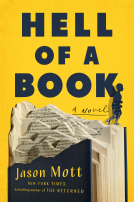
Hell of a Book, by Jason Mott*****

It really is.

This book is a standout in more ways than one. First the obvious: look at that cover! Then again, how many novels have a nameless protagonist all the way through the book? Get into it deeper, and the distinctions become more complex. The buzz around it is wholly justified. My thanks go to Net Galley and Random House for the review copy. This book is for sale now.

Our author is on an odyssey that takes the form of a book tour, and it lands him, in the end, back where he grew up. He doesn’t tour alone; apart from the various organizers he meets in various locations, he is accompanied by a small Black child he refers to as “The Kid.” Alternately, we also see the story of a young Black boy, a very Black boy, nicknamed “Soot,” who grows up in the American South.

As I read, I am always on the back foot, understanding most of what it being said, yet developing questions as I go. Our author says (often) that he has a condition, and that this is probably why he can see The Kid when others cannot. My notes ask whether his condition is dissociative, and is The Kid just part of himself? Or is The Kid Soot? Are Soot and The Kid both part of the author? Every time I come up with a plausible theory, something else happens to undercut it. Yet one other thing becomes clearer all the way through: to be born an African-American boy in the United States is to be perpetually on the back foot; perpetually having to guess how best to proceed; to perpetually guess at one’s welcome or lack of same, at the quality of one’s relationships with Caucasians, to perpetually guard one’s own safety. And to be very Black—“Nigga, I bet when you get out of the car your daddy’s oil light come on”—is to invite not only the suspicion and hostility of Caucasians, but to draw the enmity of lighter Black people, too.

The synopsis of this story that initially drew me billed it as humor, and in places, it is not only funny, but laugh-out-loud funny. But the further we get in, the darker it becomes.

There are a number of sardonic references to the publishing world; editors, agents, and other promoters have told the author that while it’s fine to write about Black characters, He must not write about being Black:

“The last thing people really want to hear about is being Black. Being Black’s a curse—no offense—and nobody wants to feel cursed when they read something they just finished paying $24.95 for…The future of this country is all about patriotic, unity-inducing language. Post-Racial. Trans-Jim Crow. Epi-Traumatic. Alt-Reparational. Omni-Restitutional. Jingoistic Body-Positive. Sociocultural-Transcendental. Indigenous-Ripostic. Treat of Fort Laramie-Perpendicular. Meta-Exculpatory. Pan-Political. Uber-Intermutual. MOK-Adjacent. Demi-Arcadian Bucolic. Write about love. Love and Disney endings…”

Later, an interviewer asks if the past doesn’t still matter, and the author says, “It does. Not just three-fifths of it, but all of it.”

So, my friend, you can see why this book should be called a love story. Race? Oh, no no no. Fear? Injustice? Police brutality? Of course not. After all, this is a hell of a book!

Highly recommended; one of the year’s finest.

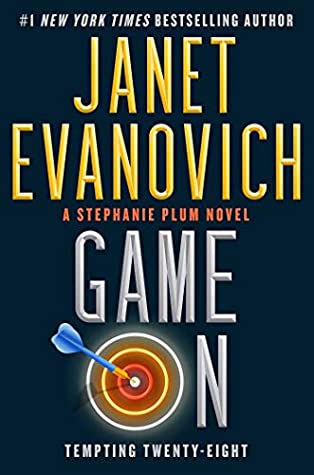
Game On! by Janet Evanovich****-*****

Stephanie Plum has been my constant companion for decades, but she never seems to get any older. We should all be so lucky!

My thanks go to Net Galley and Atria Books for the invitation to read and review. This book is for sale now.

Stephanie is a bounty hunter, working for her cousin Vinnie’s bail bond service. She tracks down no-shows, takes them to have their hearings rescheduled, and collects a commission. Her mother wishes fervently that she would get a normal job such as a bank teller, or just go ahead and marry long-time boyfriend Officer Joe Morelli, and keep house and raise kiddies. But Stephanie is long on independence, and she’s short on marketable skills, and so this is what she does. And we readers are well aware that she wouldn’t be half this hilarious as a housewife, so we cheer her on.

In an interview, author Evanovich said she had lit on the idea of a bounty hunter protagonist because the writer doesn’t need a background in legal matters the way that she would if she used a cop, detective, or lawyer. The primary skill required of a bail bonds enforcer is lying, and she felt she had a good grasp of that one.

You gotta love it.

There have been a few wobbles in the series, and a moment (long ago) when I thought perhaps it was played out. But like her intrepid protagonist, the author rallied and came back stronger than ever.

Can you read this book if you haven’t read any of the others in the series? Yes. Yes, you surely can; but you are most likely going to want to go back for the rest once you do so.

There are a few things that strike me as I read this one. I suddenly find myself wondering why Stephanie doesn’t seem to have women friends. She’s lived in Trenton—in the Burg—her entire life, so shouldn’t she have a few lifelong pals? But by the end of the story, I realized that her work buds are her go-to girls. Lula gets into a scrape and leaves what little she has to Stephanie (but of course, Lula pulls through. I don’t feel like this is a spoiler; since when would a riotously funny writer like Evanovich off a main character?) Connie is a distant relative, but she’s also a friend.

I also find myself, like other reviewers, wondering about the sanitized language and decreasing vocabulary levels. We’ve been drifting in this direction for awhile. At the start of the series, profanity was used by the people and in the situations where you’d expect to find it. The overall language level was accessible to anybody that finished eighth grade. Over the last several episodes, however, it’s been drifting downward. Now, apart from one “damn”, I found nothing, although the euphemisms are stellar (“What the fork,” “What the Hellman’s Mayonnaise,” “Son of a bagel.”)  And the overall vocabulary level is now down to about fifth grade. If it goes any lower (see the author’s other series,) I may not be interested anymore, but as it stands, it’s fast, it’s snappy, and I’m in.

The usual elements—escorting Grandma Mazur to viewings at the mortuary; exploding cars; men surprising Stephanie when they let themselves into her locked apartment; dinner with Stephanie’s parents; a geeky witness, or victim, or possibly even an offender, that Stephanie takes under her wing; and the red-hot Joe Morelli are all present and accounted for. Stephanie’s mother has been drinking heavily every time Stephanie gets into a dangerous scrape, and Evanovich has been toying with some character development in her direction. I hope she follows through.

The tension of Stephanie trying to decide between Morelli and the mysterious Ranger is over, for now, at least, and it was getting old, so I applaud this development. She knows that Ranger will never marry her, and there’s a lot he’ll never tell her. She knows Morelli. They grew up together, and they understand one another. Marriage, maybe not yet; but Joe is the one. She’s tempted by others in this installment, but for once, she behaves herself. Good.

Whereas this series isn’t the magnificent literary accomplishment attained by some mystery Grand Masters, and it doesn’t try to be, I rate it as five stars in the humor genre. It made me laugh out loud on page two, and though I read quite a lot of books each year, those that have made me howl this year can be counted on one hand. It’s a more valuable characteristic than some might guess, especially during these tense times.

Highly recommended to those that need a good laugh.

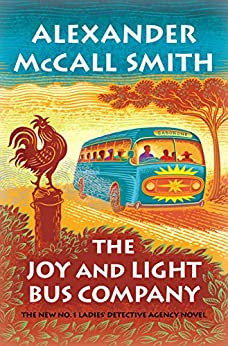
The Joy and Light Bus Company, by Alexander McCall Smith*****

“Connections with others were what made life bearable…We all need reassurance, she thought. We all need people to tell us that everything is going to be all right, even when it is not, and that we should not worry, even when we clearly need to be concerned about something. We are only human, after all, and that is why reassurance is so important to us. That is undoubtedly well known.”

I am not generally fond of cozy mysteries, yet I love this series hard. I told a friend—who works as a therapist—that the #1 Ladies Detective books are the cheapest therapy on the planet, and she agreed.

My great thanks go to Edelweiss and Penguin Random House for the review copy. This charming tale will be for sale November 16, 2021.

As is usual, we have two equally important story lines woven into a single narrative. The detective story has to do with a client—a most unpleasant fellow, but a client, nonetheless—that has come to the agency looking for help with his father’s will. His father is still alive, but not entirely himself anymore, and is planning to leave his valuable home to his nurse. Mma Ramotswe and Mma Makutsi are enlisted to dig up information about this woman, and to see if anything can be done to reverse his father’s decision. The second storyline concerns Mma Ramotswe’s husband, Mr. J.L.B. Matekoni, who has decided to invest in a dubious-sounding scheme to turn secondhand buses into a bus service. Mma Ramotswe is horrified, because in order to invest the necessary sum, it will be necessary to take out a bank loan, using the building that houses the businesses—Matekoni’s auto repair, and Ramotswe’s detective agency—as collateral. There’s also a smaller thread involving human trafficking of small children locally, and as usual, it is dealt with tidily and in a most entertaining fashion.

The book begins with Mma Ramotswe wondering what makes men happy. This is a tricky way to start a book, given the current social climate especially. Many readers, women in particular, are sensitive to having a male author write about a female character’s fervent longing to make her husband happy. The internal monologue could use some tightening up here, and that’s unusual for this writer. However, this passage is near the beginning, and once it’s done, the rest of the book more than makes up for it.

What is the alchemy that makes this series so successful? Certainly at the start, there was the novelty. It’s unusual for an English-language series to be set in Botswana, or at least, it was when this one began. But it takes a lot more than that to sustain a series over so many years.

For me, the gentle humor goes a long way. I also appreciate the depth of respect for working people that shines out of every book in this series. Mma Potokwane, who runs the orphan farm and is Mma Ramotswe’s closest friend, reflects on the squabble over the old man’s will. “Rich people are always forgetting that they are only rich because of the work of others. They do not dig their money out of the ground, you know, Mma.”

Also? There are a lot of us out here that are also “traditionally sized,” and we love seeing lovable, successful characters that look, to some extent, like ourselves.

There’s the notion that people are inherently good—try finding that in your average noir detective story—and also, the idea that ordinary people can and should intervene to the best of their ability when they see wrongdoing. “Sometimes those people simply did not see what others could see; sometimes their hands were tied; sometimes they felt threatened. And all of that meant that there were times when it was left to people like them, a private detective and the matron of an orphan farm, to do what had to be done.”

This story, however, is singular in that both Mma Ramotswe and Mma Makutsi manage their husbands through deception. Grace Makutsi reveals that she gets her husband, Phuti, to take his vitamins by stirring them into his breakfast tea without telling him. Precious Ramotswe, when unable to persuade Matekoni not to apply for the bank loan, sneaks around behind his back, looking for a way to kill the deal without his knowing it. Neither of these things leads to marital disaster, yet I find myself wondering whether these things may come back on them in a future installment.

The fact that I find myself feeling concerned about the marriages of two women that are fictional, fictional, fictional says a great deal about Smith’s capacity to develop characters with depth and breadth.

I can talk about this series, and these characters, and this book all day. I’ve already come close to it. But the best way for you to appreciate it is to get this book. It comes out in a week, so I suggest you order a copy now. Highly recommended.

The Family, by Naomi Krupitsky****-*****

4.5 stars, rounded upward.

The cover grabbed me first, two women in vintage sweaters—no faces even—and the title written in Godfather font. Oh, heck yes. I need to read this thing. The author is a newbie about whom I know nothing, so I know it may be a recipe for disappointment. I’ve taken review copies this way in the past, and have regretted it, because of course, the cover doesn’t speak to the author’s ability. But old school mobster books are fun, and they’re thin on the ground these days, so I hold my breath as I take a chance…and hit the jackpot!

This is one of the year’s best works of historical fiction, and you should get it and read it. My thanks go to Net Galley and Putnam for the review copy. This book is for sale now.

Antonia and Sofia grow up together; their fathers are both mobsters, and their houses share a wall. Not only are they thrown together for Family events from early childhood forward, but their peers ostracize them in elementary school, their family’s reputations having preceded them, so for several years, they are each other’s only option. But it’s enough.

Our story starts in 1928, and it ends in 1948. We follow the girls through childhood, adolescence, and into their early adult years. At the outset, their fathers are best friends, until Carlos, Antonia’s daddy, starts skimming, covertly building a nest egg in the hope of making a new start far away with his little family, doing an honest job, and leaving the Family behind.  His theft is, of course, detected, and he disappears; Joey, Sofia’s father, is promoted, and told to take care of Carlos’s widow and daughter. Thus, we have a clear, concrete reminder, right up front, that this is an ugly, violent business. The author’s note says she wants to demonstrate the strange way that violence and love can coexist, and she does that and more.

Those readers seeking a mob story full of chasing and shooting and scheming will do well to look elsewhere. We do find these things, of course, primarily in the second half, but the story’s focus is entirely on Sofia and Antonia. Whereas setting is important—and done nicely—the narrative’s fortune rises or sinks on character development, and Krupitsky does it right. These women become so real to me that toward the end, when some ominous foreshadowing suggests that devastating events are around the corner, I put the book down, stop reading it or anything else for half a day, and brood. I complain to my spouse. I complain to my daughter. And then, knowing that it’s publication day and I have an obligation, I return to face the music and finish the book. (And no. I’m not telling.)

My only concern, in the end, is a smallish smattering of revisionism that occurs during the last twenty percent of the novel. Knowing what gender roles and expectations are like in that time and place, I have to say that, while I can see one intrepid, independent female character stepping out of the mold, having multiple women do it to the degree I see it here is a reach.

Nevertheless, this is a badass book by a badass new talent, and Naomi Krupitsky proves that she is a force to be reckoned with. Get this book! Read it now.

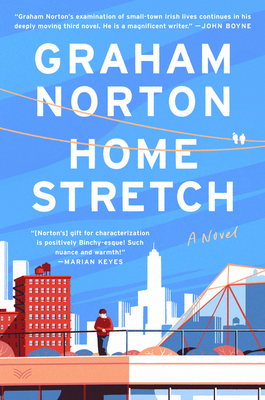
Home Stretch, by Graham Norton***-****

3.5 stars, rounded down.

Home Stretch is Graham Norton’s third novel, and because I absolutely loved his first, Holding, and his second, A Keeper, I expected great things from this one. It’s not a bad book, but it didn’t delight me the way the first two did.

My thanks go to Net Galley and HarperVia for the review copy. This book is for sale now.

We start with a tragic accident, and our protagonist, Connor, is unhurt, but three of his friends are killed, and Connor is blamed by everyone, including his family. It’s a small town, so trying to keep his head up and avoid people that dislike him is impossible.

His family feels the same, and so he is abruptly packed off to Liverpool, and from there to bigger and in many ways, better places. And in many ways this is a favorable development, as he is no longer forced to hide his sexuality; and yet, it’s a tough thing to live a life that’s separate from your family, one that you know would horrify them.

The story is set in the 1980s, the era of the AIDS epidemic. This reviewer lost friends to it during that time; a lot of people did. Norton does a serviceable job with setting, and with character too; and yet, this book lacks the spark of his earlier two novels. The pacing is not as brisk, and the surprising bursts of humor that made me laugh out loud never materialized here. At times it felt like work to read it, and I wonder if he found as much joy in writing it.

I still believe in Norton as a novelist; everybody has a “meh” moment now and then. I look forward to seeing what he writes next.

Unfinished Business, by J.A. Jance*****

Judith Jance has done it again. Unfinished Business is the sixteenth in the Ali Reynolds series; not only does she weave a compelling, tightly plotted tale, but she may have broken new ground with the role technology plays in solving crimes within the storyline. Add a sprinkling of social justice issues, and what emerges is an unmissable novel. My thanks go to Net Galley and Gallery Books for the review copy. This book is for sale now.

Ali is a former journalist, but now she and her husband, B. Simpson, own and run a cyber security firm called High Noon. B. is a nice enough fellow, but we see very little of him. Most of the time he is away on business, leaving Ali to flex her badass crime solving muscles, and providing her with a healthy chunk of disposable income that makes it easier. Other continuing characters are Cammie and Stuart; Frigg, the AI entity operating out of High Noon; and Bob and Edie Larson, Ali’s parents. Our two new characters are Harvey “Broomy” McCluskey, who is a serial murderer, and Mateo Vega, a second-chancer newly out of prison and in High Noon’s employ.

The best long-running mystery series are ones that go deep into the character of the chief protagonist and sometimes others, as well. When you think about it, there are only so many interesting crimes; only so many credible motives; and only so many believable plots an author can spin that involve only the mystery at hand. What makes the most successful ones stand out is the investment the reader has in the character and her life. Jance works her characters like a champ. Within this one, we have multiple interesting side threads. Ali’s parents are aging, and although she is more than willing to support them and advocate for them, they don’t tell her everything. They are independent and intelligent. They treasure their dignity, and their privacy. Sometimes this combination spells trouble, and so it is here. We see Ali trying to juggle the ever-changing aspects of the business while B is out of town, along with health issues facing her father, who won’t talk about them; one of her children gives birth; and then there are issues with her employees.

Point of view shifts between chapters, and so we first meet Harvey, who is a resentful, entitled jerk who has murdered his mother and gotten away with it. Unfortunately, Harvey is also a tenant of High Noon’s, and he’s in arrears on his office rent. No one at High Noon knows that he is dangerous; they figure he’s a deadbeat, and he has to go. Ohhh, honey, look out!

We also meet Mateo. Mateo has spent 16 years in prison for a murder he didn’t commit. His public defender told him the plea deal was the safe bet, and so he took it. He could have been released early if he’d expressed remorse, but nobody and nothing could make him say he did it when he didn’t, so he rotted there for his entire youth. But while inside, he continued to study technology, and earned an online degree. Now he’s released, comes out with skills, and is hired by High Noon.

I love the way Jance uses all of these characters, and the thread involving Cami is particularly interesting.

I read and reviewed most of the recent books in this series, and in number 13, I called this author out for making all of the bad guys in the story Latina or Latino, and all the good guys Caucasian, except for Cami, who is Asian. It’s great to see how she’s turned it around. The social messages here—the broken prison system; issues with keeping the aged safe; the difficulty former prisoners face in starting a new life; and of course, violence against women—are all progressive ones, and none of them hijacks the plot or slows it in any way. In fact, this novel is among Jance’s best, and that’s a high bar to meet.

Highly recommended.

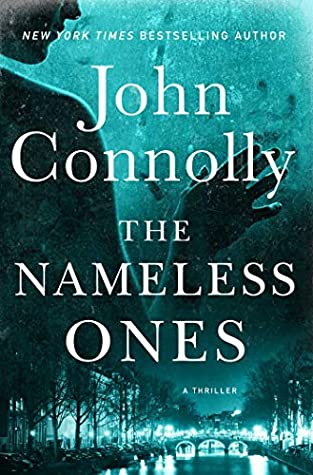
The Nameless Ones, by John Connolly*****

Connolly has written the creepiest, spookiest, best written novel you will see this October. The Nameless Ones is #19 in the Charlie Parker series; my thanks go to Atria Books and Net Galley for the review copy. This book goes up for sale October 26, 2021.

The series continues a conflict that began earlier in the series; that said, you can jump in here anyway. However, once you read this one, you’ll want to go back and pick up the others, or at least, say, the last five or six leading up to it. That’s all to the good, since Connolly can’t write as fast as you can read. Perhaps if you collect them you will be entertained until his next one comes out.

Unlike any of his other Charlie Parker stories, Parker plays a relatively peripheral role, with his two massively popular assistants, Angel and Louis, up front, with Louis having the lion’s share of the action. These two, who have served as Parker’s investigators and at times, as his body guards, are interesting characters. They do not love the law, but they do love each other. Angel is recovering from cancer treatment and Louis is in search of vengeance. Someone they had hired as a liaison in Serbia has been murdered, and the man’s last act, when he saw the walls closing in, was to wire a substantial sum into Louis’s account. Louis, in turn, intends to use that money to terminate the men that terminated his colleague. Stranger still, he is supported—in a massively unofficial manner—by the FBI. He doesn’t like it much, but there they are.

There’s a new character named Zorya, who is dead, but hasn’t crossed over. “She was a creature of the cold and dark. Zorya had winter blood.” She is physically small, and in a hoodie she is generally accepted by bystanders as an adolescent. She has attached herself to one of the men Louis is hunting, and has clairvoyant gifts. But what’s particularly interesting is her relationship to Jennifer Parker, the murdered seven-year-old daughter of Charlie. Jennifer has appeared to her father on a number of occasions, sometimes providing him with critical information. Now Connolly has decided to develop Jennifer, who has obtained a fair amount of power and authority on the other side of the veil. When Zorya targets Charlie, Jennifer targets Zorya. This is one of the coolest gambits I have seen in years, and I can’t wait to see what happens in the next book. But let’s get back to this one, since that’s what I’m supposed to be doing here.

New readers should prepare for a good deal of violence, and the most graphic and horrific shows up right at the beginning, so if you read it and aren’t sure you can stay the course through the end of the book, take heart. Lots more people are going to drop dead, but the most nightmarish details are up front. Nevertheless, it’s not something I read directly before sleeping.

The intensity and horror are nicely broken up with humor; the dialogue featuring Louis, Angel, or both positively crackles. I laughed out loud more than once. A pair of secondary bodyguards, the Fulci Brothers, whom Angel and Louis have deputized to watch out for Charlie at one point, are also welcome additions, and in no way resemble the pair that hired them. Sure enough, they save Parker’s butt. When the police arrive and Parker tells them only the bare minimum, the detective in charge reminds him that his would-be assassins may try again. “The Fulcis won’t always be ready to come to the rescue with a tire iron and a bear head.” (!!!)

As always, Connolly deftly employs a huge number of characters, and yet I am able to keep all of them straight. He keeps the time sequence linear, and this helps the story flow and keeps the players and events from becoming entangled.

If you’ve followed this review to this point, you have all the stamina you need to enjoy this exceptional novel. True, the book is longer than my review, but Connolly writes a lot better, too.

Highly recommended!

God Spare the Girls, by Kelsey McKinney*****

Journalist Kelsey McKinney makes her debut as a novelist with God Save the Girls, and I have a hunch we’ll be seeing a lot more of her work. Lucky me, I read it free and early; thanks go to Net Galley and William Morrow for the review copy. This book is for sale now.

Caroline and Abigail are the daughters of the charismatic head pastor at a megachurch in Hope, Texas. This opening paragraph had me at hello:

“For that whole brutal year, Caroline Nolan had begged God to make her life interesting. He sent a plague instead: grasshoppers emerged from the earth in late June, crawling across the dry grass, multiplying too quickly, staying long past their welcome. Now they carpeted the land she’d inherited with her sister, vibrated in the sun like a mirage. As Caroline drove the ranch’s half-mile driveway, she rolled over hundreds of them. She threw the car in park, stepped out into the yellowed grass beside the gravel drive, and crushed their leggy, squirming bodies beneath her sensible heels.”

Teenagers are people that are exploring their own identities, and there’s often some rebellion mixed into those years, but for Caroline and Abigail, there’s not a speck of wiggle room. They are constantly reminded that everything they do reflects upon their father. Forget profanity, street drugs, shoplifting, booze. These girls have even the most minute aspect of their appearances proscribed. Is that V-neck deep enough to show even a smidge of cleavage? Cover it up, or go change. How much leg? Why aren’t you wearing makeup? Not just your smile, but what kind of smile? How you sit. How you stand. And if these confines were not enough to drive any teen bonkers, they live in a fishbowl that every adult seems to own a key to. People come in and out of the family home all day and all evening, so showing up to watch television in your robe and fuzzy slippers in the family room is a risky prospect, too.

I’ll tell you right now, I couldn’t have. I really couldn’t.

But these are girls raised to believe that the Almighty is always watching, and always knows your heart, and so they do their best to shed petty resentments, whereas others must be buried deep. Buried, that is, until a shocking revelation is made about their father’s extracurricular activities.

The story is primarily told through Caroline’s point of view; Abby is the most important secondary character, and she’s interesting, but we see her through Caroline’s lens. I admire the way that McKinney develops both of them, but more than anything, I admire her restraint. In recent years, fundamentalist and evangelical Christian preachers have gone from being rather shocking, daring novelists’ subjects to low-hanging fruit. As I read, I waited for the rest of it. Which girl was Daddy molesting? What else has he done? Has he embezzled? Does he have a male lover on the side somewhere–or Lordy, a boy? But McKinney doesn’t go to any of those places. She keeps the story streamlined, and in doing so not only stands out from the crowd, but is able to go deeper into Caroline’s character.

At the end, when Abigail prepares to marry the dull, dependable boy her parents like, the scene is downright menacing; their mother, Ruthie, is helping her into her dress, and she “wielded a hook like a sword,” and as everyone takes their positions, the walkie-talkies “hiss.”

There’s a good deal more I could tell you, but none of it would be as satisfying for you as reading this book yourself. Your decision boils down to text versus audio, and I advocate for the audio, because Catherine Taber is a badass reader, lending a certain breathless quality to key parts of the narrative. But if you’re visually oriented, you can’t go wrong with the printed word here, either.

Highly recommended.

Pianos and Flowers, by Alexander McCall Smith**

Well, heck. I have so loved this author’s most famous #1 Ladies Detective series, and more recently have loved his new, satirical series starring Mr. Varg. When I saw this stand-alone collection of short stories—a genre I enjoy—I leapt at the chance to read and review it. My thanks go to Net Galley and Doubleday, but this one fell flat for me.

The collection is scaffolded by vintage photographs from The Sunday Times. Smith provides one of these photos at the start of every story, and then writes something (fictional) about the people and events displayed. I am initially deflated by these, thinking it might be a good fit for some readers, but for me more of a cure for insomnia, because Zzzzzz, when I find the italicized portion, which is intended to be a you-are-there insert. Why, why, why does every Caucasian reader under the sun think that the best way to add some World War II spice to a story, is to interject some of the racist slurs used widely at that time against Japanese people? True, it was a much more mainstream practice back then for white people to use nasty, racist terms to describe anybody and everybody that wasn’t Caucasian; you weren’t entirely safe if you were from Eastern or Southern Europe, so predominant was this tendency. Yet every author understands that if your book is to see wide circulation, you’d better not go tossing anti-Black references in as casual conversational terms. But ah—the Japanese! Now, that’s different. The Japanese don’t fight back all that much, so probably it means they don’t care. (Pause while I retch for a moment or two.)

This cheap-and-easy bit of vile, racist pop culture took this collection down from three stars to two. However, I can assure the reader that had it initially been a four or five star read, it would nevertheless have dropped to an unfriendly rating when I ran across such ugly language.

I am so done with that.

This thing is for sale if you really want it.