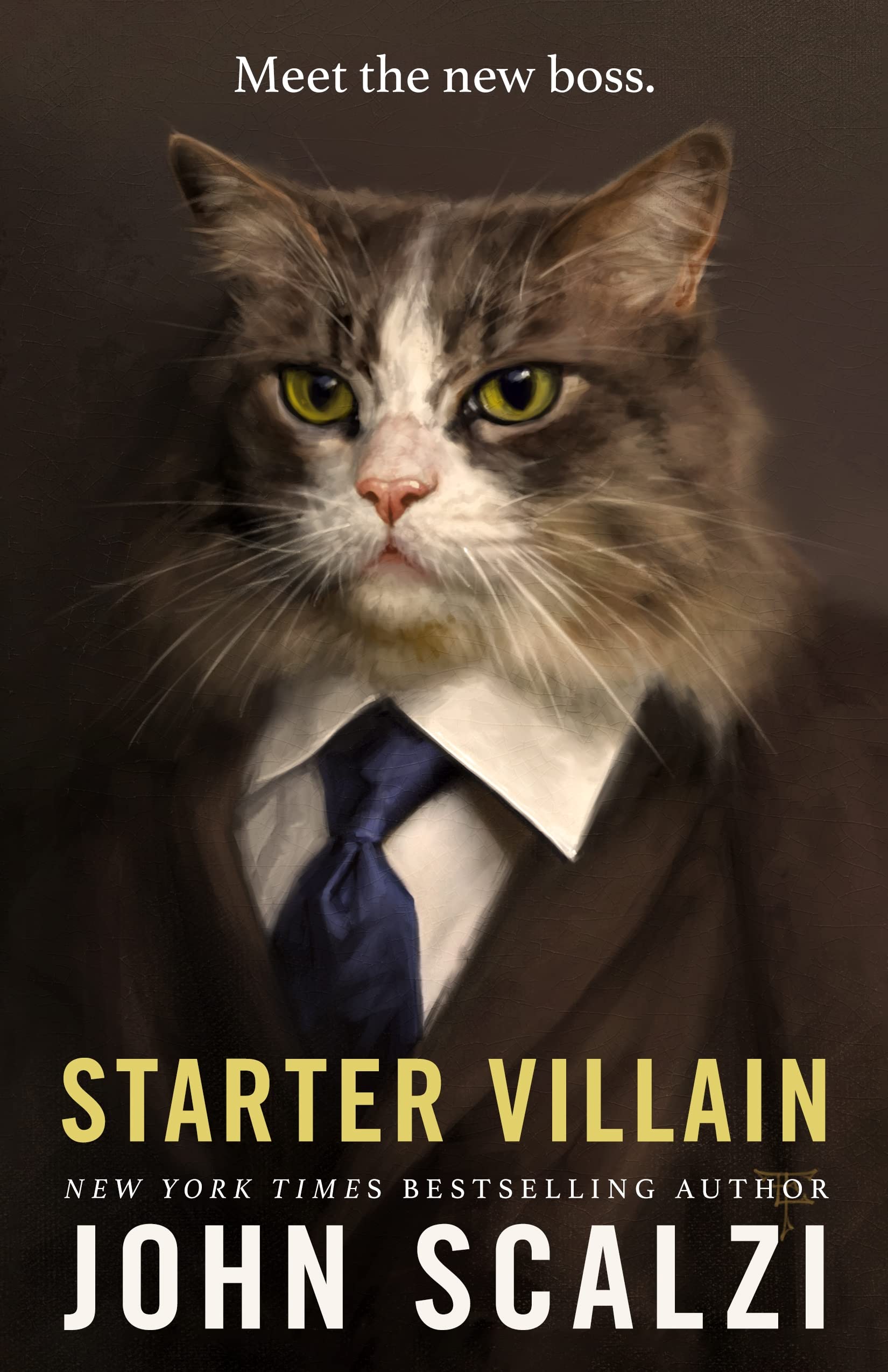
Starter Villain, by John Scalzi****

I’m not going to write a full review for this one; my spouse got it for me for Christmas, so I don’t owe anyone anything. I will tell you, though, that it’s just what I needed, funny, warm, and of course, not even close to realistic. After all, it’s fantasy. The level of unreality is well crafted and consistent within the narrative, and it’s hugely inventive. This is my first John Scalzi novel, and I will read him again in a heartbeat.

After Annie, by Anna Quindlen*****

After Annie tells the story of a family that is changed by the sudden death of the mother, a woman still in her thirties. My thanks go to NetGalley and Random House for the invitation to read and review. This book will be available to the public Tuesday, February 27, 2024.

I’ve read a number of books by this author, and I have come to notice a pattern. I read the synopsis, like the sentence I used to begin this review. I see what it’s about and shrug. Doesn’t sound like it would be all that special, but hey, it’s Quindlen, and I have liked her work before, so let’s give it a shot. After all, in past novels, the topics also didn’t seem engaging at the outset. One novel is about a family being forced to relocate due to eminent domain; another has to do with parking spaces in New York City. There’s a memoir about grandparenting, and another about—I kid you not—her dog. Nothing here seems all that appealing.

Yet in some ways, it is the very ordinariness of her subjects that draws us in. So many of us have had to move when we didn’t want to, and so we fought it; or we became so angry with a neighbor’s thoughtlessness that we fantasized about terrible revenge; or we dealt with a death that came out of the blue, striking down someone that was perfectly healthy, or that seemed to be. If we haven’t done any of these things, chances are excellent that someone else we care about has. By tapping into every day experiences and crises of various sizes, Quindlen finds commonalities.

But perhaps the most important feature of her books, particularly her novels, is the way that she crafts characters that are so visceral we would know them if we saw them on the street. Young Ali, the daughter who’s just beginning middle school, yet suddenly finds herself burdened by all of the things her mother did for the family, from child care to meals to housework, is so real to me that I nearly climb inside of her skin, and when Annie’s best buddy tries to tell Bill, Annie’s husband, Ali’s dad, that this isn’t okay and he blows her off, I want to cry out. We can see that he’s behaving selfishly, whether he knows it or not, because he is so poleaxed with grief. It’s hard to prepare a meal when you can’t stop crying. Hell, Bill can hardly go into the kitchen, because that’s where she died.

Grief was like spring, maybe. You thought you were getting out from under it, and then it came roaring back. And getting out from under it felt like forgetting, and forgetting felt like treason.

I began reading this story because I like the author, but it also serves as a grief book. I found this out when my sister died about halfway through. Unlike Annie, my sister was not in the prime of her life, nor was her death unexpected. She’d been horribly ill and in great pain for years on end. Her death was a relief, ending her pain, and ending the anguish of others that had been constantly seeing her that way, helpless to improve her life in any way. So I am not poleaxed like poor Bill. She didn’t leave behind a houseful of small children and a middle schooler trying to pick up all of the pieces. She didn’t have a six year old who would explain to everyone that his mommy wouldn’t be dead anymore once she came home from the hospital. But what I am saying is that I find this book more soothing than I would have guessed. If you or someone near to you is dealing with loss, After Annie may help you too.

Highly recommended.

The Land of Lost Things, by John Connolly*****

“We must be careful of our fancies and wary of our dreams, lest the worst of them should be heard or witnessed, and something should choose to act upon them.”

Are you up for a partly sweet, partly sinister bedtime story? If so, John Connolly is your man, and this is your book. My thanks go to Net Galley and Atria Books for the review copy. This book was published in September, 2023, and I am disgracefully late, but this is largely due to my realization that I could not read the second in a two book set and review it effectively without first ferreting out the first book, The Book of Lost Things. Now that I’ve read them both, I can recommend both to you unreservedly. At the same time, I will caution you that—what with the titles of this and its predecessor—this is emphatically not a children’s book! When I saw the title, I wondered if, like so many authors of late, Connolly had decided he should write a book for tiny tots. This is not that! Don’t hand this book to your child, or anyone else’s, unless they are already both old and mature enough to enjoy the works of Stephen King—or for that matter, other books by Mr. Connolly.

In the first book, a boy named David, who is mourning the death of his beloved mother and increasingly alienated from his father, stepmother, and tiny baby (half) brother, begins to notice strange things about the books in his bedroom, which came with the house. Events lead him to a place near his house, where he is sucked into an alternate world in an alternate wood, and it is there that nearly all of the narrative takes place.

Now, in this story, we have one of David’s descendants, a young mother named Ceres, whose little daughter, Phoebe, lies comatose in a hospital. Because of the place’s location, she decides to stay in a family home that is not being used currently, what with being rundown, but which is convenient to the place where Phoebe is. And yes of course, it’s that house, and those woods are still there.

Nearly twenty years separate the publication of the first book and the second, and I can see the difference immediately. Whereas The Book of Lost Things is well written and quite memorable, The Land of Lost Things is even better. The pages turn themselves, and the words pop off the pages. The fairy tales that Connolly implants into the first half of the book are cleverly altered, and I laugh out loud more than once as I read them. And then, as things darken and become tenser, the dangers more palpable, it’s hard for me to look away. I learned years ago not to read Connolly’s work too close to bedtime, and that habit stands me in good stead here.

Part of the charm inherent in everything Connolly writes is his impatience with pretentious attitudes and behaviors, and his deep respect for women. Add to this his tight, resonant dialogue and his dark, crackling wit, and the result is a large, loyal fan base, of which I am obviously one.

For those that love satire and are drawn to things that go bump in the dark, this magical book—and its predecessor—are highly recommended.

The Women, by Kristin Hannah****

Kristin Hannah can draw character like nobody else. Her latest novel, The Women, tells the story of Frances “Frankie” McGrath, a young woman from an upper middle class family that follows her brother to Vietnam, serving as an army nurse. Frankie is a character that will stay with me long after I read dozens of other novels, and this experience is made even more memorable by the talented Julia Whelan, the voice actor that narrates the audio version. My thanks go to NetGalley, St. Martin’s Press, and Macmillan Audio for the review copies. It will be available to the public February 6, 2024.

Frankie is twenty years old when we meet her, and her family is throwing a party for her big brother and best friend, Finley, who is leaving to serve in the U.S. Navy. Kennedy is in the White House, and most Americans still bear an implicit trust in their government. But Frankie is worried about Fin, and doesn’t like that he is about to put himself in harm’s way. He reassures her, “It isn’t dangerous, Frankie. Trust me. I’m a Naval Academy graduate, an officer with a cushy assignment on a ship. I’ll be back in no time. You’ll hardly have time to miss me.”

Frankie completes her nurse’s training, then signs on to join her brother, but before she is even packed, the telegram arrives. Finley is dead; killed in action.

The plot itself is unremarkable. Yes, war is hell; yes, friends die. And yes, a married man that sees an attractive, vulnerable American woman in a place where they are scarce, will lie like a rug in order to get close to her. But in Hannah’s hands, every joy and every sorrow are real and visceral, because we believe.

Frankie serves as a combat nurse at the front, and works in every possible hard situation. Sometimes the lights go out during surgery because a bomb has fallen; at one point her sleeping quarters is bombed and has to be rebuilt. She works for days on end without sleep when it’s necessary. And the trauma follows her home.

My only quibble with this otherwise outstanding story is the emphasis Hannah places on the abuse of returning troops by the public. She brings in the old saw about them being spat upon and called baby killers, even though an easy search confirms what I remember: this is mostly myth. Just as women weren’t really burning bras, most troops were not greeted with abuse. It’s true that the wildly patriotic parades that greeted the troops that returned from World War Two are not there for these men and women, but then, the Korean War vets didn’t see them, either. Historical fiction should honor history, not rewrite it.

With this caveat, I recommend this book to you. Do read it; it’s a damn fine novel. But do so critically, because you can’t always believe everything you read.

System Collapse, by Martha Wells*****

System Collapse is the seventh book in Martha Wells’s acclaimed Murderbot Diaries series, and it’s a humdinger. Fans have been waiting for this one, and they will not be disappointed. My thanks go to NetGalley and Tor Publishing for the review copy. This book is for sale now.

If you are one such fan, I’ve already told you what you need to know; for the uninitiated, I’ll continue. I am a reluctant science fiction reader. I generally avoid anything that involves complex world building or a new vocabulary extensive enough to require a glossary. I absolutely don’t read science fiction series anymore, because I am not that dedicated. As we age, our brains become less flexible, and so whereas I loved reading a handful of excellent but rather intricate series when I was thirty, I’m just not up for it in my retirement years. I include this information because I know that a good number of my readers are also at or near retirement age, and may be similarly reluctant. So, first: you can do this, and it will be painless.

I was finally persuaded to try this series—not for review, merely as an audiobook from the library, which is about as low risk as it gets—when readers from a number of unrelated places in my life all recommended it. I saw good things from a couple of my Goodreads friends online. How nice, I thought, but I’ll pass. Next came my children, my eldest and my youngest, both grown, of course. Their rabid enthusiasm cracked my resolve a tiny bit, but I thought, maybe later. The final straw came when a couple of lifelong friends came to visit from out of state last spring. They were embarking on a road trip around the Pacific Northwestern USA, concluding their stay here in Seattle, and they, too, were wildly enthusiastic—and one of them doesn’t read for pleasure much at all! They listened to the audiobooks of the entire series up through the sixth, which is what was available at the time, and heartily recommended it.

Well, I thought. I could check the library. I could probably listen to the first one while watering the plants, and if I don’t like it, I’ll just send it on back. But of course, I didn’t send it back; I checked out the rest of the series, and friend, if you have to stand around for thirty or forty minutes daily with a hose in your hand, this is the way to do it.

The Murderbot is a being that is part machine, part human, and the term for this within the fictional world it inhabits is “sec unit,” because it has been invented for the security of the human beings inside the various spacecraft that are flying around out there, and also partly for the security of the ship also; but as we learn, the ship can sometimes take care of itself.

“Murderbot” is the specific name that our protagonist has chosen. And the main character is indeed about ninety percent of what’s important here. We don’t need a host of invented words. There are a bazillion other characters, and no effort is made to introduce them to us gradually, but it doesn’t matter. Just let it flow over you and at some point, the most important characters will click in.

This seventh installment in the series is the first time that I have read it with my eyes. I wasn’t sure how this would go, since voice actor Kevin R. Free is so adept at reading the series that I had begun to equate his voice with the character; I needn’t have worried. In fact, I find that I prefer reading it this way, because the internal monologue is immense, and it’s much easier to tell when the character’s ruminations have ended and the action resumes when I can see the (many, many) parentheses. Also, the humor here is often sly, and when listening to the story, I don’t get a pause that provides me with time to consider what’s been said; we’re off and running, and if I don’t want to miss anything, I have to forget all about that little witticism and move forward. Reading by sight allows some reflection.

The series is drop dead funny, and it is also timely, as AI makes more inroads toward humanity of its own, raising all sorts of ethical questions for the future.

For any fans of the series that are still reading, despite having been dismissed at the start of this review: my favorite character, apart from the protagonist, is Art, the ship that is also Murderbot’s beloved friend. Murderbot’s sarcasm is matchless, except when Art is around. matching snark for snark with Murderbot as it does here, and foreshadowing suggests that when #8 is written and available, the same will be true.

And I cannot wait for the next in the series. Highly recommended!

Unnatural Death, by Patricia Cornwell*****

Unnatural Death is the twenty-seventh installment in the Kay Scarpetta series by Patricia Cornwell, and it’s as good as they get. My thanks go to NetGalley and Grand Central Publishing for the review copy. You can get it now.

For those not conversant with the series, Scarpetta is a medical examiner for the state of Virginia. She’s moved around over the course of the series, decamped to Boston, and come back. So now she’s in her old stomping grounds, but all is not well. The obnoxious, obstructive secretary she was saddled with in the last book, a miserable woman that blamed her for the ouster of the corrupt man that came before, has been—finally—fired, but somehow, she is back in a different government position in the same building, along with the corrupt guy she likes working with, so it’s tense.

Our other permanent characters are Pete Marino, who’s worked with Kay forever and is now married to her sister, Dorothy, who’s a hot mess; Benton Wesley, Kay’s enigmatic husband, a forensic psychologist that works in extremely high level situations that he can’t tell Kay about, even when they have a bearing on her life; and Lucy, her adult niece whom she has raised as her own, and who is the daughter of Dorothy. Lucy is a wunderkind, a tech wizard employed by the FBI, sometimes on loan to the CIA.

I won’t go into the premise for this installment because you can get that in the promotional blurb, but I will tell you that by the ten percent mark I was riveted, and before the halfway point my notes say, “I hate being away from this thing.” A shocking development occurs that is much more impactful to those of us that have followed the series from the start. I have heard other reviewers say that they used to read the series, then lost the habit, so I will say this: if you have read most of the series but missed a book here or there, you can still get the full measure of this thriller. If you just missed the most recent one, that’s okay. But if you go into this book cold, your very first time reading a Scarpetta book, some of the magic will be missing. Perhaps you will read it and be impressed enough to go back and binge read the whole series. It’s not a bad idea!

Any author that writes a long running, successful series like this has to flesh out the main characters to keep readers’ attention. For the first few books, pure plot-based adrenaline rushes are possible, but at some point, there’s going to be a credibility issue continuing that way. I would have difficulty believing that a forensic coroner had been kidnapped by bad guys and hurled into the back of a vehicle, bound and gagged, even once, but when it happens over and over, I’m done and I’m done. Cornwell does the smart thing instead, developing crises that are sometimes more about others in Kay’s family, but that nevertheless spill over onto her in a big way. In doing this, she forces us to examine questions that have no easy answers. For example, if an extremely dangerous development comes up that could affect you or your family, but it is also a matter of national security, and one family member knows, should they break the vows of their office in order to let you or other family members know? Or should they keep it ambiguous, along the lines of, “Maybe you should stay home today?” What if two know, and you don’t?

One way or the other, this story is a wild ride. The tension is occasionally broken up by Marino’s fixation on Bigfoot. He’s obsessed, and it cracks me up when we’re worried about killer drones and enemies unseen, and then Marino pipes up about the big ole footprint he found in the woods. For quite awhile I have wondered why Cornwell hasn’t been made a Grand Master by the Mystery Writers of America. Hopefully, this outstanding novel will serve as a clarion call. Highly recommended.

The Mystery Guest, by Nita Prose****-*****

“The maid is always to blame.”

4.5 stars, rounded upward.

Author Nita Prose introduced Molly the Maid to us in 2022. Now Molly is back. She’s the head maid now, and considerably more confident than when we first met her. Her boyfriend Juan Manuel has moved in with her, but he is conveniently out of town for most of this novel, and it’s just as well, because there’s another murder about to occur at The Regency Grand Hotel, and once more, Molly will be instrumental in identifying the killer.

My thanks go to Net Galley and Random House Ballantine for the review copy. This book will be available to the public November 28, 2023, so you can plan your gift lists accordingly.

The hotel is in high gear, planning for the big gathering that will introduce the large, new, lovely tearoom. Business has been down at TRG since the murder last year, and this special occasion should bring new life into the hotel. In fact, Molly has given up her vacation with Juan so that she can see to the set-up; everything must be cleaned, shined, and buffed to perfection. You see, famous author J.D. Grimthorpe has an important announcement to make, and he’s chosen the tearoom as the venue from which to do so.

The stage is set, and the fans arrive. Molly’s protégé, Lily, has arranged the tea cart perfectly. Grimthorpe takes the podium, and is presented with his tea. After doctoring it to his own tastes, he takes a sip and ascends the stage once more, but before he can get to the surprise announcement, he keels over dead, right on top of Lily!

Lily is terrified. She’s always been a quiet one, but now she is virtually mute. When the police come in to question her, Lily is nearly undone.

“Molly, I’m afraid.” Her eyes are round pools of trepidation.

“I know,” I say. “But why?”

“Because a famous man is dead. Because they always blame the maid. You of all people should know that.”

“You’re not in any trouble, Lily.”

“Bit soon to tell,” the detective replies.

With that, we’re off and running. The book is one hell of a page turner, and it’s over before I know it. There’s lots of spunky dialog that jumps off the page. I seldom regret putting away my book because I spend so much time reading each day, but for this one, I stayed up late.

My only quibble—a small one—is that a key part of the solution is a bit of a reach. But this is a fun story, and so I make a quick note and move on.

For those that enjoy a sparkling mystery interspersed with wry humor, this book is for you. The profound respect for the working class is icing on the teacake.

Highly recommended.

The Golem of Brooklyn, by Adam Mansbach*****

Len Bronstein is an art teacher. He has a whole lot of clay he’s filched from his employer’s supply closet, and now he’s stoned. He should make something. He should make a Golem. And friend, that’s just what he does.

Traditionally, The Golem is made by a rabbi to help the Jewish people during difficult times. Len isn’t a rabbi, and he doesn’t expect much from his creation:

Five minutes passed, and nothing happened. Len reminded himself that he didn’t actually expect anything to…he didn’t believe in any of this shit. He stood, dusted himself off, and went inside to grab a beer…Len deposited his beer in the sink just as The Golem ripped his back door off the hinges and flung it aside.

My thanks go to Net Galley and Random House Ballantine for the invitation to read and review. This book is for sale now.

Now that The Golem has awakened, he needs to know what his target is. His answer comes to him as he views the news on Len’s television. White Supremacists are railing about a Jewish conspiracy; the Holocaust, they say, was a hoax. The Golem was asleep during the Holocaust, but once it’s explained to him, he’s ready to get busy. But first, he must talk to the rabbi.

Our second main character is a woman named Miriam, Miri to you and me. She works at the bodega down the street, and Len recruits her to be a translator; The Golem, you see, only speaks Yiddish, and Len doesn’t. Miri has been drummed out of the temple because she is a lesbian, but The Golem likes her just fine. Before you know it, Len, Miriam and The Golem are on a road trip beyond all others, first to find a way in to see the Sassov Grand Rebbe, a wealthy and powerful man with a great many gatekeepers, and then to a scheduled White Pride rally down south.

This is, as may be obvious by now, very edgy humor. There’s a great deal of profanity, and whereas most of it is hilarious, at the beginning, the author could have varied his choices more. There are lots of cuss words out there, and not all of them begin with F. But this is a small matter. This novel’s action is interspersed with brief passages of Jewish history that I find very interesting, and they are so brief, and so skillfully woven into the narrative, that you may not notice that you’re learning some things.

My favorite passages involve a bombastic politician, and multiple encounters with cops. (The Golem doesn’t care for them.) As for me, I have read several very funny novels this year, but none made me laugh out loud as often as this one. And in the end–well, you don’t expect me to tell you how this ends, now do you?

Highly recommended to readers that lean left and can tolerate profanity.

Mother-Daughter Murder Night, by Nina Simon****

Nina Simon’s debut novel, Mother-Daughter Murder Night, marks a fine beginning to an auspicious career. My thanks go to Net Galley and William Morrow for the review copy. This book is for sale now.

The story unfolds with three generations of women—Lana, Beth, and Jack—solving a murder mystery together. Lana, the grandmother, has just received dreadful news from her doctor, and she’s forced to rely upon Beth, her estranged daughter, for help to and from chemo appointments. Jack is her granddaughter, Beth’s daughter. Although all three are important characters, Lana is the protagonist.

Lana doesn’t deal well with helplessness.

No sooner has she moved into the little beach house in central California where the other two reside, than Jack, a teenager with a job as a kayak tour guide when not in school, finds a dead body while she is working. Suspicion initially falls on Jack, and so Beth and Lana dive in, first seeking to prove that Jack is innocent, and then, led by Lana, to find out who actually did it.

Amateur sleuth books come with an inherent challenge to the author, because obviously, civilians that have never worked in law enforcement are badly outmatched by actual cops. They don’t have the tools, the connections, or the experience to carry it off, and so such mystery novels sometimes end up looking ridiculous. Simon holds her own here nicely.  Another issue I see frequently is with characters that are children. Jack is a teen, and she’s a bright girl, but Simon doesn’t fall into the trap of creating an unbelievably smart teen in order to justify making her walk and talk exactly like an adult. Jack has the naivete and occasional bad judgement common to kids her age, and because of this, the story rings true.

There are a couple of things that I’d change if I could. First, the whole “fiercely independent” and “tiny firecracker” personas are badly overused and becoming a cliché. The second may be partially due to my own false assumptions. Between the cover and the title, I initially thought this would be a comic caper, with the women planning to mete out some vigilante justice with hilarious missteps and hijinks along the way. Although the book has its moments, it’s not as funny as I anticipated.

Nonetheless, this is a fun read, easily followed, and with more character development than one usually sees in a novel of this nature. The chemo occasionally seems a little too easy on Lana, but it’s not beyond the pale; after all, different people tolerate these things at different levels. There’s never a moment where I slam down the book due to disbelief. I appreciate the working class realism in Beth and Jack’s lives.  

I recommend Mother-Daughter Murder Night  to those that enjoy the genre, and I look forward to seeing what Simon writes next.

Lucky Red, by Claudia Cravens*****

Larry McMurtry, eat your heart out. There’s a fine new word-slinger come to town, and her name is Claudia Cravens.

My thanks go to Random House and Net Galley for the invitation to read and review Lucky Red. This book is for sale now, and you should get it and read it.

Bridget lives a life of hardscrabble deprivation; her mother died in childbirth, and all she has is her pa. He loves her, but he’s worthless; when he finally gets a bit of money, he invariably drinks and gambles till it’s nearly gone. During one such episode, he gambles away their little house, and then buys a homestead, sight unseen and many miles away. What they find instead is a tar paper shack; there are no crops or tilled acreage, no tools or even a decent place to live. They crawl into the miserable hovel to get out of the elements, at least, and get some sleep; a rattler has the same notion, but when pa thrashes in his sleep, the rattler bites him in the neck, and then there is only teenage Bridget.

Bridget makes her way to Dodge City, and in no time, she is stone cold broke. She’s recruited to work in a brothel, the only one in town owned and run by women. She doesn’t mind the work and makes friends among the other “sporting women,” and is curiously removed from the process for which she is paid; slide prong A into slot V; moan a little, gush, and collect your pay. But later, she finds herself obsessed with a new sex worker; a lovely blonde woman named Sallie. Everyone around her understands the significance of this fascination, but Bridget herself doesn’t get it. She’s young, and she’s naïve. But when Spartan Lee, a female bounty hunter, comes to town and asks to hire Bridget, the sun shines and the angels sing.

This story is epic, and in many ways reminds me of Little Big Man, but with a female protagonist. And in many ways, what makes it so successful is its restraint. At the book’s outset, there’s a slimy man that wants to buy Bridget’s hand in marriage, which would give her father a nice chunk of change, but she hates the man, and her father doesn’t push it. A less capable writer would have done it the other way, but here, and in every instance where I predict what will happen because it’s so obvious, Cravens does something else. And the lesbian sex is brief and almost free of physical details—a sad thing for anyone looking for soft porn, but it serves to keep the story moving forward—with the emotion behind it carrying the internal narrative.

Although Bridget has no complaint about the work she does, and the management is more benign than in houses owned and run by men, Cravens keeps it real. One night, Sallie is attacked by a client, and Bridget bursts in to rescue her. It doesn’t go well. Sallie berates her for her naivete:

“You don’t see the first thing about this, though, do you. They all have a knife, Bridget. They all have a gun, and they were all born with two fists on the ends of their arms. You think you’ve got this all figured out, but any single one of ‘em could take a swipe at you some night and you’d be dead before you hit the ground.”

To tell you more would be to spoil it for you, so I’ll leave you with this: Lucky Red is the best debut novel of 2023, and one of the best books I’ve seen this year, period. Don’t miss it.