The Tin Roof Blowdown, by James Lee Burke*****

thetinroofblowSometimes people say they “ran across” a book, and that is close to how I came to read James Lee Burke for the first time. I had been tidying up for company, and my daughter had selected this book from the “free” pile at school, then decided she didn’t want it. She is a teenager, so instead of finding our charity box and putting it there, she dropped it on the upstairs banister. I scooped it up in irritation..then looked at it again. Flipped it over…read the blurb about the writer. This man is a rare winner of TWO Edgars. Really? I examined the title again; I hadn’t read any novels based on Hurricane Katrina, so why not give it a shot?

There are about a dozen writers whose novels I will read just because they wrote them. This man is now one of them. I appreciated his ability to develop characters, deal respectfully but realistically with the tragedy and travesty that was Hurricane Katrina (followed by Rita) and recognize it as such; and keep about a million plot threads going without ever dropping anything. In fact, the complexity of the character line-up–somewhere between a dozen and fifteen important people to remember, when I was on the verge of falling asleep for the night–gave me pause, but then this is #6 in a series, so it is possible that if I’d begun with #1, some of them would have been old friends by now, with just a few new ones introduced (and some disposed of before the story was over).

The setting was entirely unfamiliar to me; I have never spent time in the deep southern part of the USA, unless you count a trip with my family to Disney World, and have never set foot in Louisiana. Burke knew it well enough for both of us. His word work was sufficient to lay the canvas before me,and the devastation that was visited upon those who had previously been poor but stable was laid bare:

“They drowned in attics and on the second floors of their houses. They drowned along the edges of Highway 23 when they tried to drive out of Plaquemines Parish. They drowned in retirement homes and in trees and on car tops while they waved frantically at helicopters flying by overhead. They died in hospitals and in nursing homes of dehydration and heat exhaustion, and they died because an attending nurse could not continue to operate a hand ventilator for hours upon hours without rest.”

He gave due credit to those who, in an official capacity or otherwise, worked tirelessly for up to 72 hours on end to save the lives of the vulnerable who had been unable to get out in time, or whose parents had made the wrong choice for them. But he also tells the truth about the condition of the levee that was supposed to protect the residents of New Orleans, and how it had been permitted to deteriorate, when Federal funds were dropped by 50% without a moment’s notice or explanation, and permitted to deteriorate worst in the Black part of town. The narration spills out with disgust the “latent racism…that was already beginning to rear its head.”

Meanwhile, our hero, cop Dave Robicheaux, is trying to find out the whereabouts of a “junkie priest” who perished trying to evacuate his parishioners, but died in the flood waters when criminals stole his boat. He also keeps track of his best friend Clete, a bail bondsman and private detective who will follow him around if he is not included in the search, because some of the people Robicheaux is trying to locate are also bail skippers, and therefore also his bread and butter. Clete is an alcoholic and makes some really bad decisions; Robicheaux tirelessly tries to keep him under his wing and under control, all the while also trying to keep his wife and daughter safe from a local mercenary he’s investigating. The bad guy knows that Robicheaux’s family is his greatest treasure, and threatens them as an attempt to make him back off.

While parts of New Orleans appear untouched by Katrina, others have had their entire infrastructures destroyed, and there are virtually no navigable roads; the waters are treacherous as well, with downed power lines and debris just below the surface. In short, he has his work cut out for him.

Burke’s bad guys are complicated characters. All come from hideous family situations, and childhood has left its unalterable mark on them, but they are layered in the depths to which they will stoop in seeking wealth, power, or simply revenge. One is capable of property crime, violence, even rape, but finds he cannot look an unarmed man in the eye and shoot him; another can do it without a hitch in his heartbeat. The street smart voices I heard within these chapters felt real to me.

But the consistent thread which lies at the core of the story, of the storm, of everything that takes place between its covers, is one which the writer has hold of like a pit bull with a rat. He has his jaws around it and shakes it without ever letting loose of it, whatever other events weave in and out of his pages, the racism that caused the most harm to be brought upon those with the fewest resources, intentionally and maliciously. He will not let go of the racism that rules New Orleans.

“The original sympathy for the evacuees from New Orleans was incurring a strange  transformation. Right wing talk shows abounded with callers viscerally enraged at the fact evacuees were receiving a onetime two-thousand-dollar payment to help them buy food and find lodging. The old southern nemesis was back,naked and raw and dripping–absolute hatred for the poorest of the poor.”

I can see why this guy has a pair of Edgars to bookend his mantel. He spins a compelling, absorbing tale, and the values and priorities that lay at the core of his work are ones I share and appreciate. It was in reading this novel that I became a die-hard James Lee Burke fan. I wrote this review before I had a blog on which to put it, and this book is a must-read for those that love good fiction, good mysteries, or that care about social justice.

Angels Burning, by Tawni O’Dell*****

angelsburningTawni O’Dell is an experienced writer, but she is new to me. I was attracted to her working class setting and protagonist Dove Carnahan, the fifty year old police chief in a tiny Pennsylvanian coal town. I received this galley free for an honest review thanks to Net Galley and Gallery Threshold Pocket Books, and I liked it so much that now the rest of her work, some of which has been featured in the Oprah Book Club, is on my to-read list. Dispensing hilarity and palpable real life truths in equal measure, O’Dell is a keeper.

The strong characterization and the stirring immediacy of this storyline had me at hello. O’Dell’s genius and deft skill are shown by her capacity to develop her small town characters into flesh, bone, and sinew. We know Dove as if she were in front of us; we know her sister Neely; we even know Neely’s dogs.

In her 27 years in law enforcement, Dove has never had to deal with a murder before, and this one is particularly nasty. Camio Truly was just 17 years old when someone smashed her head in, dropped her down a sink hole and set fire to her body. Naturally, this murder isn’t Carnahan’s job; of course not. She has two deputies, one office worker and a busted vending machine. No, the larger and better funded neighboring cop department will deal with this problem. Yet in such a small town, every problem leads into every other problem, so she’s up to her neck in it in no time anyway.

The victim was one of many children in the Truly family. The Trulys are local rednecks whose days run into one another lulled by a steady dose of television viewing. The baby’s bottle has something brown and fizzy in it. Since the narrative is in the first person, Dove tells us herself:

“I marvel as I always do at this very specific kind of American poverty. The Trulys by most people’s standards would be considered poor, yet they were able to buy everything here that has ended up as trash in their front yard. They have a $3,000 TV and the latest phones, and I can’t imagine what they spend monthly on beer and cigarettes, but they couldn’t afford a laptop for their daughter to help her with her schoolwork or a copy of Psychology for Dummies.”

O’Dell gets some good ones in at the expense of this generally ambition-free family, but she also avoids turning them into a caricature. Eldest son Eddie lives away from the family home now, and when she talks to him about his last visit from Camio, she recognizes Eddie’s own traumatic past, which includes the deaths of two brothers and the horrors of Vietnam.

And in her interrogation of Shawna, the perpetually neglectful mother of the Truly brood, she throws us some surprises, establishing dignity and gravitas for this woman stoically enduring disappointment, heartbreak, and perpetual discouragement.

Interwoven into the murder mystery are two subplots that are more important than they appear. One is that her brother Champ, who’s been gone for twenty years, suddenly surfaces with a son; the other is that the man that spent a long stretch in jail for the murder of Dove and Neely’s mother is out of prison and harassing Dove endlessly, claiming that she sent him to prison knowing that he was not guilty.

Put it all together and it’s so much more than the sum of its parts. In fact, it’s pure gold. Janet Evanovich may have to move over and save a stool for a new regular at the Sassy Murder Writers’ Saloon. This title is super smart and the pages turn rapidly, leaving the reader with a sense of loss when it’s over. Whether you buy it for a beach trip or to curl up by the fire, this one’s a must-read, and it comes out January 5, 2016.

Alien Blues, by Lynn Hightower*****

alienbluesAlien Blues, the first in the David Silver series, was originally written in the 90’s, when I was busy returning to school, having my fourth child and raising the first three. I mention this only because I am dumbfounded that I missed this amazing series the first time around, and that’s the only possible reason; I was too busy trying to find a few minutes in which to sleep back then. Thank goodness Open Road Integrated Media has re-published it digitally. After reading and being really impressed by Flashpoint, another of Hightower’s terrific novels, I searched Net Galley for anything else she had written that was available to read and review, and I scored this little treasure. It’s a brave, bold genre cross of detective fiction and science fiction, and if I can read the others in the series, you had best believe I will.
First, of course, we have a murderer. Machete Man, as he is known, enjoys hacking his victims and their belongings into portable pieces. A nice touch is the would-be victim that gets away and can describe him. He hacks up all her stuff, and we know that if she hadn’t been as quick as she was, she would have been among the sliced and diced items in her bedroom. And I find the scene that occurs later between David’s wife Rose and Machete Man spectacular.

Into the mix we have the murder of an Elaki. Elaki are another species, but to a certain extent they work and interact with humans. They shimmer; they walk on fringe; they have flippers instead of hands. Roof tops are terribly dangerous, because they are slender and lightweight, and can easily blow away in a breeze. They are shorter than humans and because they have no legs, they must fold themselves to ride in an automobile made for humans. Their own are specially adapted. But we learn all these tidbits as we go along. Hightower doesn’t waste a lot of time describing them, but makes everything we learn part of the action. And so String, an Elaki that has never fit in well with his own folk, volunteers to aid in the investigation; some suspect his motives are other than what he says.

Lurking in the background is David’s traumatic past. He grew up in a ghetto, the tunnels underground known as Little Saigo. The tunnels were invented originally to house the wealthiest members of society from Earth’s degraded environment; imagine a carefully controlled housing development where there is no fear of skin cancer or other environmental hazards. But humans tend to crave the sun, and when the rich didn’t want to buy in, the project was never completed. Squatters populated the many half-completed nooks and crannies in the enormous subterranean catacombs, and eventually an implant similar to a microchip was developed so that those that lived there could identify one another, achieving a measure of safety from those that came to pillage and wreak chaos among the vulnerable.

David has not lived in Little Saigo for a long time; he has a modest but comfortable home, a wife, and darling daughters. But ultimately, he is forced to return to Little Saigo, home of his worst nightmares, in order to solve the crime.

It’s riveting.

Hightower is brilliant. The Elaki are the most memorable nonhuman characters in literature since Spock, and her female characters defy all possible stereotypes. Her pacing, character development, and capacity to develop setting that we can nearly see and breathe is outstanding. She has won the Shamus and her work has been included in the New York Times Most Notable Books list. She’s been published on four continents, and thanks to Open Road Integrated Media, those of us that missed her the first time around can now read her work digitally. And it’s available for sale now.

Highly recommended!

Flashpoint, by Lynn Hightower*****

flashpoint“Anybody talk to a doctor?”
“Guy came out of emergency and talked to the brother.”
“Hear what he said?”
“Just that they were very concerned with Mark’s condition, and were doing all they could.”
“Shit. Mark won’t make it then. They’re already hanging the crepe.”

Sonora Blair is one of the most kick-ass female detectives to hit the shelves in a very long time. Lucky me, I read it free, thanks to Net Galley and Open Road Integrated Media. The original publication date was 1995, and so the initial publishers must have dropped the ball big-time when it came to promotion, because I know this is the kind of story that resonates with large numbers of people, especially women. And I am glad to see it being resold by Open Road, because they know how to do the job right.

So back to Sonora. No wait, let’s go back to Hightower first. What a total bad-ass when it comes to setting! I loved seeing her enter the home where her children were asleep, and the explosion of naked Barbie doll parts in her daughter’s room. I loved the moment when her elderly dog had an accident in the living room, and she was so distracted by the hundred other things, personal and professional, all colliding at once, that it was not even the first thing she took care of once she found it.

So we have two interesting threads here. One is the problem. A killer out there has murdered a man by handcuffing him to the steering wheel of a vehicle and setting fire to it…and him. It’s grisly business, but Hightower doesn’t overwork the detail to where it triggers my “ick” button; in other words, although it’s terrible, it is never so terrible that I just don’t want to read it anymore. And the problem just becomes thornier and trickier the longer she works on it. Clues drop here and there, and the stakes go up.

The other thread is Blair’s personal life, and the problems she faces in dealing with home and work. It sounds like a tired old song when I put it that way, but like any really skillful writing, it sounds brand new when the author rubs her own brand of English on it and sends it spinning.

After having read several hundred mystery, crime fiction, police procedural, and thriller novels—okay, if I had starting keeping track sooner, I know it would be well over a thousand—there are a handful of devices that are so frequently used that my eyes auto-roll when I see them utilized. I was watching for them. But Blair never gets tossed into the trunk of anybody’s car; she never gets the phone call saying the killer has her kids; there is never a moment when we realize she has been framed for the killing herself, and has to solve it to save her own butt. I’m not saying a great writer can’t get away with any of those; there are some Grand Masters out there that have done it and before my eyes could make the full roll, they were glued back to the page. But once someone reaches into that worn, soiled bag of tricks, it becomes a lot harder to engage me, and I was delighted that Blair never went there.

Her facility with setting is consistently brilliant throughout the book.

One tiny odd bit: for the first chapter or two, I was convinced that Blair was African-American. When she turned up blonde later, I had to mentally reinvent her. It didn’t take long though, because I was riveted and had to get back to the story.

For fans of outstanding detective fiction, this is a must-read. Order it now for yourself, or as a gift for someone you know will love it.

For the Dignified Dead, by Michael Genelin****

forthedignifieddeadThere’s a murderer on the loose, one that has killed across international boundaries. The weapon of choice? An ice pick. Happily, the case is assigned to total bad-ass Commander Jana Matinova, the best new female detective I’ve seen in emerge in crime fiction in decades. Thank you to Net Galley and Brash Books for the DRC. This title will be available for purchase November 3.

Part of what initially attracted me to this novel was the setting. Though Matinova finds herself crossing into various parts of central Europe, she is based in Slovakia, a country not even on my personal radar. By way of apology, I will point out that for most of my life, a giant swath of Europe and Asia was designated as USSR, and the satellite states lined up like faithful guardians around its perimeter included Yugoslavia and Czechoslovakia, both of which have been carved into different nations since the Stalinist realm crumbled. So I thought I’d learn a little bit about the contemporary contours of central Europe in the most enjoyable way possible—through fiction.

Genelin doesn’t disappoint. Along with Matinova, we have a collection of other cops, some of whom garnered truly fetching descriptions, such as this one: “With his thinning hair and lopsided smile he looked like a harmless, slightly unkempt beagle without its long ears.”

In addition we have the sinister Koba, a master criminal that Matinova considers akin, perhaps, to Holmes’s Moriarty. Koba’s role in Genelin’s story is complex and fascinating.

But most of all, I appreciated the development of Jana Matinova, both for her silver-bullet speed and cleverness, and also for that which is not included. We never hear about her hair, makeup, or her figure; we don’t need to know anything about her love life, and if she experiences any ambivalence about her lack of a domestic life, we don’t hear about it. In fact, Genelin treats his protagonist just as he would a male protagonist.

Now isn’t that a breath of fresh air?

The fifth star, which I would have loved to be able to add to this engaging story, is denied because of problematic passages that popped up often enough to warrant ten different notations in my kindle: “Too wordy! Tighten it up!” It seemed either as if there were two writers, one more capable than the other, co-writing the novel, or as if someone whose mother tongue is not English was struggling to say what needed saying. I noticed this was most frequent during passages of narrative, and less likely to occur during dialogue. Whatever it is, it could benefit greatly from either some rewritten passages or strong editing. But every time I found my eyes jerking through one of these verbose areas in the text, sooner or later we would come out slick as a whistle, and everything would commence to flow again. I don’t think a published text has ever confused me so much in this regard.

That being said, I would cheerfully read other books in this series given the opportunity. Because when push comes to shove, Commander Jana Matinova is a champ!

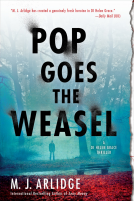
Pop Goes the Weasel, by M.J. Arlidge***

popgoestheweaselPop Goes the Weasel is the second in a detective series featuring Helen Grace. Thank you to Net Galley and Random House-Penguin for the DRC. The title goes up for sale October 6.

Arlidge is an experienced, confident writer. The opening of the book is among the best openers I have seen for quite awhile:

“The fog crept in from the sea, suffocating the city. It descended like an invading army, consuming landmarks, choking out the moonlight, rendering Southampton a strange and unnerving place.”

The tone is thus set for a grisly murder mystery, the perfect mood for an October read.

The premise here is that someone is murdering men that seek the services of prostitutes, and their slayer doesn’t merely kill the men, but eviscerates them without the courtesy of killing them first. Well, this may not be exactly evisceration: they aren’t removing their digestive tracts, but rather their hearts. And while I read that description before requesting this DRC, I should have dwelt on it a moment or two longer, because this particular story really passed my “ick” threshold, and it was my own fault for not being more careful in reading the promotional description.

That said, although it was a bit much for me, it probably won’t be for you, not if you watch a lot of cop shows on television or view a lot of adrenaline-pumping movies that feature violence. That said, I would also steer away anyone who has recently had a death in the family. The descriptions of the cadavers were so explicit that you may find your mind making leaps you didn’t count on.

Grace’s situation is linked to things that happened in Arlidge’s first in the series, and they are referred to often. You may be better off reading these in order. I didn’t read the first, and although I was able to keep up just fine in terms of following plot and character motivation, I felt a little as if I were a guest at someone else’s family dinner. There were so many little undercurrents that referred to Grace’s earlier experiences, as well as those of Charlie, another cop who’d been in the previous story as well, that I felt a bit left out. I also had difficulty, for the first half of the story, keeping Helen and Charlie distinct from one another, and this part I chalk up to the author’s failure to adequately describe each of them. Whether it is the first or tenth in a series, the author has an obligation to provide a clear picture of the protagonist as well as other important characters. That didn’t happen here. Eventually I understood the motivations of each, as well as a good deal of Helen Grace’s internal characteristics, but I never was able to form enough of a mental picture of their appearances to make a mental movie. At times, I felt as if the explicit gore and sex were substitutions for character development. The plot itself was a trifle formulaic.

For those that read the first in the series and enjoyed it, this second in the series is bound to please. It is to those readers that I recommend this mystery.

Gold Coast Blues: A Jules Landau Mystery, by Marc Krulewitch****

goldcoastblues“Tanya Maggio’s a missing person, and I got a feeling she’s missing on purpose.” This third entry of the Jules Landau series finds Landau searching for Eddie’s missing girlfriend. There’s a faded noir feeling in its pages as Landau bounces between Chicago and New Jersey trying to trace back the thread. Though confusing at times, a trifle overburdened by excess characters, it’s a fun, original story. Thank you once and thank you twice to Net Galley and Random House Alibi for the DRC. This title is available for purchase September 22.

The search for Tanya leads Landau to the mean streets of Irvington, New Jersey, where a crooked cop named Cooper explains that in their town, they don’t try stamp out crime…they manage it. So anyone that is hooked up to the criminal world is fair game; the idea, at least ostensibly, is that bystanders should not be caught in the crossfire.

Right.

Turns out the New Jersey people are running a scam. Those among the one percent that have more time and money than good sense invest in fine wine, wine that is worth hundreds of thousands of dollars for a case of a dozen bottles. Hey, its value appreciates, and some liken it to gold or silver. If a bottle gets busted, then that’s what insurance is for.

With a bizarre scenario such as this one, it’s only to be expected that someone would come up with the idea of counterfeiting labels and brewing up some fake stuff. After all, no one is going to drink it anyway, right? Who’s to know?

The plot twists, and it turns sometimes enough to confuse me. Hold up…are we in Illinois, or are we still in Jersey? But when push comes to shove, this romp is too enjoyable to walk away from. “That little shit Spike”, an heir to the Irvington mob, is one character that shines bright enough to keep those pages turning. Another, of course, is Landau’s ridiculous cat Punim, for whom he sits down to compose a legal trust fund when he is depressed and in danger. His own life may be on the line, but by god someone has to be paid to feed Punim his chicken hearts every day. And then there is Amy. Is she an enemy? A spy? She sure as hell isn’t really a psychic, but she knows enough that she has to be something. Maybe she has Tanya tied up in her closet. You never can tell.

The originality of the plot is assisted by Krulewitch’s affinity for figurative language. I loved his description of the “horror hotel” and the “stunningly verdant” house located on…wait for it…Bunnybrush Lane.

September is a good time to curl up under the quilts with a good book, or for those in warmer climes, it’s not too late to stretch out on the beach with one. Either way, if you need an escapist beach read, or a good noir mystery, this might be the book for you.

X, by Sue Grafton *****

xBefore I review this title, I have a plea: can we just make the alphabet a teensy bit longer? Because I don’t think I am ready for this series to end, and it’s getting perilously close. But meanwhile, thank you to Net Galley and Putnam-Penguin Publishers for the free DRC, an unexpected treat, especially since it was such a clean galley. The title goes up for sale August 25, but you can order it in advance, too.

As often happens, our story isn’t just about one mystery. There’s an official investigation that goes bad; an unofficial investigation that goes worse; and then there’s a big pile of trouble that drops itself into the neighborhood where Kinsey and Henry (who is ten percent Kinsey’s landlord and ninety percent her surrogate father) live. As always, taut suspense is intermingled brilliantly with silly, naughty, impulsive things that Kinsey Millhone, our intrepid but mischievous detective, dreams up.

This past year saw Grafton inducted as a Grand Master by her fellow mystery writers, and it really should have happened sooner. The level of writing she practices spills over the standard detective story genre and at times approaches literary fiction.

In this story, Kinsey is concerned about the drought in California, and the issue is deftly interwoven into the plot without ever becoming preachy or slowing the pace. Like everything else Grafton writes, it’s well executed.

And here’s my own confession: I love this book so hard that I deliberately slowed down how much of it I read each day. I could have had this review to you last week, but every time I noted that I’d gone 10 or 15 percent further in, I took it away from myself and forced myself to go read a different galley for awhile, sort of like Mary Ingalls making her Christmas candy last as long as possible. But now it’s finished, and the only thing left to do is tell you that it’s every bit as good as what you have come to expect. And if you are new to the series…well okay, I guess if you are new to the series, you are either really young, or you’ve been in a coma for the last twenty years. Welcome to the world of the living; here is your book. And although it can stand on its own just fine if you read it without reading the A-W mysteries, it’s even better if you read them in order.

I can remember my first Kinsey Millhone story. I found C is for Corpse in a train station shop, and soon afterward found myself in bed, recovering from whiplash. (People really do get whiplash; mine was from a car wreck, not a train wreck.) I was mostly okay as long as I kept my head on the pillow and did not try to move my neck—so ideal for reading a paperback. Once I was up and at ‘em, I hunted down the A and B titles, and from then forward, I read the series in order. And over the years and many installments, Kinsey has evolved from the super-hardboiled detective she was in the first book (which was already really strong) to a more developed character. Because when you have a longstanding series, you really can’t have one episode after another in which your protagonist gets whacked over the head or grabbed from behind, hogtied and tossed into the trunk of a car. People start to roll their eyes if you do too much of that shit, but then you have to find another way to maintain their interest level. Grafton does this by combining some really tricky, interesting problems (and yes, some danger) with a lot of character development.

I don’t know about you, but I tend to assign faces of people I know or have seen to characters in books. It helps me run the book as a mental movie if they have a face and a voice. Since Grafton has said in interviews that she sees Kinsey as a sort of younger, skinnier alter ego, I have created an imaginary Kinsey who looks like a cross between younger-Grafton and Stephanie Zimbalist (actor who played a TV detective many years ago). But when she opens her mouth to crack wise, I hear the voice of Roseanne Barr. So go figure!

So here we are. I am more than twenty years older than when I first met Kinsey; since then, I’ve gone back to school, had a career, had another child and raised her, adopted another child and raised him, and retired from teaching. Through it all, Kinsey has remained a wonderful constant, perhaps the adult version of having Grandma come to visit. Oh boy, she’s here! Or, oh boy, she’s coming back! And frankly, I am just not ready to let go. If you’ve been following the series for a long time too, you may feel the same.

The good news is the present. Right now, there’s this wonderful detective novel that you can order up, and you can float away to Santa Teresa. What an awesome vacation read. Even if it rains wherever you are going, you could have a terrific time curled up on a bed just reading this. In fact, you don’t really even have to go anywhere. Turn your phone off; get your favorite beverage and maybe some munchies; and reserve a time to just wallow and enjoy. Because when it comes to a riveting novel that is also, at times, laugh-out-loud funny, I just don’t see where you will find anything better.

Brush Back, by Sara Paretsky *****

brushbackA good mystery writer engages the writer at the beginning, and gets the adrenaline pumping by the 75% point in the story arc. A great mystery writer grabs us by the shirt right from the get-go, ramps us up into overdrive during the first quarter of the story, and doesn’t let us go till we turn the last page, exhausted, feeling both satisfied and bereaved because the story is over. And Sara Paretsky is a great writer, every single time. She’s only gotten better with this 17th installment of the Vic Warshawski series. Thank you and thank you again (and again, and again) to Putnam-Penguin Publishers and Net Galley for the DRC. You can buy this book July 28 if you want to. And you know you do!

Vic is a working class hero, but she’s left the mean streets of the south part of Chicago behind, and when she goes back to visit, nobody who knew her when she was younger will let her forget it. But she does go back, because an old flame approaches her with a serious problem. His mother Stella is out of prison, finally. She pulled the full twenty years for murdering her daughter Annie. But now there is a possibility she really didn’t do it, and Frank wants Vic to search for the truth. Vic doesn’t like it one bit, but agrees to give him a single hour off the clock; after that, it’s the standard fee. She has bills to pay just like he does.

Things turn ugly very quickly, of course. Of course they do! But just as she is ready to wash her hands of the whole unpleasant business, the evening news picks the story up, along with insinuations that smear her own family’s legacy. Now it’s a matter of family honor; Vic is in it for keeps. Her attorney tells her to keep out of it; Lotty, who is like a second mother to Vic, tells her the same thing. Steer clear; let it go. But our detective is like a dog with a bone, and together with her family pride and reckless nature, she’s in it up to her neck again in no time.

In this installment of the Warshawski series, Paretsky has eighty-sixed young relative Petra, who visited a recent installment, and I was glad to see her go. I found her abrasive. However, young cousin Bernie, a high school student checking out colleges, is visiting, and every inch of my being understood Warshawski’s annoyance at the lack of privacy a teen in one’s home creates, and the irritation of having a young person who’s awake half the night and sleeping in the living room all damn day. I have five grown children and endless others have accepted my hospitality over various summers, and so this tidbit hit home. But Bernie is a much more agreeable sidekick than Petra was, and I hope Paretsky will find cause to bring her back in some future installment.

Another of my favorite moments was the lecture Warshawski’s mechanic treated her to when her car was stripped right down to the nub after she left in parked in a South Chicago hot spot under emergency circumstances. He recites the litany of every bad thing she has ever permitted to happen to every single car she’s owned and brought to him, and I laughed out loud as I read it. I would quote it here, but for that I am supposed to wait for the published copy to be sure it hasn’t been altered, and that won’t happen, since you need to know to order your copy right now.

In closing, there are four things you need to remember. First, don’t just pack your gun; pack enough ammunition to get you through your misadventures. Second, technology is a great boon to those that collect threatening evidence against bad guys; scan your pictures, your receipts, your photos and damning letters and put them in the Cloud where bad guys can’t get to them. Third, try to stay away from the cement mafia if at all possible. The things they do to their enemies just aren’t pretty. And fourth, in an unfair scrap when they’re bigger than you are, go for the ankles!

Oh, there’s so much more, but hey, that’s what the book itself is for. It’s not due out till the end of the month, but you can reserve your copy now. Do it!

Monica’s Sister, by Earl Emerson *****

monicassisterAh, it’s good to be reading a Thomas Black story again. Black is back with his lovely wife, Kathy, a good-hearted woman who makes some interesting friends. One of them is Angela Bassman, a woman who shows up all the time like a bad penny, making ridiculous charges against anyone and everyone, and bragging about having so many friends in high places, having done such fantastic things, that one is left rolling one’s eyes. And so when Thomas hears Angela’s voice approaching his office, he does what any thinking human being would do: he leaps into the closet and shuts the door. Anything to avoid that woman!

The wheels of the story start moving, and things get more complicated. Angela, whose famous sister is the actress, Monica Pennington, hires Black to help her with what is supposed to be a simple task, but isn’t. He would like to back out, but he smells a rat. Despite the crazy nature of Angela’s claims, she is obviously being followed by someone. Strange things happen, and too many coincidences occur. Whether Angela is crazy or whether she isn’t, his detective’s intuition starts to quiver, and he becomes more entangled in her affairs than he had anticipated, especially when she falls to her death, and he sees it happen. Later, Pennington hires Black to find out why Angela killed herself. Because of course, that’s what happened…isn’t it?

Emerson, a Shamus winning author who sets his stories here in the misty Pacific Northwest, usually right here in Seattle, is one fine writer. Hundreds of interesting, free galleys come my way in a given year, but I wanted to read his story badly enough to put it on my wish list, and luckily, my spouse snapped it up and gave it to me for Mother’s Day. What a fantastic gift!

The overall tenor of the story begins as gut-bustingly funny, and then gradually darkens and becomes more suspenseful. By the story’s end, I was literally (yes, I do mean literally) sitting on the edge of my seat, putting off the family members that wanted my attention with a robotic “…just a sec. Just a sec. Yeah I know. Give me just a minute.”

Emerson also uses the occasion to talk a little bit about bipolar disorder, and the ways it can turn a person’s life upside down, but he does it in a way that prevents the book’s pace from hitching. It’s masterfully done!

If you like strong detective fiction, or fiction set in the Pacific Northwest, or both, you just can’t do any better than this book. Seriously recommended for just about everyone.