The Morningside, by Tea Obreht****

In 2019, Tea Obreht blew me away with Inland, a work of historical fiction—alternative history actually—so creative that I haven’t stopped thinking about it to this day. Her new book The Morningside is a dystopian novel that, while not as remarkable as the previous effort, is both intriguing and memorable.

My thanks go to NetGalley and Random House for the invitation to read and review. This book is for sale now.

Our protagonist is Silvia, and she and her mother are refugees from a homeland made dangerous by violent political turmoil. They were invited to live in The Morningside, a once grand old building fallen into disrepair by the flooding that comes with climate change. Silvia’s aunt, who arrives first, and her mother are to be caretakers and participate in the resettlement program.

At eleven, Silvia is full of questions. Her mother never talks about her father or about the past. Her aunt has photographs and stories; her mother is like the librarian that just wants everyone to stop talking. She is consumed by her fears. We readers have to wonder which of them is more realistic. Should the aunt stop blabbing, or should Sil’s mother get a grip? Silvia clearly prefers her aunt’s approach, but then, Sil is just a kid.

There’s a considerable wait list to get into school, so in the meanwhile, Silvia is bored, and bored kids have a tendency to get into trouble. Silvia becomes obsessed with the reclusive artist that lives in the penthouse. Nobody talks to her, because nobody is supposed to bother her. The one obvious thing about this neighbor is that she leaves home at the same time each day with her three dogs.

Silvia becomes convinced that the woman is a sorcerer whose dogs transform into humans—her three sons—for a portion of each day. My initial reaction is the same as her mother’s: don’t be ridiculous, Sil. Leave that poor woman alone. But then it dawns on me that this is fiction, after all, and this is Obreht, so…could the woman have supernatural powers?

Silvia is assisted twice in her spying mission, first by a neighbor that goes by Lam, and that is willing to exchange a pass key to enter the artist’s home for mail that was sent to him after he moved out.  I wonder about this; an eleven year old is approached by an adult man for secret purposes. What could possibly go wrong?

Her other confederate is a girl her own age whose family moves into The Morningside.  How starved Silvia has been for a peer!  Yet this girl is even gutsier than Silvia, and she leads her into dangerous waters more than once.

That’s all I’m going to tell you, except that the story is fresh and original, and although I tend to be skeptical when it comes to this genre, there is never a moment when I find myself stepping back and saying, no way.

With a young protagonist, one might be tempted to say this is for young adults, and that’s possible; yet the vocabulary is advanced enough that the younger reader had better have extraordinary skills in reading and comprehension, not to mention stamina.

I recommend this novel to those that love the genre.

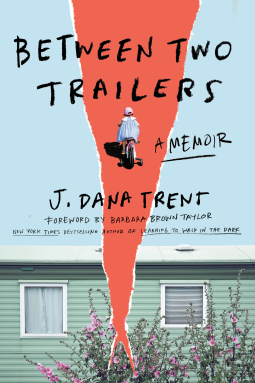
Between Two Trailers, by J. Dana Trent*****

And you thought your childhood was difficult.

Dana Trent is the child of two drug addicted schizophrenics who met and fell in love on the psych ward. The fact that she lived to adulthood is astonishing. Her story is captivating; my thanks go to NetGalley and Random House for the invitation to read and review. This memoir will be available to the public April 16, 2024.

“’Kids make the best hustlers,’ King told me the week after I was expelled from preschool. He lifted me onto the counter and coated his arms with palmfuls of petroleum jelly from the biggest Vaseline tubs Walmart sold. Then he greased up mine. ‘No one expects a runt in a Looney Tunes T-shirt to shank you,’ he explained. ‘Budgie!’ he said and pointed to my chest, then sealed my street name with a Vaseline cross to my forehead. ‘Budgie,’ I parroted, finger to my own chest…‘Guns are for idiots,’ he added. ‘Here.’ He handed me my first pocketknife, a foldout two-inch blade with a horse and buggy painted on the handle. Knives teach you to accept the inevitable. ‘You’ll get stabbed,’ he said, ‘but you’ll survive. No big deal.’”

The nickname “Budgie” was chosen because she was his lookout on drug deals. She would ride along with him, his trunk stuffed full of drugs, and when he got out, she was stationed on the highest available vantage point. If she saw someone—an ambush, the cops, anyone—she was supposed to sing like a bird. (Even other drug dealers and manufacturers questioned the wisdom of hauling a three year old on such expeditions, but King, as her father was known, was not easily influenced.)

At such moments, one might wonder where her mother was. Usually her mother was either unconscious in bed, or on the way into or out of that state. Because her father was awake and slightly more predictable, Dana considered him the more reliable parent. Before she was old enough for kindergarten, she understood that it was up to her to take care of The Lady.

My initial response to this scenario was to be bitterly angry at whoever decided to expel this child from preschool. Boom, there went that tiny girl’s one tie to the safer, saner world. How could anyone look at her behavior, her clothing, her hair and not call Children’s Services? I’m still fuming.

Miraculously enough, Trent made it to adulthood, and after years and years of therapy, she is able to lead a normal life. She’s achieved a remarkable amount, with a Ph.D. to her credit along with a solid career in academia.

And she can write! There is never a slow moment in this memoir, a hair raising read that I brought out at lunchtime, but never at bedtime. There is very little by way of dialogue, and that makes the swift, steady pacing even more remarkable.

Between Two Trailers is one of the year’s best reads. Highly recommended.

What the Taliban Told Me, by Ian Fritz****

Ian Fritz was an Airborne Cryptologic Linguist who served with the U.S. Air Force in Afghanistan for five years. Trained in both Dari and Pashto, he became one of only two people that could understand what was being said by all of the people on the ground before and during battle. Following his service, he became a physician and writer. This is his memoir.

My thanks go to Simon and Schuster Publishing and NetGalley for the invitation to read and review. This book is for sale now.

Fritz was in many ways the perfect recruit; his family didn’t have any money, and he was brilliant, which meant that if he was going to have any opportunities, they would most likely come from the U.S. armed forces. He blew through his public school years, as gifted students that aren’t challenged often do.

This is where I long to stand on a big box and yell through a bullhorn: gifted students are at risk children! We must provide them with challenging, interesting curriculum, or they will stop bothering with school. I’ve been saying so for decades, and I’m saying it again right now. So many times educators and school districts assume these kids will automatically be fine. If the student is bored, they use them as unpaid tutors for their peers, which distorts relationships among the students and does nothing to provide the highly capable student with new, interesting material. These kids need different educations from those in the mainstream. Ian’s story is a powerful example of why this is so.

Ian was sent to an elite language training program, and then he was deployed. Initially, the successful flights in which targets were found, identified, and killed—often partly or solely because of his contribution—were exhilarating, but as time went on, he began to feel conflicted. On the one hand, the Taliban were responsible for the horrific, cowardly attacks on American civilians on 9/11, and were therefore a legitimate target. On the other hand, being able to understand what enemy soldiers were saying to one another made him aware that these were normal people, attempting to live their lives and repel the U.S. invaders. It’s hard to hate someone, or to be indifferent to them, when you overhear them discussing their plans for after the day’s fighting is done, or declaring that it’s just plain “too hot for Jihad today.” Sometimes a threat on the ground would be identified, and the Americans wouldn’t realize that this was an error until after the person they’d targeted was dead. And he knew the names of the dead, sometimes hear the survivors below desperately trying to get their comrade to a medic, but then…oh. Too late.

Then there was this culture among others he served with, those not trained in the language and who were therefore able to demonize the targets, howling with laughter at the way a body on the ground could be made to bounce if you shot it at just the right angle. He realized that “no one else had heard, and no one else ever would hear, the simultaneous screams of the JTAC [U.S. officer on the ground] and the Talibs. Or the sudden quiet when the Talibs died.”

Ultimately, he learned that Afghanistan was actually a lot safer without U.S. forces than with them.

As Fritz began to internalize his despair, he grew suicidal, and he knew he had to get out. It’s at this point that he was charged with malingering and cowardice; he would later learn that it was a trend among the linguists serving in this theater.

Fritz is one hell of a fine writer, and the narrative flows smoothly. I was surprised to find that this was a quick read, despite the intensity of the material. Surely there must be other military memoirs relating to Afghanistan, but as he points out, nobody else is writing about this experience, because almost nobody else has done what he has.

For those with the interest and the courage, this memoir is recommended.

The Great Divide, by Cristina Henriquez*****

I found The Great Divide, by Cristina Henriquez, on a short list of most anticipated novels of 2024. I don’t like to get shut out when a book gets this much buzz; then there’s the added draw of an unusual setting. The U.S. doesn’t see a lot of fiction published that’s set primarily in Panama during the early 1900s, and so that sealed it. My thanks go to NetGalley and Harper Collins for the review copies, both audio and digital. This story lives up to the hype, and I recommend it to you.

I am not so sure about it at the outset. There is a robust quantity of characters that are important to the story, and each of them is given a brief chapter all to themselves. I wonder whether they will ever intersect, or if this will turn out to be a collection of short stories, but before much longer, characters are meeting other characters. They don’t all end up together in the end, but we can see the ties that have formed. There are a lot of people to keep track of, and for me, having both the print version and the audio is tremendously helpful. Robin Miles narrates in a way that is natural and fluid, and I don’t notice much of what is around me when I listen to her. But once in awhile a character is mentioned and I draw a blank; here is where the Kindle version is essential, because I highlight the names of each of the characters, and this enables me to instantly flip back to where they were introduced to us without having to stop listening. Eventually, of course, I no longer need to do so, but knowing that I can makes for stress-free reading.

I am engaged with these characters, each of whom feels real to me, and I groan when I see them get into trouble, and sigh with relief once they are in the clear again. The ones that I care about most are a father and son that are estranged from each other, neither wanting to stay that way, yet both of them incorrectly interpreting the silence of the other. As we reach the climax, I can tell there are three ways for this situation to resolve: they can reconcile; one of them can die; or the son can decide to follow another character back to the U.S.A. without reconnecting with his dad.  It only now occurs to me that there was a fourth possibility, which was to leave them still estranged at the end; but by this time, Henriquez had shown herself to be a better writer than that, and while I won’t tell you how they wound up, I will say that she didn’t leave her readers dangling.

Because this is an intricately woven tale with a lot of equally important characters, I’m not including any quotes, but I will say that Henriquez is a talented writer, and anyone that loves good historical fiction should get this book and read it. This applies even more so to those interested in Latin American history and the building of the canal. I hadn’t read her work before, but she’s on my radar now, and I look forward to seeing what she writes next.

The Hunter, by Tana French*****

In 2020, Tana French gave us The Searcher, the first in the Cal Hooper detective series. By that time I was already an established fan, but I loved that book particularly well, for reasons I’ll revisit in a moment. Now we have the second in the series, The Hunter, and if anything can reduce this crusty old English teacher to a blushing fan girl, this is it. Two books in, this is already on my short list of favorite series. My thanks go to NetGalley and the Penguin Group for the review copy. This book will be available to the public Tuesday, March 5, 2024.

The series debut introduced the characters, with the protagonist being a retired Chicago cop that found this tiny Irish village on vacation and, needing a new home far from his ex-wife, yet affordable, discovered a bargain fixer of a home and decided to stay. The story’s main problem revolved around a nearly feral tween that kept popping up at Cal’s place. The scrappy little stinker that was relieving Cal of food, occasionally, and doing other unsettling things turned out to be a girl; her name is Teresa, but she’s known as Trey. Her family was in dire straights following the departure of Trey’s father; her brother had left, intending to return, but never had. The mystery was where Trey’s brother had gone, what had become of him, and why. In the interim, she became greatly attached to Cal, who enjoyed her company and taught her some woodworking skills, but also kept a careful distance, lest rumors start and grow.

Now Trey is a bit older, and she is more civilized. She is close to both Cal and Lena, the local woman that Cal has been seeing. But as life settles into a civilized hum, one that would be comfortable had climate change not created a drought that has local farmers at the near end of their wits and their bank accounts, the unexpected happens once again: Johnny Reddy, Trey’s no-account father, has returned. Cal is prepared to step back, if need be, in case Trey wishes to bond with her actual dad rather than himself. Meanwhile, Johnny vows to visit Cal with some local moonshine, and “make a night of it.”

“Trey says nothing. If he does that, she’ll get Cal’s rifle and blow his fucking foot off, and see can he make his way down the mountain to Cal’s after that.”

Johnny never succeeds in bonding with Cal, who doesn’t like the look of him. “Johnny gives him the urge to pat him down and ask him where he’s headed. There are guys like that, who flunk the sniff test just going to the store; it’s a good cop’s job to work out whether they’re actually doing something hinky, or whether it’s just that they will be sooner or later, probably sooner.”

The village is a tiny one, and outsiders are few. Everyone in the vicinity knows that Johnny’s back; everyone wonders what he’s up to. They haven’t long to wait; he’s brought a man with him, one whose family once lived here, or so he says; and the man is interested in seeing if there’s gold on some of the local properties. “He has a rich man’s smile, easy and understated, the smile of a man who isn’t required to put in effort.”  Now the question is whether this “plastic Paddy” is a shyster trying to rip off the locals, or if he is someone that Johnny is seeking to fleece. Meanwhile, Trey has a different agenda, a private one.

The thing that makes this story so much better than your standard mystery is the characterization. If you are in search of a thriller that is all page-turning action, this isn’t your book. However, if you love a layered story with complex, convincing characters, this is for you. I said in my previous review of the first in the series that Trey is what makes an otherwise solid story a golden one, and that’s even truer here. One could even argue that it’s really her series, with Cal existing as scaffolding. Time will tell.

In particular, though, anyone that works with, or has worked with at risk youth cannot, must not miss this story. French has taken hold of my heartstrings hard, and I don’t want her to let go. Highly recommended.

Martyr! by Kaveh Akbar

“’Do you worry about becoming a cliché? ‘

“’How do you mean?’

“’Another death-obsessed Iranian man?’”

My thanks go to Doubleday and NetGalley for the invitation to read and review this singular debut novel. This book is for sale now.

Our protagonist is Cyrus, an Iranian immigrant who comes to live in the U.S. as an infant. He is raised by his father, Ali; his mother’s plane was shot down shortly after Cyrus was born, an accident on the part of the U.S. military. His father dies suddenly while he is away at college, leaving him rootless. He spends a lot of time anguishing over death, wondering what is worth dying for. He doesn’t want to waste his “one good death.” Later, he points out that “If I died trying to kill a genocidal dictator tomorrow, the news wouldn’t say a leftist American made a measured and principled sacrifice for the good of his species. The news would say an Iranian terrorist attempted a state assassination. “

And you know that he’s right.

The thing that attracted me to this story is its difference from everything else that I have read. Persians almost never show up in American novels, and when they do, the Persian is the other, the bad or weird person, pretty much like the quote above suggests. So I was all in.

However, I have to say that the amount of angsty inner dialogue makes this a slooow read in places. There is also dialogue between Cyrus and friends, but most of it basically the same thing with a different format. I was primed for humor, since that’s how the book is being promoted, but didn’t find much of it.

The story wakes up a bit when Cyrus leaves Indiana for New York, but the writing remains inconsistent, and the transitions are sometimes a bit ragged.

The revelation about his mother, which occurs toward the end of the story, is startling, and I didn’t see it coming, but it also presents a credibility issue; I won’t go into details here, because it would be a spoiler. Still, apart from this one reservation, the ending is nicely rendered.

Akbar is an interesting writer, and I look forward to seeing what he writes next.

Scattershot, by Bernie Taupin*****

I was a teenager when Elton John’s music exploded onto the radio, and to this day, there are certain songs that I play in celebration, or when I need my mood lifted. For decades it lay in the back of my mind, wondering what was behind these lyrics or those. Never one to delve into the lives of celebrities all that often—a few shallow attempts convinced me that usually the most interesting thing about them is their work, which I’ve seen or heard already—I nevertheless filed it away, to find out about those lyrics one day.

Retirement came, and so with extra time to spare, I finally learned that Elton didn’t write those words. None of them! It was his writing partner, Bernie Taupin. I found this out only after reading an Elton John bio. I searched for one of Bernie’s and found empty air instead. When I saw this galley, I had to read it, and I am so glad that I did. Big thanks go to Net Galley and Hachette Books for the review copy; this book is for sale now.

Sometimes a public figure will publish a memoir, but either openly or secretly, they require a ghost writer, and in the cases of some others, we may wish that they had. Taupin, however, is a writer, and boy does it show! His eloquence is undeniable, hilarious in some places, moving in others. His judgment is unerring, knowing when to be brief and when to use detail, and his candor is refreshing as well. The result, for me, is that when I’ve finished reading, instead of the usual five or six quotes that I’ve highlighted so that I can select one or two to use later, I instead find that I’ve highlighted eighty-eight, and some of these are multiple pages in length! I’ve spent an hour trying to choose which one to share, and it’s hard because they’re all brilliant. Since choosing just one is impossible, let’s just go with the first, which is near the beginning of the book, the beginning of the Bernie and Reg (Elton, later) show. The chapter begins:

“Sheila hated my coat. I can’t say I blame her. It hung on a hook on the back of our bedroom door like a Neanderthal artifact from the Natural History Museum…when it rained, which was often, it smelled like an uncured yak hide. Afghan coats were in style, as were kaftan jackets, three button tees, and velvet pants. I’m positive we didn’t succumb to the latter, but as for everything else, my new best friend and I did our very utmost to look the part…Sheila was Reg’s mother.”

Born in a tiny, isolated hamlet into the very bottommost scrapings of the working class, Bernie knew from an early age that he wanted out. He loved his family, and later, when money came his way, he took good care of his parents, but he never wanted to live in that place again, and became Californian down to the marrow of his bones the instant he landed in Los Angeles.

Taupin doesn’t hold much back, that’s for sure. The most essential ingredients of a top notch autobiography are that the person has lived an interesting life; knows how to write about it; and is willing to talk about just about every aspect of it. Taupin gets top marks in all three areas. Early on, I became concerned about his attitude toward women, given that the first we learn of his having married is when he makes a side reference to his first marriage dissolving, and I thought, Seriously? You tell us all of the everything, but don’t even mention your marriage? Small wonder it didn’t take. I maintain that concern through two more marriages that get little ink; but then we reach his current, and most likely permanent union, and everything changes and I feel much better.

Taupin has stories about just about every celebrity on the planet, and he does talk about the inspirations for his lyrics. I would have finished this book much sooner, but the greatest joy of reading a rock and roll musician’s memoir is reaching back to listen to the songs whose lyrics he scribed, as well as the many musical influences that shaped him. (Country western, I kid you not!) This book became such a prominent part of my day that my family was leery of turning up during the lunch hour, because I had passages to read aloud. And yet they had to admit that many of them were pretty damn good.

This book is highly recommended to all that love rock music, Elton John, and also to those that just love a resonant, well written memoir.

Lucky Red, by Claudia Cravens*****

Larry McMurtry, eat your heart out. There’s a fine new word-slinger come to town, and her name is Claudia Cravens.

My thanks go to Random House and Net Galley for the invitation to read and review Lucky Red. This book is for sale now, and you should get it and read it.

Bridget lives a life of hardscrabble deprivation; her mother died in childbirth, and all she has is her pa. He loves her, but he’s worthless; when he finally gets a bit of money, he invariably drinks and gambles till it’s nearly gone. During one such episode, he gambles away their little house, and then buys a homestead, sight unseen and many miles away. What they find instead is a tar paper shack; there are no crops or tilled acreage, no tools or even a decent place to live. They crawl into the miserable hovel to get out of the elements, at least, and get some sleep; a rattler has the same notion, but when pa thrashes in his sleep, the rattler bites him in the neck, and then there is only teenage Bridget.

Bridget makes her way to Dodge City, and in no time, she is stone cold broke. She’s recruited to work in a brothel, the only one in town owned and run by women. She doesn’t mind the work and makes friends among the other “sporting women,” and is curiously removed from the process for which she is paid; slide prong A into slot V; moan a little, gush, and collect your pay. But later, she finds herself obsessed with a new sex worker; a lovely blonde woman named Sallie. Everyone around her understands the significance of this fascination, but Bridget herself doesn’t get it. She’s young, and she’s naïve. But when Spartan Lee, a female bounty hunter, comes to town and asks to hire Bridget, the sun shines and the angels sing.

This story is epic, and in many ways reminds me of Little Big Man, but with a female protagonist. And in many ways, what makes it so successful is its restraint. At the book’s outset, there’s a slimy man that wants to buy Bridget’s hand in marriage, which would give her father a nice chunk of change, but she hates the man, and her father doesn’t push it. A less capable writer would have done it the other way, but here, and in every instance where I predict what will happen because it’s so obvious, Cravens does something else. And the lesbian sex is brief and almost free of physical details—a sad thing for anyone looking for soft porn, but it serves to keep the story moving forward—with the emotion behind it carrying the internal narrative.

Although Bridget has no complaint about the work she does, and the management is more benign than in houses owned and run by men, Cravens keeps it real. One night, Sallie is attacked by a client, and Bridget bursts in to rescue her. It doesn’t go well. Sallie berates her for her naivete:

“You don’t see the first thing about this, though, do you. They all have a knife, Bridget. They all have a gun, and they were all born with two fists on the ends of their arms. You think you’ve got this all figured out, but any single one of ‘em could take a swipe at you some night and you’d be dead before you hit the ground.”

To tell you more would be to spoil it for you, so I’ll leave you with this: Lucky Red is the best debut novel of 2023, and one of the best books I’ve seen this year, period. Don’t miss it.

Hang the Moon, by Jeanette Walls*****

Jeanette Walls is the author of outstanding memoirs, most notably The Glass Castle. Her new novel, Hang the Moon, is brilliant, and you should read it. My thanks go to Net Galley and Scribner for the review copy. This book is for sale now.

Sallie Kinkaid is born and raised near the turn of the twentieth century in a tiny backwater in Virginia, daughter of its wealthy scion, “Duke” Kinkaid.  Her mother has died, and Duke has remarried, and now Sallie has a younger half-brother, Eddie. Sallie is a daredevil, given to occasional recklessness, whereas Eddie has a gentler, more introverted nature, with a love of learning and music. But one day, hoping to awaken some more adventurous aspect of his personality, Sallie takes Eddie out for a ride in her cart, and he is injured. Just like that, Sallie no longer lives with her father; she is cast out to live with an impoverished aunt, and there she remains for nearly a decade.

Sallie is a young woman when she returns, and now she must navigate the shoals of local politics, keeping clear of Duke’s sometimes unpredictable temper.  Duke owns nearly every property in the county, and he is deft at doling out favors and keeping the local peace, always in a way that works to his own advantage. Sallie has a hundred questions, some longstanding, and others that develop as she works for her father. However, questions are discouraged in the Kinkaid home. An aunt tells her, “Honey, there are some rocks you don’t want to look under.”

When the local economy is shaken by the unthinkable, Sallie must make some hard choices as she comes into her own. Moonshine has long been an unofficial, yet pivotal way that the local working class makes its living, and when feuds erupt and the government attempts to intervene, Sallie must choose sides. As she comes into her own, she discovers some hard truths about the family she thought she knew. Walls is at her best here, with a strong, resonant setting, a clear, credible plot, and unforgettable characters. This is the sort of book that one comes back to. Highly recommended.

The Magic Kingdom, by Russell Banks*****

Some writers may fade as their bodies begin to fail them, publishing books that aren’t quite up to their usual standards; Russell Banks, on the other hand, seems to have saved one of his best for last. The Magic Kingdom tells the epic tale of Harley Mann, a boy that spends most of his boyhood on a Shaker plantation in Florida, and then becomes a real estate mogul later in life. My thanks go to Net Galley and Knopf Doubleday for the review copy. This book is for sale now.

Harley’s father dies when he is young, and his mother is forced to take him and his many siblings elsewhere. At first, they land in a religious cult on a plantation that works them like slaves; then Elder John, the head of a Shaker Colony in Florida, rescues them. Harley’s mother and most of his siblings become Shakers and remain with the colony until its eventual demise, but Harley has his doubts.

Nobody can craft character the way that Banks has, and he has melded a fascinating setting, one which begins over a hundred years in the past and follows Mann into his dotage in 1971, and which also incorporates a fair amount of Florida geography and history. Most of the story centers around Harley’s deep and abiding love with Sadie Pratt, a young woman being treated for tuberculosis in a nearby sanitarium. Sadie is not a Shaker, but is friend to them, and visits often when her health permits; Harley, just coming of age, falls for her hard. There’s a good deal of tension between Harley and Elder John, who despite all of his adherence to Shaker beliefs and practices on the surface, is also privately building himself a personal stake that only Harley knows about. By the time the book is over, I find myself wondering whether Harley’s character represents a real historical figure. No indeed; this is just the kind of magic that one finds in Banks’s novels, his capacity to build characters so real that they are nearly corporal.

The little shots off the bow that are fired at the Disney Corporation—by Harley, of course, and his representative after his demise, not by Banks—add a tinge of edgy amusement.

Because I had fallen a bit behind, I procured the audio version of this book from Seattle Bibliocommons, and so I can tell you that the narrator does a fine job, and it’s as easy to get lost in this story listening to it as it is reading it from the text; I did some of each.

This novel is brilliant, and all that love excellent literary fiction or historical fiction should get it and read it.