Giveaway: Black-Eyed Susans, by Julia Heaberlin

BlackEyedSusansThis giveaway ends Friday, July 31 at midnight! Thank you to my sponsors for permitting me to extend the deadline. Hot new psychological thriller won’t go for sale until August 21, but thanks to Net Galley and Ballantine, you have a shot at your very own advance copy! If you live in the continental USA and have a snail mail address to give me if you should win, then you are eligible.

This is my first giveaway ever, and I began it on the review page, but so far only 5 people have expressed interest, and only one has left the contact information necessary for me to notify the winner. That means that by entering your contact info–which I will not use for any other purpose but to notify you that you’ve won and get your address to the sponsors–you have an outstanding chance of winning. Just a few days, people! Come on in!

Black-Eyed Susans Giveaway; My Very First!

I am pumped about this! I was contacted by a rep from Net Galley and offered a copy of Ballantine’s hot new mystery for a blog giveaway, which I have not done before. I hope a lot of people will enter. If you’d like to be included in the drawing, which will occur at the end of this week in a totally random manner, please go down to the bottom of the page where it says “Leave a Reply”. Type in your name (or a pseudonym for now if you prefer) and an e-mail address where I can reach you. If you win, I will send a message to your e-mail, and at that point you need to give me a real name and snail mail address, which will be released only to the Net Galley rep.

I promise not to use your e-mail address for anything else. Actually, I don’t have an e-mail list to sell, and I don’t have anyone to sell it to. But if someone pops up and offers me great riches, I will turn them down…I promise!

This page will dominate my blog for the whole week. As a refresher, here’s the review again, and the attention-getting cover:

BlackEyedSusansTessa is the sole survivor of a group of young women who were left for dead in a mass grave, which was then planted with flowers. The Black-Eyed Susans became a metaphor for the trauma she experienced. This thriller, Heaberlin’s first following a highly respected career in journalism, is a great read with a few problems, most of which have to do with trying to cram too many details into a single novel. It was looking like 3.5 stars to me until it passed the halfway mark; then it hit its stride. Ultimately, the eloquent manner in which issues surrounding the death penalty were braided into the narrative won the final .5 star from this reviewer. And at this point, I have an obligation to tell you I read the book free, and to say thank you to Net Galley and Random House Ballantine for the DRC. The book will be available to the public August 11.

Tessa is an adult, a single parent, and it’s been twenty years since her abduction and attempted murder. There are memories she tries to bury, and there are other niggling details that she can’t make sense of. In a writing style somewhat reminiscent of Jodi Picoult, Heaberlin flashes us back and forth from Tessa’s adolescent memories to the present, a life in which her sole objective at first is to protect her own teenage daughter, Charlie, whom she is afraid may pay the ultimate price. Because Tessa’s stalker has been planting Black-Eyed Susans in her yard and various other places, and she is scared half to death.
Strange, threatening packages appear in the mail. And her best friend Lydia disappeared mysteriously not long after the trial. There are so many shadows, so many possible threats out there that her inclination is to retreat into her artist’s studio, and into her home. Don’t rock the boat.

The problem is that an innocent man is about to become one more victim of Texas’s capital punishment. Her supposed attacker, the supposed killer of the other Susans, waits on death row…and the clock is ticking. She knows he didn’t do it, and she’s been holding out. Once she decides to testify to his innocence, will she be believed? Can she get there in time?

A tremendous amount of research went into teenage trauma and its possible affects, and the capital punishment process (and the process of its defense) in Texas. Heaberlin has done her homework; if anything, she may have done a little too much, or tried to incorporate too much of her work into one novel. Somewhere around the 37 percent mark, I found myself not mystified, but confused. What were all these references to the OJ Simpson trial doing here? Who the hell is Jo? Is Lydia dead, moved away, or what? The suspense fell away while I stopped reading in irritation to go back over the book and try to discern what I had missed or forgotten.

However, just before the halfway mark, the author found her stride and everything came together. From that point till ninety percent, I was riveted. Portions of the text approached the level of literary fiction. I found myself questioning my earlier complaints, and went back and reread the passages I had marked earlier to see whether I had just been distracted, or in a snarky frame of mind. But no, the inconsistency is really there.

The supernatural bits about the other Susans being in her head, talking beyond the grave, may have turned up in the author’s research as a possible outcome of trauma, but they felt extraneous to me, as if they had been shoe-horned into the text. If I had been her editor, I would have cut them.

I was not entirely happy with the ending, which felt a bit contrived, but I was so deeply satisfied by what I had read up to that point that I didn’t feel let down.

My advice to the reader is this: if you are opposed to the death penalty and love a good thriller, get a copy of this novel. I think you’ll find it as satisfying as I did. You may want to flag pages where you have questions with sticky notes, or mark it digitally if you read it that way; later on it will all make sense.

And whatever you do, remember: there are no millionaires on death row. Not in Texas, and not in any other state that has capital punishment in the USA.

Hard Rain, by Peter Abrahams ****

hardrainHard Rain is a nail-biter of a suspense novel, part mystery and part espionage thriller, and Peter Abrahams is a writer with credentials as long as your arm, including being Stephen King’s favorite American suspense novelist. After reading this skillfully woven tale I can see why. My thanks go to Net Galley and Open Road Integrated Media for the free galley. It was one wild ride!

Hard Rain is set in the period after Vietnam, but prior to the time when satellites revolutionized our means of communication. Our opening scenes involve a mysterious, sinister fellow named Bao Dai. His murder of a stranger for no apparent reason sets the reader on edge, and the surreal tone the writer lends is better than anything I have ever seen. In fact, the writing style and pacing are so brilliant that until I stumbled across some unexpected but fairly glaring problems in the last quarter of the book, it was headed for a five star review and a home on my favorites list. But more about that later.

Our chief problem, once the initial set up flashes past us, is that Jessie’s daughter is missing. Her ex-husband, Pat Rodney, took her for the weekend. They were going to go fishing, and then she was going to be returned to Jessie in time for a birthday party. But they never made it to the fishing boat, and there are some ominous messages on Pat’s answering machine. Kate never came home, and Jessie has no clue where she is.The cops aren’t all that concerned, seeing it as a routine custody violation that will surely be resolved on its own, but Pat has never been responsible, and has never ever wanted full custody; Jessie just doesn’t think he would snatch her. Her best friend, Barbara, is a no-holds-barred lawyer, and she’s ready to get down to business, but she is killed by a hit and run driver as she goes to cross Jessie’s street, wearing Jessie’s yellow rain slicker. That one person was the entire cavalry; now Jessie is on her own.

It just doesn’t look good.

The trail takes Jessie to Bennington College in Vermont. Pat was originally from Vermont, and she thinks he may have gone home, or at least contacted his family. And once there, all hell breaks loose. A particularly harrowing scene involves a chase scene in a subterranean tunnel beneath the dormitories.

A parallel storyline that blinks in and out has to do with an aging spy named Zyzmchuk, who is about to be sent out to pasture. Keith and Dahlin, a snappy, younger pair of more business-like spooks, plan one further adventure for “Zyz” in the hope that when it’s over, he’ll either be dead or leave quietly. These two, for some reason, made me think of Haldeman and Ehrlichman, the two sinister advisers that did President Nixon’s bidding at times, and at other times kept him on a leash to keep him from acting crazier than he already was. Maybe it’s because I am also reading Tim Weiner’s galley about the Nixon presidency. I have to say that of all the myriad characters that wink in and out of this complex, deliberately disorienting story, Keith and Dahlin are my favorites.

The imagery, with water and falling being constant themes throughout this spooky story, is among the best I have read, together with a deceptively simple sentence pattern that creates suspense in something of a house-that-Jack-built fashion. I still can’t figure out how he does it. It’s uncanny, and really absorbing.

So, even with the problems toward the end, is this creepy novel worth your time and money? Assuming you enjoy this sort of story, I have to say yes, it is. In fact, this writer won the Edgar earlier in his career, and that early title is now on my to-read list. I probably won’t find it as a galley, which means I have to hunt it down at the library, or fish around for it on my annual pilgrimage to Powell’s City of Books. So what follows was not enough to cross this writer off my A list, by any means. And now if you read further, there are going to be spoilers, so if you want to read this yourself and not know how the ending shakes out—or at least bits of it—this is the place to quit reading. And for those skimming, I will make it more obvious:

*****SPOILERS AFTER THIS POINT!!!*****

We are 75% of the way into the story. Jessie has been beaten by bad guys, and has been rescued, medical attention sought by our very own spook, Zyzmchuk. He is keeping an eye on her partly for her own good (awww), but also so that she doesn’t get in his way, because her mission interferes with part of his. He sets a guard to watch her when he has to go out, but otherwise, he sits in a chair in her hotel room there in New England, keeping watch over her. She is a sweet young thing still; he is retirement age.

And so there she is, with a nasty concussion and a number of other bad injuries, worried about her missing child, and so what would be more natural than inviting this duffer, a man as ancient as I am now, to come climb in bed with her so they can have great sex?

What the hell?

“’Shit,’ said Dahlin.
“’Fuck’, said Keith.’”

Okay, that quote belongs much earlier in the book (and more than once), but I like it here just as well, so I have taken the liberty of inserting it. Because really…what is that about? Did someone in marketing decide the book needed some gratuitous sex in order to sell properly? Go figure.

At the 85% we have to wonder whether some bad editor also cut out a chunk of story that should have been more judiciously and lightly pruned, because when Jessie sneaks out of her hotel room to try to find her daughter, she returns to find that Zyz, the guard Zyz posted while he stepped out, and all other apparent spooks and body guards have decamped. We, the readers, know that the guard in her hotel room was killed after she snuck out, but we don’t know where the hell Zyz went. And the next time we run across him, he is strolling into his office in Washington as if nothing untoward ever occurred. There is never any real explanation for this bizarre leap in the plot.

All that said, once again, I would happily read more of this author’s work. His capacity to create a frisson of chilly suspense far outweighs the Hollywood-like choice to dump the hot chick in bed with the old guy, as well as what may have been an editor’s error toward the conclusion.
*****END OF SPOILER ALERT!*****

This book will be released digitally July 28, and you can get a copy anytime you like now. What better way to spend a vacation, or even a staycation? Just stay out of the water, and definitely keep an eye on your kids. You won’t want them out of your sight while you read this story!

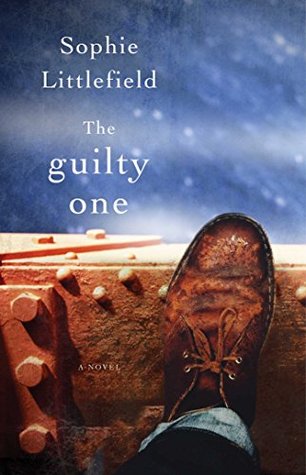
The Guilty One, by Sophie Littlefield *****

Sophie Littlefield, author of the Bad Day series (A Bad Day for Sorry, etc) has hit a new level of excellence with The Guilty One. Many thanks to Net Galley and Gallery Books for the DRC! This book goes up for sale on August 11, and if you love a good novel, this one is for you.

Our chief protagonists are Maris and Ron. Maris is Calla’s mother…or she was. Calla is dead now. The court has convicted Karl of her murder, a heartbroken, enraged loss of control over a bad teenage breakup. Ron is Karl’s father, and as we open our first setting, he is considering jumping off the Golden Gate Bridge. At the last minute he decides to phone Maris, and ask her whether to jump or not.

theguiltyoneIt shows a good deal about Ron’s character, weak and lacking in integrity, that he not only phones Karl’s victim’s mother to dump the responsibility on her, but also wears a windbreaker to the bridge because his travel guide mentions that it is cool and windy there, even in warm weather.

The last time I read Littlefield’s work, it was the Bad Day series. The first book won multiple awards and was deeply satisfying, a savvy, witty dig at domestic abuse. The same topic enters this discussion in a more oblique fashion. In her earlier series, she seemed to lose momentum as the series unfolded, and it appeared to me that she couldn’t decide whether she wanted to write a series that was mostly of the detective fiction genre, or mostly romance. Here, she has taken a giant step away from mystery and detective fiction, and this straight-up fictional story is told with grace, maturity, and authority. It’s obvious right there in the first few pages. I was reading a handful of galleys at the time, and my first note to myself was “See now, this is good writing.”

Maris has lost her marriage, and at first it appears to be a consequence of Calla’s death—so few couples can experience the death of a child and stay together—but as the story progresses, it becomes clear that a split was in the works long before this. And Maris makes a decision that resonates with me. She drops everything and everyone, more or less, and without thinking, going purely on instinct, starts over in a new place, with a greatly reduced standard of living. At first I wonder whether Maris is merely slumming, seeing how the other half lives, but deep down, I have to trust Littlefield not to do anything so shabby, and she doesn’t. Maris is the one we root for, the one that drives the plot forward and pulls us in.

Ron and Deb have stayed together as Karl has gone through the trial and been found guilty, but the strain is there. Ron starts out entirely believable and not very likeable. He never becomes the stand-up individual that Maris is, but he is a dynamic character, complicated and interesting. He undergoes a lot of change as the story progresses.

Throughout this riveting novel, there was never a moment when the veil lifted and I recalled that these characters weren’t real. I raced toward the end with a sense that I had to see how it came out, and then when it was over, I felt a sense of loss, wanting to turn another page and find Maris still there so I could check in with her, like a good friend. And that is ultimately the hallmark of great writing.

Get online. Take a bus. Get in the car. Hijack a plane—okay, maybe not—but do what you need to do in order to get a copy of this accessible, compelling new fiction. Littlefield rocks it. You can pre-order it now, so you will be able to read it right away. If you do, you too will want to stand up and cheer!

Black-Eyed Susans, by Julia Heaberlin ****

BlackEyedSusansTessa is the sole survivor of a group of young women who were left for dead in a mass grave, which was then planted with flowers. The Black-Eyed Susans became a metaphor for the trauma she experienced. This thriller, Heaberlin’s first following a highly respected career in journalism, is a great read with a few problems, most of which have to do with trying to cram too many details into a single novel. It was looking like 3.5 stars to me until it passed the halfway mark; then it hit its stride. Ultimately, the eloquent manner in which issues surrounding the death penalty were braided into the narrative won the final .5 star from this reviewer. And at this point, I have an obligation to tell you I read the book free, and to say thank you to Net Galley and Random House Ballantine for the DRC. The book will be available to the public August 11.

Tessa is an adult, a single parent, and it’s been twenty years since her abduction and attempted murder. There are memories she tries to bury, and there are other niggling details that she can’t make sense of. In a writing style somewhat reminiscent of Jodi Picoult, Heaberlin flashes us back and forth from Tessa’s adolescent memories to the present, a life in which her sole objective at first is to protect her own teenage daughter, Charlie, whom she is afraid may pay the ultimate price. Because Tessa’s stalker has been planting Black-Eyed Susans in her yard and various other places, and she is scared half to death.
Strange, threatening packages appear in the mail. And her best friend Lydia disappeared mysteriously not long after the trial. There are so many shadows, so many possible threats out there that her inclination is to retreat into her artist’s studio, and into her home. Don’t rock the boat.

The problem is that an innocent man is about to become one more victim of Texas’s capital punishment. Her supposed attacker, the supposed killer of the other Susans, waits on death row…and the clock is ticking. She knows he didn’t do it, and she’s been holding out. Once she decides to testify to his innocence, will she be believed? Can she get there in time?

A tremendous amount of research went into teenage trauma and its possible affects, and the capital punishment process (and the process of its defense) in Texas. Heaberlin has done her homework; if anything, she may have done a little too much, or tried to incorporate too much of her work into one novel. Somewhere around the 37 percent mark, I found myself not mystified, but confused. What were all these references to the OJ Simpson trial doing here? Who the hell is Jo? Is Lydia dead, moved away, or what? The suspense fell away while I stopped reading in irritation to go back over the book and try to discern what I had missed or forgotten.

However, just before the halfway mark, the author found her stride and everything came together. From that point till ninety percent, I was riveted. Portions of the text approached the level of literary fiction. I found myself questioning my earlier complaints, and went back and reread the passages I had marked earlier to see whether I had just been distracted, or in a snarky frame of mind. But no, the inconsistency is really there.

The supernatural bits about the other Susans being in her head, talking beyond the grave, may have turned up in the author’s research as a possible outcome of trauma, but they felt extraneous to me, as if they had been shoe-horned into the text. If I had been her editor, I would have cut them.

I was not entirely happy with the ending, which felt a bit contrived, but I was so deeply satisfied by what I had read up to that point that I didn’t feel let down.

My advice to the reader is this: if you are opposed to the death penalty and love a good thriller, get a copy of this novel. I think you’ll find it as satisfying as I did. You may want to flag pages where you have questions with sticky notes, or mark it digitally if you read it that way; later on it will all make sense.

And whatever you do, remember: there are no millionaires on death row. Not in Texas, and not in any other state that has capital punishment in the USA.

World War Moo, by Michael Logan****

“Where there’s war, there’s udder destruction.” Michael Logan’s new release, World War Moo, is the sequel to Apocalypse Cow. Mix the zombie apocalypse with mad cow disease, toss in some technology, then ask the spirits of Terry Pratchett and Monty Python to hop into the cauldron. What follows is a deeply mooooving story that is bound to amuse. Many thanks go to Net Galley and St. Martin’s Press for allowing me a glimpse in advance.

worldwarmooHow does one contain the deadly infection that has taken over the British Isles, and why are some people inexplicably immune to it? The world appears to have gone stark raving mad, or at least, part of it has. Trade among nations has been obliterated, and famine is rampant. Inflation is out of control, and when you find yourself spending a thousand pounds for a rat kebab, it’s pretty clear that simply surviving ought to be the order of the day.

Not so for young Geldof. His Grandfather Carstairs, the evil genius who twiddles his moustache to prove his inner nature, has appeared and told him that his mother is alive and in danger. Fanny must be rescued from Britain before the bombs fall; there’s even talk of dropping neutron bombs. Grandfather Carstairs has come to help Geldof, not because of any depth of affection, but because he needs an heir to take over his evil empire. He has to find out whether Geldof is “man enough” to do the job.

In addition to being entertained, I greatly appreciated Logan’s metaphorical explanation of the difference between male and female brains. In fact, much of the book is composed of hilarious metaphors and similes. English teachers’ paradise meets the zombie cow apocalypse: the stuff of which dreams are made.

This absurd story, second in its series, was released yesterday. Better get going before they’re all gone!

Everybody Rise: a Novel, by Stephanie Clifford****

everybodyriseAll Evelyn has ever wanted is to please her mother; all Barbara, Evelyn’s mother, has ever wanted is for Evelyn to be accepted into elite Eastern society. Barbara doesn’t care whether Evelyn is well read, but she had sure as hell better know which spoon to use, and what to wear to every occasion…and most of all, she had better know “everybody who’s anybody”. In other words, Clifford’s skewer of high society hits the mark in ways both wry and hilarious. This terribly amusing little tale goes on sale August 18—oh wait, was my rhyme a trifle tacky? Anyway, you can buy it soon, or you can order it in advance, but I was lucky and got a copy free from Net Galley and St. Martin’s Press for this humble review. Thank you to both of them.

Evelyn’s parents want different things, and it’s just her luck—she is their only child, so all their expectations fall on her shoulders. Her father, an attorney with egalitarian notions and a folksy Southern manner, is often out of town, working for the clients he represents and sticking it to the big pharmaceutical companies. So most of the time, it’s Evelyn and her mother. And her mother is relentless in her need for social stature.

Evelyn is sent to Sheffield Boarding School, which should provide some relief, but her mother obtains a copy of the student directory, and has tracked the social value of every child there. Evelyn is friends with Charlotte, a young woman of high ideals and great loyalty, but she has pigtails, a social no-no, and the wrong damn family. Evelyn is conflicted, because she is close to Charlotte, but her mother wants her to drop her. Her mother has chosen the people Evelyn should cultivate. Imagine!

Over the course of time, Evelyn manages to worm her way into the upper reaches of the social echelon, but she can’t financially afford the lifestyle she is expected to lead. And worst of all, she comes to realize, once she is rubbing elbows with the cream of society, that her mother is actually pretty embarrassing. Her mother does not have as much upper-crust social sense as she thinks she does.

She’d better avoid her.

You may think I have spoiled the surprises, but you haven’t heard the half of it. There are so many choice bits along the way, and then the ending is something else entirely. At times I felt that I was watching a train wreck I was incapable of stopping, but the thing is, I really liked watching it, and the ending, which seems obvious as it approaches, is a surprise after all.

If you’re heading for the beach this August, or just need entertainment for a good long holiday weekend with the air conditioner cranked and a nice drink ready to hand, this is a gift you should get for yourself. It’s absorbing and vastly entertaining.

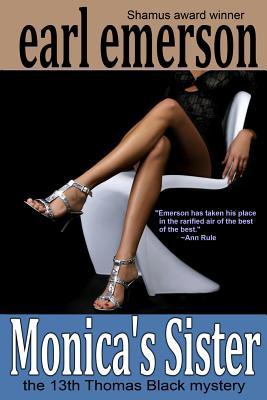
Monica’s Sister, by Earl Emerson *****

monicassisterAh, it’s good to be reading a Thomas Black story again. Black is back with his lovely wife, Kathy, a good-hearted woman who makes some interesting friends. One of them is Angela Bassman, a woman who shows up all the time like a bad penny, making ridiculous charges against anyone and everyone, and bragging about having so many friends in high places, having done such fantastic things, that one is left rolling one’s eyes. And so when Thomas hears Angela’s voice approaching his office, he does what any thinking human being would do: he leaps into the closet and shuts the door. Anything to avoid that woman!

The wheels of the story start moving, and things get more complicated. Angela, whose famous sister is the actress, Monica Pennington, hires Black to help her with what is supposed to be a simple task, but isn’t. He would like to back out, but he smells a rat. Despite the crazy nature of Angela’s claims, she is obviously being followed by someone. Strange things happen, and too many coincidences occur. Whether Angela is crazy or whether she isn’t, his detective’s intuition starts to quiver, and he becomes more entangled in her affairs than he had anticipated, especially when she falls to her death, and he sees it happen. Later, Pennington hires Black to find out why Angela killed herself. Because of course, that’s what happened…isn’t it?

Emerson, a Shamus winning author who sets his stories here in the misty Pacific Northwest, usually right here in Seattle, is one fine writer. Hundreds of interesting, free galleys come my way in a given year, but I wanted to read his story badly enough to put it on my wish list, and luckily, my spouse snapped it up and gave it to me for Mother’s Day. What a fantastic gift!

The overall tenor of the story begins as gut-bustingly funny, and then gradually darkens and becomes more suspenseful. By the story’s end, I was literally (yes, I do mean literally) sitting on the edge of my seat, putting off the family members that wanted my attention with a robotic “…just a sec. Just a sec. Yeah I know. Give me just a minute.”

Emerson also uses the occasion to talk a little bit about bipolar disorder, and the ways it can turn a person’s life upside down, but he does it in a way that prevents the book’s pace from hitching. It’s masterfully done!

If you like strong detective fiction, or fiction set in the Pacific Northwest, or both, you just can’t do any better than this book. Seriously recommended for just about everyone.

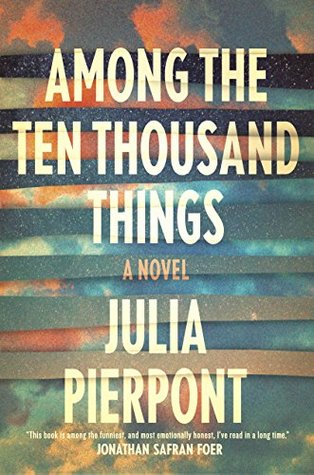
Among the Ten Thousand Things, by Julia Pierpont *****

amongthetenthousandJack is an artist living in New York City. Sometimes he sleeps in the apartment where he lives with his family. Sometimes he sleeps in his studio, when his work is really going strong. Just as sometimes he sleeps with his wife, whereas sometimes, he sleeps with whoever. This story is about the fallout that occurs when one of the random women he has taken up with, then discarded comes back with a vengeance, and though she intends to punish Jack through his wife, instead she ends up punishing him and his wife through their children, who are the unhappy recipients of the series of randy e-mails the woman he’s just jettisoned prints up and delivers to his building. My god, my god. And before I go farther, let me say thank you to Net Galley and Random House for allowing me a sneak peek. This book will be published next month.

Jack and his latest-fling have been prolific writers, it seems. It takes a large, somewhat weighty box to hold all the hideous missives that have passed between the two of them. And though it’s a rotten thing he’s done to his wife Deb, it slips out early on that she has married him only after dating him while he was married to someone else. Hey, what goes around, comes around.

Unfortunately, Jack is sufficiently garrulous enough with his recent conquest that he shares his children’s names with her, and when eleven year old Kay accepts the box to take upstairs, she is thinking that it is nearly her birthday, and perhaps what is inside is a gift that she can’t wait two weeks to know about. And then one of the papers on top of the pile has her name on it. It isn’t underlined, nor in bold or colored ink, but one’s name tends to jump out at one. And so the steamy sex talk she is way too young to see in any context whatsoever is accompanied by the sentence, “I know about Kay.”

It’s almost enough to permanently traumatize a kid. Well, maybe we can forget that “almost”.

The events are so horrible that any sensible reader would turn away rather than face what comes next, but Pierpont has a fresh, immediate writing style that pulls one in, almost to the extent that we care about those kids as if they were our own. We keep reading because we have to know what happens to them.

Several times I grew angry enough with Jack that I found myself senselessly typing angry retorts into my kindle comments. Nobody sees that stuff but me, but typing seemed better than waking my spouse to inveigh against this self-absorbed asshole, this swine who has the nerve at first to blame Kay for reading mail not meant for her eyes. Oh please!

And when Deb equivocates, I want to smack her, too. Sure, I know I said that what goes around comes around, but once you have children, the whole equation is altered, and you have to act immediately on their behalf. She feels a little sorry for Jack at first, at the alienation his children display toward him, and I just want to shake her. Don’t feel bad for him, the pig! Feel bad for your kids! Hello?

The kids are really what the book is all about, what makes it worth reading. They aren’t little big-eyed Holly Hobbie dolls, but both innocent and insolent, naughty and adorable, disturbed, devastated, and resilient as well. They flounder; they struggle. And when the story ends, the spell isn’t really broken until one accepts that they are fictional, because believe me, the whole thing feels so very real.

Pierpont is a damn good writer. She will be a force to be reckoned with in the literary world, a writer to watch. I can’t wait to read whatever is next!
As for you, you should get this novel when it comes out July 7. Maybe you should even reserve yourself a copy. What a fascinating book, by a strong new author.

The Missing and the Dead, by Jack Lynch *****

themissingandthedeadJerry Lind is missing, which is especially strange, given that he knows he is about to inherit a small fortune. It seems unlikely that he would take off for a long time without letting someone know about it. He ought to be back by now. Moreover, the next people in line to inherit his share are also wondering if he is okay. Not that they hope he isn’t. Of course not! And at this point I have to break my narrative to let you know that I was fortunate enough to get this DRC free, courtesy of Net Galley and Brash Books. It was previously published in the 1980’s and is just now being released digitally.

Back to Jerry. No, never mind, forget him for a minute. Let’s talk about our assassin.

Our assassin is not getting any younger, and his wife is exhausted from all the moves. Every time he carries out a contract, they have to either abandon their stuff or get a truck, and over years and years of professional killing, it wears a woman down. She wants a garden. From now on, he needs to either make do with the significant amount he’s squirreled away from his successful if messy business, or he’s going to have to goddamn hide the bodies.

It’s the least he can do for her.

Peter Bragg is our man. Jerry’s sister hires him to go to Barracks Cove, where Jerry was supposed to be running a professional errand, and see if he can’t track him down. And Bragg goes in prepared. If you are sick of reading wussy narratives that give flimsy reasons for the intrepid sleuth not to carry a gun and make sure he has bullets, this is your guy, and this is your story. Has he ever fired that thing? Oh yes. But not just for practice…in the line of duty? Again, oh hell yes.

And it’s a good thing, as it turns out.

By the time the thing is over, a great deal of action has taken place, and though I am a six-to-eight book-at-a-time reader, the urgent, taut narrative (reminiscent somewhat of the Richard Stark detective novels from about the same period) grabbed me by the front of my shirt and held me there until the last page was turned.

It was nominated for an Edgar, and the clever juggling of setting and character development, along with a plot line that is unbelievably lean and compelling, will probably leave you wondering, as it did me, why he was denied and just who exactly did get it.

The consolation? If you have a kindle, you can read this book right now. Change the window on your screen and order it up. You’ll have an excellent weekend…if you can wait that long!