
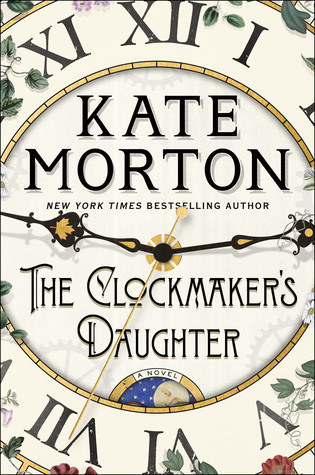
The Clockmaker’s Daughter, by Kate Morton***

TheClockmakersDaughterKate Morton is queen of the British historical mystery, and so I leapt at the chance to read and review The Clockmaker’s Daughter. My thanks go to Net Galley and Atria Books. This book will be available October 9, 2018.

This story starts strong with a spellbinding first person narrative told by the woman whose spirit resides eternally at Birchwood Manor. She came here with Edward, a wellborn cad that “could make the very devil pray”, one that called her his muse. Edward seduced her, yes, but he would never have married her.

Elodie Winslow is an archivist in present-day London.  In the course of her duties, she runs across two pictures in a leather satchel. One is a photograph, quite old, and the other is a sketch of a house that seems familiar to her somehow. And so of course, faithful readers are cued right away to watch for a connection between Elodie, and the people, setting, and events that are introduced at the book’s beginning.

Find me a writer that can create more resonant settings in a British historical mystery; I dare you. For the first quarter of this novel, I was in it, steeping in the escapist paradise Morton provides, drinking in the several characters and narratives. But at the thirty percent mark, when yet another new thread, another new character—or is it an old character pretending to be a new character—is introduced, I find myself searching for a nice brick wall to smack my forehead against. It’s hard to get to know any of these characters with so many new ones added.

Usually with Morton’s books, the details and subsections are worth the reader’s careful attention because it all comes together so well at the end. Here, there’s excellent setting and a lot of secrets but not enough plot or character development, and so before the story is even halfway done I find myself eyeing the page numbers. How much longer…?

I also find myself wondering what story elements are classic, and which are simply overused. The old house with the secret doors?  I will never get tired of this element, especially when the writer is as capable as Morton. But bullies at a boarding school—meh. I am ready to be done with that one. And the sack of kittens to be drowned? I gave myself permission to skip a page, because it is. Not. Worth. It.

Many of Morton’s faithful fans will be pleased; her trademark style is unmistakable, and if that’s what you want, here it is. But a story this complex needs more legs to go with it, and less reliance on stale devices.

Am I done reading Morton? Not by a long shot. Every author has a story or two that isn’t magical. But when a story requires this much effort on the part of the reader, the payoff needs to be greater than it is here.

Recommended to diehard Kate Morton fans; even so, get it free or cheap, but don’t pay full jacket price this time.
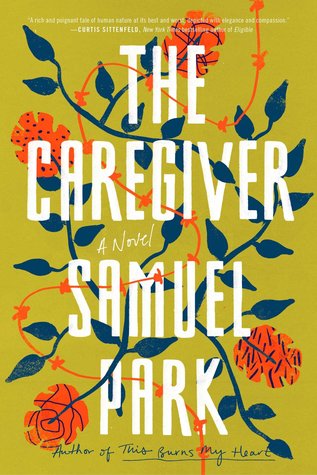
The Caregiver, by Samuel Park*****

TheCaregiverThe Caregiver is one of the year’s best surprises. I read this book free and early, thanks to Net Galley and Simon and Schuster. Our protagonist is Mara Alencar, and our setting is split between present day Los Angeles, and Rio de Janeiro, Brazil in the 1980s. I am drawn to the story initially because of the setting, which I don’t see often; but it is Mara that keeps me turning the pages. Those that treasure excellent, character-based literary fiction should get this book and read it.
Mara is just a kid, and all she really wants is food, shelter, and the comfort and companionship of her mother, Ana. Ana is a young single mother that works as a voice-over actress, repeating the lines of English-language programs in Portuguese. The pay is low, and Ana’s self-discipline is negligible. Life is a constant struggle.

One evening Ana is visited by a group of students that claim they plan to rob a bank in order to fund a revolution. Ana’s job is to distract Chief Lima so that a comrade can be liberated from prison. The comrade will play an important part in the revolution; as for Ana, she will be paid handsomely, and then she will be free to go if she likes. Mara doesn’t like these rough people and their threatening demeanor, but Ana hears the amount they will pay, and once she receives an advance, she’s in.

Everything is seen through Mara’s eyes, both in childhood as these events unfold, and later, looking back during her years working as a caregiver to a manipulative older woman that shares some of Ana’s characteristics. As a child, Mara is often afraid or confused, or both. Her mother reminds her often that she is all that matters, and that the two of them will always be together; in the next moment, she will do something so blindingly selfish, so completely inappropriate that I want to yank the woman into the kitchen and remind her that she has a child and responsibilities. She will tell Mara, not for the first time, that she could never stand to lie to her because they are so close, and she loves her so much; but we turn the page and sure enough, she lies to her child, or she is gone for days on end with no warning or explanation. There are occasions when she seems to lie unnecessarily, and I want to throw my tablet at the wall, I am so frustrated.

The ending is a complete surprise, and it makes perfect sense within the chaotic context of the time and place.

The most admirable aspect of this story is the consistency of the narrator. A writer that can tell a story from a child’s point of view without mixing up the developmental level that affects a child’s perceptions, vocabulary level, and capacity to analyze what she sees is hard to find. A male writer that can do this, and that can also consistently write a woman’s story in the first person without giving himself away is a unicorn. Samuel Park convinces me that I am listening to a woman tell her story, and repeatedly I am pulled under, only to be reminded when I go to make notes at the end of my writing session that this is a male novelist. This doesn’t happen. I am gob-smacked at his level of perception and originality.

I never met Park, but I grieve for him anyway as a reader. Please come back, Mr. Park. One book is not enough; forty-one is too young.

Highly recommended.

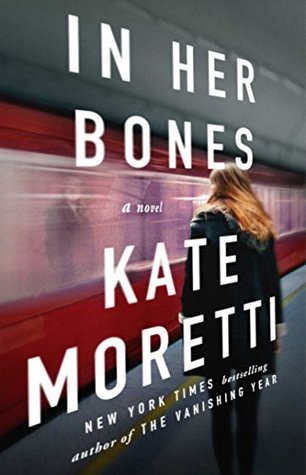
In Her Bones, by Kate Moretti****

InHerBonesMoretti’s mysteries are addictive, and when I found this galley in my email, I jumped it to the front of the queue. Big thanks go to Net Galley and Atria for letting me read it free and early. You can buy it now.
Edie is an outcast, spurned by her friends when her mother Lilith is arrested as a serial killer. Since it is so rare for a serial murderer to be female, the press is everywhere; meanwhile, all Edie has left is her brother Dylan and later, his young family. Otherwise, the people to whom she feels most closely bonded don’t know Edie, don’t realize that she is watching them, obsessing over them in person and in cyberspace; they are the bereaved family members of Lilith’s victims. It gives me chills.

One day Edie takes her voyeuristic tendencies to the next level; when the man she’s been stalking is found dead, police immediately suspect Edie of being his killer. And as we read Edie’s narrative, which tells us some things but not everything, we wonder too: is Edie a lonely, isolated young woman searching for connection to another human being; or is she a chip off the old block, a stone cold killer just like her mama?

The first person narrative alternates with a third person study of Lilith, and so the voice switches from Edie’s very personal story to a clinical, dry report regarding her aberrant mother. (Let me tell you, whatever issues you may have with your own mother—she’s going to seem like the mother of the year once you’ve read this.)

I’ve read a few unhappy reviews by online friends. but I like this book. It helps if you approach it as a mystery rather than a thriller; those in search of a grab-you-by-the-hair page-turner may not get what you’re looking for, but I wanted an interesting story with an original premise and a credible ending, and this is that. In addition, the third person case notes written by social workers and their ilk ring true to me. In fact, I made a wry note to myself, wondering whether Edie or Dylan might have been in one of my classes; I have never taught the children of a serial killer to my knowledge, yet the wanton neglect and lack of nurturance, even a simple effort to provide the basics eludes Lilith in a way that seems familiar. You think I am exaggerating? Not so much. There are terrific parents; there are indifferent parents; and there are, I am sad to say, more than a few Lilith Wades out there in the parent pool.

This is my third galley by this writer. Whereas I liked The Blackbird Season a little more than this one, mostly because of its amazing word smithery, I find this story more original and memorable than The Vanishing Year, which has the sort of denouement that makes me roll my eyes. Here Moretti pulls the ending together in a way that keeps me thinking about the characters rather than the author, and I sigh with appreciation when it’s done.

All told, it’s a solid mystery with a satisfying conclusion. Recommended to all that enjoy the genre.

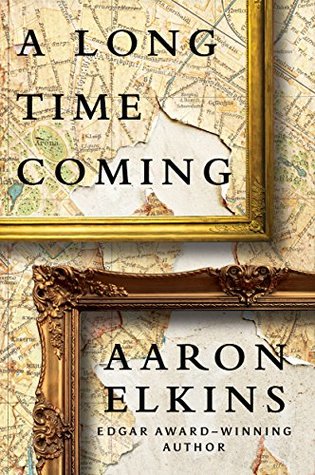
A Long Time Coming, by Aaron Elkin**

ALongTimeComingAaron Elkin has been writing mysteries for a long time, but he is new to me.  When I saw this title listed on Net Galley, I went to Goodreads and found that his work is well regarded by some of my friends; add to this his residence in my own Pacific Northwest, and I am ready to give his work a try. Thanks go to Net Galley and Thomas and Mercer for the DRC, which I received free of charge in exchange for this honest review.

The story starts well. Val Caruso is an art curator, and his personal life is a mess. He’s stone cold broke, and so when he is approached to do a job involving a stolen-but-found Renoir, his interest is piqued. An ancient Holocaust survivor claims ownership of a painting that has been sold to someone else, and Caruso is hired to help. I particularly enjoy the character of Esther, the domineering but charming friend that connects the two men; alas, we will soon leave her behind when we go to Milan.

At the outset the amount of art related information feels just about right to me. The book is sold as a popular read rather than a niche item for art aficionados, and I am cheered by this, since I have little to no interest in art. As we travel to Milan, however, the art lectures become oppressive. By the forty percent mark I find myself watching the page numbers roll by, oh so slowly, and cursing myself for having taken the galley. Brush strokes? Historical nature of paint color? Who the hell cares? The travelogue aspect of the book also starts well, but eventually the level of detail slooows this story to a crawl. I find myself cynically wondering whether this series is simply a ruse for the author to claim his globe-trotting expenses on his tax returns.

Elkin has a solid reputation built on an earlier series, and at some point I may give that one a whirl, but Val Caruso and I are done.