
The Old Fire, by Elisa Shua Dusapin***

Elisa Shua Dusapin is the author of The Old Fire. My thanks go to NetGalley and Simon and Schuster for the invitation to read and review. This book is for sale now.

The promotional materials describe this brief work of literary fiction as the author’s “most personal and moving novel yet.” If that is truly the case, I don’t think I want to read her earlier work. It’s not a terrible novel necessarily, but given the hype, I am a little surprised. Someone else praised it as “subtle,” and I can vouch for its subtlety; but for me, it is a story in which I keep waiting for something to happen, and in the end, I’m still waiting.

In broad contours, it is a story in which our protagonist, Agathe, must return to the tiny hamlet in France in which she was raised following the death of her father. Her sister Vera is still there, but they haven’t seen one another in a long time. Her mother is alive, but the parents split up when she and Vera were children, and they don’t see her. She and Vera must deal with the estate, hence the title.

As Agathe returns to the house where she was raised, there are all sorts of issues hovering in the background. She is pregnant, deciding what to do about it; her sister Vera, who is mute due to some physical but unexplained cause, resents her for moving to New York when they were both still fairly young; Agathe has a partner back in New York that wants a commitment, but she holds him at arm’s length. She used to have a crush on a neighbor in their French village; does she still?

As the book ends, none of these things is addressed much. Agathe and Vera sort through their father’s effects and make decisions, not always agreeing; there’s a great deal of inner monologue; and when Agathe leaves to return to New York, nothing much has changed or been decided about anything. And I am left with questions and more questions. What’s with Vera’s mutism? Why don’t they and their mother talk? Agathe comes to France, and not even a phone call…? What does Agathe even think of the man back in New York that’s waiting for her?

I’m inclined to recommend this book to insomniacs as a sure cure, but it’s probably not that simple. I note that it was a huge hit in France, and has been translated into dozens of languages, yet most English-speaking readers seem as underwhelmed as I am, and so I have a hunch that my lack of enthusiasm may be cultural. But I can only report my own impressions, and my impressions say that this book is a snooze fest.
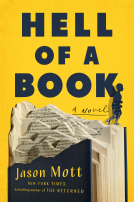
Hell of a Book, by Jason Mott*****

It really is.

This book is a standout in more ways than one. First the obvious: look at that cover! Then again, how many novels have a nameless protagonist all the way through the book? Get into it deeper, and the distinctions become more complex. The buzz around it is wholly justified. My thanks go to Net Galley and Random House for the review copy. This book is for sale now.

Our author is on an odyssey that takes the form of a book tour, and it lands him, in the end, back where he grew up. He doesn’t tour alone; apart from the various organizers he meets in various locations, he is accompanied by a small Black child he refers to as “The Kid.” Alternately, we also see the story of a young Black boy, a very Black boy, nicknamed “Soot,” who grows up in the American South.

As I read, I am always on the back foot, understanding most of what it being said, yet developing questions as I go. Our author says (often) that he has a condition, and that this is probably why he can see The Kid when others cannot. My notes ask whether his condition is dissociative, and is The Kid just part of himself? Or is The Kid Soot? Are Soot and The Kid both part of the author? Every time I come up with a plausible theory, something else happens to undercut it. Yet one other thing becomes clearer all the way through: to be born an African-American boy in the United States is to be perpetually on the back foot; perpetually having to guess how best to proceed; to perpetually guess at one’s welcome or lack of same, at the quality of one’s relationships with Caucasians, to perpetually guard one’s own safety. And to be very Black—“Nigga, I bet when you get out of the car your daddy’s oil light come on”—is to invite not only the suspicion and hostility of Caucasians, but to draw the enmity of lighter Black people, too.

The synopsis of this story that initially drew me billed it as humor, and in places, it is not only funny, but laugh-out-loud funny. But the further we get in, the darker it becomes.

There are a number of sardonic references to the publishing world; editors, agents, and other promoters have told the author that while it’s fine to write about Black characters, He must not write about being Black:

“The last thing people really want to hear about is being Black. Being Black’s a curse—no offense—and nobody wants to feel cursed when they read something they just finished paying $24.95 for…The future of this country is all about patriotic, unity-inducing language. Post-Racial. Trans-Jim Crow. Epi-Traumatic. Alt-Reparational. Omni-Restitutional. Jingoistic Body-Positive. Sociocultural-Transcendental. Indigenous-Ripostic. Treat of Fort Laramie-Perpendicular. Meta-Exculpatory. Pan-Political. Uber-Intermutual. MOK-Adjacent. Demi-Arcadian Bucolic. Write about love. Love and Disney endings…”

Later, an interviewer asks if the past doesn’t still matter, and the author says, “It does. Not just three-fifths of it, but all of it.”

So, my friend, you can see why this book should be called a love story. Race? Oh, no no no. Fear? Injustice? Police brutality? Of course not. After all, this is a hell of a book!

Highly recommended; one of the year’s finest.