
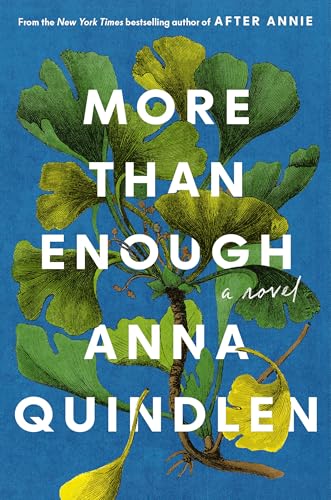
More Than Enough, by Anna Quindlen*****

More Than Enough, the new novel by Anna Quindlen, packs a great deal of intimacy into a relatively short book. My thanks go to NetGalley and Random House for the review copy. This book will be available to the public February 24, 2026.

The story arc here is not a traditional one in that there are several threads relating to the protagonist, and it’s hard to identify one as central. Instead, all of them are interwoven around a theme of knowing how to let go and move forward. Our protagonist, Polly Goodman, wants a baby desperately. She and her husband, a zoo veterinarian, have been trying for years. They’ve done blood tests, fertility treatments, and even in vitro procedures, but in the end, she comes away with an empty womb and no baby. The hardest thing is when she feeling vulnerable and someone is gentle with her: “I was one kind impulse from a kidnapping or a crying jag.”

In the midst of it all, she is momentarily distracted by the results of a gag gift given to her by her book club buddies. They present her with an ancestry kit, and the results are surprising. At the same time, she struggles with her parents. Her mother, a judge, is wedded to her career, and Polly has never been able to connect with her emotionally. Her father, whom she loves more than nearly anyone, suffers from dementia and lives in a facility. She visits him nearly every day.

And the best friend she has—one of the book club pals—has cancer, and it’s not going well.

All of these threads blend seamlessly within the narrative; Quindlen has such an engaging writing style that I’m not thinking about a central storyline because I feel as if I’m hearing from a friend. Usually I don’t enjoy reading stories about people that might be called upper middle class, because I cannot relate to them at all, but Quindlen magically bridges that gap.

I could go on, but I’m not sure I should, because I love this story enough that I want to tell you every single thing that happens, and that’s not a good idea. The one additional thing you should know, if you don’t already, is that Quindlen has a great heart for teachers and for teens, and so she portrays both in a way that is authentic and immediate. Again, I should not relate well to the private school where Polly teaches girls that come from well to do families, but Quindlen reminds me that all children have needs, and all children deserve not only an education, but an adult sensitive enough to understand them.

I hope Quindlen lives—and writes—forever, but when she goes, as we all must, she should be made the patron saint of high school teachers.

Highly recommended.

Ohio, by Stephen Markley*****

OhioMarkley’s thunderous debut is not to be missed. My thanks go to Simon and Schuster and Net Galley for the review copy, which I read free and early, but this is one of the rare times I can say that if I’d paid full hardcover price, it would have been worth it. This is the summer’s best fiction, and it’s available to the public August 21, 2018.

Our story is broken into a prelude and four additional parts, each assigned to a different protagonist, all of whom knew one another, traveling separately from four different directions; they were born during the great recession of the 1980s and graduated from New Canaan High in 2002, the first class to graduate after 9/11. We open with the funeral parade held for Rick Brinklan, the former football star killed in Iraq. His coffin is rented from Walmart and he isn’t in it; wind tears the flag off it and sends it out of reach to snag in the trees. The mood is set: each has returned to their tiny, depressed home town, New Canaan, Ohio, for a different purpose. The town and its population has been devastated economically by the failure of the auto industry:

“New Canaan had this look, like a magazine after it’s tossed on the fire, the way the pages blacken and curl as they begin to burn, but just before the flames take over.”

At the mention of football, I groan inwardly, fearing stereotypes of jocks and cheerleaders, but that’s not what happens here. Every character is developed so completely that I feel I would know them on the street; despite the similarity in age and ethnicity among nearly all of them, there is never a moment when I mix them up. And the characters that are remembered by all but are not present are as central to the story as those that are. As in life, there is no character that is completely lovable or benign; yet almost everyone is capable of some goodness and has worthwhile goals.

Families recall the closure of an industrial plant with the same gravity with which one would remember the death of a beloved family member; the loss has been life changing. Residents are reduced to jobs in retail sales and fast food, welfare, the drug trade, and military service due not to legal compulsion, but economic necessity. Everyone has suffered; Walmart alone has grown fatter and richer.

This is an epic story that has it all. We see the slide experienced by many of New Canaan’s own since their idealistic, spirited teenaged selves emerged from high school to a world less welcoming than they anticipated. One of the most poignant moments is an understated one in which Kaylyn dreams of going away to school in Toledo. This reviewer lived in Toledo during the time when these youngsters would have been born, and I am nearly undone by the notion that this place is the focus of one girl’s hopes and dreams, the goal she longs for so achingly that she is almost afraid to think of it lest it be snatched away.

Because much of each character’s internal monologue reaches back to adolescence, we revisit their high school years, but some of one person’s fondest recollections are later brought back in another character’s reminiscence as disappointing, even nightmarish. The tale is haunting in places, hilarious in others, but there is never a moment where the teen angst of the past is permitted to become a soap opera.

Side characters add to the book’s appeal. I love the way academics and teachers are depicted here. There’s also a bizarre yet strangely satisfying bar scene unlike any other.

Those in search of feel-good stories are out of luck here, but those that treasure sterling literary fiction need look no further. Markley has created a masterpiece, and I look forward to seeing what else he has in store for us.

Amish Guys Don’t Call, by Debby Dodds****

AmishGuysDon't Amish Guys Don’t Call is funny, absorbing, and ultimately lifting. Dodds has a great heart for teenagers, and this title is one that should grace every high school and middle school library, and will also attract parents and teachers of adolescents. I read it free and early thanks to Net Galley and Blue Moon Publishers. This book will be available to everyone June 13, 2017.

Samantha is still smarting from her parents’ divorce and her father’s inattention when her mother moves them to Lancaster, Pennsylvania, which is the heart of Amish country. Samantha has been in trouble for shoplifting, and the urge increases when she is in stressful situations. To her surprise and delight, she strikes up a friendship with Madison, who in turn pulls her into the most popular circle at school.  The one thing that gets in Sam’s way is her wholesomeness. She doesn’t drink, smoke, or use street drugs; not only is she still a virgin, but she’s never had a boyfriend. Madison tells Sam that all of this can end, with some careful time and grooming. Thus is “Project P” launched.

Despite the name of the boyfriend project, this book is free of explicit sexual situations. We see drug use, and sexual situations arise, so those considering whether this title is right for your teen or group of teens should bear this in mind. If in doubt, buy a copy for yourself and read it first.

At a big party held at night in a cornfield by Amish boys during their Rumspringa, a period in which some Amish groups permit their adolescents a taste of what the outside world is like and tolerate sometimes-extreme behaviors as a rite of passage, Samantha meets a young man named Zach. He’s handsome, and he’s drawn to her. We can tell from his behaviors (as well as the book’s title) that he is Amish, but it takes quite awhile for Sam to catch on. She is obsessed with his failure to provide her with his cell number. Is there another girl in the picture?

This story was a fun read, but I don’t recommend it to general audiences apart from those that really enjoy a wide variety of YA novels. Every nuance is explained thoroughly, and so whereas the text is accessible to students—with vocabulary at about the 9th grade level—most adults will want something more nuanced.  That said, if I were still in the classroom, I would purchase this title. Because the subject matter might provoke conservative parents, I would not use it as assigned reading or use it as a classroom read-aloud, but I know that a lot of students will want to read it.

Recommended for teens that are not from highly conservative backgrounds.