
Ian Fritz was an Airborne Cryptologic Linguist who served with the U.S. Air Force in Afghanistan for five years. Trained in both Dari and Pashto, he became one of only two people that could understand what was being said by all of the people on the ground before and during battle. Following his service, he became a physician and writer. This is his memoir.

My thanks go to Simon and Schuster Publishing and NetGalley for the invitation to read and review. This book is for sale now.
Fritz was in many ways the perfect recruit; his family didn’t have any money, and he was brilliant, which meant that if he was going to have any opportunities, they would most likely come from the U.S. armed forces. He blew through his public school years, as gifted students that aren’t challenged often do.
This is where I long to stand on a big box and yell through a bullhorn: gifted students are at risk children! We must provide them with challenging, interesting curriculum, or they will stop bothering with school. I’ve been saying so for decades, and I’m saying it again right now. So many times educators and school districts assume these kids will automatically be fine. If the student is bored, they use them as unpaid tutors for their peers, which distorts relationships among the students and does nothing to provide the highly capable student with new, interesting material. These kids need different educations from those in the mainstream. Ian’s story is a powerful example of why this is so.
Ian was sent to an elite language training program, and then he was deployed. Initially, the successful flights in which targets were found, identified, and killed—often partly or solely because of his contribution—were exhilarating, but as time went on, he began to feel conflicted. On the one hand, the Taliban were responsible for the horrific, cowardly attacks on American civilians on 9/11, and were therefore a legitimate target. On the other hand, being able to understand what enemy soldiers were saying to one another made him aware that these were normal people, attempting to live their lives and repel the U.S. invaders. It’s hard to hate someone, or to be indifferent to them, when you overhear them discussing their plans for after the day’s fighting is done, or declaring that it’s just plain “too hot for Jihad today.” Sometimes a threat on the ground would be identified, and the Americans wouldn’t realize that this was an error until after the person they’d targeted was dead. And he knew the names of the dead, sometimes hear the survivors below desperately trying to get their comrade to a medic, but then…oh. Too late.
Then there was this culture among others he served with, those not trained in the language and who were therefore able to demonize the targets, howling with laughter at the way a body on the ground could be made to bounce if you shot it at just the right angle. He realized that “no one else had heard, and no one else ever would hear, the simultaneous screams of the JTAC [U.S. officer on the ground] and the Talibs. Or the sudden quiet when the Talibs died.”
Ultimately, he learned that Afghanistan was actually a lot safer without U.S. forces than with them.
As Fritz began to internalize his despair, he grew suicidal, and he knew he had to get out. It’s at this point that he was charged with malingering and cowardice; he would later learn that it was a trend among the linguists serving in this theater.
Fritz is one hell of a fine writer, and the narrative flows smoothly. I was surprised to find that this was a quick read, despite the intensity of the material. Surely there must be other military memoirs relating to Afghanistan, but as he points out, nobody else is writing about this experience, because almost nobody else has done what he has.
For those with the interest and the courage, this memoir is recommended.
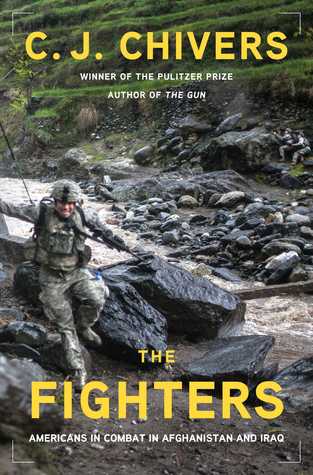 Chivers is a senior editor at The New York Times, and has won the Pulitzer for journalism. This meaty but readable book is the culmination of his years covering the U.S. wars in Iraq and Afghanistan. It is not the creation of a man parked in a library behind his laptop; he has personally gone to Iraq, Afghanistan, Syria, Ukraine, and Libya, and has either accompanied the people he writes about or retraced their footsteps. He covers the lives of six servicemen in the lower and middle ranks of the armed forces, and so he primarily uses eye witness reporting and interviews, in addition to American military data. I read it free courtesy of Net Galley and Simon and Schuster in exchange for my honest review. The Fighters will most likely be regarded in future years as the go-to book for those that want to know more about this war and the people whose lives were changed by it—including many of those whose homeland is or has been part of the war zone.
 Seattle Book Mama