
The Demon of Unrest, by Erik Larson*****

When it comes to history, it’s hard to conjure a more capable author than Erik Larson. I’ve thought this for some time, but his Churchill biography, The Splendid and the Vile (2020) cemented this impression.  I am therefore gushingly grateful to NetGalley and Crown Books for the review copy. I would have paid full cover price for this book if that was the only way that I could get it—or the only way that I could get it soon.
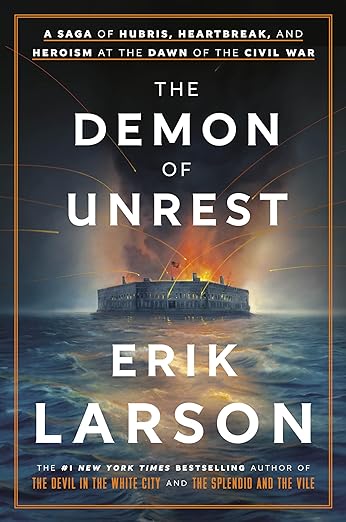
This book focuses on Fort Sumter, the Federal fort off the coast of South Carolina that became the catalyst for the opening guns of the American Civil War. The Southern states that seceded from the US, or that attempted to do so, believed themselves entitled to seize the forts, munitions, and indeed, every single ounce of American property located within the borders of their states—and although Fort Sumter and the lesser, partially constructed forts around it were on islands rather than inside the state’s boundaries, they expected to annex those, too.

Meanwhile, as most know, Major Robert Anderson was the fort’s commander, and he desperately wanted orders from Washington. The period following Lincoln’s election, up until he actually took office, was a critical one, but President Buchanan was determined to postpone any official acts until he could hand the responsibility to someone else. He didn’t want his legacy marred by the beginning of a civil war, or indeed, by any sort of noteworthy strife whatsoever, and so he mostly just hid from everyone. Representatives from South Carolina—would-be ambassadors that came to conduct international business—were turned away without official recognition, and that’s about the only worthwhile thing the guy did. And during this fraught period, Anderson and those he commanded waited tensely to learn whether they would be ordered to evacuate, or to defend the fort.

They waited a long damn time; too long.

This is a complex story and an interesting one, and so there are many historical characters discussed, but the primary three that take center stage are Major Anderson; Edmund Ruffin, a South Carolinian firebreather, stoking the fires of secession; and Mary Chesnut, the highly literate wife of a member of the ruling elite. Others of importance are, of course, President Lincoln; Allan Pinkerton, the head of the notorious Pinkerton Agency, which is tasked with keeping Lincoln alive; and a Southern power broker named Hammond, with whom the story begins.

In starting the narrative by discussing Hammond, Ruffin, and Chesnut, Larson gives us a fascinating window into the minds of the South Carolinian ruling elite, known among themselves as “the chivalry.” They style themselves as if they were characters from out of Arthurian legends, placing their own somewhat bizarre code of honor above every other possible principle, and beyond matters of simple practicality. I’ve always been fascinated by the way that leaders of morally bankrupt causes arrange their thoughts and rationales so that they can look at themselves in the mirror every morning and like what they see, and nobody can explain it quite the way Larson can. Everything is crystal clear and meticulously documented. I’m a stickler for documentation, and so although I feel a little silly doing so for someone of his stature, I pull two of his sources, Battle Cry of Freedom, by James McPherson, and Mary Chesnut’s Civil War, which is the diary she wrote leading up to and during the war, from my own shelves, and turn to the pages indicated in a couple of the notes. There they are, just where Larson said they’d be! This may not impress you, but it makes me ridiculously happy.

The story commences with Hammond, a wealthy planter with a highly elastic moral code. There’s a fair amount of trigger worthy material here—though the term had not been coined yet, he was a sexual predator of the highest order, and delighted in writing about the things he did to his nieces. Although this information, drawn from primary sources, does its job by letting us know exactly what kind of person helped shape the rebellion, it’s hard to stomach, and I advise readers that can’t stand it to either skim or skip these passages, because one can easily understand the majority of the text without them.

Once upon a time, this reviewer taught about the American Civil War to teens, and yet I learn a hefty amount of new information. In particular, I find the depiction of Anderson illuminating. I have never seen such a well rendered portrait of him before.

I could discuss this book all day, and very nearly have done so, but the reader will do far better to get the book itself. Highly recommended, this may well be the best nonfiction book of 2024.
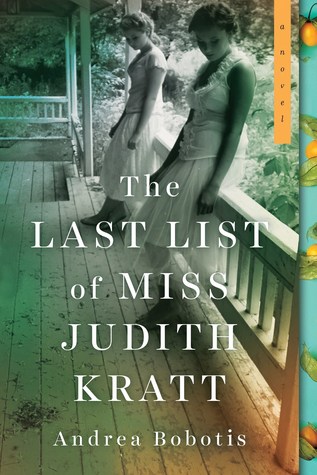
The Last List of Miss Judith Kratt, by Andrea Bobotis*****

“We will choose what we take with us.”

This thunderous debut by Andrea Bobotis bears a small resemblance to the work of Elizabeth Strout and the late Harper Lee. Issues of race and menacing family secrets simmer beneath the surface of this narrative like some otherworldly being biding its time in the swamp, till at last it rises and we must look at it.

As the story commences, Judith, who is quite elderly, is ready to take inventory. Her family home, all six thousand square feet of it, is jammed full of heirlooms, and each is fraught with history. The year is 1989, but as Judith examines one heirloom and then another, she takes us back to the period just before the stock market crashes, back when she was young and her parents and brother were still alive.

I have to confess that the first time I picked up this story—free to me, thanks to Net Galley and Sourcebooks Landmark—I thought, Huh. A boring old lady and her stuff. Pub date’s a ways off, so let’s put this one on the bottom of the pile. Of course, I picked it up again later. I read a bit farther this time and found I was acutely uncomfortable; I told myself I had to read it because I had requested the galley, but then I didn’t for awhile.

But like Judith, I pride myself on being reliable, so toward the end of June I squared my shoulders and opened the book. An hour later my jaw was on the floor and my husband was avoiding me, because he knew if he got too close I would start reading out loud. If you were to show up right now I’d do the same to you. I genuinely believe this novel and the characters and social issues they’re steeped in is one for our time.

Judith is the eldest of the Kratt children; her companion, Olva, lives with her, but her status is undetermined and remains that way far into the book. Part of the time she appears to be a live-in servant, hopping up whenever Judith wants a cup of tea or a blanket; at other times the two of them sit on the porch together and watch the world go by as if they were sisters or good friends. We know that they grew up together and share a history as well as the trauma of growing up with the vicious, unpredictable Daddy Kratt, the wealthiest man in Bound at the time.

As layer after layer is peeled back, using the household treasures that are inventoried as a framework of sorts, we see the gratuitous cruelty that was part of both women’s daily existence as children. Kratt can be generous at times, and yet at others—with increasing frequency—he is vicious and sadistic. We see the responses his unpredictable fury brings out of Judith as a child, her younger brother Quincy, who’s a chip off the old block, and their younger sister, Rosemarie. Kratt can ruin someone’s entire life purely on whim and never feel the slightest regret. He likes to watch. The entire town fears him.

Now he’s gone, and here we are. Judith acknowledges that her social skills are stunted, and she never knows what to say or do to smooth a difficult situation. She was never a pretty girl, and she has never married.  We can also see that she is solipsistic, insensitive to the feelings of others, and at times just straight-up mean, but she doesn’t see herself that way, because she measures herself against her late parents.  Judith is nowhere near as nasty as her daddy was; she has never permitted herself to be broken by him, as her mother was.  So Judith tends to let herself off the hook lightly. As she remembers back over the years the cataclysmic events that have taken place around her—or in some cases, because of her—her overall tone is self-congratulatory.

But her little sister, who is also an old lady now, returns to the family manse, and that overturns the apple cart in a big way.  How dare Rosemarie run out and leave Judith to contend with that awful man but now come back to claim her birthright?  Isn’t that right, Olva?

Olva just smiles.

In fact, this story is every bit as much about Olva as it is about Judith. . Every single one of these women is sitting on secrets; every one of them has a different story to tell. Every new revelation brings additional questions to mind, so that although this is not a mystery or a thriller, I cannot stand to put it down. I generally like to flop on my bed at night and read before I go to sleep, but I can’t do that with this book. I’d climb under the covers; open the book; read a little ways and then sit bolt upright. Eventually I realized that this cannot be the bedtime story. (It occurs to me just now that retelling one or another portion of this story in the voice of one of the characters not heard from would make a great creative writing assignment related to point of view.)

What Bobotis has done here is masterful. She begins with an old, wealthy white woman and yet develops her, and I cannot think of even a dozen books where that has been accomplished in a believable way in literature; once we get old, that’s pretty much who we are going to be. But the elderly Judith at the story’s end is a better person than the elderly Judith at the outset. And as if that weren’t enough, she also develops Olva, the dark-skinned elderly companion that seems to us, at the beginning, to be a live-in servant or nurse of some sort. But however circumspect Olva has been—a prerequisite for an African-American that wants to stay alive in the American South in the past and at times, maybe the present—Olva does in fact have some things to say. It is Rosemarie’s return that makes this possible.

This isn’t necessarily a fun novel to read, and yet the skill with which it is rendered is a beautiful thing in and of itself. I believed every one of these characters, those within this pathologically corrupt family and those around it. I suspect that the formidably talented Bobotis could pluck any one of these characters and create a sequel just as remarkable. This writer is going to be around for a long, long time, and as for me? I’m ready to read whatever she comes up with next.

Highly recommended.

Call Your Daughter Home, by Deb Spera*****

Deb Spera is a force; small wonder that Call Your Daughter Home is the book that bloggers have been talking about. This barn burner of a debut goes on sale today.  My thanks go to Net Galley and Harlequin for the review copy.  It curled its fingers around me on page one, and by page ten I knew it wouldn’t let me go till it was done with me. It ended as powerfully as it began.

The year is 1924. Gertrude Pardee lives with her four little girls in a shack in the swamp in Third World conditions; they are nearly feral. A storm is coming, but Gert has a job to do. Her brutal ass hat of a husband lies dead in the swamp, dispatched by the bullet she blasted into his brainpan. As the storm bears down, she peels off her only dress and strides naked into the muck to deal with his corpse:

“Alligators feed once a week, and sometimes, if the prey is big enough, they don’t need to eat for almost a year. But I don’t know how long it takes a gator to eat big prey. Daddy never said nothing ‘bout that and I never asked.”

Our other two main characters are Retta, the first free woman in her family, and Annie, Retta’s employer. Retta cares for Mary, Gert’s youngest, when Gert is too sick and injured from the broken face she sustained the last time Alvin beat her; Retta’s husband Odell and her neighbors all tell her that it’s trouble to bring a white child into Shake Rag. “Don’t get messed up with that white family. No good can come of it,” and she knows it’s true. What if the girl dies? But Gert coaxed her into it, telling her it would be the Christian thing to do, and Retta is moved by this sick, helpless five year old. She assures everyone it’s just for three days.

Miss Annie is a Caucasian small businesswoman and wife of a farmer, yet she has trouble of her own; there’s some dark family baggage she’s been avoiding for a good, long while. As the storm bears down, evidence comes to light and she is forced to see it. Not one of us would want to be Miss Annie; believe it.

Spera weaves a captivating tale, and we see the world from the disparate points of view of all three women, each of them told alternately in a first person narrative, and we’re also told how they see each other. The setting is dead accurate, brooding and thick with dread, and it scaffolds the development of each character more capably than anything I have read recently.

It is Retta that tells us that as we give birth, we must call out to our child so that “whichever soul is at the gate will come through.” She called out to her girl as she birthed her, but now she is gone. In fact, each of these three women has lost a daughter, and this provides the central theme of the story.

Feminists and those that love Southern fiction have to get this book and read it. There’s nothing like it. Do it.

Grief Cottage, by Gail Godwin*****

Happy release day! This deeply moving story takes awhile to warm up, but once it gets moving, you’re pretty much in it for keeps. Those that love literary fiction will have to look far and wide to find better.

seattlebookmama's avatarSeattle Book Mama

griefcottage“We know so very little about the people we are closest to. We know so little about ourselves.”

Gail Godwin has been lauded and honored many times over, and has five New York Times Bestsellers to her credit. I read Grief Cottage free and early, thanks to Net Galley and Bloomsbury USA. Now I have to find her earlier work and read it, because her extraordinary prose is worth seeking out. Those that love achingly brilliant literary fiction will want to read this book, which will be available to the public June 6, 2017.

Marcus and his mother live alone and are very close; when she dies, it is as if the bottom has fallen out of his world. He is taken in by a relative he has never met; his Great-Aunt Charlotte lives on a tiny island off the coast of South Carolina. Haunted by his grief, Marcus is…

View original post 389 more words