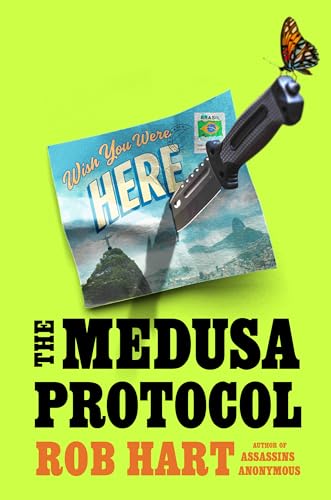
The Medusa Protocol, by Rob Hart****

“’I’m Mark, and I haven’t killed anyone in two and a half years,’ I say.    ‘Hi, Mark.’”


The Medusa Protocol is author Rob Hart’s second book in his Assassins Anonymous series. Happily for me, I didn’t notice that I was reading the second in a series; I didn’t read the first, and I might have sidestepped it had I realized I was entering mid-series. As it was, I had fun and enjoyed this satirical romp through a sea of professional murderers, sharks, and poisonous vipers.

My thanks go to NetGalley and Putnam Penguin for the invitation to read and review. This book is for sale now.

Our story commences with a group of recovering assassins meeting in a church basement. Then things start to go sideways; a member who’s expected isn’t there, but sends her personal choice of pizza to let them know she’s in trouble just as enemy assassins crash the meeting.

Huh? What?

From there, we dive down the rabbit hole, seeing the past and present alternately through the eyes of Mark, who is Astrid’s mentor in the program, and Astrid, a recovering killer who has been kidnapped and is being held in a Brazilian prison on an island in shark-infested waters, and which is home to a great many large, venomous vipers. How can her friends rescue her without having to kill anybody?

Just keep whispering the Serenity Prayer to yourselves, guys.

This is a fun read. Although the point of view shifts with every chapter, either between characters or time periods, these are clearly delineated, and I have no trouble keeping them straight. I only had the digital galley, not the audio, but I suspect that, assuming the reader provides the headings at chapter beginnings, it will be fine. The humorous moments when the rescuers worry about the mission threatening their sobriety are meted out exactly as they should be, not so many that it stops being funny, but frequent enough to keep me chuckling. There isn’t a lot of character development, but I don’t expect it from a satirical, action-packed novel like this one; there is some dialogue toward the middle that is overly wordy and should be edited down, but apart from that, it’s smooth as glass.

Some reviewers suggest not reading this one unless one has read the first; I am glad I didn’t see that advice till after I had read this one. I don’t care that this book provides spoilers for the first, because I am not going to read that one anyway. I will, however, cheerfully read the next in the series, whenever it becomes available. Meanwhile, I recommend this nifty little book to you.

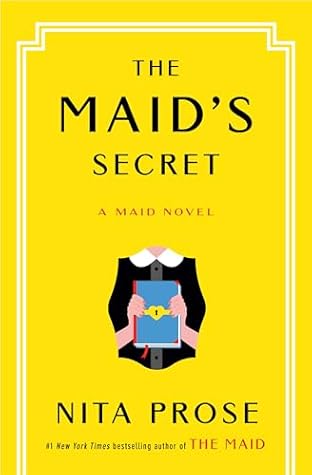
The Maid’s Secret, by Nita Prose****-******

Molly the Maid is back for the third installment of Nita Prose’s excellent and wildly successful series. My thanks go to NetGalley and Random House Ballantine for the review copy. This book will be available to the public April 8, 2025.

As in the first two books, we find Molly employed at The Regency Grand Hotel; she’s been promoted to Head Maid as well as Special Events Manager. She is engaged to chef Juan Manuel, a lovely fellow that helped fill the void in her life when her beloved Gran died. But everything changes when Brown and Beagle, art appraisers famed for their reality television program, come to do a show at The Regency Grand. Along with all of the “polishing to perfection” that is necessary for such a massive event, Molly decides to bring a few of her late grandmother’s trinkets along; you never know, maybe one of them will be worth something.

Oh, it most certainly is!

Once her rare and valuable object becomes public knowledge, Molly’s life changes completely. She no longer has privacy, which she holds dear; strangers are constantly in her face seeking autographs, and the press won’t leave her alone. Meanwhile, we are apprised of the circumstances leading up to this startling discovery. Gran comes to us from beyond the grave—so to speak—in the form of a diary that Molly didn’t know she kept. Chapters in this book alternate between the present day in Molly’s life, and the past, as told in epistolary fashion by Gran.

I wasn’t a big fan of this method, and I’m still a bit ambivalent, which is where the half star off the rating went. It seems like a lazy way to go about telling a story. However, if an author must use this method, it’s hard to imagine it being done better.

Of course things don’t go smoothly following the discovery of the heirloom; if they did, then there would be no novel. But I will leave the conflicts and resolution to the reader to discover.  As for me, I found the series of events, and the ending, believable enough for our purposes, and I enjoyed the story greatly, despite my misgivings about Gran’s storytelling method.

Recommended to those that enjoy the series; this book may be read as a stand-alone, but will be better enjoyed if you can read the first, second, or both earlier books first.

Mothman’s Merry Cryptid Christmas, by Andrew Shaffer***

My thanks go to Net Galley and 8th Circle Press for the review copy. This book is for sale now.

When I saw the cover of this children’s book, I thought it had strong possibilities. It’s original, and I thought it was conceptually strong, so I read it. Having done so, I have come away underwhelmed.

For a book like this, a takeoff on Rudolph the Red-Nosed Reindeer, two things are important. We need resonant, bold, eye-catching artwork to engage the little person that is reading it, or to whom it is being read, and we need a regular cadence. We’re supposed to be singing this book to the same tune as the song, and while the text certainly rhymes, it’s nowhere near in pocket. It’s awkward as hell, actually. Get out your metronome and try it, I dare you.

And as for the artwork, it can best be described as minimalist. When I saw Mothman on the cover, I was thrilled. Kids would love it, I thought. But that’s basically what’s on every single page. Mothman, plus a small amount of unengaging other stuff. There’s no bold artwork at all, and very little art of any kind. The illustration of our protagonist is the entire show, over and over.

I’ve since learned that this is a series. I haven’t seen any of the other books, but I’m going to guess they are more of the same. In fact, if I continue writing much longer, I will talk myself into dropping the rating to 2.5 stars instead of 3.

It feels lazy to me; it didn’t come close to meeting my expectations. When I took the galley, I thought that if this book was as good as I hoped it might be, I would purchase a copy of it for my grandsons. I’m not going to do that now, and if I won’t, I cannot recommend you buy it either.

Mastering the Art of French Cooking, by Colleen Cambridge****

This charming cozy mystery, set in Paris during the postwar years, had me at hello. Tabitha is an American expat, and her best friend, Julia Child, is teaching her how to cook. But one evening, during one of the Childs’s many soirees, a woman is murdered…and the knife in question came from Julia’s kitchen!  To make matters even worse, the victim was carrying a card with Tabitha’s name and address on it when she was found. For some young women, this would be a wakeup call, and the morning would see them on the next available plane to Detroit; but Tabitha is made of sterner and more curious stuff, and so she begins snooping.  

My thanks go to Net Galley and Kensington Books for the review copy; this book is for sale now.

To cope with the horror of the previous night’s events, Julia is roasting a ham.  “I just had to take my mind off everything. Can you even believe it, Tabs? Someone murdered a woman in this building—with my knife! That means they had to have been in my kitchen! This kitchen!”

Like many an amateur sleuth in other mysteries, Tabitha begins poking around. Sometimes she has smart ideas, and at other times she is breathtakingly dense, but there is never a time that I am thinking about the author rather than the protagonist, and that means that I believe the character. There are some familiar tropes and the occasional cliche: “She knew too much!” But it never becomes a problem, possibly because this is a novel that doesn’t take itself too seriously. Now and then the author breaks down the fifth wall, or nearly so. For example, Tabitha tells us that she knows what to do because she has read plenty of Nancy Drew mysteries.

The solution to this whodunit is fairly transparent, and I am able to predict the solution, along with the conclusion of the additional thread of incipient romance early in the book, but the whole thing is so adorable that I never become annoyed. “Just like an Agatha Christie novel—all the questions answered at the end, and the villain is caught, and everyone else is happy.”

Because I had fallen behind, I supplemented my review copy with the audio version, obtained from Seattle Bibliocommons, and narrator Polly Lee does a brilliant imitation of Julia Child! In fact, all of the passages involving Julia are brilliant, and that is my favorite aspect of this story.

Sometimes an author manages to step on multiple pet peeves of mine, and yet I emerge pleasantly entertained anyway, and that’s what has happened here. This is light reading, but it isn’t insipid. I look forward to reading the next in this lovely new series. Recommended to cozy readers.

Livid, by Patricia Cornwell*****

I really enjoyed this, the 26th entry into the Kay Scarpetta series. From time to time, people publish unhappy reviews, but for me, it never gets old. In this one, a terrorist attack is made locally, and it’s associated with an attempt on the life of the U.S. president, who is in town at the time it occurs. Kay is, of course, the chief coroner, and she’s forced to perform the autopsy on someone she knows.

The ending isn’t satisfying, and with any other author, I’d knock off the last star. But with Cornwell, I know from experience that when she does this, it’s because it isn’t really over. This will come up again, if not in the next book, then in another soon after it.

Because I couldn’t get the galley, I checked out the audio book at Seattle Bibliocommons. The audio is kind of a mixed bag. I like how the narrator voices the protagonist, and she also does recurring character Pete Marino well. I thought it was wrong to read the voice of Lucy, Kay’s badass adult niece, with a higher pitched voice than any of the other characters. She is a daredevil that doesn’t suffer fools, and if anything, her voice should be lower in pitch than Kay’s. I also thought she made the judge a bit too languid sounding, which is at odds with the things she says. In short, if you are a reader that enjoys both audiobooks and print ones, go with the print. If you like only audiobooks, then go ahead.

If you haven’t read this series, I do suggest you begin with the first and work your way up. I might not have enjoyed this one so much if I didn’t know the characters.

Hypnosis is for Hacks, by Tamara Berry****

Eleanor Wilde is a sham medium, a fraud who’s used her dramatic talents and the trust of her clients to bilk them. But lately things have changed; she has received intelligence from the great beyond, specifically from her deceased sister. As a businesswoman that now resides in a small town in the UK and doesn’t want her neighbors to hate her, she’s shifted most of her business to herbal cures and such. As it happens, this doesn’t keep all hell from busting loose.

My thanks go to Kensington Books and Net Galley for the review copy. This book is for sale now.

Eleanor–you may call her Ellie—is the protagonist in a satirical cozy mystery series, and this is the fourth. I read and reviewed the first two, but somehow missed out on the third. The first two took place in a tiny village where the ruling family lives in an honest-to-goodness castle. She went there, in the first in the series, to conduct a bogus séance, but instead fell in love with Nicholas, heir to the estate. Now the castle is in need of serious repairs. It’s summer, and the castle is hot enough to be uninhabitable, and so Ellie accompanies the elderly Vivian, matriarch of the castle, to the seaside. Her brother Liam, who is visiting, joins them. And once there, all sorts of things go wrong. We have a menacing, possessed doll that reappears in or near Ellie’s room, no matter what she does to destroy it, and a sinister figure from Ellie’s checkered past shows up as well. And of course, of course, of course, Ellie witnesses a murder shortly after arriving, but nobody will believe her.

I came away of two minds about this particular installment. The thing I’ve appreciated most about this series is that Berry’s writing is hilarious, and whenever an obvious plot device is utilized, it’s done in such an over-the-top manner that we can imagine the author winking and guffawing. Nothing here is to be taken seriously. In the past there’s been very little character development, and I was okay with that, because I wasn’t looking for great literature; I was looking for a laugh.

Here I find some changes. There’s less humor, although two particular bits, one involving lobsters and another involving, per the title, hypnosis, made me snicker. But I also find more character development. Realistically speaking, a series can’t last long if there’s no character development, and so I’m pleased to see Berry adding a bit of depth, but at the same time, what I really want is to laugh out loud. We live in tense times, and there’s a growing body of evidence that we live longer if we laugh. A silly, escapist novel that lets us forget current events entirely for a brief while, forget our own troubles, whatever they may be, and sit back and howl at what our clever author has cooked up, is worth more than many can imagine.

Nonetheless, this story is better by far than most of what’s out there within the humor genre, and I recommend it to you. Now…where’s that cat?

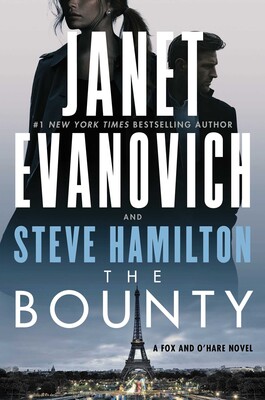
The Bounty, by Janet Evanovich and Steve Hamilton**

This book is the seventh in the Fox and O’Hare series. Our protagonists are Kate O’Hare, who is an FBI agent, and Nick Fox, a conman. My thanks go to Atria Books and Net Galley for the invitation to read and review. While this book isn’t my cuppa, there will be readers that enjoy it. One way or the other, it goes up for sale on Tuesday, March 23.

The first six books of this series were cowritten by Evanovich and Lee Goldberg. There’s no explanation for why Goldberg is out and Hamilton is in, but the switch may account for some of the inconsistencies between the earlier books and this one. An example: Kate and Nick were tight in the earlier stories, and yet somehow, they can’t stand each other now. There’s no reason given for the change, so I have to assume it’s an authorial quirk; I have to say, not an original one.

The premise is that the pair are hot on the trail of a massive cache of Nazi gold; also pursuing this treasure is criminal organization known as The Brotherhood. Kate and Nick are charged with finding the gold and bringing The Brotherhood to its knees.

Before they are even off the plane, I have questions. For example, since when does the FBI have authority to do this sort of thing abroad? In cases of terrorist attacks on American citizens, sure. But treasure hunting on foreign soil? And since when does any law enforcement body send two officers to bring down an entire organization? You can see my point.

But this is the sort of story that one can only appreciate by suspending disbelief and buying the premise. The whole thing has something of a James Bondian flavor to it, consisting of large amounts of chasing, hiding, climbing, leaping, and in between, dialogue, dialogue, dialogue. There’s a fair amount of derring- do; there’s a parachute, a grappling hook, lock picks; you name it. The element that distinguishes it from other such books is that both Fox’s and O’Hare’s fathers get involved.

For me to enjoy a novel from this genre, I need either a well-crafted story with literary merit, including character development, (i.e., James Lee Burke, Sue Grafton, John Connolly,) or else some form of well-executed humor. There are a fair number of wonderful satires out there, and of course, there’s the series that made Evanovich famous, the Stephanie Plum numbered series, which have hit more than they’ve missed and almost always make me laugh out loud more than once. In reading The Bounty, I don’t find these things.

However, not every reader has the same preferences that I do. This is a fast read with accessible vocabulary—my inner snark popped out at one point, and my galley has a note when the word “independence” is used: “Wow, four syllables!”—a linear story line, and an easily followed plot. I could see hauling something like this to the hospital when you’re going to have surgery and your attention span won’t be up to par. And then there’s the consideration of interest. Some want to read action, action, action, and if the story were more realistic, we’d probably be reading about paperwork, reports, and endless months cultivating a contact that proves to be useless. Not entertaining.

Even so, I can’t recommend this book for general audiences, or even for those that like the series.

The Man That Got Away, by Lynne Truss*****

This is the second entry in the Constable Twitten series, and my fourth book by this writer. Truss is a reliably funny author, but this is her best yet. My thanks go to Bloomsbury and Net Galley for the review copy. You can buy this comic masterpiece now, but first you should read A Shot in the Dark if you can, because the background information you will find there will make this book even funnier.

Constable Twitten is the only capable, driven cop in Brighton, a small seaside tourist town in England. Steine, his boss, is unwilling to recognize that crime exists here at all; he is possibly the most gullible character to appear in fiction. For example, he believed an April Fool’s Day newscast about the spaghetti weevil, said to be ruining the spaghetti harvest. The other officer is slightly better, but when his dream of going undercover finally comes true, he becomes so immersed in his new role that he forgets he is supposed to be fighting crime. He is posing as a musician and spends all his time at the club performing or practicing; he doesn’t even bother to check in at the station. Twitten is left virtually alone to deal with Brighton’s crime wave.

Here is a pattern I’ve seen with Truss’s novels. The beginning is usually lame. The first time I read her work, I saw so many not-funny lines in the first ten percent that had I not owed a review, I might have been tempted to abandon it. However, even though I had decided that this was probably a pretty stupid book, I noticed a change as it went on, and by the last thirty percent or so, I was laughing out loud. Consequently, I was expecting a progression in this novel, from not-funny to slightly-funny to actually-pretty-funny to gut-splittingly-funny. I reminded myself that patience would pay off here, and I opened the book…and laughed on the first page. This book starts out at ten and it stays there all the way through.

There are several threads that are good here; we have the blind wax sculptor that makes dreadful likenesses for the wax museum, and there’s Inspector Steine being duped into believing a con woman is his long lost niece. But the most memorable, achingly funny bits are centered around Mrs. Groynes, the police station’s secretary who is also the janitor, and also the brains of an organized crime ring. Twitten knows this, and Groynes knows that he knows, but he cannot persuade another living soul that it’s true, and so there she remains, unhindered, using her job to obtain intelligence that in turn helps her underworld minions avoid detection.

 It isn’t difficult.

Those that love excellent satire need look no further. I highly recommend this hilarious book to everyone.

Bluebird, Bluebird, by Attica Locke*****

Attica Locke’s mysteries are consistently excellent, so when I found a review copy for this first entry in her Highway 59 series, I felt as if I had struck gold. Big thanks go to Net Galley and Mulholland books. This book is for sale now.

Darren Matthews is a Black Texas Ranger, and he’s in big trouble. He’s suspended from the force, and his wife Lisa has thrown him out of the house until he cleans up his act. She doesn’t want to be married to a man that is so careless of his own health and safety; if he takes a desk job and quits drinking, he can come home to his family. But right now he’s on his own, and right now he’s still drinking, and it is in the process of moving from one drink to another that he meets Randie, the recent widow of Michael Wright. The official story the local sheriff tells is that Michael killed Missy Dale, a Caucasian woman whose body was dragged from the swamp behind Geneva’s bar, and then himself. The only problem with that theory, Darren discovers, is that Michael died before Missy. Darren thinks they were both murdered.

As Darren goes deeper into the case, after receiving short-term, conditional support from his boss, he finds more elements that suggest a murder and subsequent cover-up. He’s closer to the truth; the sheriff and another local big-shot are closer to apoplexy; and he’s less likely to go home to Lisa.

Attica Locke is one of a handful of consistency brilliant mystery writers in the US. Her capacity to carry me to the murky rural South and create taut suspension that makes me lean forward physically as I follow the story is matchless. I’ve read more than a hundred other books between her earlier work and this one, yet I still remember the characters, the setting, and above all, that brooding, simmering dark highway. This is what sets her apart from other authors in an otherwise crowded field.

I also like the way she addresses racism, and here Darren investigates the role of the Aryan Brotherhood of Texas; I ache as I read of the continuous injustice that Darren, Michael, and so many others face both within this story and in real life. And I want to cheer when Darren says that he will never leave, because the ABT and other White Supremacy groups don’t get to decide what Texas is. It is as much his story as it is theirs, and he will fight for it.

“Darren had always wanted to believe that theirs was the last generation to have to live that way, that change might trickle down from the White House. When, in fact, the opposite had proven true. In the wake of Obama, America had told on itself.”

Darren risks his life once again in his determination to dig up the rotten hidden truth and lay it out in the sun where everyone can see it. The ruling scions of Lark are equally determined to prevent him from doing it. The intensity of this thing is off the charts, but fortunately I know this author’s work well enough not to start reading it close to bedtime, because once I am into the book’s second half, I will have to finish it before I can do anything else, including sleep.

The good news for me and for other Locke fans is that this is the beginning of a series. I received this galley after publication, and now the second of the Highway 59 series, Heaven, My Home, is slated for release in September. (Watch this blog!)

Highly recommended.

Foundryside, by Robert Jackson Bennett***-****

Foundryside RD4 clean flat3.5 rounded up. This title is the first in a new series. Those that love fantasy, and especially those that already enjoy this writer’s work will want to check it out. My thanks go to Crown and Net Galley for the DRC, which I received free and early in exchange for this honest review. Bennett comes to this project with a list of awards as long as your arm, so I was excited to read him. I probably would have been more impressed by this book if there hadn’t been so much build up. Still, it has a lot going for it. It will be released August 21, 2018.

The fictional city of Tevanne in which this story takes place is even more polarized than the developed world of today; there is a walled city in which the haves get everything and live in tremendous luxury, and then we have The Commons, where not only is there no law enforcement or legally held private property; in fact there are no laws at all. This is where the dispossessed try to stay alive. Our protagonist is Sancia, a thief that has been commissioned to steal a valuable artifact. Buildings speak to Sancia through her hands, so when she doesn’t want to be distracted or drained, she must wear gloves. The technology of the time is scriving, a magical method similar to artificial intelligence on steroids, and this dominates the plot. Sancia discovers Clef, a key that is scrived, and Clef becomes her sidekick.

The story starts out with a lot of noise, but not much of substance takes place; we have scriving, and we have a lot of chasing, running, hiding, climbing, jumping, running, fighting, running some more and…well, you get the idea. I generally prefer a more complex plot along the lines of Stephen Donaldson or Tolkien, but I was glad I stayed with it when I saw where it ended up.

I am pumped to have a series that has a strong female protagonist, and here we also have a female villain. I would be even more pumped if rape were never even mentioned. I read an interview years ago with movie director Jodie Foster, who said that working with male writers, directors and producers was frustrating, because so few of them were able to imagine motivation for a female character without landing there. Why would this character do [whatever]? Why, she must have been raped. It was rape. She’s afraid of rape.

Still, after all of the scriving, running, chasing, hiding, fighting and fleeing, we come to an ethical quandary that makes it worth the wait. And of course, the series is still in its infancy, so it’s fun to get in on the ground floor.

Bennett’s fans will be delighted, and those that love fantasy should consider adding this book to their queue.