
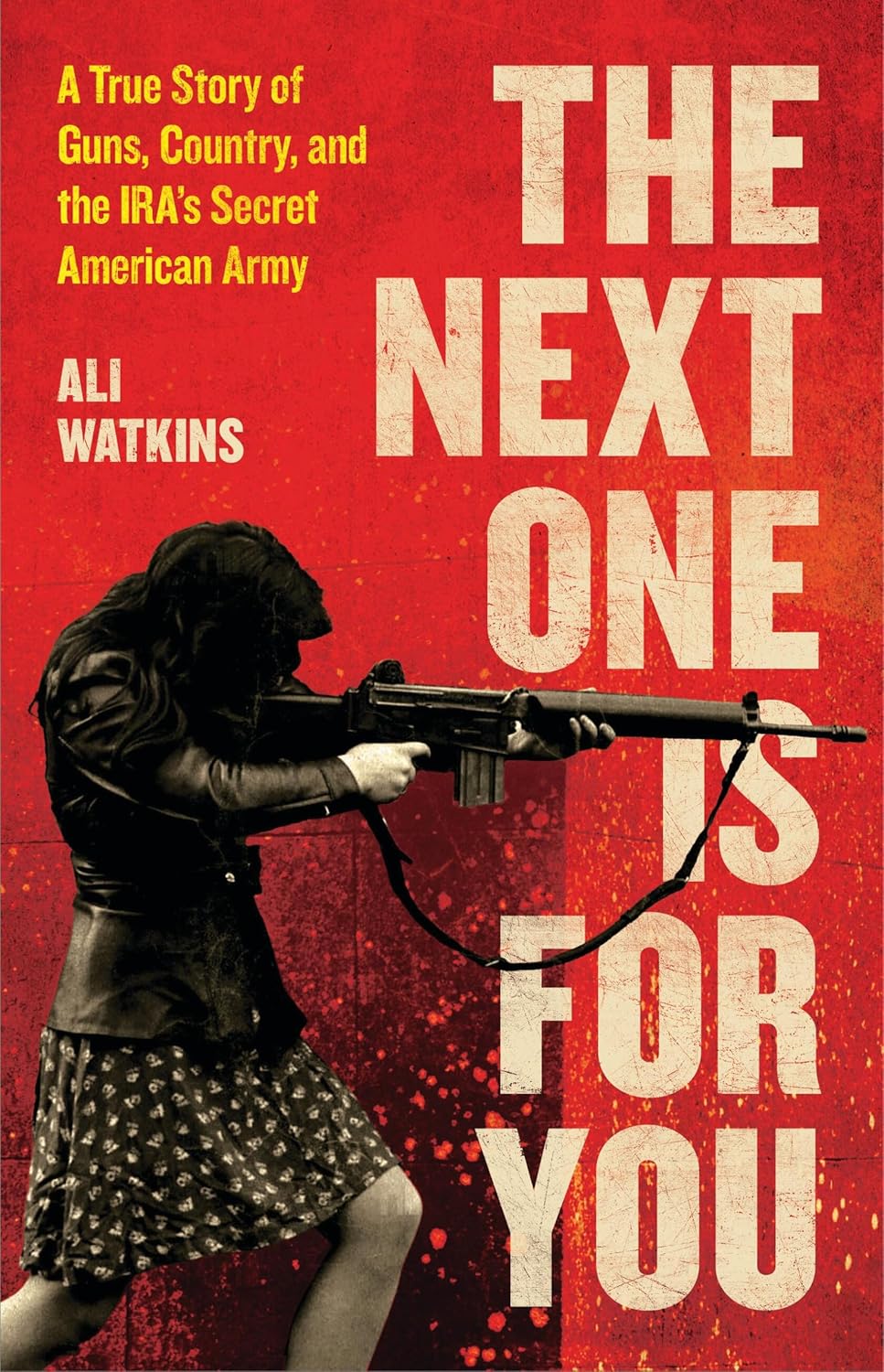
The Next One is for You, by Ali Watkins****

One of the most hotly contested political issues for English speaking people during the 1970s and 1980s was the battle taking place in the North of Ireland between its original inhabitants and the British government. This reviewer was deeply interested in the conflict while it took place, and so when I saw this book, The Next One is for You: A True Story of Guns, Country, and the IRA’s Secret Army, by Ali Watkins,my heart began to pound before I’d read a single page. My thanks go to NetGalley and Little, Brown and Company for the review copy. This book is for sale now.

The fight between the working-class citizens of Belfast and the middle-class Protestants, who worked hand in glove with the British Crown, has roots that are centuries deep. Watkins reviews these without going into the weeds, and leads us up to modern times succinctly. I appreciate her fair discussion of the manner in which the Irish Republican Army, or IRA, developed and burgeoned. (U.S. readers new to the topic should know that ‘Republican’ was part of the name due to a desire for the Irish Northern counties to be restored to the Republic of Ireland, not because of any political similarities to the Republican party in the U.S.A.) Initially the movement was modeled on the Civil Rights Movement of the United States, with large, peaceful marches; there were signs, songs and speeches given. People packed lunches and took their children with them. But these protests were violently repulsed, with police and the military surrounding the participants so that there was no escape, and then shooting them like wooden ducks in an arcade.

Poverty was widespread in Belfast and its surrounding areas, with few jobs, and miserable living conditions in government subsidized apartments. “A Catholic surname got you passed over for jobs, if you even got the chance to apply.”  There was no Bill of Rights, and when armed forces chose to search someone’s home, they announced themselves by kicking the door in. The situation was intolerable.  And so, when peaceful protest was no longer possible, there were two choices remaining: armed struggle or defeat. “The goal: to expel the British from Northern Ireland, whatever the cost.”

Because such a large portion of the U.S. population is of Irish descent, these circumstances were of great interest in America. When the IRA broke off from the more traditional, less militant (and ineffective) organization that already existed, it wasn’t long before many Americans wanted to help in some way. Two organizations developed in the States, and this is much of what Watkins discusses. Clan na Gael was an Irish solidarity organization that had existed in the U.S. since 1867. It became an important element in the Irish struggle, organizing politically, and raising funds. But in order to gain widespread appeal, there needed to be an additional organization that existed for those that wanted to contribute financially to the poor of Belfast without also supporting the armed fight. In 1969, NORAID was born.

A disclosure: this reviewer was a great supporter of both organizations during that time. In fact, I once won a raffle from the Clan, which netted me a wheelbarrow of whiskey! Since I don’t drink, I took one bottle for my spouse and donated the rest back to the Clan. I never joined the Clan, primarily because I wasn’t asked.

Watkins discusses the history of both organizations as well as the key individuals that brought them about. She does a magnificent job and brings a treasure trove of outstanding documentation, right up until nearly the end of the book, at which point she inexplicably lapses into the journo-speak of the period, blathering about “senseless violence” in an abrupt shift that made my jaw drop. She had already explained, very capably, just why a nonviolent struggle was completely impossible. The devastating numbers of Irish youth that died during this campaign is indeed heartbreaking, but at the same time, just what else were they supposed to do? No foreign government was even remotely interested in assisting them; the British government was a key ally of the U.S. government, and had something of a headlock on its protectorates. And while I respect that the author had to conclude the book in one way or another, just admitting that there was no clear solution would have been vastly better than parroting American mainstream media of the time period. What the what?

Nevertheless, those with an interest in this struggle should get this book and read it. Just bear the ending with a grain of salt.

Autopsy, by Patricia Cornwell*****

Autopsy is number 25 in the Kay Scarpetta series, the first forensic thrillers ever to see print. This series began in 1990, and I have read every single one, but this is the first time I’ve scored a review copy. My thanks go to William Morrow and Net Galley.

When the series began, Scarpetta was the chief medical examiner in Virginia. When last we saw her, she was working in Massachusetts, but now she’s come full circle, brought back to her old position in order to root out corruption and restore the office to the integrity it held when last Scarpetta was in charge. She didn’t expect it to be easy, and it surely isn’t.

There are long running characters that have been so well developed over the years that I almost feel as if I would know them on the street. Her husband, Benton Wesley, holds a sensitive position within the FBI, and the necessary secrecy and sudden need to pack a bag and go somewhere has led to marital tension over the course of the series, but not so much this time. Kay’s niece, Lucy, is more like a daughter; she has been estranged from her mother at times, a high-strung, self-absorbed woman that looks out for number one every minute of every day. The mother—Dorothy—is now married to Pete Marino, with whom Scarpetta has worked closely for the length of the series, and they live nearby.

At this juncture, new or inconstant readers may wonder if there’s any point to jumping into a book this far into the series. I read it with that question in mind, and whereas you won’t have the background and depth of context that faithful fans possess, you can understand everything that happens here; Cornwell doesn’t burden the reader with assumed knowledge.  And if you are a new reader, likely as not, you’ll find yourself headed to the library or bookstore to pick up others from this series. It’s that addictive.

The only background information that might make a difference is that from the outset, Kay’s whole family (except Dorothy, of course) fears for her well-being. A murder occurs in the area, and the victim is a neighbor of Pete and Dorothy’s. Immediately, there’s this sense of urgency, and it’s more than one would ordinarily expect. A neighbor has been killed; the circumstances are weird, and we don’t know whodunit; everyone is edgy about personal security, and again—especially regarding Kay’s safety. So let me help you out, if you’re new: over several of the most recent episodes, someone has attempted to kill Kay, nearly succeeding more than once, and though the occasional thug has been caught, the schemer behind the attempts is still out there somewhere. The narrative makes no specific references to any of this, which I appreciate. It’s obnoxious when a book costs as much as new books do these days, for the author to insert what amount to advertisements to buy her other books. But for those not in the know: If the beginning seems a little overwrought, that’s why.

Add to this that the old guard is still entrenched in Kay’s workplace, with people whispering behind her back, and her secretary clearly plotting against her. She’s just arrived, but she is on the back foot, trying to find out what’s going on and who can be trusted, and trying to establish her own authority without making enemies unnecessarily. As I read, I find myself urging her to assert herself. Because to me, Scarpetta isn’t a fictional character at all. I believe in this character, and I believe in Benton, Lucy, and Marino, too. I’ve known them longer than a lot of people I see in real life, after all.

Those of us that read a lot of mysteries, thrillers, and so forth become accustomed to timeworn plot devices. I have a little list of things I hate to find in books of this genre, and Cornwell avoids them all. There is no alcoholic protagonist that just wants a drink, a drink, a drink. There’s no kidnapping of the protagonist and stuffing her in the trunk (or backseat, or whatever,) nor does this happen to any of her loved ones. Scarpetta is not being framed for a murder she didn’t commit, nor is anyone she loves.

Instead, we get an autopsy in outer space, supervised remotely by Scarpetta. How cool is that?

One other aspect of this book, and this series, that I love, is that there is just enough interesting information included about forensic investigation without the story turning into some tedious science lecture, as I have found in books scribed by Cornwall’s imitators.

The pacing is swift, the dialogue crackles, and a new character, Officer Fruge, is introduced. Hers is the last word in the book, and for some reason, it made me laugh out loud, a first for this series.

Welcome home, Scarpetta.

The Power Couple, by Alex Berenson****

Alex Berenson has done it again! I first read his work when I found a galley for The Prisoner, the eleventh in his John Wells series. When I saw that this stand alone thriller was available, I jumped on it. My thanks go to Net Galley and Simon and Schuster for the review copy.  The Power Couple is a fast read and a fun one, and I recommend it to you.

Rebecca (call her Becks) and Brian Unsworth are type A achievers, and both work for the federal government; she is a spy, and he is a hacker. But like so many couples, the similarities that brought them together are getting in their way now. With their children, Kira, who is nineteen, and Tony, who is younger, they take off for Europe to let off steam and spend quality time together. Maybe.

Early in the story, Kira is abducted, and from there forward, the pacing is perfect. Now and then Berenson pulls us back a bit as he shares sketches from their pasts that lead up to this event, but each reminiscence is brief, and the shift between points of view and time periods adds to the suspense. We see their lives through the perspectives of all except Tony, who is a minor character. In the end, Kira is the one we like best. (Trust me.) There’s not a lot of character development, but this isn’t that kind of novel.

I don’t want to give more away, because if I kill any surprises, you won’t enjoy the story as much; what I will say is that even if your own marriage is less than perfect, it is a shining beacon of integrity and affection when contrasted with that of the Unsworths.

This book is for sale now, and just right to take on vacation with you.