
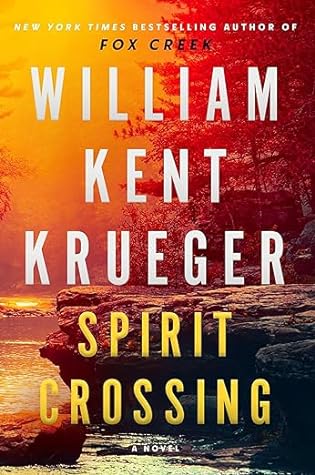
Spirit Crossing, by William Kent Krueger

Spirit Crossing is the spellbinding new novel in the Cork O’Connor series by William Kent Krueger. The book starts with two missing women, and an accidental discovery of a fresh grave. Readers faithful to the series will recognize the characters; there are enough of them, mostly related to one another, to provide depth and interest, without confusing the reader or making the plot too complex.

Lucky me, I read it free and early. My thanks go to NetGalley and Atria books for the invitation to read and review. This book is for sale now.

The story begins innocently enough, with the series protagonist, Cork, out berry picking with his son, son-in-law, and grandson, who is known by the Ojibwe nickname Waaboo. While searching for blueberries, they come across a fresh grave. Waaboo sees the victim standing before him, as if she is still alive, and he’s distraught because she is so unhappy. Waaboo is not the first one in his family to have this ability; nobody doubts that he sees what he says he sees. And so the men immediately wonder whether this is the grave of Olivia Hamilton, daughter of a wealthy Anglo, who’s been reported missing with massive headlines everywhere; or that of Crystal Two Knives, a missing Native girl whose name barely elicits more than a yawn from law enforcement.

And so right away, we are looking at not only the characters, but the longtime issue of missing Native girls and women, and the way that law enforcement neglects their cases for those whose families have money and connections.

One of the things I admire most about Krueger’s writing is the way that he incorporates urgent issues that especially impact the place where he lives—northern Minnesota—into the plot, blending them in so seamlessly that the reader isn’t distracted, because the issues are part and parcel of the mystery to be solved. He does the same thing with pipeline protests similar to the Dakota pipeline that lit up the headlines in recent years. Other aspects of the story include Ojibwe (Chippewa) culture and history, which is part of every book in the series, since most of the family is Ojibwe, and in this case, a character with a brain tumor. When significant events occur and the woman with cancer is the only one to witness them, did they really happen, or is it the brain tumor talking? This adds a layer of psychological tension not present in most of Krueger’s book; I’m not a fan of that subgenre, and am pleased to see that this doesn’t take over the plotline. It’s dealt with tastefully and without sensationalism.

Those that read my reviews know that I have an interest in seeing how authors develop child characters, particularly in a story such as this one, in which the child plays a major role. It makes me crazy when an otherwise competent author searches for shortcuts, such as a child that’s precocious or gifted, to explain away their own failure to craft the child’s character in a way that is honest developmentally. This is one more reason I enjoy this series. Yes, Waaboo has unusual powers, but he is still a small boy. The notion of going home without blueberries is a major blow. Tears threaten. I love the way Krueger develops this kid, and I can’t wait to see more of him in the future.

My one criticism involves a specific passage between the 88th and 90th percentiles, just as we rise toward the climax. Without going into spoilerish details, I will say that one character does something that everyone in the family agrees they must not do, and without any explanation, everyone in the family is fine with them doing it this time. This, of course, puts the character in danger, which anyone that’s paying attention can predict the very moment the action commences. It’s clumsy in a way that is atypical of this author, and I have no idea why he makes the choice he does, but it affects my enjoyment of the book, because suddenly I am not thinking as much about the characters as I am about the author. Having this occur a split second before the climax is especially grating.

On the other hand, I am picky. Very picky. I suspect that this passage will annoy only a small percentage of readers.

I do recommend this book, and this series, to those that love a good mystery. Although it can be read as a stand-alone, those with the time and inclination might enjoy going back a few titles, or even to the beginning of the series.
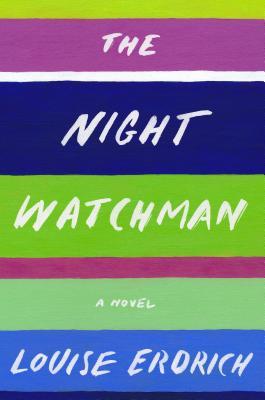
The Night Watchman, by Louise Erdrich*****

I cannot believe it has taken me this long to read the legendary novelist, Louise Erdrich. I had my reasons—wrong ones, as it turns out—and I am grateful to Net Galley and HarperCollins for the review copy, and thus helping me pull my head out of…the place where it was. This excellent novel is for sale now.

Let me explain, first off. Many years ago, I enrolled in an alternative graduate program that emphasized respect for all cultures and races, and which required, as a graduation requirement, attendance at a full day seminar listening to a locally famous Native storyteller.  The story was delivered in a monotone, with a good deal of repetition and no effort at summarization. So, after dutifully suffering through 6 hours of it on one of the hottest days of summer, I pledged to myself that I’d never go through that again.

Twice, good friends have urged me to read Erdrich’s novels, but I was also told she was an American Indian storyteller whose heritage formed a central theme in her writing. My eyes glazed over, and I vowed to give it a miss. When The Night Watchman drew early raves, I realized that my assumptions about Erdrich might be in error, and I hustled back to Net Galley to see if I might still score a galley. It’s a lesson well learned.

The year is 1953, and the place is the Turtle Mountain reservation in North Dakota. Patrice Paranteau has finished school, but she doesn’t want to get married. She has seen her friends do so and turn into old women overnight, shivering as they hang the wash to freeze dry in winter, and collecting snow to melt so that their children can take a bath. No thanks. Instead,

I cannot believe it has taken me this long to read the legendary novelist, Louise Erdrich. I had my reasons—wrong ones, as it turns out—and I am grateful to Net Galley and HarperCollins for the review copy, and thus helping me pull my head out of…the place where it was. This excellent novel is for sale now.

Let me explain, first off. Many years ago, I enrolled in an alternative graduate program that emphasized respect for all cultures and races, and which required, as a graduation requirement, attendance at a full day seminar listening to a locally famous Native storyteller.  The story was delivered in a monotone, with a good deal of repetition and no effort at summarization. So, after dutifully suffering through 6 hours of it on one of the hottest days of summer, I pledged to myself that I’d never go through that again.

Twice, good friends have urged me to read Erdrich’s novels, but I was also told she was an American Indian storyteller whose heritage formed a central theme in her writing. My eyes glazed over, and I vowed to give it a miss. When The Night Watchman drew early raves, I realized that my assumptions about Erdrich might be in error, and I hustled back to Net Galley to see if I might still score a galley. It’s a lesson well learned.

The year is 1953, and the place is the Turtle Mountain reservation in North Dakota. Patrice Paranteau has finished school, but she doesn’t want to get married. She has seen her friends do so and turn into old women overnight, shivering as they hang the wash to freeze dry in winter, and collecting snow to melt so that her children can take a bath. No thanks. Instead,

“She was the first person in the family to have a job. Not a trapping, hunting, or berry-gathering job, but a white people job. In the next town. Her mother said nothing but implied that she was grateful. Pokey had this year’s school shoes. Vera had a plaid dress, a Toni home permanent, white anklets, for her trip to Minneapolis. And Patrice was putting a bit of every paycheck away in order to follow Vera, who had maybe disappeared.”

The point of view shifts between Patrice; a local boy turned boxer, Wood Mountain; Haystack Barnes, the white math teacher and boxing coach; and Thomas, Patrice’s uncle, who is the night watchman at the jewel bearing plant. Thomas is modeled after Erdrich’s grandfather, and the author’s notes at the end mention that his struggle to save the Chippewa land made writing this book an emotional experience.  

As the story opens, Patrice is preparing to track down her sister, who is rumored to have had a baby in Minneapolis, and Thomas is organizing a group of Chippewa to attend the hearings in Washington, D.C. The Feds have sent a letter to the tribe suggesting that since they were clearly successful, they would surely no longer require government aid or protection. Their land would be absorbed by the U.S. government and then sold to private buyers; its current residents would be relocated to cities where they could get work. And it’s a measure of exactly how clueless the average American was about the Chippewas’ plight that Barnes, who lived and worked among them, said, “I don’t understand why it’s so bad. It sounds like you get to be regular Americans.”

There are other points of view as well; the most memorable are the Mormon missionaries that have drawn the short straw and been sent to minister to the “Lamanites.” This religion holds that the inferiority of American Indians is revealed holy truth; only by converting can they be salvaged, and when that happens, the new converts will slowly become whiter. Our two missionaries dislike each other profoundly, which is unfortunate since they may only separate from one another to use the toilet. When the main story becomes intense and at times, very sad, in will pop the missionaries and before I know it, I am laughing out loud.  In addition, I admire the way the strong female characters are developed.

There are three primary threads to follow: what Patrice decides to do with her future; whether Vera will be found; and whether the Chippewa of Turtle Mountain will lose their land. All are handled with the mastery one might expect from an iconic author.

Don’t be the idiot that I was. Get this book and read it now.