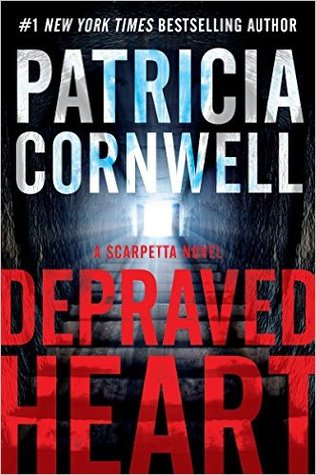
Depraved Heart, by Patricia Cornwell*****

depravedheartI’ve been reading Cornwell for over a decade. Her Scarpetta series is curiously addictive, a bit like curling up in my favorite chair with a furtive pint of gelato and maybe a ridiculous TV show or YouTube clip. But in thinking that way, I sell Cornwell short. She started out strong; floundered just for a short time; and now she is better than ever. And perhaps you are waiting for a disclaimer saying that I read it free, but in fact I did not. I’ve yet to see Cornwell’s work on Net Galley. The kindle version popped up as the deal-of-the-day for four bucks, and I grabbed it while I could.

It was worth it.

We open with Kay Scarpetta’s head in a really bad place. Those that follow her series will recall that the previous novel ended with her being shot in the leg with a harpoon by a villain we had believed to be dead. Scarpetta is fragile now, both physically—that leg will never be the same—and mentally. She jumps at shadows now. Unfortunately, not everything is in her head; as the story opens, Scarpetta’s niece, Lucy, is having her home ransacked by the FBI. At the same time, Scarpetta’s phone has been hacked—certainly a fear to which all of us can relate—and a creepy video clip of Lucy from long ago, including Lucy doing things that are illegal—is shown on Kay’s phone, beyond her control and without Lucy’s knowledge, while Scarpetta is working a crime scene. Once the clip is over it vanishes, leaving no record or proof that it occurred. Soon thereafter, a huge black helicopter follows Scarpetta and cop Pete Marino, a series regular, to the estate Lucy shares with her partner Janet and a small child in Janet’s custody.

Every mystery writer that is successful enough to have a long-running series is faced with credibility issues eventually. One character, whether gumshoe, cop, forensic pathologist, butcher, baker, or candlestick maker can only encounter a certain number of traumas in his or her lifespan before even the most enthusiastic readers will say, “Okay. Wait a minute. Are we getting captured and tossed into the trunk of a car again? Seriously?”

The best series writers are able to forestall this in two ways that I have seen. The first and most critical is that more of the story is about character development—the protagonist’s, and sometimes those close to the protagonist, and so we are invested in the outcome of the problem because we care so much about our hero. And if a writer is really strong, as Cornwell is, she can make us care about the lives and problems of regular side characters also.

The second way longstanding series writers get away from repeating the classic or even trite gumshoe stand by scenarios, such as I’m-being-framed-and-must-prove-my-innocence, or The-bad-guys-have-threatened-to-harm-someone-in-my-family-if-I-don’t-follow-their-demands-so-I’m-going-to-catch-them, is by being totally bad ass writers. By this I mean that either they go ahead and use the stupid devices I just mentioned but they do it so well we don’t care, maybe don’t even realize they’ve done it till the story is over; or they find another way to ramp up the tension without employing those tired devices. Cornwell scores big in this department with Depraved Heart.

Rather than wondering about the threat of evil, possibly death, that may come from outside her nearest and dearest family—including people like Marino who she considers family—part of the threat appears to be coming from within it. So we have this stark psychological thriller; for example, given that Scarpetta’s husband Benton works for the FBI, isn’t it odd that he didn’t say anything about the bust on Lucy’s place? Isn’t it strange that he won’t answer her texts?  But then given how jumpy and shaky Kay Scarpetta is, and the fact that she is defying doctor’s orders in order to do the things she is doing, we also wonder…hey Kay, are you all right?

Maybe what she actually needs is a pile of meds and a good long nap.

So we have the suspense of fearing external threats; fearing treachery from somewhere within the family; and added fear that Kay has finally just straight-up lost it. And then there’s the fear that Kay is right to feel threatened, but that others will disbelieve her, and we see their skepticism.

I have to tell you, this is a fast read, partly because of the amount of dialogue but also because the pacing is electric!

By now, you probably already know whether you are a Scarpetta fan or not. If you are on the fence, this should pull you over onto the side of avid readers. If you have never read a book in the Scarpetta series, don’t start with this one. Get a copy of the first in the series, or as close to the first as you can get, and work your way forward, because a lot of the reader’s sense of urgency is spun from the bond we have already formed with the protagonist and those close to her in previous installments. It’s not a good series to enter from the middle.

But for Scarpetta fans, this is a must-read!

Far From True, by Linwood Barclay****

This one is available for purchase now, so I am running my review one more time.

seattlebookmama's avatarSeattle Book Mama

farfromtrueBarclay is an established writer, with a number of best sellers to his credit, but he was new to me. My thanks go to Net Galley and Berkley Publishing Group for providing me with a DRC in exchange for an honest review.

And indeed, it does take a pro to weave such an intricate plot so adroitly. But let’s take it from the top and go from there.

The story is set in Promise Falls, an ironically named town that contains more trouble than you can imagine. The initial crisis takes place at the drive-in movie theater, the last showing before the place closes up and the property is sold. But then the unthinkable happens.

Like most disasters, this one triggers a flurry of other emergencies erupt related to the victims of the theater tragedy. There are greedy relatives, heartsick loved ones, and other events and individuals that are just…

View original post 457 more words

Clawback, by JA Jance*****

I intended to reblog this on its release date, but missed by 48 hours. Happy release day, Judith Jance!

seattlebookmama's avatarSeattle Book Mama

clawbackI’m a long time reader of novels by JA Jance, but until I read this new release, I would have told you that her Arizona series are second string efforts compared to the JP Beaumont titles set in Seattle. Not anymore! Thank you to Net Galley and Touchstone Publishers for the DRC, which I read in exchange for an honest review. The book will be available to the public March 8.

Ali Reynolds is our protagonist. Her parents have retired, investing their lifelong savings with a company that turns out to be involved in a Ponzi scheme. Ali’s father goes to see his investment agent, who has also been a close friend for decades, and finds him dying. In attempting to revive him and another person, Dad gets the victims’ blood all over himself, and so he is suspected of murder when he calls 911. In an effort to help…

View original post 211 more words

‘Til Death Do Us Part, by Amanda Quick***-****

tildeathdousI was looking for good historical fiction and ran across this novel, which is also a mystery and romance. It’s a little different from much of what I read, and reminds me a bit of Victoria Holt, whose work I read voraciously as a teenager and younger woman. I received the DRC courtesy of Net Galley and Berkley Publishing Group in exchange for an honest review. This title will be available to the public April 19, 2016.

Calista Langley is a spinster, which is what unmarried women were called a century ago. She runs salons in her home for the purpose of intellectual discussion, a chance for men and women to get to know one another in a socially acceptable setting before they commence the courting ritual. But Langley has a stalker. A man has been using a long-disused dumbwaiter to hoist himself up to her bedroom, where he can watch her in the shadows. He leaves grim mementos mori—associated with death—on her pillow for her to find. Her initials are etched in them, a particularly chilling detail. We know fairly early who it is that is doing this, but Calista herself does not know.

“This is what it had come to—a life lived on the razor edge of fear. The sense of being watched all the time and the ghastly gifts were playing havoc with her nerves…Her intuition was screaming at her, warning her that whoever was sending her the gifts was growing more obsessed and more dangerous with each passing day. But how did one fight a demon that lurked in the shadows?”

At about the same time, Trent Hastings has come to see her, convinced that she is corrupting his sister Eudora, a client and frequent guest at the salons held in Calista’s home.

The overall tone of the story is a trifle melodramatic for my taste right now, but if you had given me this book thirty or thirty-five years ago, I would have worn it out re-reading it and then passed it on to my friends. The romantic scenes are steamy yet tasteful . Quick can raise our interest to a higher level just building up to a kiss than many of the writers of erotica are able to do with everyone’s clothes on the ground and explicit information left, right, and center.

In fact, though I often make a point of letting my readers know when a book will be objectionable to conservative Christian readers, in this case I feel confident in saying you should be fine here. The language never gets hotter than an occasional “damnation!”

One thing that was especially interesting to me was the minute detail given to Victorian funeral customs and the odd accessories that were popular then. It never occurred to me, for example, that anyone would spend good money on a tear-catcher, but some folks did. For the more practical purchasers, the coffin bell is a handy way to let everyone know that you’re not dead after all, and would like out of this box, please!

All told, this was a fun, accessible read. I rate it 4 stars as a YA novel, and 3.5 stars rounded up for general audiences.

Storme Warning, by WL Ripley****

stormewarningStorme Warning is the fourth and thus far final installment in a terrific series. I have read three, and will read the fourth if I can find it. The snappy patter and nonstop action and suspense make it hard to put down once you’ve begun. I rate it 4.49 stars, and thank Brash Books Priority Readers Circle for providing me with this DRC in exchange for an honest review. The book is available for purchase right now.

Wyatt Storme is retired from football. He divides his time between his cabin in Missouri and another cabin in Colorado; this story takes place in Missouri. He owns a considerable piece of land because after having the press follow him hither and yon for the duration of his NFL career, he craves simplicity and solitude. “Reclusive”, as his best friend Chick explains to an outsider.

Because all of a sudden, Wyatt’s land is chock full of outsiders. Hollywood director Geoffrey Salinger wants to shoot his hot new movie on location; his star has received death threats, and Chick has been tapped as bodyguard. Wyatt doesn’t like it much, but Chick wants the work, so he agrees to tolerate the intrusion, but he sets terms in a way that provide him with an unusual amount of control over industry hotshots that aren’t accustomed to leaving the driver’s seat. Combine this scenario with the smart, snappy patter between Wyatt and Chick; throw some 70’s song lyrics into the narrative as if they are merely part of the story; add some mobsters from out of town; and you have a really fun, fast-paced story.

The final .51 star is denied because of the way the author deals with race. He means well to be sure. But racist terms that are sprinkled in an almost nonstop stream throughout the book are going to make this a prohibitively painful book for most African-American readers. It’s true that Ripley uses the “n” word and other slurs (against other races also, but mostly Black folk) to determine who is a bad guy, but when one is close enough to the heat those terms create, all the fun stops as soon as the word appears. It’s like finding a rattlesnake in the cookie jar; you’re having a good time, expecting good things to continue happening, and then, bam, there it is.

Depending on who you are, it’s enough to take your breath away.

To be sure, I don’t know what it is like to be a person of color; I am not one. But for many years I have been the only Caucasian person in my house, with others here being either Asian, Black, or mixed, and I do know what it is to be the wife and mother of people that don’t enjoy white privilege. The “n” word and others like it are serious, serious things. And insult is added to injury by having the African-American character unable to enter a scene without race issues being the first to fall from his lips. Most Black people don’t really want to engage white people in discussions of race unless it’s in a formal political setting, and even then, it’s more comfortable to talk to another person of color, or a room that is mostly people of color. But LeBeau is clearly in this story for no purpose other than to be the Black character. He isn’t developed, and what is worse, he isn’t capable of much that is positive. As with the Black girl in the brief restaurant scene, a white guy has to come to the rescue. To depict all characters of color as victims and set them up to be saved every stinking time by Caucasian characters is inexcusable. (LeBeau tries to carry off a rescue once, but it doesn’t work out, and Chick emerges the hero once more.)

Should the writer continue the series, I recommend that he simply use white folks, if that’s his comfort zone, or include multiple people of color and develop them. Give them characteristics beyond coming into the room and making readers aware they aren’t white. And don’t diminish them by making them unable to stand up for themselves or others. I further recommend not using that word, ever again. It’s cheap and easy, but it costs some readers dearly. I would not give this book to my son to read. The pain would outweigh the enjoyment; in fact, I guarantee he wouldn’t finish it. There are more subtle yet unmistakable ways to demonstrate that a character is racist, if that is a key goal. There are other ways just to show that a character is a bad guy, too.

Hollywood and television have learned how to create actual characters of color, as opposed to casting someone to “be the Black guy”. Ripley has skill enough to do the same.

I’ve given the downside of this novel more space than the 90 percent that I enjoyed, but I have done so because no other reviewer I’ve seen so far has addressed it, and someone has to do it.

With the single clear caveat provided here, this fast-paced, mostly-funny detective story is recommended .

Dang Near Dead, by Nancy G. West**

Note to the reader:  A small drought sometimes occurs between publication times; the spring galleys are out now, and I am happily reading them. The review below was written during the brief time (less than 4 months during 2013) during which I was reading and reviewing DRCs, but had not yet begun my blog. Below is an unfavorable review for a badly written book, but here’s the stand-up thing about the publisher: because my review was so specific in areas I saw needing remediation, Henery Publishers auto-approved me to read their galleys after I wrote it. You’ve got to admit, that’s great.  In a few days, I will have current reviews ready for you to read, but in the meantime…

dangneardeadDear god. What was I thinking?

I had a case of the blues, and I noted my reading material was all on the dark side: Nixon, Goebbels, the Battle of Antietam…maybe I needed something to lighten things up a bit, something fun, something a little bit fluffy. I spotted this title on Net Galley, and I knew it was a risk that it would be too cutesy-pie for my taste. But upon reflection, I had enjoyed cozy mysteries by Sophie Littlefield (A Bad Day for Sorry) and Sarah Shankman (Digging Up Momma; The King is Dead), and I noted that West had won a Lefty award for humorous writing. Why not give it a try?

Why not indeed.

How can one writer manage to stuff every stereotype–many of them sexist–into one really dumb book? I don’t say these things lightly. I write here and there myself, and I try to remember that writers have feelings too. But honestly…references to needing time (on a trip to a Texas ranch) “to primp before the barbecue” and another character noting that since the clown keeps his makeup in the cooler to keep it from separating, that maybe they should keep theirs in there too…really?  Maybe it was intended to be humorous, but it fell wide of the mark. Actually, the clown was the only redeeming character in the book.

The protagonist, Aggie, has a thing for the sheriff; has this been done to death already or has it not? When spotted in a compromising situation, she distracts him by kissing him, then pushing him away. Does yes mean no, or does no mean yes?

Every overused plot device will at some point be used successfully by someone else. The previously mentioned Littlefield has done the leading-the-sheriff-on routine and done it well at times. But to use a device that is essentially old and tired, a writer needs to be so exemplary–and now I am thinking of James Lee Burke–that we completely forget that the schtick has been used before, because we are so deeply engaged by the characters and the situation in which they find themselves.

I have never thrown an e-reader. It is a good way to break an expensive device. I didn’t do it this time either…but I came close.

Recommended exclusively for the brain dead, just in time for Halloween.

The Disappeared, by Roger Scruton***

thedisappearedThe Disappeared was published in UK, and is now available to readers in the USA. Scruton shines a spot light on victims of domestic violence, trafficking, and rape. It’s a timely issue, and no one can read his story and walk away unmoved. Thanks go to Bloomsbury Reader for inviting me to read and review the DRC free in exchange for an honest review. This book is available to the public tomorrow, February 26.

The stories evolve around three women’s stories; we have Sharon, Muhibbah, and the reader is the third, with the narrative switching to the second person, a woman being abducted and raped on board a ship: “…you are nothing but female meat.”

The default for the second-person character is female, which I found gutsy and laudable. Unfortunately, positive treatment of women in this novel begins and ends here…and the second-person character is going to be raped right away.

Justin and Stephen are the two goodhearted men that are trying to assist Muhibbah and Sharon, both of whom are being cruelly abused at home. In each case, it is an immigrant that is doing the abusing. And here I winced.

On the one hand, I can see that Scruton is letting us know that the cultural mores of Islam should not be considered a legitimate excuse for domestic abuse. He clearly can’t do that without including a Muslim woman. Yet if we could have some positive depiction of a Muslim individual somewhere within the text to cut across the stereotype that is so widespread, and which this novel tends to embrace, it would make for better literature and a fairer accounting. Because not all Muslim families hurt their women. I have taught Muslim girls in Seattle that are well educated and whose parents permit them to choose what their futures will hold. Scruton’s depiction of only sneaky, violent, and abusive Muslims makes for a two dimensional telling, which is a shame, because his academic background and word-smithery indicate he is capable of better things.

The central part of the novel slows, and here the plot drags when the writer tries to do too much with a single story. Justin lapses into philosophical musing, which would perhaps work for mainstream fiction or romance genres, but not as much for a suspenseful, missing-woman mystery or thriller. The character worries about the environment, and a lot of detail is given to wind farms and solar panels that not only fails to move the plot forward, but brings all action to a halt. He loses himself in heavy metal music, and several pages are suddenly devoted to hard rock. What? Why? Scruton is by trade a philosopher above all else, but to write a strong thriller, the message has to be driven home through story only. A drifting inner narrative in the midst of what has been action, action, and more action leaves the reader feeling cheated.

Toward the end of the novel, the pace quickens once more, and ultimately the three narratives are braided together at the story’s end in a way that is masterful.

Spoiler: don’t read past this point if you want the ending to be a complete surprise.

I find myself perturbed at the gender stereotypes that seem to belong to another era. Women here are either victims, sex objects, or both. The only female professional is one that steps in as a bureaucrat and foils the rescue effort one of our two male heroes is attempting. In addition, I found myself wondering why neither man can use his position and authority to lend comfort and aid without either becoming sexually involved with the girl or woman he is trying to help, or wanting to do so. The 16 year old girl that can’t get over her crush on the older male teacher and immediately drops her clothes for him despite his reticence sounds like something out of a men’s magazine. No, no, and no.

Scruton is an experienced writer, and is eloquent in painting a portrait of abused women hidden in plain view in the major urban centers of Western, developed nations. If he can cut across stereotypes and introduce greater complexity as he develops his characters, the next novel will be even better.

The Invisible Guardian, by Delores Redondo***-****

theinvisibleguardianThe Invisible Guardian has received widespread acclaim in Spain. It will be available to English speaking audiences March 8, 2016. My thanks go to Net Galley and Atria Books for the DRC, which I received in exchange for an honest review. I rate this book 3.5 stars and round upward.

The title comes from the Basajaun, which translates to “invisible guardian”. It’s a mythological creature, large, hairy, filled with kind intentions; sort of a goodhearted Bigfoot. Protagonist Amaia Salazar is a detective who finds herself drawn back to the Basque country, where she grew up and where her family resides, in order to solve a mystery. Locally, many residents regard the Basajaun as undeniable reality. Salazar deals with this, in addition to limitless family drama, in order to solve the crime.

I really struggled with this novel. There were times I felt I was being talked to death, and I am guessing that Basque conversational tradition may be very different from that of the US. I was stunned that a detective would be permitted to run an investigation in which her own family members are considered suspects, but since it isn’t discussed beyond a brief conversation in which Salazar is offered the chance to hand the case off to someone else, it is probably a thing that is done in that part of the world. I can’t see how it would become an international best seller if not. Or perhaps I am naïve.

At times it feels as if there was far too much personal drama, and it seems to distract from the mystery. Some of it turns out to be germane to the case, and other parts are included primarily to develop the protagonist. On top of the relationship issues between Salazar and siblings, Salazar and in-laws, and Salazar and her colleague, she is trying to become pregnant, and we have to deal with her feelings about that. If it were up to me, the pregnancy thread would be yanked and saved for a future installment if used at all. It seems like one thing too many.

I did a huge eye-roll during the scene in which a local resident wants to know whether the body was bitten by a bear or the Basajaun, and Salazar explains that it’s too early in the investigation to know, one way or the other. There are also hideous sexist assumptions and statements in the dialogue throughout the book, but these will be dealt with near the end, so don’t abandon the story over this alone.

To the positive, I wanted to read this novel partly to stretch my own cultural boundaries, and in that I succeeded. When I think of Spain, I tend to think—as urban dwellers often do—of its cities, art, and music. I knew nothing, nothing, nothing about the Basque people. I still don’t know a great deal, but I got my toes wet, and everyone has to start somewhere.

In addition, Redondo can tell setting like nobody else. The descriptions of areas I have never been and never will are adroit and visceral. I felt as if I were the invisible presence standing alongside Salazar.

It seems unfortunate that there is new information introduced during the last ten percent of the novel, without which the reader has no possible opportunity to unravel the mystery. However, the plot and pace pick up significantly, and many of what seem to be extraneous story elements are braided together so deftly that my overall impression of the novel is greatly improved.

For those interested in learning more about the Basque culture, this novel is recommended.

Clawback, by JA Jance*****

clawbackI’m a long time reader of novels by JA Jance, but until I read this new release, I would have told you that her Arizona series are second string efforts compared to the JP Beaumont titles set in Seattle. Not anymore! Thank you to Net Galley and Touchstone Publishers for the DRC, which I read in exchange for an honest review. The book will be available to the public March 8.

Ali Reynolds is our protagonist. Her parents have retired, investing their lifelong savings with a company that turns out to be involved in a Ponzi scheme. Ali’s father goes to see his investment agent, who has also been a close friend for decades, and finds him dying. In attempting to revive him and another person, Dad gets the victims’ blood all over himself, and so he is suspected of murder when he calls 911. In an effort to help clear her father, Ali, along with her parents and those with whom she works at High Noon, unravels one layer after another of deception and danger.

Those that read my reviews know that I am always sensitive to the subtext. In addition to telling a well woven, technically savvy tale of suspense, Jance is brilliant here in the way she crafts her female characters. She takes apart almost every conceivable stereotype without pausing the story’s pace or becoming preachy or conspicuous. As the mother of a half-Asian daughter, I particularly appreciated the development of Cami. But even for those that don’t care much about social issues as reflected in text, it’s a tightly wound tale that will leave any reader leaning forward in their easy chair, straining to get to that last page and the denouement.

Besides enjoying the mystery, I also learned some things. I had never heard of a “clawback”, a terrible law that has to do with penalties that are assessed victims of Ponzi schemes, and I had also never heard of a “Silver alert”. I read a lot of nonfiction, but Jance’s new book is a great reminder that we can learn things from fiction too, and it’s often more fun that way.

Highly recommended to everyone.

Far From True, by Linwood Barclay****

farfromtrueBarclay is an established writer, with a number of best sellers to his credit, but he was new to me. My thanks go to Net Galley and Berkley Publishing Group for providing me with a DRC in exchange for an honest review.

And indeed, it does take a pro to weave such an intricate plot so adroitly. But let’s take it from the top and go from there.

The story is set in Promise Falls, an ironically named town that contains more trouble than you can imagine. The initial crisis takes place at the drive-in movie theater, the last showing before the place closes up and the property is sold. But then the unthinkable happens.

Like most disasters, this one triggers a flurry of other emergencies erupt related to the victims of the theater tragedy. There are greedy relatives, heartsick loved ones, and other events and individuals that are just bizarre. And then there are more bodies, and the number “23” appears over and over again, a grim warning.

Some mystery novels are great for the classroom. This one isn’t. In fact, if I were a school librarian I wouldn’t buy it either. Leave this one for consenting adults.

For us, there is more flexibility. There are some parts that are more sexually explicit than your average detective novel, and readers know whether or not they find this appealing. If you have read Barclay’s other mysteries, perhaps you already have some notion of what is in store. But if, like me, you come to this title without having read the first book in the Promise Falls series, you can dive in as if it were a stand-alone mystery. There is no prior knowledge assumed.

I liked the story in spite of the kinky stuff that reached beyond my own perception of what is tasteful. The suspense was so palpable, and the many subplots so well woven throughout the text that I expected to rate this title five stars. I read several books at a time, and for awhile this was my “dessert” mystery, the book I reached for after I had dispatched my obligation to the publisher for a title I had not enjoyed as much. While there were a couple of situations that confused me sometimes—we have two new couples that are starting a relationship while all this unfolds, and I tended to mix them up, and which kid was whose again?—most of the characters were distinct and developed sufficiently that I knew who they were and what they were like when the story bounced back to their point of view. Frequent changes in setting, character, and point of view heightened the suspense.

I was eternally grateful not to have a protagonist agonizing over whether or not to stop at the bar, whether or not to have just one beer. Heaven save me from any more agonized alcoholic main characters. And so this was a relief.

Ultimately though, the ending left me feeling cheated, and that is where the final star fell off my rating. To be sure it was a surprise ending, but it felt dissonant and tacked on. I often can’t tell how much I like a good story until I see the ending, and that was surely true here.

Nevertheless, it’s a solid piece of fiction, and worth your time and dime. Unless you have deep, deep pockets, I don’t think I would go full hard jacket price for this one, but if you can obtain it at a discount, digitally, or in paperback, it’s a fun read for a chilly late winter weekend.

This title will be available for purchase March 8.