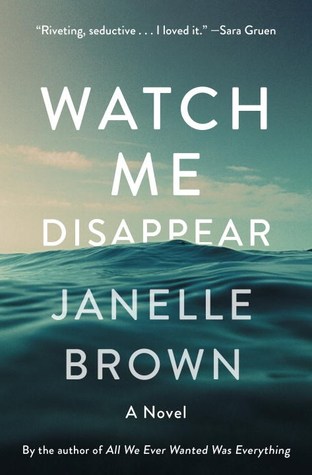
Watch Me Disappear, by Janelle Brown*****

WatchMeDisappear“…how can you ever really know the truth about another person? We all write our own narratives about the people we know and love…”

Billie Flanagan is living the good life in Northern California. Her husband, Jonathan, has a lucrative career that permits her to stay home, even though Olive is now in middle school. But one day she heads out on one of her favorite hiking trails, the Pacific Crest Trail in Desolation Wilderness, and she never returns. Search and Rescue crews find a single hiking boot and a cell phone far below the trail with its screen smashed. Her bank cards and checking remain untouched. Jonathan and Olive are forced to face the truth: Billie is never coming home again. They hold the funeral, and a year later, Jonathan sits down to write a memoir of his life with Billie. It is here that we join the family.

Many thanks go to Net Galley and Random House for the invitation to read and review in exchange for this honest review. The book will be available to the public July 11, 2107.

This psychological thriller starts with daughter Olive, who is in middle school, seldom a proud or happy time for any of us. But one day Billie appears to Olive in the hallway and tells her that she should be looking harder; she isn’t trying. Olive is convinced that her mother is still alive and trying to reach her. Eventually Jonathan starts to wonder as well. Neither of them is able to move on effectively without knowing the truth, yet there it is: they have no body and they have no proof of anything. As their journeys unfold, both externally and internally, Brown develops the hell out of both of these characters and through the memories both evoke in word and thought, she develops Billie best of all. An interesting side character named Harmony rounds things out nicely.

As each layer of each character is revealed—I was planning to say it’s like having three sets of Russian nesting dolls, but that’s not right; each has many more layers than that, more like onions–the reader’s viewpoint is forced to shift from one point of view to another, and so we wonder at various times about alternate possibilities. Could Billie really be alive somewhere? Did she just up and fucking leave them? She’s done that before. She is a runner. She has been known to drop people with no warning at all, just ghost them. It was a long time ago, but it’s true.

Or is she dead at the hands of…hmm, the ex-boyfriend that surfaces at the funeral? And we wonder whether maybe Jonathan, whose memories of Billie are not all as rosy as the ones we hear at the outset, did something to harm her. And then we wonder about Billie’s friend Harmony, who moves into Jonathan’s life rapidly enough to disturb Olive considerably. She’s so needy, so hungry for his attention; would she have offed Billie in order to have a crack at him? Many of these ideas are merely hinted at rather than voiced by the narrative, and this is part of what makes it so tasty. At first, I think my idea is original because I am so smart, but then I look back, as a reviewer has to do, and I can see it’s not really about my being smart (darn), but rather about very subtle foreshadowing. Brown uses lights and mirrors to get our minds moving in different directions, and the disorientation is, in its own twisted way, part of the rush.

A last note goes to the tangential but rarely-seen moment when a character muses about why it’s so hard to find an abortion clinic when you need one. This is the reverse side of a pet peeve of mine, the commonly used notion that every accidental pregnancy necessarily must end in childbirth, as if the year were 1950 or 1960 rather than the 21st century. I wonder whether Brown had to fight to keep that reference in her novel? One way or the other, this was going to be a five star review, but when I found that courageous little nugget, I wanted to shout for joy!

As to the end…I can’t tell you what happens of course, but I will tell you that this doesn’t end ambiguously. By the conclusion, the reader knows what happened to Billie.

When all is said and done, this is fiction that every feminist can embrace. If there is a heaven, Charlotte Perkins Gilman is looking down, and she is cheering.

Summertime, and the Reading is Easy

On my radar for July and August:

Lockdown, by Laurie R. King*****

lockdownI am a big fan of Laurie R. King’s contemporary thrillers, and this one is no exception. Thank you to Net Galley and Random House Ballantine for the DRC, which I read free and early in exchange for this honest review. It’s for sale today, so now everyone can read it.

King’s feminist fiction is made more delicious by her careful attention to detail. There is NEVER a single moment in which the setting—which is primarily at Guadalupe Middle School—slips and shows the reader that the Great and Powerful Oz is really just a human behind a curtain. Her magic never falters. Every fine detail regarding school schedules, culture, and protocol is true to life. This reviewer spent a couple of decades teaching in a middle school not much different from King’s fictional one, and I have never seen any novelist get everything so completely right in using school as the main setting.

As the cover suggests, this story is centered around a school shooting in California that takes place on career day. This is ticklish business to say the very least, one that authors dared not approach for a long time. Now, with Columbine significantly in our rear-view mirror but with school shootings an increasing, ever-present concern, King works it like a pro. A large measure of her success has to do with the way she builds her characters. We have a complex blend, from the school administrator, Linda McDonald; to her spouse Gordon, who has secrets that must not be revealed; to Tio, the custodian, another man that holds his cards closely; to the kids, the kids, the kids. We have Mina, the perfect student who has worries all her own, to Chaco—my personal favorite—to a host of others. By the time we reach the climax, we feel as if we know each one of these people, and so it isn’t a story of violence in the broad sense, but the fates of real people that collide.

This white-knuckle read treats issues of class, ethnicity and gender with the sensitivity one might expect from a master of the genre.  When I finish, it is replete with the satisfaction I receive at the end of Thanksgiving dinner—but this feast is one I don’t have to cook up myself, which makes it all the better. I’ve read 11 other books, mostly galleys, since I read Lockdown, and yet in my memory this one stands out as exceptionally strong fiction, the kind of book one wants to read a second time. And I know that when I do, some things will leap out from the pages brand new, because such a layered, intricate story is full of delightful niches and crannies that aren’t necessarily seen the first time through.

I wholeheartedly recommend this story to good people that love novels of suspense.  If it means you have to pay full freight—do it anyway. I would have.

Watching the Detectives, by Julie Mulhern*****

“’There’s been an incident…Mrs. White in the study with a revolver.”

watchingthedetectives
Mulhern is on a roll. This is the fifth book in the Country Club Murders series, but I plunged in without having seen the first four, and it was still a treat. Thank you, thank you to Net Galley and Henery Press for the DRC, which I snagged free and in advance in exchange for this honest review. It is now available to everyone.

The story is set among the Caucasian upper middle class of the 1970s, and Mulhern renders the period—when this reviewer was a mere, blushing wisp of a girl—so well that I checked twice to see whether it was an older title being re-released.

Ellison Russell is our protagonist, and people keep dying at her domicile. It’s become a nuisance, and there’s a cop that thinks it’s too great a coincidence. Ellison’s in a jam, and her thirteen-year-old daughter Grace isn’t helping. She sulks when they are told they must leave the house for a few days because it’s a crime scene, exclaiming that people have died at their house before and they didn’t have to leave. It’s just not fair!

Ellison is a widow, and a merry one at that; she has a flirtation going with a local cop whose name is Anarchy—a guy who believes in rules– but her main man is Mr. Coffee. He’s always there for her.

I moan when Ellison’s mother is introduced—yet one more overbearing mother, I thought, and authors always blame everything on mothers, just like everyone else does—but then I am surprised by where she takes it. I won’t say more lest I ruin it for you. But I will say this: every overused or overworked plot element is here for a reason, either to take it apart, or to make fun of it. Mulhern considers every word in this dandy novel carefully, and the result is splendid.

As the story unfolds there are other witty tidbits tucked in here and there, such as a character named Margaret Hamilton who is such a witch. But the frippery and snarky humor aren’t the whole package; while the mystery is a romp, serving up the snobbery of the petit bourgeoisie with a sharp skewer, this excellent novel is also a nicely turned feminist manifesto. While the mystery is a fine 4-star beach read, the author’s purpose is a strong one that’s delivered well. It is for this aspect that the fifth star is given.
Highly recommended for strong women and those that love them.

The Perfect Stranger, by Megan Miranda*****

“To get blood out, you’d have to do a deep clean. With bleach.”

the-perfectstranger

Fans of Miranda’s may rejoice, and those that haven’t read her work will have to start now. This riveting psychological thriller may leave you jumping at strange noises and sleeping with the lights burning, but oh, it will be worth it! I read this book free and in advance, thanks to an invitation from Net Galley and Simon and Schuster, but it’s available to the public Tuesday, May 16, 2017, and you won’t want to miss it. It’s the perfect story for the time in which we live, with alienation, deception, fear, and misplaced trust looming large.

Leah Stevens has some boundary issues, and it’s lost her a position in journalism. Disgraced, she decides to leave town and start over in the Pennsylvania countryside. She gets a teaching job there. A former roommate, Emmy Grey, surfaces just in time to go along with her and split the rent on a house in the woods. It’s a terrific house, but there are noises at night.

Leah says there are cats under there, scratching, scratching.

They have hardly settled in before things start to go amiss. Strange events occur that leave her frightened. When the woman’s body is dredged from the lake, Leah realizes it’s been awhile since she has seen Emmy. They work different hours, but still…shouldn’t she have seen her by now? She’s late with her share of the rent.

Leah feels as if someone is watching her at night through the glass doors at the front of the house.

This spine-tingling journey keeps me guessing every step of the way. Every time I think I see a formula starting to unspool, Miranda does something different, something I didn’t see coming. And as Leah trusts her instincts to protect her, we see for ourselves just how bad her instincts really are. Ultimately, she decides to get out of the house and ends up at the end of the road, at “the last no-tell motel”.

The plot here is taut and original, but the success of the story hinges on character. Leah’s past transgressions are vague at the outset, and we readers can tell it’s a dark time that she doesn’t like to talk about. But as the lies and the layers of deceit are peeled away one by one, we realize just how poor her sense of boundaries really is. Leah is so believable that she’s almost corporeal; I want to grab her by the wrist, haul her into the kitchen and talk to her, but even if I were able to do that, she wouldn’t listen to me.  Her personality is divided, part savvy journalist, objective and focused; half overly trusting, vulnerable waif. Her capacity for self-preservation is more limited than she knows. Is she going to make it out of this thing in one piece?

I can’t say more or I’ll ruin it for you, but this is the book you’re looking for, whether you are going to the beach or just need time to escape right here at home.

Just be sure to toss a blanket over those big glass doors before you settle in to read. Trust me.

The Twelve Lives of Samuel Hawley, by Hannah Tinti*****

thetwelvelivesofs “Everything breaks if you hit it hard enough.”

What would you do to protect those you love the most? Tinti’s epic father-daughter tale has already drawn accolades far and wide. What can I add to it all? There are only so many ways to say that someone is a genius and that her work deserves the highest praise and honors. I received my copy free and in advance, courtesy of Net Galley and Random House, in exchange for this honest review, and I’ve spent the last month trying to decide what I can add to the discussion. Although 2017 is clearly an outstanding year for literature, this title stands head and shoulders above everything else I’ve seen. It will likely be the best fiction published this year.

Our two protagonists are Samuel Hawley and his daughter, Loo. The story is arranged with alternate points of view, and also moves from present tense to the past, when Lily, Loo’s mother, was alive. Hawley is a career criminal, a man that has robbed and killed as part of a business transaction, but his tenderness for his daughter and his wife keep us connected to him.

As a parent, though, Hawley is kind of a mess. He does his best, teaching his daughter useful tasks like how to file the serial number off of a weapon and how to use it, but at the same time, he keeps his criminal business quiet and low, and she is nearly grown before she realizes what he actually does for a living. The two of them move around the country frequently, and they have a routine that gets them gone in a hurry when it’s necessary, but as she gets older he takes her to the Massachusetts town where her maternal grandmother lives. And I have to say, Mabel Ridge, Lily’s mother, is one of the most arresting side characters I have seen in a very long time.

For Loo’s sake, Hawley works as a fisherman and sets down roots. His participation in the Greasy Pole event, a cherished local tradition, wins him a place in the community. But he’s left enemies in his wake, and Hawley is constantly alert to the threat others pose. Who’s in prison, and who’s out? Who’s alive, and who isn’t anymore? Sooner or later, someone he doesn’t want to see is bound to rock the life he has established for himself and his daughter.

This is the sort of literary fiction that lets the reader forget that it’s art, because it reads a lot like a thriller. There are scenes that are laugh-out-loud funny; my favorite involves a car thief named Charlie.

Samuel Hawley seems to me to be a character for our time. Fifty years ago, a novel like this would have been controversial—and it may still be, who knows? Great literature often is. But today with the stratospheric growth of the American prison population, many more members of the book buying public either have done time, know someone that has, or know someone that barely escaped having to do so. It’s no longer unthinkable that a person that has done some truly reprehensible things, may also be a human being.

One way or the other, you have to read this book. The buzz it’s created is only the beginning. If you read one novel this year, let this be it. It’s available now.

Silence, by Anthony Quinn*****

silenceSilence is the third in the Inspector Celcius Daly series, but I read it alone and didn’t realize I had missed anything until I got online and looked. I received my copy free from Net Galley and Open Road Media in exchange for this honest review. It’s been for sale for almost a year and I apologize for my tardiness; the book had been out for several months before I received my DRC, and so I kept setting this review aside in order to write about stories that were about to be published immediately.  None of this should keep you from rushing out to order a copy; as you can see I rated it five stars, and I am picky these days.

I am immediately drawn to this book because of the setting; it takes place in Northern Ireland during the Troubles of the 1970s. Although I am impatient with the trite expression used by the journalist in the story—“sectarian violence”—I find the setting resonant and the characters credible. The entire thing is wholly original, but it’s complex, so it’s not something you can read while you’re trying to do something else.

Our protagonist is the Inspector Daly, a lonely man with kind intentions and deteriorating mental health. We have a dead man in the priest’s hotel room, but then we learn the dead man isn’t Father Walsh. If that’s not Father Walsh, where has he gotten to, and who is our victim? Last is our villain, Daniel Hegarty, an IRA man captured and turned by the Special Branch.

I particularly appreciate the moment with the sheep.

The field of mysteries, thrillers, and others of this ilk are thick with mechanisms that make me want to throw things. I think everyone that’s read many books in this genre has a private list. I am simply ecstatic to find that no one here is trying to solve the mystery either because they themselves are framed for something they didn’t do, or because a loved one has been threatened; no one in our tale is kidnapped, blindfolded, gagged, and tossed into the trunk—er, boot—of a car.  It’s refreshing.

Of course, to get a five star rating takes more than just a lack of irritating features. The setting, in the dark, in the muck, and sweating past police checkpoints, is both visceral and at times, scary. It’s the sort of story that makes a reader snuggle under the covers and be grateful for a safe, warm place to lie down. The characters are not always lovable, but they are entirely believable. That’s what counts with me. And the ending is a complete surprise, yet also makes sense.

For those that like literate, complex mysteries, it’s hard to beat. Highly recommended.

Say Nothing, by Brad Parks***

saynothingEvery parent with a baby or toddler has this one terrible, dark fear: that someone will take that baby.  In Say Nothing, that horrific event is doubled when Sam and Emma, twin sons of Scott and Alison, are taken and the note that sends frozen tendrils of fear up their spines instructs them not to tell anyone. No police; no one at all can know. “Say nothing.” Thanks go to Net Galley and Dutton Penguin for the DRC, which I received in exchange for an honest review. The book came out last week and is now available for purchase.

This story takes off like a rocket.  Scott Sampson is a Federal judge, and some devious criminals that know the family’s every habit snatch the children and send him a text message before either parent knows they are gone. Someone has impersonated Alison, swept by their preschool, and whisked the little ones away. How absolutely terrifying!

The purpose is soon clear: the kidnappers want to manipulate a major case on the Federal docket, assigned to Scott Sampson. Contacting police is out of the question. They’ve threatened to cut off their little fingers, one by one, and mail them to their parents.

Parks is a champ at building suspense. For me, the thrill is tarnished when I see a repetitive error—one many people won’t even notice—that has the effect of sweeping aside the curtain and showing me that the Great and Powerful Oz is just a guy in a chair. In this case, having had a judge in the family for many years and seeing the mistake in the text makes it hard to maintain the premise.  You see, when one is in court, the judge is “The Honorable” and is addressed as “your Honor”; in private life, his employees, friends and family all call him John, or Mr. W—. We used to eat out with this man frequently, and there was always a little family eye roll and slight smile when the obsequious maitre d’ at a downtown restaurant where we often ate came dashing out to the valet parking area calling, “Oh, Judge W—! Judge W—! We have your table ready now!”

In private life, if you need a title, a Supreme Court judge is called “Justice Jones”. Everyone else is called “Mr. Jones” or “Ms. Jones”.

I try to push past this obstacle but the error is made often in the dialogue, and so the memory of my relative’s patient courtesy is always lurking in the margins of my perception of the story. The upshot is that for me, it really gets in the way.

That said, I like the pacing of this story, and the solution is elegant and plausible.

Recommended to fans of the author’s Carter Ross series.

The Roanoke Girls, by Amy Engel*****

Happy release day! I read and reviewed this title back in December and called it “…smoking hot, a barn burner of a book.” Today it’s for sale. You won’t find anything like it out there.

seattlebookmama's avatarSeattle Book Mama

theroanokegirlsAmy Engel makes her debut as a writer of adult fiction with this title, having begun her career writing fiction for young adults. The Roanoke Girls is smoking hot, a barn burner of a book, diving into some of society’s deepest taboos and yanking them from the shadows into the bright rays of Kansas sunshine, where the story is set, for us to have a look at them. It’s not available to the public until March 7, 2017, and frankly I don’t know how you are going to wait that long. I received a DRC for this title from Net Galley and Crown Publishing for the purpose of a review.

Lane grows up in New York City, raised by a mother that shows no sign of warmth or affection, a woman that seems to either cry or sleepwalk through most hours of most days. When she hangs herself, Lane bitterly…

View original post 638 more words

The Devil’s Country, by Harry Hunsicker****

thedevilscountryHarry Hunsicker is the former executive vice president of the Mystery Writers of America as well as a successful author. Reading this suspenseful and at times almost surreal tale makes it easy to understand why so many people want to read his work. I’d do it again in a heartbeat. Thanks go to Net Galley and to Thomas and Mercer for the DRC, which I received in exchange for this honest review. This book will be available to the public April 11, 2017.

Arlo Baines, a former Texas Ranger, is on the road when it all unfolds; he’s stopped at the tiny town of Piedra Springs, traveling from one place to another by Greyhound Bus, and he doesn’t intend to stay. He finds a place to get some food, sticks his nose in a copy of Gibbon, and tries to ignore everyone around him. Friendly conversation? Thank you, but no.

Unfortunately for him, there’s a woman with kids, and she’s in big trouble. Clad in an outfit that screams sister-wife, she is terrified, tells him she is pursued, and next thing he knows, she is dead. What happened to the children? Before he knows it, Baines is hip deep in the smoldering drama of the Sky of Zion, a cult that has deep tentacles into the local business and law enforcement establishments.

The narrative shifts smoothly back and forth between the past and the present, and Baines’s motivation is revealed. He is on the move because his wife and child were murdered by corrupt cops, who he then had killed. One particularly chilling scene, the one in which Baines is told to leave town, gives me shivers. In general, however, I find that the scenes taking place in the present are more gripping and resonant than those in the past.

Interesting side characters are Boone, a retired professor with a crease on his head and flip-flops that are falling apart; the local sheriff, Quang Marsh; journalist Hannah Byrnes; and the bad guys in Tom Mix-style hats, with the crease down the front. Setting is also strong here, and I can almost taste the dust in my mouth as Baines pursues his quest in this little town with quiet determination. Every time I make a prediction, something else—and something better—happens instead. In places, it’s laugh-out-loud funny!

Readers that love a good thriller and whose world view leans toward the left will find this a deeply satisfying read. Hunsicker kicks stereotypes to the curb and delivers a story unlike anyone else’s. I would love to see this become a series.