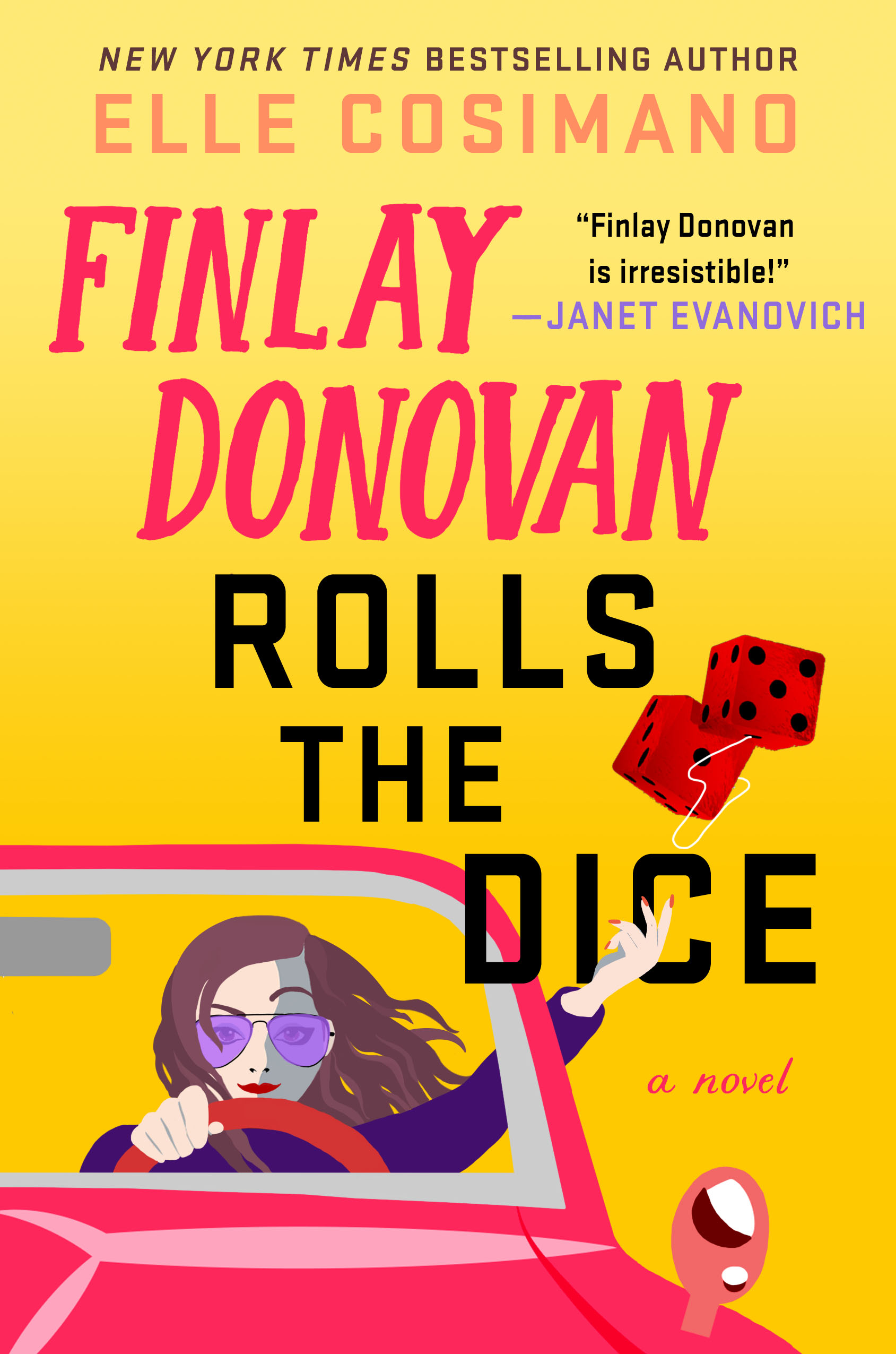
Finlay Donovan Rolls the Dice, by Elle Cosimano*****

“I’m telling you, Finlay, this book is good. This whole SERIES is good. The plots may be a little far-fetched, but these characters are so real! It’s like they just jump off the page!

Finlay Donovan Rolls the Dice is the fourth in the raucously entertaining series by Elle Cosimano. My thanks go to the Minotaur and St. Martin’s Press Influencer Program and NetGalley for the review copy. It will be available to the public Tuesday, March 5, 2024.

At the end of the previous book, Javi, Finn’s nanny Vero’s boyfriend, was abducted by mobsters that wanted to collect a gambling debt incurred by Vero. In this one, the two women plan to travel to Atlantic City to rescue him, with the cover story of needing time to unwind. However, things snowball, and before you know it, almost all the people they hold dear—and a few people that they don’t—are headed there, too. What follows is a riotous adventure with a lot of moving pieces. I love it.

More than any other, this installment has been controversial among reviewers. In the series debut, Finlay is an innocent, entirely law abiding single mother strapped with bills, work, and child care issues. She’s in the midst of a contentious divorce and her soon-to-be ex is an attorney, which makes Finlay’s efforts an uphill battle. She’s easy to relate to, and when, through no fault of her own, she finds herself with a corpse in her car, it seems entirely believable.

With the second and third books in the series, Finn, accompanied by the more street smart Vero, find themselves in deeper trouble. Just as they mop up one mess, another arises, until there’s a sort of house-that-Jack-built tower of problems that see both women in increasingly tenuous circumstances. They break the law once as a life or death matter, but then cannot safely come clean, so they do their best to put it behind them, but someone or something comes along to threaten the modest safety and security they’ve begun to enjoy. Bodies and crimes pile up, and now, with the fourth installment, the author can’t reasonably convince the reader that whatever happens next is purely an oopsie. Instead, she has to draw on other possibilities. Personally, I like it.

Finn and Vero are chasing down the underworld figures that they believe have abducted Javi, and there’s considerable risk involved. A couple of times I literally draw in my breath at the risks they take. Add to this the need to fabricate excuses to tell the myriad members of the retinue that have descended on Atlantic City with them, and it’s an ambitious undertaking.

In this circumstance, I no longer require realism. The whole thing takes on the flavor of a comic caper, what with the clown car full of women, including Finn’s mother; Finn’s ex-husband, who is in charge of the children; and various others (I am being deliberately vague here) that descend on them once they arrive. To put it another way, if Stephanie Plum and John Dortmunder—or if you prefer, Bernie Rhodenbarr—had a baby, she might be Finlay Donovan.  

If you need a good laugh, this book is for you; however, with this series, you really should begin with the first in the series, Finlay Donovan is Killing It. With just four in the series (and the audio is outstanding, too,) this will be a quick and hilarious adventure. What are you waiting for? Jump on in.

Falling Onto Cotton, by Matthew E. Wheeler*****

“This is the most famous thing to happen in Milwaukee since Laverne and Shirley got cancelled.”

Chance McQueen is a musician and restauranteur, an honest man doing his level best to tiptoe around the morass of organized crime that exists around him without getting his toes wet. It isn’t easy. His ancient Uncle Vinny is the local don, and he’s dying. Chance has told him many times that he would prefer to avoid this part of the family business, but he’s been dreaming. Uncle Vinny has stage four lung cancer, and he summons his nephew to share some hard truths:  “It’s simple. Either you take over the family before I’m dead, or Frank will have you killed before my body’s cold…Charles, when did you ever get what you want?”

This oddly charming debut came to me free and early, and my thanks for the review copy go to Net Galley and M.D.R. Publishing. This book is for sale now.

Wheeler’s debut reads as if scribed by a seasoned novelist, and he introduces a lively collection of memorable characters. He serves as mentor and father figure to Winnie, a dapper young man that has it bad for a sweet young thing named Alex; Geoff, his best buddy, who is Black and gay, and endlessly loyal; a homeless veteran living behind the restaurant, who is never a caricature; and Chance’s nemesis, Frank Bartallatas: “Frank Bartallatas was pure evil in a massive frame. More than one little fish had disappeared after swimming too close to Mr. Bartallatas.”

The story is set in 1990, and each of the agreeably brief chapters is headed with the title of a rock song from the 1970s and 80s, which is a portent of what the chapter brings. I like this guy’s playlist, and I stopped reading more than once to add his songs to my own collection.

Here are the things I like most, apart from the playlist: I like the strong, resonant characters, which are well enough developed that they are easy to keep straight; the setting, which hasn’t been overused by other writers, and is a credible choice; the selective use of violence, which cannot be left out of a story like this, but never feels excessive, sickening, or prurient; and the pacing, which never flags. In addition, I like the mobster aspect of this story, an angle that we aren’t seeing much in new fiction.

I have no serious complaints, but if I could change anything here, there are two things I’d tweak: First, Geoff practically can’t have a conversation with Chance without making awkward race jokes, and Caucasians that spend time with African-American people will tell you that never happens, no matter how close you are; and second, the alcoholic protagonist is becoming trite, so I’d either let Chance kick his habit without a protracted, detail-laden struggle, or I’d just let the guy drink. Chance’s dead fiancée is enough hubris all by herself. But clearly these are minor concerns, or this wouldn’t be a five star review.

This rock solid debut signifies great things to come from this author, and a little birdie tells me that there may be future novels featuring Chance McQueen. My advice to you is to get in on the ground floor of this series-to-be, because it’s going to be unmissable. Highly recommended.

Robicheaux, by James Lee Burke*****

Robicheaux“You ever hear of the Bobbsey Twins from homicide?”

Dave Robicheaux and Clete Purcel are back. For those that have never read the work of James Lee Burke, it’s time; for those that have missed his two best-loved characters, this new release will be as welcome, as cool and refreshing as a Dr. Pepper with cherries and ice. Lucky me, I read it free thanks to Net Galley and Simon and Schuster in exchange for this honest review.

Robicheaux is a Cajun cop from New Iberia, a small town an hour from New Orleans. Southern Louisiana, he tells us in his confidential narrative, has become “the Walmart of the drug culture.” He is under tremendous pressure; grieving the loss of his wife, Molly in an auto accident, he blacks out one drunken night, the same night that a murder occurs. Dave was in the area, and he cannot say he didn’t commit the murder, because he can’t recall anything. That’s why they call it a black out. His daughter Alafair returns from the Pacific Northwest to help her father pull himself together; she tells him he didn’t do it because murder is not in him. Clete says the same thing. But Dave is a haunted man, and he wonders what he is capable of.

To cap it all off, Dave has been assigned to investigate the rape of Lowena Broussard. The story doesn’t gel, and he wonders if it actually happened.

All of the fictional ingredients that make up Burke’s fictional gumbo are here: slick politicians, mobsters, thugs, and sociopaths. We also have people from Hollywood, whose casually entitled behavior and attitudes are anathema to Robicheaux and probably also to Burke. Alafair has been hired to write a screen play, and lascivious comments directed her way from those in charge of the film make Dave see red.

Clete figures prominently here; as longtime readers already know, Clete “would not only lay down his life for a friend, he would paint the walls with his friend’s enemies.” At one point a couple of thugs follow him into the men’s room at a local bar, and we fear they will kill him. Instead, “Maximo and Juju went to the hospital, and Clete went to the can.”

Burke has long been admired for the way he renders setting. A creative writing teacher could assign this book, because examples of how to render a place in a way that is original and immediate can be found by flipping to almost any page. But there’s more than that here. The dialogue crackles. The narrative is luminous at times, philosophical at others (are the Confederates the new Nazis?) and hilarious here and there as well. It’s enough to make ordinary writers sigh; I may write, and you may write, but neither of us will ever write like this.

There’s also plenty of fascinating Cajun culture here, and it’s so vastly different from anything I have known in my long life, most of it spent in the Pacific Northwest, that I find myself rereading passages. There’s a travelogue feel to parts of it that is unmatched anywhere else.

Lastly, I have to tell you that this story holds an extra element of suspense for me. These characters were originally crafted in the 1960s, and our author is growing old. I wonder as I read whether he intends to kill his heroes, one or both, in order to prevent future pretenders from usurping them. Every time I find Clete in danger, my heart nearly stops. I know that Dave has to make it all or most of the way through this book because it’s written in the first person, but Clete can go any damn minute.

Will Burke pull the plug?

Obviously I am not going to tell you anything more; the quotes you see above all occur early. But for those that can read work that is gritty and at times violent—I had to take little breaks now and then—there is no better fiction anywhere.

Note to the reader: there are some of Burke’s older books on YouTube in the form of audio books. Authorized? Unauthorized? Who knows, but for now at least, there they are.