
Ain’t Nobody’s Fool, by Martha Ackmann****

“People don’t come to see me be me. They come to see me be them.”
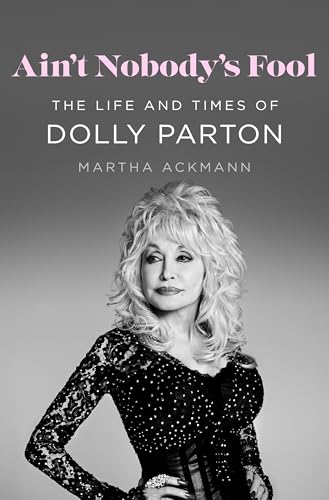
Ain’t Nobody’s Fool: the Life and Times of Dolly Parton, by Martha Ackman, is a fine biography of one of America’s most iconic musicians. My thanks go to NetGalley and St. Martin’s Press for the review copy. This book is for sale now.

Dolly began singing as a child, first informally, as children do, but she also understood very early on that this would be her life’s work. Most of her family was musically inclined, but she had a greater talent and a greater need to use it. She also had the right personality for the job; though her early years were filled with deprivation—the song “Coat of Many Colors” does actually describe an early childhood experience that marked her—she was also born with a sunny outlook and determination. For example, when she met the love of her life, Carl Dean, just as she was beginning to be heard on the local radio, she told him that though she loved him, she could not become a traditional wife to him. She would not have supper waiting when he finished work. She would not produce a houseful of children. These are the things that would prevent her from realizing her burning ambition. They were a trap. And happily, Carl—a private man that didn’t listen to country music so much as Led Zeppelin—told her that was just fine with him. He wasn’t going to tag along everywhere and be Mr. Dolly Parton, but they would make it work. And they did.

Fans of Dolly’s might have wondered, as I did, whether we would learn more about the rather mysterious Carl when reading this biography. We will not, apart from seeing Dolly’s philosophy where her marriage was concerned. Though in every other respect she has been open and accessible to the public, Dolly has followed her mother’s advice, that she should find just one thing about her life that she would not share with others, but keep for herself. For Dolly, that’s Carl. The man died last year, but she still keeps Carl, and her memories of their sixty years of marriage, to herself. And I don’t see how we can complain.

Whenever I read a galley, I highlight passages that I think might be suitable to include as quotes in my review. In this case, I highlighted 60! I can’t use them all, but this should give the reader a clue as to how readable this lovely biography is, and how saturated with quotes from Dolly, and from those that know and love her. From her early, sometimes tumultuous years working for and with Porter Wagoner, to the actors that she worked with in movies such as 9 to 5 and Steel Magnolias, to her own family members, it’s rich. Another fun fact: by doing some of her recordings in Tennessee, and by creating the massive theme park, Dollywood, she has come close to doubling the GDP of the state of Tennessee!

Many people may not be aware of Dolly’s intellect and savvy business skills. I have read so many musical memoirs and biographies of hugely talented, successful musicians that trusted others to take care of their business matters and accounting, only to discover too late that they’d been robbed. Perhaps my favorite anecdote in this biography is where early on, when she was only starting to be recognized, Colonel Parker, the man that ran Elvis’s career and gutted his finances, came to Dolly to express interest in one of her songs. Elvis wanted to sing “Islands in the Stream.” But he told her sweetly, Elvis is accustomed to receiving the publishing rights to any song he performs. And Dolly, also responding sweetly, told him how sorry she was, but she just didn’t believe in parting with her catalog. Many years later, after she and Kenny Rogers had gone more than platinum with that same song, she said that that song alone made her more than enough money to buy Graceland, at least hypothetically!

Serious fans and researchers will do well to augment their knowledge by reading at least one other biography, or Dolly’s own autobiography, My Life. Though author Ackman has a congenial writing style and has read a great deal about her subject, she has apparently never interviewed Parton herself. I combed through the documentation at the end of the book and found that out of the hundreds of end notes, there are just five references to a couple of interviews by the author with friends and family of Dolly’s. Sources for the book’s early chapters are sparse and not well integrated, relying almost exclusively on the autobiography.

Nevertheless, this is a greatly enjoyable read. I played Dolly’s music as I read, and though I am finished with it and am reading other things now, I still carry Dolly around with me.

The Rulebreaker, by Susan Page*****

Barbara Walters was a force to be reckoned with. She was the journalistic pioneer who singlehandedly smashed the glass ceiling that kept women from anchoring network news; over the years she would conduct television interviews with heads of state, criminals, otherwise reclusive stars, and anyone else she deemed newsworthy. She was ruthless in the pursuit of a story, but during interviews, she used velvet gloves to deliver the most searing questions, and her subjects responded.

My thanks go to NetGalley and Simon and Schuster for the review copy. This book is for sale now.

Page has written a full, epic autobiography, starting with Walters’s childhood, which was fraught with uncertainty, and ending with her death. She has written it the way the story of a luminary should be written, touching on the many remarkable aspects of Walters’s life without lingering too long on any one of them. She keeps the pacing brisk, and the tone respectful but frank, never fawning. I can’t imagine anyone doing a better job, including Walters herself; the autobiography, Audition, is the most cited source in the endnotes, but Walters had a tendency to drone while telling her own story, particularly about her childhood, while Page keeps it moving.

Walters grew up in a show business household; her father, Lou Walters, produced live shows, and when they were successful, the family lived in style; when they weren’t, it was hand-to-mouth genteel poverty. His gambling addiction caused the family terrible hardship on numerous occasions, and once she made it in the industry, Barbara was forever writing checks to bail him out of debt. Her younger sister, Jackie, was intellectually disabled, and needed constant care and attention. Barbara remarked that in looking back, she doesn’t feel that she was ever young, as she carried so many adult responsibilities at such an early age.

Breaking into mainstream journalism—not fashion or cooking stories, but hard news—was a tough road. She did it at a time when women weren’t expected, or allowed, to do much of anything outside of mothering, housekeeping, and a small number of stereotypical positions. Any female that dared step outside these tight confines was labeled, not as an attorney, manager, or journalist, but as a “lady journalist,” and so forth. Her job on the Today show was announced—with a bit of urging from Barbara herself—in the New York Journal-American thusly:

“’Dawn Greets Barbara, A Girl of Today,’” the headline over the story read. ‘A very attractive, shapely, well-groomed, coiffed and fashionably frocked feminine member of NBC’s dawn patrol” …adding that she had ‘no wish to become a personality.’ She wants to remain as she is…the prettiest reporter in television.’”

That didn’t last, if it was ever true at all. She fought, tooth and toenail, for every single advancement in her career; mainstream news anchors, male of course, resented her and resisted her, particularly when she was hired to appear as a co-anchor. Her early career was marked with restrictions, with Harry Reasoner and Walter Cronkite subjecting her to endless bullying and requirements of when she could speak on the air—not until they had—and other petty, petulant rules.

But she never gave up, and she never went home.

As is often true for anyone that lives for their career, Walters wasn’t able to maintain any of her marriages or raise her own child. She was busy. This is the one regret she voiced at the end of her life, when she found herself alone, with only her longtime paid assistants to see to her needs.

Page narrates her own audiobook, which I checked out from Seattle Bibliocommons in order to catch up, and I immediately noted how much her voice and intonations resemble those of her subject, albeit without the speech impediment. I enjoyed listening to her.

Perhaps my favorite moment in this book is the moment when a very elderly Barbara Walters falls on a marble staircase after refusing to take the arm of the younger woman offering it. She faceplants, is badly injured, but when she regains consciousness, the first thing out of her mouth is an imperial order: “Do not call an ambulance. Do not call an ambulance.” (Of course they did. They had to.)

Although Walters was never a feminist crusader and generally looked out for herself, her family, and friends rather than her younger peers, we women owe her a debt of gratitude. She forced doors open that were bolted shut, and the ripple effect was immeasurable.

Highly recommended to those interested in Walters, feminist history, and anyone that just enjoys a good biography.